


Most social-service agencies think they have a competency framework. What they actually have is a training tracker — a spreadsheet showing who completed which module — sitting completely disconnected from who gets assigned what cases. Someone finishes a domestic-violence training on Tuesday and gets a high-acuity DV case on Wednesday, and nobody checks whether "completed the module" means "can actually hold that case safely."
That gap between training completed and work assigned is where things quietly break. Not loudly. There's rarely a single catastrophic case that traces back to it. Instead you get slow erosion: a newer worker in over their head, a supervisor pulled into firefighting instead of coaching, documentation that misses things a more competent worker would have caught. And when someone leaves, the institutional knowledge about who could actually handle what walks out the door because it was never written down anywhere.
This piece is about building a workforce competency framework for social services that connects three things most agencies keep separate: what people are trained on, what they're allowed to be assigned, and how fast they're moving toward working independently. The point isn't to add bureaucracy. It's to make competence legible — something a new supervisor can read off a matrix instead of reconstructing from hallway reputation.
Why "training completed" tells you almost nothing
The pattern you see across agencies of every size: training is measured by attendance, and competence is measured by nothing. A caseworker sits through eight hours of trauma-informed care, signs the roster, and that's the record. Six months later, when their supervisor tries to figure out whether they're ready for solo crisis calls, there's no evidence to look at except gut feel and a completion checkbox.
The deeper problem is that most training is scoped wrong for how the work actually happens. Full-day sessions dump everything at once, weeks before a worker ever touches that case type. By the time they need the skill, half of it is gone. Meanwhile the skills they do use daily — writing defensible notes, running a safety assessment under pressure, handing off to a partner agency cleanly — often get zero formal instruction. People learn those by absorption, which means they learn them inconsistently and pass on their own bad habits.
There's also a coordination cost nobody prices in. When competence lives only in supervisor heads, assignment becomes a bottleneck. Every non-obvious case has to route through the one or two people who "know who can handle it." Those people become the constraint. The agency can't scale past their bandwidth, and it can't survive their departure.
The three pieces that have to connect
A working framework isn't a training catalog. It's three interlocking components:
Eliminate case management chaos.
TryCasi helps you organize, monitor, and report on every case efficiently and securely.
- Centralized case tracking
- Automated client notifications
- Team task coordination
No credit card required
-
Competency tiers — defined levels of practical capability, per domain, that describe what a worker can do unsupervised.
-
Micro-courses — small, targeted learning units mapped to specific tier movements, delivered close to when the skill is actually needed.
-
A caseload eligibility matrix — the rules that say which tier is required to hold which case type, at what volume.
Sign-offs are the connective tissue. A tier isn't granted by finishing a course; it's granted when a supervisor observes the skill in real work and signs off. And time-to-autonomy — how long it takes a worker to reach independent practice on a case type — becomes your measurement layer, telling you whether your training and supervision are actually working or just consuming hours.
Keep these separate in your head and the whole thing stays diagnosable. When something's wrong, you can ask: Is the training missing? Are sign-offs not happening? Is the eligibility matrix set wrong? Most agencies conflate all three and end up blaming individuals.
Reproducible competency tiers
The tiers only work if they describe observable behavior, not vibes. "Understands trauma-informed care" is useless. "Can conduct an intake with a client in acute distress, de-escalate, and complete a safety plan without prompting" is something a supervisor can actually watch happen.
A four-tier structure holds up well across agency sizes:
| Tier | Label | What it means operationally | Supervision level |
|---|---|---|---|
| T0 | Shadowing | Observes only; no independent client contact on this domain | Full co-presence |
| T1 | Supported | Handles cases with pre-review of plans and post-review of notes | Review before + after action |
| T2 | Independent | Holds standard cases solo; escalates by defined triggers | Periodic spot-check |
| T3 | Anchor | Handles complex/high-acuity cases; mentors and signs off others | Peer-level; consults up rarely |
The important move is that tiers are per domain, not per person. A worker can be T3 in housing casework and T1 in behavioral-health crisis work at the same time. Treating competence as a single global level is the most common design mistake — it produces workers who are "senior" on paper getting handed cases they've never actually built capability in.
Define tiers around the domains that carry real risk in your agency. For most, that's something like: intake/triage, crisis and safety, benefits navigation, child/family casework, substance use, and multi-agency coordination. Six to eight domains is usually enough. More than that and the matrix becomes unmaintainable.
A sample micro-course map
The point of micro-courses is to make tier movement possible and specific. Each course should map to one tier transition in one domain, and be short enough to consume right before the work is needed — 20 to 45 minutes, not a full day.
A partial map for the crisis/safety domain might look like this:
-
T0 → T1 "Running a first safety assessment" (structure, required fields, what triggers immediate escalation) + one observed practice session
-
T1 → T2 "De-escalation under time pressure" + "Documenting a safety plan that holds up in review" + three supported cases signed off
-
T2 → T3 "Coaching a colleague through a live crisis" + "Recognizing the edge cases where standard protocol breaks" + mentoring two workers to T2
Higher tiers aren't just more content — they're more observed practice and, at the top, teaching others. Competence you can teach is competence you actually have. That's also how you manufacture more anchors instead of hoarding them.
Keep the catalog small and version it. A common failure is course sprawl: forty micro-courses, half outdated, nobody sure which is current. Tie each course to a review date and an owner. If a course hasn't been touched in a year, someone has to either re-confirm or retire it.
Sign-off templates that hold up
A sign-off is a supervisor certifying, in writing, that they observed a worker perform a skill at the required standard. The template should be short enough to complete in a couple of minutes but specific enough to mean something.
A workable sign-off record captures:
-
Worker and domain/tier being certified
-
Specific competency observed (the exact behavior, not "did well")
-
Evidence — case ID, live observation, or reviewed documentation
-
Standard met / not met, with a one-line note on what tipped it
-
Supervisor name and date
-
Re-validation date (competence expires — more on that below)
Build re-validation reminders into your sign-off workflow to prevent stale competencies.
The most common gap: sign-offs happen for the celebratory moments and never for the maintenance. Someone hits T2 in crisis work, gets signed off, and then nobody ever re-checks it — even three years later, even after protocols changed. Build re-validation into the record itself. High-risk domains like crisis and child safety should re-validate every 12 months; lower-risk domains can stretch to 24.
This is where supervisor capacity becomes real. Sign-offs only mean something if supervisors have the time and skill to observe properly, which ties directly into how you structure supervision overall. If your supervision model is already drowning, sign-offs become rubber-stamps. The supervision model that prevents burnout approach — building observation and coaching into predictable rituals rather than squeezing them into crisis gaps — is what makes a sign-off system credible instead of theatrical. Supervisors also need a baseline of data literacy to read time-to-autonomy metrics without misinterpreting them.
The caseload eligibility matrix
This is the piece that turns competence into an operational rule instead of a filing cabinet. The matrix says, for each case type: what minimum tier is required to hold it, and any volume constraints.
A slice might read:
| Case type | Min tier to hold | Volume cap by tier | Escalation rule |
|---|---|---|---|
| Standard benefits navigation | T1 | T1: 8, T2: 20, T3: 25 | None routine |
| Housing placement, stable client | T2 | T2: 15, T3: 20 | On placement failure |
| Active DV / safety concern | T2 (crisis) | T2: 6, T3: 10 | Any acuity increase → T3 review |
| Child safety, open investigation | T3 | T3: 8 | Mandatory second review |
Two things make this matrix earn its keep. First, it makes over-assignment visible. When a T1 worker gets tagged to a T2 case because everyone's slammed, the system flags a mismatch instead of letting it slide quietly into a bad outcome. Second, it forces honesty about capacity. If your matrix says child-safety cases need a T3 and you have three T3 workers with a hard cap of 8 each, you cannot pretend to hold 40 of them. The numbers stop lying to you.
The volume caps also connect straight to retention. Overloading your best workers past their caps is how you burn out anchors and lose them — which then collapses the whole tier structure, since anchors are who you rely on for sign-offs and mentoring. Getting caseload rules right is inseparable from the broader work of building sustainable career ladders and caseload rules with a retention ROI model.
Measuring time-to-autonomy
Time-to-autonomy is the metric that tells you whether the whole system actually functions. Defined simply: for a given domain, the median number of weeks from a worker's first exposure (T0) to their first sign-off at T2 (independent practice).
The measurement rules matter, because it's easy to game or misread:
-
Count calendar weeks, not "active" weeks. Real onboarding includes the gaps, the coverage crunches, the weeks a supervisor was too swamped to observe. Hiding those makes your number look good and your process look better than it is.
-
Measure per domain, not per worker. A worker reaching T2 in intake fast and T2 in crisis slowly tells you something specific — probably that crisis sign-offs are the bottleneck.
-
Track the median and the spread. If the median is 14 weeks but a quarter of workers take 30+, you have a consistency problem in supervision, not a training problem.
-
Separate "training done" from "signed off." The gap between those two dates is pure supervision latency. When it's large, your bottleneck is supervisor observation time, not learning content.
A pattern worth watching: an agency finds their time-to-autonomy in benefits navigation is a reasonable 9–11 weeks, but crisis work drags out to 20+ weeks. Digging in, it's not that crisis training is bad — it's that only two supervisors are qualified to sign off crisis competencies, and both are constantly pulled into live cases. The fix isn't more training. It's expanding the pool of people who can sign off, which means pushing more workers to T3 in that domain first. The metric pointed straight at the real constraint.
A short real scenario
A mid-sized family-services agency — roughly 40 caseworkers across intake, housing, and family casework — kept running into the same problem: new hires took forever to carry a full load, and two senior workers were effectively the bottleneck for everything non-routine. When one of those seniors went on extended leave, assignment nearly seized up. Nobody else knew who was ready for what.
They built out tiers per domain, a micro-course map tied to tier transitions, and a caseload matrix with volume caps. The first thing they discovered was uncomfortable: several "experienced" workers had never been formally signed off on domains they'd been quietly holding cases in for years. They re-validated everyone over about a quarter.
The measurable shift showed up in time-to-autonomy. New family-casework hires had been reaching independent practice somewhere around 22–26 weeks; within two hiring cycles that came down to roughly 15–17. The bigger change was harder to quantify — assignment stopped funneling through two people. Supervisors could look at the matrix and route cases without a meeting. When someone left, the gap was visible and fillable instead of mysterious.
Where the system actually lives
None of this survives in a spreadsheet at scale. Tiers, sign-offs with re-validation dates, a live eligibility matrix, time-to-autonomy tracked per domain — that's a lot of connected state, and disconnected files rot fast. Re-validation dates get missed. The matrix drifts from reality. Nobody can pull the time-to-autonomy numbers without a day of manual work.
Here's a simple workflow of how the platform checks eligibility at assignment time.
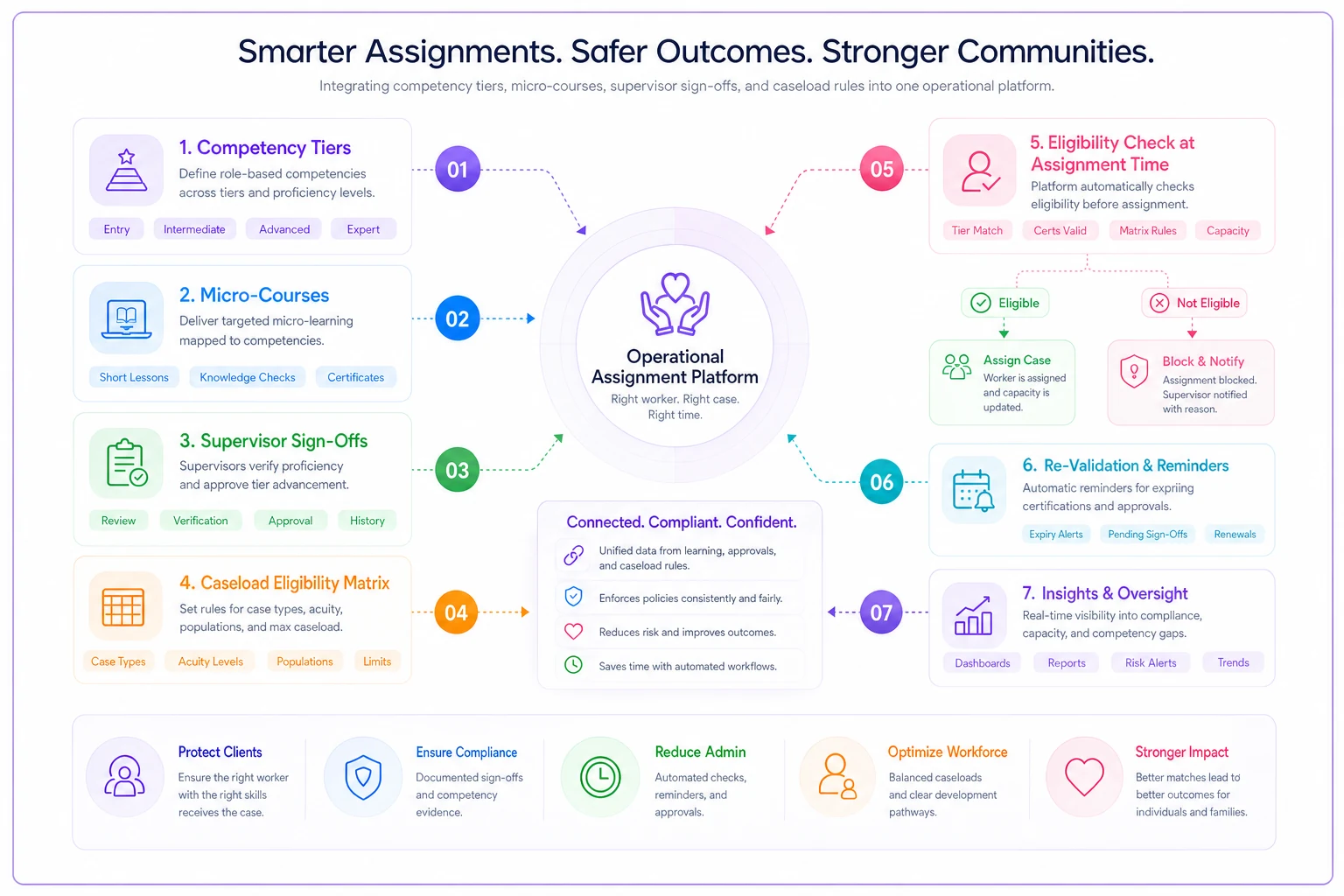
This is where the workforce framework naturally belongs inside the same operational platform that already holds your cases and assignments. When competency tiers live next to caseload data, the platform can check the eligibility matrix at the moment of assignment — flagging a tier mismatch before a case lands on the wrong desk rather than after. Sign-offs and re-validation dates can trigger reminders instead of relying on someone remembering. Time-to-autonomy stops being a quarterly manual audit and becomes something a supervisor glances at on a dashboard. The value isn't automation for its own sake — it's that competence stays legible and current without someone hand-maintaining it, which is exactly the part that always decays first.
When this is worth building — and when it isn't
This framework earns its complexity at a certain scale. If you're a team of five where everyone knows exactly what everyone else can handle, formalizing tiers is overhead you don't need yet — though even small teams benefit from writing down what "signed off on crisis work" actually requires, so it survives your first departure.
Where it becomes essential:
-
You're past the point where one person can hold "who can do what" in their head (usually somewhere around 15–20 workers)
-
You have real turnover and keep re-losing the knowledge of who's ready for what
-
Assignment routinely bottlenecks through one or two senior people
-
You handle high-risk case types where a wrong-tier assignment carries real consequences
Where it backfires: if you build the tiers and matrix but never resource the sign-offs. A framework with no observation time behind it is just a more elaborate completion tracker, and workers will correctly read it as bureaucracy. The sign-off layer is the whole thing. Skip it and you've built a catalog, not a competency system.
The core shift is small but hard: stop treating competence as something people either have or don't, and start treating it as something you define, observe, certify, and re-check per domain — then wire it directly to who gets assigned what. When those pieces connect, a new supervisor can read your team's real capacity off a matrix, and the knowledge of who can safely hold which case stops living in two people's heads and starts living in your operation.
Ready to transform your social services workflow?
Join 500+ agencies using TryCasi to improve case outcomes, enhance collaboration, and reduce administrative burden.