

Most supervision in social work isn't designed. It accumulates.
Someone gets promoted because they were good with clients and inherits a supervision "structure" that's really just a recurring calendar invite. The first few months, it works fine. Then caseloads climb, two staff leave, the funder wants an extra outcome report, and supervision becomes the meeting everyone protects on the calendar but nobody actually prepares for.
That's the pattern worth paying attention to. Burnout doesn't usually announce itself in a resignation letter. It shows up earlier — in the supervision system — as skipped sessions, vague check-ins, and a supervisor spending 40 minutes reacting to whatever crisis walked in that morning instead of noticing whether their staff can actually sustain the work.
A real supervision model in social work has to do three jobs at once: develop the person, keep an honest read on their wellbeing, and stay connected to whether cases are actually moving. When those three drift apart — and they almost always drift apart under caseload pressure — supervision turns into either a paperwork ritual or a therapy session with no operational teeth. Neither one prevents burnout.
This is a systems piece. The point isn't "have better one-on-ones." It's how supervision rituals, wellbeing signals, and outcome data connect into one loop that actually holds up when the team grows and the pressure increases.
The three things supervision is secretly trying to do (and why they collide)
Pull apart a supervision conversation and you'll find three separate agendas fighting for the same 45 minutes:
-
Developmental — Is this person growing? Do they have the skills for the cases they're carrying?
-
Wellbeing — Are they okay? Is the emotional load of the work manageable or are they quietly running on empty?
-
Operational / outcome — Are cases progressing? Where are things stuck? What's slipping?
When a supervisor has too many direct reports, the operational agenda eats everything. It's the most urgent and the easiest to measure. "Where's the housing assessment for the Reyes family?" is a concrete question with a concrete answer. "How are you holding up?" is not, so it gets a reflexive "yeah, fine, busy" and everyone moves on.
What happens across a lot of small teams is that wellbeing gets sacrificed first, development second, and operational survives — but only in its most reactive form. Six months of that and you've got a supervisor who technically meets with everyone weekly and still has no early warning when someone is about to burn out. The rituals existed. They just weren't structured to surface the right signals.
The fix isn't more meeting time. It's giving each of the three jobs a defined slot and a rhythm, so they stop competing.
The 30/60/90 supervision ritual (and why the intervals matter)
Weekly or biweekly supervision handles the running caseload fine. What it doesn't handle is the slower stuff — skill development, role fit, cumulative strain — because those don't change week to week and get invisible inside the noise of case updates.
Eliminate case management chaos.
TryCasi helps you organize, monitor, and report on every case efficiently and securely.
- Centralized case tracking
- Automated client notifications
- Team task coordination
No credit card required
That's what the 30/60/90 rhythm is for. It's a layered set of structured checkpoints riding on top of your regular sessions. Regular supervision handles cases. The 30/60/90 checkpoints handle the person and the trajectory.
For a new hire, the intervals are obvious: 30, 60, and 90 days after start. The more useful move that most teams miss is running the same cadence on a rolling basis for existing staff — quarterly, essentially — using the same templates. New hires get the ritual for onboarding; everyone else gets it as an ongoing calibration.
Here's roughly what each checkpoint should carry:
| Checkpoint | Primary focus | Key questions | Signals to capture |
|---|---|---|---|
| 30-day | Orientation & footing | Is the caseload size realistic? Are the tools/workflows clicking? What's confusing? | Overwhelm early, tooling friction, unclear expectations |
| 60-day | Skill & judgment | Where do you feel confident? Where do you second-guess? Which case types drain you most? | Skill gaps, case-type strain, autonomy readiness |
| 90-day | Trajectory & sustainability | Is this pace sustainable? What would make the work more manageable? Growth direction? | Burnout risk, retention risk, development path |
The reason the templates matter more than the calendar: without them, a 90-day check-in becomes "how's it going, all good? great." Templated prompts force the conversation into territory a busy supervisor would otherwise skip. A prompt like "Which case type drains you most, and how many of those are currently on your list?" does more real work than an hour of open-ended chat, because it connects an emotional signal directly to a caseload fact you can actually act on.
One common mistake is treating 30/60/90 as purely a new-hire thing and dropping it after that. Onboarding is when supervision is most attentive and least needed — the person is fresh. Month 14, when the same person is carrying 30% more than they started with, is exactly when a structured check would catch something. If the ritual only exists for new hires, you're watching people most closely at the wrong time.
Run the 30/60/90 cadence on a rolling quarterly basis for existing staff, not just new hires.
If the ritual only exists for new hires, you're watching people most closely at the wrong time.
Wellbeing indicators that don't require a psychology degree
The instinct when people say "track wellbeing" is to reach for a formal burnout inventory. Those have their place, but quarterly 20-question surveys are lagging indicators — by the time the score drops, the damage is months old.
What actually works in day-to-day operations are a few concise, observable signals that a supervisor can read without turning into a clinician. Leading indicators, not diagnostics.
-
Documentation lag creeping up. When someone who normally closes notes within a day starts running 4–5 days behind, that's rarely a time-management issue. It's usually the first visible symptom of overload or avoidance.
-
Response latency to internal messages. Not client-facing — internal. A staff member who goes quiet inside the team is often pulling back emotionally before they'd ever say so.
-
Case type avoidance. Someone stops volunteering for or subtly deflects certain case types (child safety, active crisis). Worth a gentle question, not an alarm.
-
The tone of case notes. Neutral, procedural language shifting toward either clipped shortness or unusual over-explaining can signal strain.
-
Self-reported energy, one number. A single question at each session — "1 to 5, where's your energy this week?" — tracked over time. The number itself matters less than the trend.
Most of these signals already exist inside your normal operational data. Documentation lag, message response times, which case types someone picks up — you're generating that information whether you look at it or not. The problem is almost never a lack of data. It's that nobody has connected these operational breadcrumbs to a supervision conversation.
Worth stating plainly: these are conversation starters, not verdicts. A supervisor who confronts someone with "your notes are 5 days late, are you burning out?" will get defensiveness and a broken relationship. The right move is quieter — "I noticed notes have been running a bit behind, what's your week actually looking like?" The indicator opens the door. The conversation does the rest.
Bringing outcomes into the room without turning supervision into a performance review
If you put outcome dashboards front and center in supervision, staff hear "you're being measured" and every honest wellbeing conversation dies on the spot. If you keep outcomes out entirely, supervision floats away from the actual work and becomes an emotional check-in disconnected from whether clients are getting anywhere.
The trick is to use outcome data as a shared diagnostic tool, not a scorecard. The dashboard sits between the supervisor and the caseworker, looked at together, to answer "where is the system getting stuck?" rather than "what did you fail to do?"
A practical agenda structure for a standard supervision session, roughly time-boxed:
-
Wellbeing check (5 min). Energy number, anything heavy this week. Always first — it signals priority.
-
Outcome dashboard scan (10 min). Cases progressing, cases stalled, anything drifting past expected timelines. Read together.
-
Stuck-case deep dive (15 min). Pick one or two stalled cases from the dashboard. Problem-solve. This is where development actually happens.
-
Load and capacity (5 min). Given what's on the dashboard, is the caseload realistic for the next two weeks?
-
Actions and follow-through (5 min). Concrete next steps, who owns what.
The outcome data drives the developmental conversation (step 3) and the wellbeing conversation (steps 1 and 4) instead of competing with them. A case that's been stuck for six weeks is both an operational problem and a potential source of strain for the person carrying it. Looked at together, the dashboard makes the emotional load visible in a way that "how are you doing" never will.
If you're still building out what those outcome indicators should even be, the practical framework for measuring social services outcomes covers the indicator and data-cadence side in depth. Supervision is where that measurement work actually gets used, so the two systems need to be designed to fit each other.
What breaks as the team grows
A supervisor with 4 direct reports can hold most of this in their head. They notice when someone's off. They remember which cases are stuck. The informal system works.
At 8 reports, the informal system silently fails — and here's the part that catches people: it fails without any obvious signal. Meetings still happen. The calendar still looks full. But the supervisor is now context-switching across 8 people's caseloads and the depth collapses. Wellbeing check-ins get shorter. Outcome reviews get skipped when the week's busy. Nobody decides to lower the quality — it just erodes.
-
Inconsistency between supervisors. Two supervisors, two totally different supervision experiences. One does deep wellbeing work; the other runs status updates. Staff notice, and it drives resentment and uneven retention.
-
No shared record of the soft stuff. When a supervisor leaves, everything they knew about their people's strain, growth edges, and history walks out the door. The new supervisor starts blind.
-
Outcome data lives somewhere supervision can't reach. Dashboards in one system, supervision notes in a notebook or a Word doc. The connection between the two exists only in the supervisor's memory, which doesn't scale.
-
The rolling 30/60/90 quietly disappears. Under pressure, the quarterly checks are the first to get postponed, then forgotten. Onboarding checks survive because HR tracks them; the ongoing ones don't have an owner.
This is fundamentally a coordination problem, and it's the same category of problem as handoffs between teams. The governance playbook for cross-team casework deals with ownership and SOPs across teams — supervision has the identical failure mode internally: when nobody clearly owns the ritual and the record, it degrades the moment things get busy.
Where the system actually gets held together
Once you're past a handful of staff, keeping supervision consistent stops being about supervisor discipline and starts being about whether the structure lives somewhere durable.
> Supervision workflow: from signal to conversation
>
> Operational data generated → Wellbeing signals surfaced ahead of session → 30/60/90 checkpoint triggered → Outcome dashboard reviewed together → Stuck-case conversation → Actions recorded → Next session context carried forward
Here's a simple visualization of that workflow.
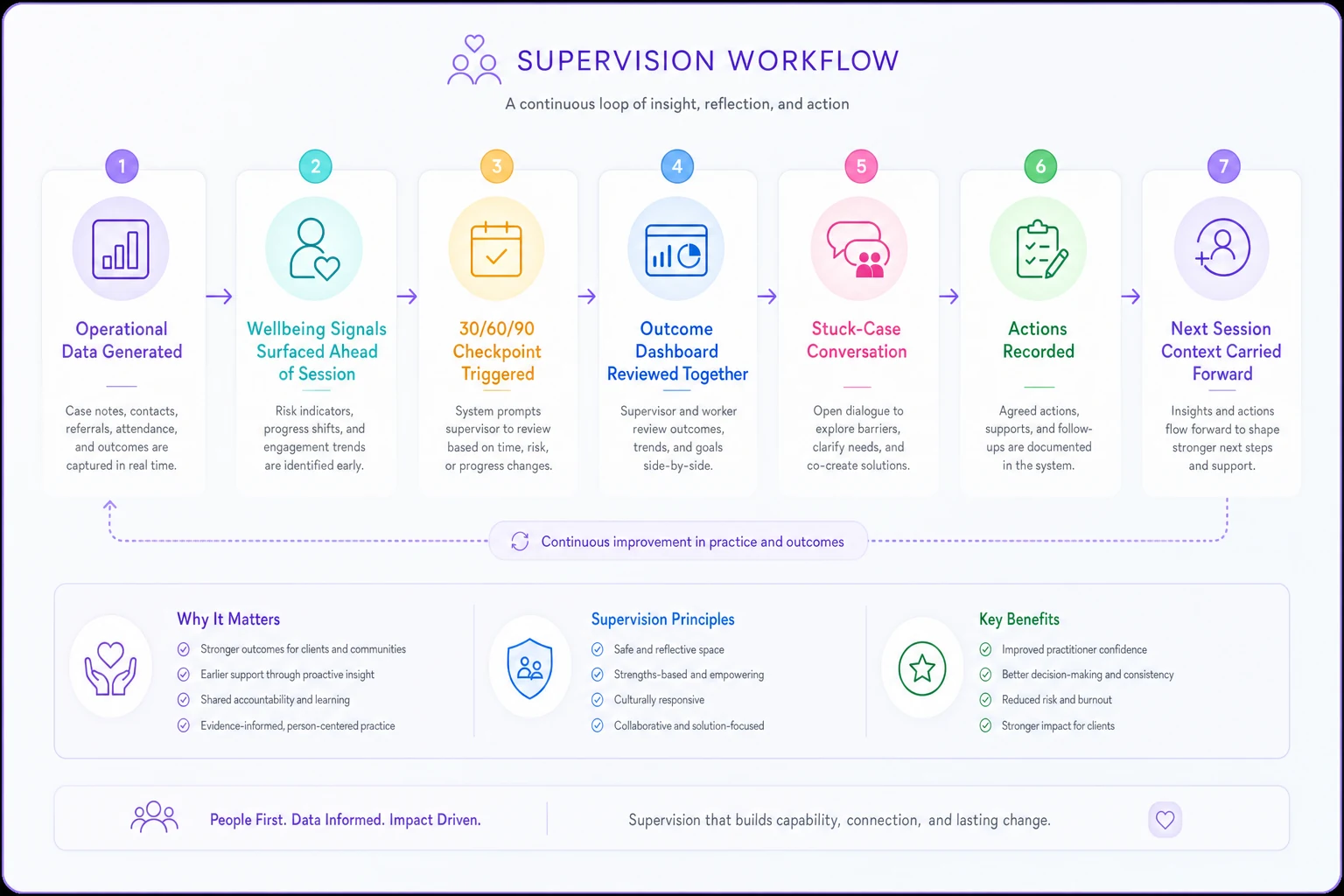
This is the practical role good case management software plays — not as a magic fix, but as the place where the loop stays connected. When the outcome dashboard, the caseload data, and the supervision templates live in the same system, a few things stop leaking:
-
The 30/60/90 templates fire as scheduled tasks instead of depending on someone remembering. The rolling quarterly checks get an owner: the system.
-
Wellbeing signals that are already operational data — documentation lag, response latency, case-type patterns — can surface automatically ahead of a session, so the supervisor walks in already knowing where to look. That kind of automation is genuinely useful: it's not making the human judgment, it's making sure the human doesn't miss the signal buried in the data.
-
Supervision notes attach to the actual cases and outcome trends, so the "soft stuff" becomes part of the record instead of living in one person's memory.
The point isn't to automate supervision. Supervision is a human relationship and it should stay one. The point is to automate the remembering and the surfacing — the parts that break first under load — so the human time gets spent on the conversation instead of on reconstructing context.
A real scenario: mid-sized family services team
A family services team, roughly 22 caseworkers under 3 supervisors. Turnover had been running high — they'd lost about a quarter of frontline staff over the course of a year, with most departures clustering somewhere around the 8-to-12 month mark. Exit conversations kept surfacing the same theme: people felt unsupported and blindsided by their own burnout. Supervision existed on paper — weekly sessions, an onboarding checklist — but it had drifted into status updates.
What they changed was mostly structural, not a bigger budget. They standardized the 30/60/90 templates across all three supervisors and ran them on a rolling quarterly basis for existing staff, not just new hires. They added a five-minute wellbeing block to the front of every session, with the single energy number tracked over time. The outcome dashboard got pulled into supervision so stalled cases drove the middle of the conversation. And they started surfacing documentation lag ahead of sessions so supervisors had a quiet heads-up on who might be struggling.
Over the following year, turnover dropped to somewhere in the low teens percentage-wise — not fixed, but a clear and sustained improvement. The bigger shift was qualitative: supervisors said they were catching strain weeks earlier than before, usually flagged by documentation lag or a slipping energy number rather than by someone finally saying they were done. Two people who'd probably have quit got moved onto lighter, better-matched caseloads in time and stayed.
Nobody worked fewer hours. The work didn't get easier. What changed was that the supervision system started seeing problems while they were still solvable.
When this model is overkill (and when it's essential)
When a lighter version is fine: A team of 3 or 4 with one supervisor probably doesn't need the full apparatus. The informal system genuinely works at that size. Adopt the habits — wellbeing first, outcomes as a shared tool — without building heavy infrastructure. Formalizing too early creates paperwork nobody needs.
When it becomes essential: The moment you cross into multiple supervisors, or a single supervisor carries more than 6 or 7 reports, the informal approach is already failing whether you can see it or not. That's the threshold where consistency and a shared record stop being nice-to-haves.
Who should be careful: If your team's trust is already low — recent layoffs, a punitive culture, staff who see any measurement as a threat — bolting outcome dashboards onto supervision will backfire hard. Rebuild the wellbeing and developmental sides first. Introduce the outcome integration only once people believe the dashboard is a shared tool and not a weapon. Sequence matters more than completeness.
Closing the loop
Supervision, done as a real system, is one of the few operational levers that touches everything at once — retention, case quality, outcomes, and the day-to-day experience of the work. The reason it's so often neglected is that it's the easiest thing to let quietly degrade. Nothing dramatic happens when a supervision session gets shallow. The bill arrives later, in turnover and stalled cases and people leaving right around the point they'd become genuinely good at the job.
The 30/60/90 rituals give the slow-moving stuff a place to surface. The wellbeing indicators turn data you already generate into early warnings. The outcome-integrated agenda keeps the whole thing tied to whether clients are actually getting somewhere. None of these pieces does much alone. Together they form a loop that holds — and one that keeps holding as the team grows and the pressure that usually breaks supervision keeps climbing.
If you're thinking about the follow-through mechanics of this — how structured checkpoints and timed follow-ups keep from slipping — the case closure playbook uses the same interval-based discipline on the client side. The pattern is the same either way: rituals that fire on a schedule, tied to the data, so the important things don't quietly fall off the calendar when everyone gets busy.
Ready to transform your social services workflow?
Join 500+ agencies using TryCasi to improve case outcomes, enhance collaboration, and reduce administrative burden.