


Case closure feels simple until you're sitting across from a family six months later, starting from scratch because nobody documented why the case closed or what warning signs to watch for. The administrative burden of reopening cases that should have stayed open longer costs social service agencies thousands of hours a year — time that could go toward actual client support.
Most agencies treat closure like a checkbox exercise. Client stable? Goals met? Close it. But without a proper follow-up protocol, closure creates a revolving door that wears out both caseworkers and clients. A structured case closure follow-up protocol turns what's usually a rushed administrative task into a real operational checkpoint.
The hidden operational cost of poor closure protocols
When a case closes without clear documentation or a follow-up schedule, you lose institutional memory. The next caseworker starts blind, spending somewhere between 8 and 12 hours rebuilding context that should have been preserved. Multiply that across hundreds of cases a year, and the wasted time becomes significant fast.
Beyond the time problem, premature closures damage client trust. Families who stabilize temporarily often deteriorate within 60 to 90 days without ongoing support. When they come back, they're not just at square one — they're frequently worse off and more resistant to engagement. The operational cost compounds from there: harder cases, longer interventions, worse outcomes.
There's a legal dimension too. Without clear closure rationale and documented re-open triggers, agencies struggle to defend decisions during audits or legal proceedings. One agency I'm familiar with faced a wrongful termination lawsuit because they couldn't produce documentation explaining why a high-risk case was closed without follow-up protocols in place.
Building the 30/90/180-day framework
The 30/90/180-day structure isn't arbitrary — it maps to natural stability checkpoints in most social service interventions. At 30 days post-closure, immediate crisis factors typically resurface if the intervention wasn't sufficient. At 90 days, you catch medium-term deterioration patterns. At 180 days, you start to see whether gains are genuinely sustainable or whether cyclical issues are creeping back.
Eliminate case management chaos.
TryCasi helps you organize, monitor, and report on every case efficiently and securely.
- Centralized case tracking
- Automated client notifications
- Team task coordination
No credit card required
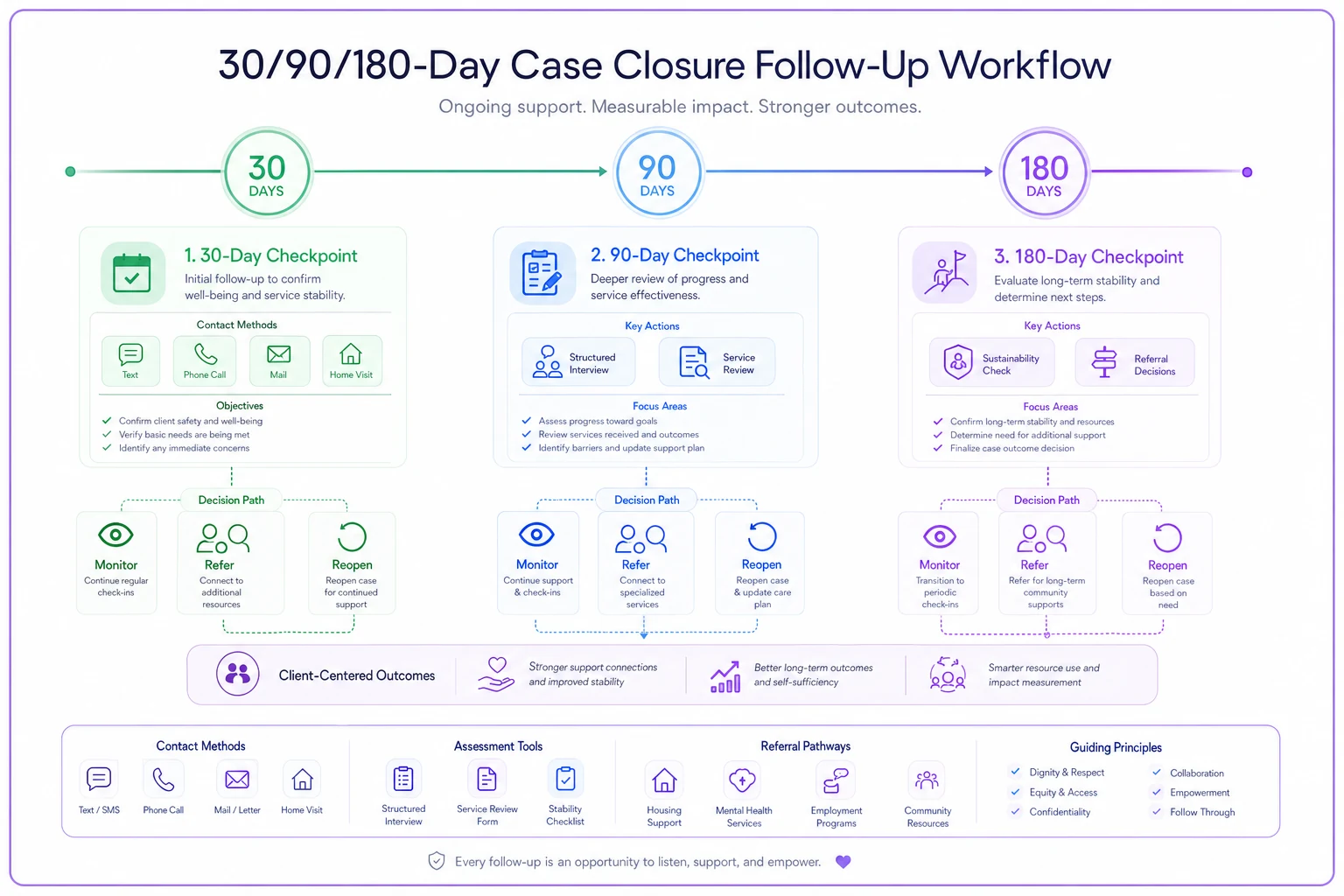
Here's a simple workflow to visualize the 30/90/180 follow-up process.
30-Day Check Protocol
The 30-day mark catches immediate rebounds. This isn't a full assessment — it's a targeted wellness check focused specifically on the issues that triggered initial involvement.
Contact method hierarchy:
-
Text message (highest response rate)
-
Phone call within 48 hours if no text response
-
Mailed check-in form if phone unsuccessful
-
Optional home visit for high-risk closures
Key assessment areas:
-
Primary intervention goals still met?
-
Support systems still functional?
-
Any crisis indicators present?
-
Client comfortable with the closure decision?
Documentation requirement: A one-paragraph summary noting contact method, client status, and any concerns. Time investment: 15 to 20 minutes per case.
90-Day Assessment Protocol
The 90-day check goes deeper, assessing whether initial gains held and identifying emerging patterns. This checkpoint catches what some workers call the "honeymoon effect" — clients maintain stability briefly after closure but start struggling once formal support is gone.
Assessment components:
-
Brief structured interview (10 to 15 minutes)
-
Review of any service utilization since closure
-
Check on environmental factors (housing, employment, relationships)
-
Screen for new stressors or significant changes
Red flags that trigger immediate review:
-
Loss of stable housing
-
Substance use relapse indicators
-
Domestic violence concerns
-
Child welfare issues
-
Mental health deterioration
-
Loss of primary income source
Documentation: A half-page assessment form with checkboxes for key domains and a narrative section for concerns.
180-Day Sustainability Check
The six-month mark determines whether closure was genuinely appropriate or whether cyclical issues are reemerging. This check often reveals seasonal patterns, relationship cycles, or gradual deterioration that shorter follow-ups miss entirely.
Focus areas:
-
Compare current functioning to closure baseline
-
Identify any accumulation of minor issues
-
Assess preventive support needs
-
Determine if referral to lower-intensity services makes sense
This one can be lighter touch — often a brief phone conversation or even a text exchange for stable cases. The goal is pattern detection, not comprehensive reassessment.
Documentation requirements that actually protect everyone
Closure documentation serves three purposes: legal compliance, operational continuity, and client protection. Most agencies over-document routine elements while under-documenting critical decision points.
Essential Closure Documentation Checklist
Primary stability indicators:
-
Specific goals achieved (with measurable outcomes)
-
Current risk assessment score
-
Support system stability rating
-
Client agreement with closure decision
-
Any dissenting opinions from team members
Re-open triggers (must be specific):
-
Named risk factors to monitor
-
Threshold levels for each factor
-
Who to contact if triggers appear
-
Timeline for reassessment if triggers present
Follow-up schedule confirmation:
-
Dates for 30/90/180 contacts
-
Preferred contact methods
-
Backup contact information
-
Who conducts follow-ups
Handoff information:
-
Services client continues receiving
-
Key contact at each service
-
Information sharing agreements
-
Emergency contact protocols
The one-page closure summary
Beyond detailed documentation, every closure should have a one-page summary that any caseworker can scan in 30 seconds to understand the essential situation. This document lives at the front of the file and includes:
-
Three-sentence case summary
-
Closure date and rationale
-
Top three re-open triggers
-
Follow-up schedule
-
Emergency contact
This summary prevents the common scenario where reopened cases stall because new caseworkers can't quickly parse hundreds of pages of notes.
Clear re-open triggers that prevent emergencies
Vague triggers like "if situation deteriorates" are operationally useless. Specific, measurable triggers allow anyone — the client, family members, partner agencies — to recognize when re-engagement is needed.
Housing-related triggers
-
Eviction notice received
-
More than one month behind on rent
-
Utilities disconnected for non-payment
-
Staying with others more than 14 consecutive days
-
Homeless episode of any duration
Child welfare triggers
-
School attendance below 85%
-
New child protective services report
-
Children staying with others without a formal plan
-
Medical neglect indicators (missed appointments, medication gaps)
-
Supervision concerns reported by mandated reporters
Mental health/substance use triggers
-
Psychiatric hospitalization
-
Medication non-compliance exceeding two weeks
-
Substance use relapse with functional impact
-
Suicidal ideation or self-harm behavior
-
Significant behavioral changes noted by support system
Support system triggers
-
Primary caregiver incapacitated
-
Loss of childcare arrangements
-
Domestic violence incident
-
Death of primary support person
-
Relationship breakdown affecting children
When triggers are observable and specific, they stop being judgment calls that vary by worker and start being operational checkpoints that anyone can monitor.
Templates that save time without sacrificing quality
30-Day Follow-Up Text Template
"Hi [Name], this is [Caseworker] from [Agency] checking in 30 days after we closed your case. Reply with: GREEN if things are stable, YELLOW if you have some concerns, or RED if you need immediate support. You can also call me at [number]."
Follow-up for YELLOW responses:
"Thanks for letting me know. Can we schedule a brief call this week? Reply with best day/time or call directly."
90-Day Phone Script
"Hi [Name], I'm calling for your 90-day check-in. This should only take about 10 minutes. First, are the main issues we worked on still resolved? [Listen, note any concerns] Have any new challenges come up since we closed your case? [Listen, probe if needed] Are your support systems still working well? [Specifically ask about childcare, family support, services] On a scale of 1-10, how confident are you that things will remain stable? [Anything under 7 warrants deeper discussion] Do you have any questions or concerns about services?"
Re-Opening Assessment Matrix
| Trigger Present | Severity (1-3) | Duration | Client Wants Help | Action |
|---|---|---|---|---|
| Single trigger | Low (1) | <1 week | No | Monitor, check again in 2 weeks |
| Single trigger | Low (1) | >2 weeks | Yes | Offer targeted referral |
| Single trigger | Medium (2) | Any | Yes | Reopen for brief intervention |
| Multiple triggers | Any | Any | Yes | Full reopening |
| Any trigger | High (3) | Any | Any | Immediate reopening |
Re-Opening Assessment Matrix
Common closure mistakes that create operational chaos
Closing during temporary stability
The most expensive mistake is confusing temporary improvement with sustainable change. A family that's stable for 30 days after intensive intervention often isn't truly stable — they're still running on the momentum of recent support. Real stability usually requires 60 to 90 days of consistent functioning without intensive involvement.
A pattern that shows up repeatedly: families receive intensive support, stabilize quickly, case closes at 30 to 45 days, crisis returns within 90 days. The operational cost of that cycle consistently exceeds what it would have cost to keep the case open with step-down support.
Documentation without accessibility
Detailed documentation buried in case notes helps nobody. Critical information has to be immediately findable. If a caseworker can't locate re-open triggers within 60 seconds, the documentation system has already failed.
Structure files with operational efficiency in mind:
-
Closure summary on top
-
Follow-up schedule clearly marked
-
Re-open triggers highlighted or in a separate section
-
Contact information updated and verified
Rigid trigger interpretation
Triggers need to be specific, but response to triggers still requires judgment. A family experiencing a triggering event while actively engaged with other supports might not need case reopening. Conversely, subtle pattern changes that don't show up in formal triggers might warrant it.
The framework guides decisions — it doesn't replace professional judgment. Train staff to treat triggers as discussion starters, not automatic decision points.
When proactive follow-up prevents crisis returns
A youth services agency that implemented this exact 30/90/180 protocol saw crisis re-presentations drop by roughly 40% within eight months. The 30-day checks caught housing instability early. The 90-day checks identified relationship deterioration patterns. The 180-day checks revealed seasonal mental health patterns the agency had never previously tracked.
The operational improvement came from catching problems before they became emergencies. Instead of families returning in full crisis requiring immediate intensive intervention, the follow-up protocol caught issues while they were still manageable. Average intervention time for reopened cases dropped from around 87 hours to roughly 35 hours.
More importantly, families reported feeling supported rather than abandoned. The follow-up contacts — even when no additional services were needed — maintained trust. When issues did arise, families reached out earlier because the relationship stayed warm.
Technology that enables consistent follow-up execution
Manual tracking of follow-up schedules across hundreds of cases isn't sustainable without systematic support. Modern case management platforms use automation to keep follow-ups on track without piling on extra administrative work.
Automated reminder systems alert caseworkers when follow-ups are due, pre-populate contact information, and can send initial text messages automatically. That removes the cognitive load of tracking dates while ensuring nothing falls through the cracks.
The documentation side benefits from templates and structured forms that prompt for required information without forcing lengthy narratives. AI-assisted tools can scan closure documentation to confirm all required elements are present and flag missing re-open triggers or unclear follow-up schedules before they become a problem.
Some platforms now integrate outcome tracking directly with follow-up protocols — automatically calculating days since closure, tracking re-opening rates, and surfacing patterns in which cases return. That kind of operational intelligence helps agencies refine their closure criteria based on actual outcomes rather than gut instinct.
Making the protocol work with realistic caseloads
The protocol looks solid on paper until you're managing 40-plus active cases with barely enough time to return calls. Implementation has to account for operational reality.
Batching similar follow-ups into fixed weekly time blocks (e.g., Tuesday mornings for 30-day checks) creates efficiency and reduces context-switching.
Start by batching follow-ups. Set aside specific weekly time blocks for follow-up contacts rather than scattering them across the schedule. Tuesday mornings for 30-day checks, Thursday afternoons for 90-day calls — whatever works. The repetition creates efficiency and mental focus.
Use technology for initial contact attempts. Automated texts for 30-day checks can handle the majority of cases, with only concerning responses requiring direct caseworker follow-up. That preserves human time for cases that actually need it.
Some agencies designate specific workers to handle all post-closure follow-ups, letting them develop expertise in quick assessments and pattern recognition while freeing case-carrying workers to focus on active cases. It doesn't work for every team, but where it fits, it works well.
Most importantly, track the return on the time invested. Document hours spent on follow-ups versus hours saved on prevented crisis reopenings. Most agencies find the protocol pays for itself within a few months through reduced emergency interventions.
The compound effect of systematic closure
Proper case closure with structured follow-up isn't just about individual cases — it shifts how the whole organization operates. When every closure includes clear documentation and follow-up protocols, you build institutional memory that survives staff turnover. New workers can quickly understand case history and current status. Supervisors can audit closure decisions effectively. Partner agencies know exactly when and why to re-refer.
The data generated through systematic follow-up also reveals patterns that are invisible without structure. Which types of cases reliably stay closed? Which need extended monitoring? Which seasonal factors affect stability most? That intelligence drives better resource allocation, training priorities, and program design over time.
And maybe most importantly, good closure protocols change the relationship between agencies and clients. Instead of abrupt endings that feel like abandonment, structured follow-up creates gradual transitions that preserve dignity and trust. When clients know they can return without judgment if specific triggers occur, they're more likely to reach out early rather than waiting until things have fully fallen apart.
The operational investment in proper closure protocols pays back through reduced crisis interventions, better outcomes, lower liability exposure, and staff that aren't constantly firefighting. In a field where resources are perpetually stretched, systematic closure with follow-up is one of the higher-return operational improvements available.
Ready to transform your social services workflow?
Join 500+ agencies using TryCasi to improve case outcomes, enhance collaboration, and reduce administrative burden.