


Multi-team casework breaks down in predictable ways. The intake team documents everything perfectly. The assessment team follows their protocols exactly. The ongoing support team manages their caseload by the book. And yet cases still fall through the cracks, families wait weeks for simple updates, and everyone ends up in meetings trying to figure out who was supposed to do what.
When three teams blame each other for the same dropped case
The problem isn't individual team performance. It's the absence of clear governance for how teams actually work together.
The pattern shows up consistently across social service organizations: teams optimize their own workflows while handoff points become organizational black holes. Cases get stuck in transition. Information disappears between systems. Accountability evaporates the moment responsibility crosses a team boundary.
Most agencies respond with more meetings, more documentation requirements, or a full reorganization. None of that fixes the core issue. You need actual governance structures for cross-team operations — not just better team-level procedures.
Why handoffs fail even with good teams
Think about what happens during a typical case transfer. The intake worker completes their assessment, uploads documents to the shared drive, sends an email to the assessment team, and marks the case as ready for transfer in the tracking spreadsheet. The assessment coordinator sees the email two days later, can't find half the documents, needs clarification on three items, and sends questions back to intake. The intake worker is already on different cases. The family calls asking for a status update. Nobody knows who should respond.
Eliminate case management chaos.
TryCasi helps you organize, monitor, and report on every case efficiently and securely.
- Centralized case tracking
- Automated client notifications
- Team task coordination
No credit card required
This isn't a people problem or a training problem. It's a systems problem.
Each team optimizes for its own workflow. Intake wants to move cases quickly to manage volume. Assessment needs complete information to do thorough evaluations. Ongoing support requires historical context that often gets lost in translation. Without governance structures defining exactly how handoffs work, each team develops their own interpretation of the process — and those interpretations rarely line up.
The gaps compound. A housing coordinator creates their own intake form because the standard one doesn't capture what they need. The mental health team builds a separate tracking system because the main one doesn't fit their workflow. The benefits team starts running their own assessments because waiting on the assessment team takes too long. Before long you have parallel processes, duplicate work, and cases bouncing around while families wait.
Building governance that actually works
Real casework governance isn't about more policies. It's about building operational structures that make cross-team coordination automatic rather than something that depends on individual effort.
Start with role definitions that extend beyond team boundaries. Don't just define what the intake coordinator does within intake — define their specific responsibilities during handoffs to assessment, their accountability for post-transfer questions, and their role when cases loop back. Same for every position that touches cross-team work.
Below is a simplified view of how a governed handoff process should flow across teams:
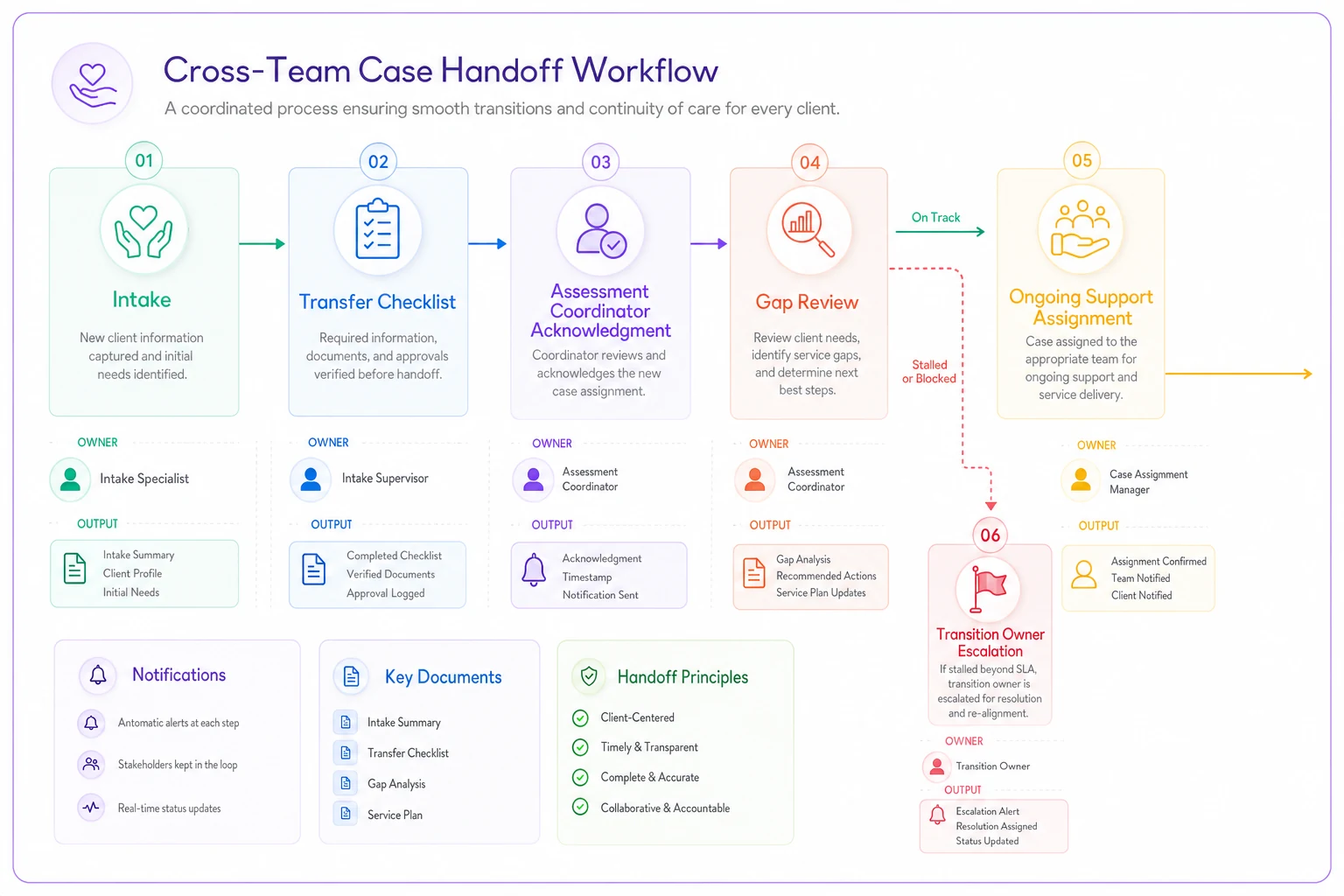
This kind of flow, when documented and enforced, removes the ambiguity that causes most handoff failures. Teams know their entry and exit points. Transition owners know when to step in.
Most organizations miss this: you need transition owners, not just team owners. Someone needs to own the space between intake and assessment. Someone else owns assessment to ongoing support. These aren't full-time roles — they're governance responsibilities added to existing positions. Without named owners for these transitions, they become nobody's problem.
Map your handoff points first. Not the ideal process, but what actually happens. Track 20 cases through your system and document every touchpoint, every delay, every back-and-forth. Patterns show up quickly. The same information gets requested repeatedly. The same clarifications happen every time. The same delays occur at the same points.
Build handoff protocols around those patterns. If assessment always needs three specific data points that intake doesn't naturally collect, put those into the intake process. If ongoing support always loses historical context, create a case summary template that travels with the file. If certain case types reliably need coordination between housing and mental health, build that coordination into the workflow rather than hoping someone remembers.
The onboarding problem nobody talks about
New staff break cross-team workflows faster than almost anything else. A new intake worker doesn't know the assessment team needs photos of certain documents, not just scans. A new assessment coordinator doesn't realize the housing team uses a different priority scale. A new case manager doesn't know to check three different systems for a complete history.
Standard onboarding covers team procedures. It rarely touches cross-team governance. New staff learn their job, but not how their job connects to others. They follow team SOPs correctly while inadvertently breaking workflows for the teams downstream.
-
Week one Shadow a case through a complete handoff to the next team
-
Week two Sit with the receiving team to understand what they actually need
-
Week three Handle a handoff with direct supervision
-
Week four Debrief common failure points with transition owners
This isn't just training. It's building governance awareness from day one. New staff need to understand they're part of a system, not just a team. Their work has consequences for teams they may never directly interact with.
Create an onboarding scorecard that includes cross-team competencies. Can they identify the three critical handoff points for their role? Do they know who owns each transition they're part of? Can they name the top pieces of information the next team needs? These become gate checks before someone handles cases independently.
Sample SOPs that prevent real problems
Generic SOPs tell people what to do. Governance SOPs tell people how to work together. That difference matters more than most agencies realize.
Case Transfer SOP Between Intake and Assessment:
-
Pre-transfer requirements
-
- All documents uploaded to case folder using naming convention
[CaseID][DocType][Date]
-
- Transfer checklist completed with supervisor signature
-
- Three-day advance notice to assessment coordinator via system flag AND email
-
- Family notified of transfer with new contact information
Transfer execution:
-
- Morning of transfer
intake worker confirms all items complete
-
- By noon
assessment coordinator acknowledges receipt
-
- Within 24 hours
assessment reviews and identifies any gaps
-
- Within 48 hours
intake responds to gaps or schedules clarification call
-
- Transfer considered complete only after assessment confirmation
Escalation triggers:
-
- No acknowledgment within 24 hours
escalate to transition owner
-
- Gaps not resolved within 72 hours
joint supervisor review
-
- Family contact during transition
both teams coordinate response
Cross-Team Communication Protocol:
-
Standard communication channels
-
- Urgent (same day)
phone call plus system flag
-
- Important (48 hours)
system message plus email
-
- Routine (5 days)
system message only
-
- FYI only
weekly digest email
Response time commitments:
-
- Urgent
2 hours
-
- Important
24 hours
-
- Routine
72 hours
-
- FYI
no response required
Information that always requires immediate notification across teams:
-
- Safety concerns
-
- Court involvement
-
- Media contact
-
- Family crisis requiring coordinated response
-
- Service authorization changes affecting multiple teams
Shared Documentation Standards:
-
Required elements for all cross-team documentation
-
- Date, time, documenting worker, and team
-
- Purpose of interaction
-
- Other teams notified or involved
-
- Specific follow-up needed from other teams
-
- Timeline for follow-up
Prohibited documentation practices:
-
- Referencing another team's actions without verification
-
- Documenting assumptions about another team's plans
-
- Including other teams' internal communications
-
- Making commitments on behalf of other teams
Use the transfer checklist as a gating step in your case management system so transfers can't proceed until required fields are complete.
These SOPs work because they address actual failure points, not theoretical processes. They acknowledge that teams operate differently while creating consistent interface points between them.
Measuring governance effectiveness
You can't manage cross-team governance without measuring it. But most metrics focus on individual team performance, not system performance.
Track transition metrics separately from team metrics. How long do cases sit between teams? How often do they bounce back for missing information? How many clarification exchanges happen per handoff? Those numbers tell you where governance is breaking down.
| Metric | What It Measures | Review Frequency |
|---|---|---|
| Average transition time by handoff point | How long cases sit between teams | Monthly |
| Clean handoff rate | Transfers completed without callbacks | Monthly |
| Cross-team response rates | Whether communication protocols are followed | Monthly |
| Multi-team coordination cases | Volume requiring joint work | Quarterly |
| Escalations due to ownership confusion | Where governance is unclear | Quarterly |
Review these metrics with transition owners, not team supervisors. The goal isn't to blame teams — it's to identify governance gaps. When handoffs consistently fail at the same point, that's a governance problem, not a performance problem.
Technology's role in governance (and where it fails)
Agencies often assume technology will solve governance problems. They invest in case management systems expecting seamless handoffs, then are surprised when the same problems resurface in digital form.
Technology amplifies whatever governance you already have. Good governance gets better with the right tools. Weak governance just gets worse faster. If transition ownership isn't defined, a case management system digitizes the confusion. If documentation standards aren't clear, shared systems become dumping grounds for inconsistent information.
The most effective approach uses technology to enforce governance, not replace it. Build handoff protocols into system workflows. Require specific fields before cases can transfer. Set automatic notifications for transition owners when cases sit too long. Generate governance metrics without manual tracking.
AI-powered operational software can surface patterns that are hard to see manually — cases with certain characteristics that consistently get stuck between specific teams, handoff failure rates by worker or case type, coordination gaps that repeat in predictable ways. That kind of visibility lets you adjust governance structures before problems become systemic.
But technology can't create governance where none exists. It can't decide who owns a transition or resolve accountability disputes between teams. Build the governance first, then use technology to scale and enforce it.
When governance actually takes hold
The shift happens gradually. Teams stop pointing fingers during case reviews. Workers know exactly who to call when something gets stuck. Families stop receiving conflicting information from different departments. Cases move through the system predictably, even when staff turns over or volume spikes.
One child welfare agency implemented governance structures after years of cross-team friction. They didn't change their teams or bring in new staff. They created clear transition ownership, built handoff SOPs, and started measuring system performance instead of just team performance. Within six months, case transition time dropped significantly. More importantly, worker frustration went down because everyone understood their role in the larger system — not just their own piece of it.
The real test is what happens during a crisis. Agencies with strong governance adapt quickly when things get disrupted. They know who owns decisions about adjusted handoffs. They have protocols that can be modified systematically. Agencies without governance structures tend to fragment, with each team developing incompatible responses that create more confusion for everyone involved.
Building your governance playbook
Start small. Pick one high-volume handoff point. Map it completely. Identify the failure points. Assign a transition owner. Write one solid SOP. Measure the impact. Use that to expand governance to the next handoff.
Don't try to govern everything at once. Focus on the transitions that affect the most cases or create the most problems — usually intake to initial service, assessment to ongoing support, or crisis intervention to regular programming. Get one transition working predictably before moving to the next.
Include frontline workers in governance design. They know where handoffs actually fail. They've built workarounds for governance gaps. They understand what information the next team really needs versus what policy says they need. Governance built without frontline input tends to become a parallel bureaucracy that everyone quietly ignores.
Review and adjust quarterly. Governance isn't static. As case patterns shift, as teams evolve, as new programs launch, structures need to adapt. Build review cycles into the governance itself. Transition owners should meet quarterly to discuss what's working. SOPs should have revision dates. Metrics should drive governance changes, not just performance reviews.
The goal isn't perfect handoffs — it's predictable ones. When everyone knows how cross-team work happens, when accountability is clear, when problems have defined escalation paths, the system works even when individual cases are complicated. Strong governance doesn't eliminate all problems. Cases will still have complications. Teams will still have conflicts. But with proper structures in place, those become manageable issues rather than systemic failures. The work stays hard, but the operations become reliable.
The work stays hard, but the operations become reliable.
Ready to transform your social services workflow?
Join 500+ agencies using TryCasi to improve case outcomes, enhance collaboration, and reduce administrative burden.