



Most agencies treat retention as a fire to put out. Someone gives notice, a supervisor scrambles, HR runs a market comp check, maybe a small raise gets approved, and the cases get "temporarily" redistributed to whoever has bandwidth. Six months later the same thing happens with a different person. The redistribution never gets undone, the caseloads quietly creep up, and the next resignation lands on a team already carrying more than it should.
That's the pattern behind most conversations about workforce sustainability social services leaders are having right now. The problem isn't that anyone lacks good intentions. It's that retention gets handled as a series of one-off decisions instead of a written policy everyone can see and predict. When staffing rules live only in a supervisor's head, every departure becomes a negotiation, and every negotiation produces a slightly different answer.
This piece walks through the pieces of a compact workforce policy package—role ladders, caseload formulas, redistribution rules, on-ramp milestones, span-of-control guidance, and a simple ROI model—and how they connect into something you can actually adopt rather than improvise.
Why one-off retention tactics quietly fail
A raise fixes one person's frustration for a while. It does nothing about the structural reasons people leave. And in casework, those structural reasons are remarkably consistent: no clear path forward, caseloads that grow invisibly, no defined moment where "you're doing the job of the next level up" turns into "you're paid and titled for it."
Here's what usually plays out in practice. A strong caseworker starts absorbing complex clients because they're good at it. Nobody counts those cases differently. Their manager notices the extra effort and tries to reward it informally—flexibility on schedule, first pick of trainings, a verbal "you're next in line." None of that shows up on paper. Eighteen months in, that person is functionally a senior worker doing lead-level work at a base-level title and salary. When a competing agency posts a role that names the level they're already performing at, the offer isn't even close to a raise—it's recognition. They take it.
The failure isn't the counteroffer that came too late. It's that there was never a defined ladder describing what "the next level" looks like, so the person's growth happened off the books until someone else formalized it for them.
Tactics react. Policy anticipates. The whole point of a workforce package is to move decisions upstream—before the resignation, not after.
The role ladder: make the next step visible
A career ladder in casework doesn't need to be elaborate. It needs to be honest about what changes between levels, and it needs to name the milestones that trigger a promotion conversation so those conversations stop being purely subjective.
Eliminate case management chaos.
TryCasi helps you organize, monitor, and report on every case efficiently and securely.
- Centralized case tracking
- Automated client notifications
- Team task coordination
No credit card required
A workable ladder for a mid-sized team usually has four or five rungs. The key isn't the number of levels—it's that each rung is defined by what the person does and owns, not by how long they've been there.
| Level | Primary focus | What they own | Typical caseload weight | Promotion milestone |
|---|---|---|---|---|
| Case Aide / Associate | Learning core workflows | Supported caseload, documentation | ~0.6 of full load | Independent on standard cases, clean documentation for 90 days |
| Caseworker I | Independent standard casework | Full standard caseload | 1.0 (baseline) | Consistent outcomes, handles moderate-complexity cases unsupervised |
| Caseworker II / Senior | Complex cases + informal mentoring | Reduced count, higher complexity | 0.8 (weighted heavier per case) | Mentors newer staff, owns a case type, leads a partner relationship |
| Lead / Coordinator | Team coordination, quality | Small caseload + team QA | 0.4 caseload + oversight | Ready for formal supervision responsibility |
| Supervisor | People + outcomes | No direct caseload or minimal | Oversight | — |
Two things matter more than the exact structure. First, promotion milestones are written and checkable, so a worker knows what "ready" looks like and a supervisor can't stall the conversation indefinitely. Second, higher levels mean different work—usually fewer cases weighted heavier, plus responsibility for other people or a domain. If your "senior" caseworker just carries the same load plus 15 extra cases, that's not a ladder. That's a punishment for being competent.
One common mistake: building a ladder where the only way up is into supervision. Plenty of excellent caseworkers don't want to manage people, and forcing that as the sole growth path pushes your best practitioners out. A parallel senior-practitioner track—more complexity, more autonomy, more pay, no direct reports—keeps them.
Caseload formulas that are actually reproducible
"How many cases is too many" gets answered emotionally in most agencies. Someone feels overwhelmed, they say so, and the response depends on how sympathetic the supervisor is that week. A caseload formula replaces the vibe with a number anyone can reproduce.
The core move is to stop counting cases as if they're identical. A stable follow-up case and a high-acuity crisis case both count as "1" on a headcount, but they consume wildly different hours. A reproducible formula weights cases by complexity so the load reflects reality.
-
Define 3–4 complexity tiers. For example
routine (weight 1), moderate (weight 2), complex/high-acuity (weight 3.5). Base the weights on rough time-per-case, not gut feel—pull a few weeks of actual touch time if you have it.
-
Set a weighted-point ceiling per full-time caseworker. Say the ceiling is 40 points. That could be 40 routine cases, 20 complex ones, or any mix that lands at 40.
-
Adjust the ceiling by role. A Caseworker II carrying mentoring duties might have a ceiling of 28 points. A Lead with QA responsibilities, 15.
-
Recalculate on a fixed cadence. Monthly works for most teams. Complexity drifts—a routine case can escalate—so the points a worker carries this month aren't necessarily what they carried last month.
Keep a short shared scoring guide with examples for each tier to reduce subjective drifting.
The value of the point ceiling is that it makes overload visible and defensible. Instead of "I feel swamped," a worker can say "I'm at 47 points against a 40 ceiling," and the supervisor has a concrete trigger to act. It also stops the invisible creep where your best people absorb the hardest cases because they can handle them—the complexity weighting means those cases cost them points, which forces a real redistribution conversation.
Getting complexity scoring consistent across a team is its own small discipline, and it leans heavily on clean intake and documentation. If different workers score the same case differently, your ceilings mean nothing. This is where consistent data practices—the kind covered in the governance playbook for cross-team casework—do quiet but real work: shared definitions and handoff ownership are what keep the weighting honest.
Redistribution rules: who catches the dropped cases
Redistribution is where good caseload policy usually dies. The formula might be sound, but when someone leaves or goes on leave, the actual reassignment happens in a hallway: "Can you take a few of these?" And the "few" never come back off the plate.
Write the rules before you need them.
-
Trigger Redistribution happens automatically when a worker crosses their point ceiling by more than 10%, or when a departure or leave creates orphaned cases—not when someone complains.
-
Sequence Orphaned cases go first to workers below 80% of their ceiling, weighted so no one lands above 100%. If everyone's already near ceiling, that's a hiring or coverage signal, not a redistribution problem—and the policy should say so explicitly.
-
Sunset clause Temporary redistributions have an end date. If Case X moved to Maria "for now," the policy names when "now" ends—usually the next monthly recalc—so temporary doesn't silently become permanent.
-
Complexity balance You don't dump all the hard cases on your strongest worker. Redistribution spreads complexity, not just count, so the person who's already good at complex cases doesn't quietly become the agency's overflow valve.
The sunset clause is the piece almost everyone skips, and it's the one that prevents slow burnout. Every temporary reassignment that never sunsets becomes a permanent tax on a specific person. Enough of those and your most capable worker is carrying a load nobody officially approved.
On-ramp milestones: the first 90 days decide the next three years
Turnover isn't spread evenly. A large chunk of it happens in the first six months, when a new hire either gets ramped into confident independence or gets thrown a full caseload before they're ready and starts drowning.
A structured on-ramp is really a caseload schedule tied to competency checkpoints. Instead of "here's your 40 points, good luck," the load builds as the person demonstrates readiness.
-
Weeks 1–2 Shadowing, system access, documentation standards. Zero owned cases. Learns intake and consent workflows cold.
-
Weeks 3–6 Carries 25–30% of a full point load, all routine tier, with supervisor co-review on every case note.
-
Weeks 7–10 Ramps to ~50% load, introduces moderate-tier cases, spot-check review instead of full co-review.
-
Weeks 11–13 ~70–80% load, first complex case with a mentor attached.
-
Around day 90 Full load only if the competency checkpoints are met. If they're not, the ramp extends—it doesn't default to full.
The mistake here is treating the on-ramp as onboarding paperwork rather than a load-management tool. The point isn't to make the new person feel welcome (though that matters). It's to prevent the specific failure where a hire gets a full complex caseload in week three, makes avoidable errors because they don't know the workflows yet, and either quits or gets quietly labeled "not a good fit" for a problem the agency created.
The on-ramp also connects directly to how supervision is structured. Ramping load against competency checkpoints only works if supervisors are running consistent check-ins, which is exactly the rhythm described in the supervision model built around 30/60/90 rituals. The staffing policy and the supervision cadence are two halves of the same system—one sets the load, the other verifies readiness to carry it.
Supervisor-to-staff ratios: the number that breaks everything else
Every policy above assumes supervisors have time to run it. Caseload recalcs, promotion conversations, on-ramp checkpoints, redistribution decisions—all of it lands on the supervisor. Stretch the span of control too wide and the whole package collapses back into improvisation, because there simply aren't enough hours to run it properly.
What tends to hold up in practice:
-
1 supervisor to 5–6 caseworkers when the work is complex or the team is largely new. New staff need real checkpoint time, and complex cases need real consultation.
-
1 to 7–8 for a mature, mostly-senior team on stable case types.
-
Beyond 1
8, quality supervision becomes theater.
Check-ins get shorter, promotion conversations get skipped, caseload recalcs slip, and you're back to reactive retention.
A pattern worth naming: agencies under budget pressure widen the span of control first, because it looks like the cheapest cut. It's often the most expensive one. A supervisor stretched across ten reports can't catch the early signs of overload or disengagement, so problems surface as resignations instead of correctable situations. You saved one supervisor's salary and lost two caseworkers you'll spend months replacing.
A simple retention ROI model you can put in a budget
The part that gets leaders to actually adopt policy instead of nodding along is showing the money. Retention is usually discussed as a "nice to have," but the cost of turnover is concrete, and a rough model beats no model every time.
Start with the fully-loaded cost of losing one caseworker. It's more than recruiting—it's the vacancy period, the overtime or redistribution strain on the remaining team, the ramp time before a replacement is productive, and the harder-to-price hit to client continuity.
| Cost component | Estimate |
|---|---|
| Recruiting + hiring | $3,000–$5,000 |
| Vacancy coverage (overtime, strain) | $4,000–$7,000 |
| Onboarding + ramp (reduced productivity ~3 months) | $8,000–$12,000 |
| Lost client continuity / rework | Harder to price, but real |
| Rough total per departure | ~$15,000–$24,000 |
Say a 40-person casework team runs 30% annual turnover—12 people a year. At a midpoint cost of roughly $19k per departure, that's around $228k a year walking out the door.
Suppose the workforce package—ladders, weighted caseloads, redistribution sunset rules, structured on-ramps, sane spans of control—cuts turnover to 20%. That's 8 departures instead of 12. Four retained people times ~$19k is roughly $76k in avoided cost annually. Against that, the cost of building and running the policy is mostly staff time plus perhaps a modest bump in senior-track compensation—call it $30k–$40k. The math clears comfortably, and it clears in the first year.
You don't need these exact figures. Plug in your own salary bands and turnover rate. The point is to walk into a budget conversation with "here's what turnover is costing us and here's the modeled savings," not "people seem burned out."
When this makes sense—and when it doesn't
This makes sense when you have enough people that staffing decisions repeat—roughly 15+ caseworkers—and turnover is a recurring line item rather than a rare event. At that scale, written policy pays for itself by removing the negotiation from every departure.
This is overkill when you're a five-person team where everyone knows everyone's load and a formal point-weighted ceiling adds bureaucracy without solving a real coordination problem. Small teams should still write down a rough ladder and redistribution rule, but the full apparatus isn't worth it yet.
Who should NOT do this: any leader planning to adopt the ladder and caseload formula but skip the supervisor ratio and the sunset clauses. A ladder with no time to run promotion conversations, or caseload rules with no enforced redistribution end date, is worse than nothing—it creates the appearance of policy while the same informal creep continues underneath. Adopt the connected pieces or don't bother.
A short real scenario
A regional family-services nonprofit ran about 34 caseworkers across three program areas. Turnover sat near 32%, and exit interviews kept surfacing the same two themes: no visible path forward, and caseloads that "somehow" grew. Nobody could actually reproduce how loads were assigned—it was supervisor discretion, program by program.
They built a four-rung ladder with a parallel senior-practitioner track, a three-tier weighted caseload with a 40-point ceiling, and redistribution rules with a monthly sunset. They also pulled two overstretched supervisors back from 1:9 down to about 1:6 by promoting two Leads into the coordinator role the new ladder created.
Over the following year, turnover dropped to roughly 21%. The senior track mattered more than expected—three strong caseworkers who'd been close to leaving for lead roles elsewhere stayed once the II/Senior rung gave them a real, paid step up without forcing them into management. The redistribution sunset caught something else too: two workers had been quietly carrying leftover cases from a departure eight months earlier that nobody had ever reassigned back.
The modeled savings landed somewhere around $80k–$95k in avoided turnover cost for the year. But the operational change they noticed most wasn't financial—resignations stopped being surprises, because overload showed up on the point ceiling weeks before it showed up as a notice letter.
Where tooling quietly helps
None of this requires software to start—a spreadsheet runs the first version fine. But the pieces get fragile by hand at scale. Recalculating weighted caseloads monthly across 40 people, tracking which redistributions have hit their sunset date, flagging when someone crosses their point ceiling, surfacing who's due for a promotion milestone review—that's a lot of manual bookkeeping, and manual bookkeeping is exactly what slips first when supervisors get busy.
This is where an operational platform earns its place. Caseload weighting and ceilings update as case complexity changes, redistribution sunset dates trigger reminders instead of relying on memory, and overload flags surface before a resignation does. AI-assisted workflows can watch point ceilings and on-ramp checkpoints in the background so the policy runs itself rather than depending on a supervisor remembering to check. If you're weighing how to actually put a system like this into practice without a painful transition, the phased rollout playbook for case management software covers the adoption side in more depth.
A simple workflow for tooling looks like this:
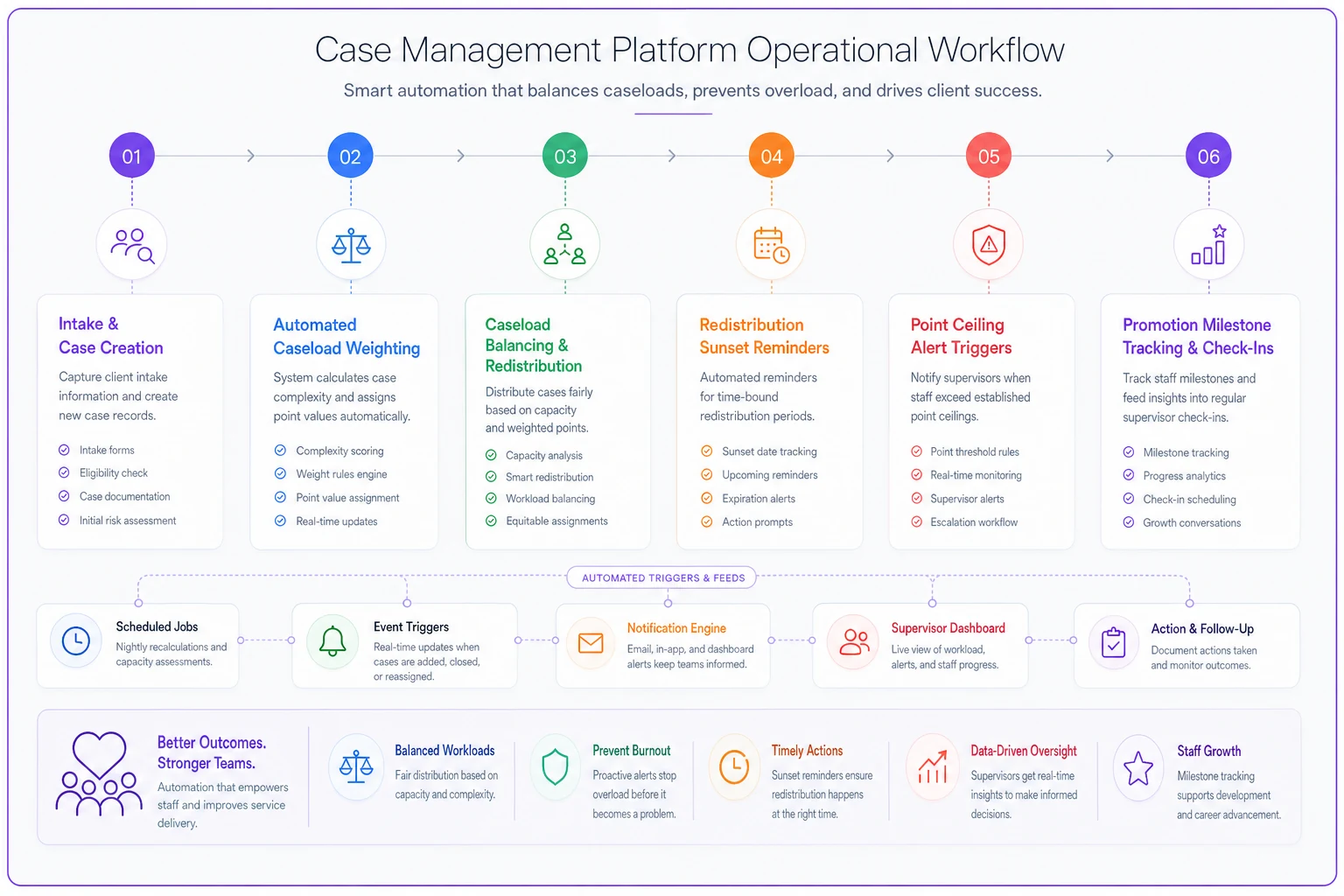
The tooling isn't the point, though. The point is that staffing policy only works if it runs consistently, and consistency is exactly what erodes when everything's tracked in someone's head or a spreadsheet three people forget to update.
Pulling it together
Retention stops being a scramble the moment staffing becomes a system instead of a series of individual saves. A ladder makes the next step visible before someone leaves to find it elsewhere. Weighted caseloads make overload measurable before it becomes burnout. Redistribution sunsets stop temporary strain from turning permanent. On-ramps prevent the early-tenure drop-off. Supervisor ratios keep the people running all of it from being underwater themselves. And the ROI model gets it funded.
The pieces are only powerful together—the ladder assumes redistribution rules, the caseload formula assumes supervision time, the on-ramp assumes checkpoints someone actually runs. Adopt them as a package and you shift from patching leaks after every exit to building a workforce that holds. That shift, more than any single tactic, is what genuine workforce sustainability in social services actually looks like.
The pieces are only powerful together—the ladder assumes redistribution rules, the caseload formula assumes supervision time, the on-ramp assumes checkpoints someone actually runs. Adopt them as a package and you shift from patching leaks after every exit to building a workforce that holds. That shift, more than any single tactic, is what genuine workforce sustainability in social services actually looks like.
Ready to transform your social services workflow?
Join 500+ agencies using TryCasi to improve case outcomes, enhance collaboration, and reduce administrative burden.