

Most continuity planning in small social-service programs is theater. There's a binder somewhere, maybe a Google Doc from two directors ago, and a vague sense that "if something major happens, we'll figure it out." Then something major happens — a key caseworker quits mid-grant-cycle, the one person who knows the HMIS login goes on leave, the interpreter contract lapses — and the whole thing wobbles because the program was quietly held together by three people and one unwritten workflow.
The problem isn't a lack of dedication. It's that resilience in small programs is almost always personal rather than structural. A specific human knows how to do a specific thing, and no system captures that knowledge. When that human is unavailable, the service doesn't degrade gracefully. It drops.
This is a blueprint for building the opposite: a layered operating model where critical services are mapped to their failure points, every failure point has a named owner and a backup, and the whole thing is stabilized through predictable rituals instead of heroics. It's meant for programs that don't have a dedicated operations team — where the deputy director is also the compliance lead, the de facto IT person, and sometimes still carries a caseload.
Why continuity breaks in small programs specifically
Larger agencies fail at continuity for bureaucratic reasons — too many handoffs, diffuse ownership. Small programs fail for the opposite reason: too few people, too much undocumented knowledge, and no slack in the system to absorb a shock.
What tends to happen is a slow concentration of critical functions into whoever is most competent. The best caseworker becomes the informal trainer. The most organized person becomes the keeper of all the consent forms. The one bilingual staffer becomes the de facto language-access department. None of this is on an org chart. It just accretes over time because it's efficient — until it isn't.
A useful diagnostic: draw your program as a map of services, then ask, for each one, "If the single most knowledgeable person vanished tomorrow with no notice, what would stop?" The honest answer usually exposes four or five single points of failure you've been running past for years.
The second structural issue is that small programs rarely distinguish between services that must continue and services that can pause. Everything feels urgent, so nothing gets prioritized. When a disruption hits, staff try to keep all functions running at full capacity with reduced resources — and end up doing everything badly instead of doing the critical things well.
Layer 1: Map the critical services, not the tasks
Start by listing the services clients actually depend on, framed as outcomes rather than activities. Not "we do intake" but "a new client in crisis can get assessed and connected to emergency resources within 24 hours." Not "we maintain records" but "a caseworker can access a client's safety plan when they need it."
Eliminate case management chaos.
TryCasi helps you organize, monitor, and report on every case efficiently and securely.
- Centralized case tracking
- Automated client notifications
- Team task coordination
No credit card required
For each critical service, identify three things:
-
The single point of failure — the person, system, login, contract, or step that the service silently depends on.
-
The failure impact — what breaks for clients, and how fast.
-
The named owner — not "the team," but one human accountable for keeping that service running and for maintaining its backup.
The "named owner" part is where most programs cheat. They write "intake team" or "all caseworkers." That's not an owner, that's a diffusion of responsibility. One name. That person doesn't have to do everything — they have to make sure the service survives disruption.
Here's a simplified version of what this mapping looks like for a program running housing stabilization and family case management:
| Critical service | Single point of failure | Failure impact | Named owner | Backup |
|---|---|---|---|---|
| Emergency intake within 24h | Only 2 staff trained on triage rubric | New crisis clients wait days | Intake supervisor | Cross-trained generalist |
| Benefits/consent record access | One admin knows the file system | Caseworkers can't verify eligibility | Data lead | Deputy director |
| Language access for 3 top languages | Single bilingual staffer + one vendor | ~15% of caseload can't be served | Program director | Backup vendor on retainer |
| HMIS/case platform login + reporting | One person holds admin credentials | Grant reporting stalls | Data lead | Director has admin access |
| Partner referral handoffs | Informal relationships, no shared process | Clients fall through cross-agency gaps | Partnerships lead | Documented contact list |
The table is less important than the discipline of actually filling it in. When programs do this exercise honestly, the uncomfortable pattern that emerges is that the same two or three names show up as owner across half the rows. That concentration is your real vulnerability.
Layer 2: A prioritization rubric for when you can't do everything
During a disruption, you will have fewer people and the same demand. The instinct to keep all services at full capacity is exactly what causes collapse. You need a rubric decided before the crisis, when you can think clearly.
A simple scoring approach that holds up under pressure: rate each service 1–3 on three dimensions.
-
Client safety exposure — does a pause create physical, housing, or safety risk? (3 = immediate danger, 1 = inconvenience)
-
Irreversibility — if we skip this for two weeks, can it be recovered? (3 = permanent harm or lost eligibility, 1 = easily caught up)
-
Legal/funding obligation — are we contractually or legally required to maintain it? (3 = mandatory, 1 = discretionary)
Add the scores. Anything at 7–9 is a must-protect service that gets resources first. Anything at 4–6 runs at reduced capacity. Anything at 3 or below pauses without guilt.
The insight most programs miss: some of your most visible activities score low. Monthly outcome dashboards, certain documentation, routine check-ins with stable clients — these feel important because leadership looks at them, but they're recoverable and non-urgent. Meanwhile, quiet functions like interpreter availability or safety-plan access score high and get neglected because nobody's watching them until they fail.
This rubric also gives you political cover. When a funder or board member asks why a reporting cadence slowed down during a staffing crisis, you have a defensible, pre-agreed logic rather than an improvised excuse.
Layer 3: Temporary SLA adjustments (the part nobody plans)
Standards don't disappear during disruption — but pretending you can hold normal service levels with half your staff is dishonest. The healthier move is to pre-define degraded-but-acceptable service levels and the triggers that activate them.
For each must-protect service, write two SLA tiers: normal operations, and continuity mode. Then define what flips the switch.
-
Normal crisis intake assessed within 24 hours, routine intake within 5 business days.
-
Continuity mode crisis intake within 48 hours, routine intake paused with a waitlist and weekly status call; triggered when intake staff drops below 60% or caseload-per-worker exceeds an agreed ceiling.
Writing these in advance turns the switch into a decision, not a slow slide into failure. Without pre-set tiers, service quietly degrades, nobody announces it, clients and partners keep expecting normal timelines, and trust erodes before anyone acknowledges a problem exists.
One operational detail that matters: whoever owns the service also owns communicating the SLA change — to clients, to partners, and to referral sources. A degraded service that everyone knows about is manageable. A degraded service still being advertised as normal is a liability.
Layer 4: Ready-owner playbooks
A named owner with no playbook is just a name. The playbook is the thin document that lets a backup person run the service without the original owner in the room.
Keep these brutally short. A playbook that runs ten pages won't get read at 7am during a crisis. The goal is a one- or two-page operating card per critical service containing:
-
The purpose — what outcome this service protects, in one sentence.
-
The minimum viable version — what "running at reduced capacity" actually looks like.
-
Access — where the logins, contacts, templates, and forms live (and who else has them).
-
The first three steps — what the backup person does in the first hour.
-
Escalation — who to call when it exceeds the backup's authority.
The common mistake is writing playbooks that describe the ideal process in full detail. In a disruption, nobody needs the ideal process — they need the stripped-down version that keeps clients safe. A good test: could a competent colleague from an adjacent team pick up the card and keep the service alive for a week? If not, it's too complicated or too dependent on tribal knowledge.
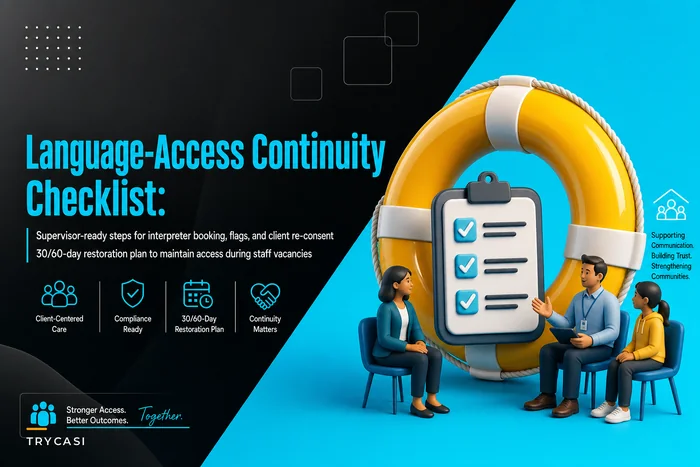
Language access is the classic place this falls apart. When the one bilingual staffer leaves or goes on extended leave, programs discover there was never a documented fallback. Building the playbook before that happens — with vendor contacts, scripts, and fallback steps — is exactly the kind of thinking covered in a language-access continuity checklist for turnover and vacancies, and it's worth treating interpretation as a first-tier critical service rather than a nice-to-have.
Similarly, when a specific service like housing placement collapses mid-case, you don't want staff improvising. Having a pre-built decision structure — like a rapid contingency case conference template for failed housing placements — turns a chaotic scramble into a repeatable 48-hour response. That's a ready-owner playbook in action for one of the highest-stakes failure points.
Layer 5: Simple staffing, device, and reserve plans
Continuity isn't only about process — it's about having enough slack in people, equipment, and money to absorb a shock. Small programs almost never build slack because every dollar is spoken for. But a little structured reserve prevents disproportionate damage.
Staffing. Cross-training is the cheapest resilience you can buy. No critical service should have fewer than two people who can run its minimum viable version. You don't need everyone trained on everything — that's wasteful — you need coverage depth of two on the must-protect services. Map it, find the gaps, and schedule deliberate cross-training each quarter to close them.
Cross-training is the cheapest resilience you can buy.
Devices. The functions that break fastest in a disruption are often tied to specific hardware or home internet. If a caseworker's laptop dies or a staffer's connection drops during remote work, can they keep serving clients? Keeping one or two spare, pre-configured devices and a couple of backup hotspots is a modest cost relative to the service interruption it prevents. This connects directly to broader thinking on equitable remote work setups — a digital inclusion strategy for equitable remote casework teams matters just as much for staff continuity as for client access.
Reserve. Even a modest operating reserve — enough to cover a temporary contract interpreter, a short-term staffing gap, or an emergency device purchase — changes how a program weathers shocks. You're not funding a rainy-day account for its own sake; you're funding the specific line items your failure map tells you are most exposed.
The 72 / 30 / 90-day stabilization rituals
Knowing your failure points doesn't create resilience. Rituals do. Here's a cadence that fits a small team without turning into a second job.
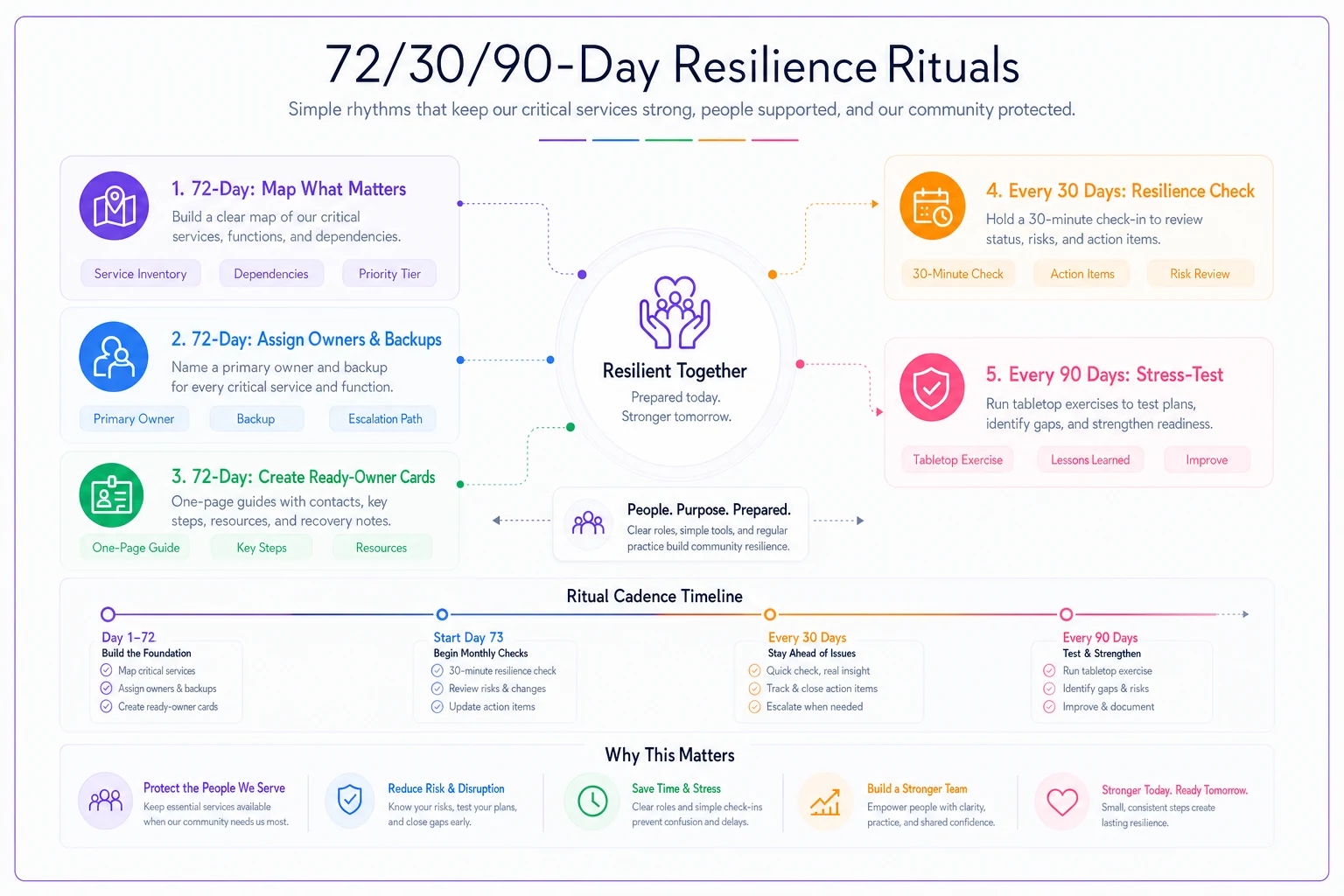
The first 72 days — build the map and the cards. This is the setup phase, run roughly over ten weeks rather than a single frantic sprint. By the end of it you should have:
-
A completed critical-service map with single points of failure named.
-
One named owner and one backup per must-protect service.
-
A one-page ready-owner card for each must-protect service.
-
Your two-tier SLAs written and your continuity-mode triggers agreed.
Don't aim for perfect. A rough map that exists beats a flawless one that's still being planned six months out.
Every 30 days — a 30-minute resilience check. Short, recurring, non-negotiable. The agenda stays the same: Did any single point of failure change this month? Did anyone who's a named owner or backup leave, join, or change roles? Are all the access credentials and vendor contacts on the cards still current? Did we quietly enter continuity mode on anything without declaring it? This monthly rhythm is what keeps the plan from rotting into another stale binder.
Every 90 days — a stress test. Once a quarter, run a real tabletop. Pick one critical service, declare its owner "unavailable," and have the backup actually run it from the card alone for a day — or at least walk through it live. You will find broken links, outdated contacts, and steps the card forgot. Fix them on the spot. Programs that do this consistently find their failure points on a calm Tuesday instead of during an actual emergency.
This visual shows the sequence and major steps of the 72/30/90-day rituals.
You will find broken links, outdated contacts, and steps the card forgot. Fix them on the spot. Programs that do this consistently find their failure points on a calm Tuesday instead of during an actual emergency.
When this full model makes sense — and when it's overkill
This blueprint is worth the effort when your program delivers services where a pause creates real client harm, when you're dependent on a handful of key people, or when you're scaling and starting to feel the strain of coordination across more staff and partners. If a single resignation has ever thrown your operation into weeks of recovery, you need this.
It's overkill if you're a two-person program where everyone already does everything and shares all knowledge by default — though even then, the device and reserve thinking still applies. And building the elaborate version all at once is a bad idea. Programs that try to map every service and write forty playbooks in month one usually burn out and abandon the whole thing. Start with the three or four services that score highest on the rubric. Expand later.
A short real scenario
A small family-services program running roughly 180 active cases had its continuity resting on two people without fully realizing it. One staffer held the case-platform admin credentials and produced all grant reporting. Another was the only reliable Spanish-speaker on a caseload that was close to 20% Spanish-dominant households.
Within the same quarter, the bilingual staffer went on unexpected medical leave and the data lead gave notice. The program nearly missed a grant reporting deadline, and for about three weeks a significant chunk of its Spanish-speaking clients were effectively on hold while leadership scrambled for interpreters at premium rates.
After that, they ran the mapping exercise. Nothing fancy — a spreadsheet, named owners, and one-page cards for six must-protect services. They cross-trained a second person on reporting, put a backup interpreter vendor on a small retainer, and set a modest reserve aside for exactly these gaps. The next time someone left — and someone always eventually leaves — the backup ran reporting from the card, the interpreter line was covered within a day, and clients barely felt it. What had previously taken weeks to recover from became a manageable few days.
Where software fits, quietly
You can run this entire model on spreadsheets and shared docs, and plenty of good programs do. The thing to watch for is that the map, the owners, the SLAs, and the credentials don't scatter across six different places and go stale — because a continuity plan nobody can find is the same as no plan.
As programs grow past a certain size, the coordination overhead of keeping all this current by hand becomes its own single point of failure. This is the natural place where an operational platform earns its keep: keeping critical-service ownership, access, SLA tiers, and backup assignments in one living system, surfacing when an owner leaves or credentials expire, and automating the monthly reminders so the resilience rituals actually happen instead of quietly slipping off the calendar. The point isn't the tooling — it's that the structure survives turnover, which is the whole reason you built it.
The takeaway
Resilience in small social-service programs isn't about having a thick emergency binder. It's about honestly mapping where your services silently depend on specific people and systems, naming who's accountable, writing down just enough that someone else can keep things running, and practicing it on a calendar. Build the map, protect what scores highest, degrade the rest on purpose instead of by accident, and keep it alive with light recurring rituals. Do that, and the next resignation, leave, or outage becomes a bad week — not a crisis.
Do that, and the next resignation, leave, or outage becomes a bad week — not a crisis.
Resilience in small social-service programs isn't about having a thick emergency binder. It's about honestly mapping where your services silently depend on specific people and systems, naming who's accountable, writing down just enough that someone else can keep things running, and practicing it on a calendar. Build the map, protect what scores highest, degrade the rest on purpose instead of by accident, and keep it alive with light recurring rituals. Do that, and the next resignation, leave, or outage becomes a bad week — not a crisis.
Ready to transform your social services workflow?
Join 500+ agencies using TryCasi to improve case outcomes, enhance collaboration, and reduce administrative burden.