

When a staff member who anchors your language access leaves, the gap almost never shows up in the org chart. It shows up three weeks later, when a client who speaks Somali is sitting in a waiting room, an interpreter was never booked, and the only person who knew the vendor login is gone. Nobody planned for the coverage to fail. It failed quietly, in the handoff nobody documented.
This is a specific, recurring failure mode — the continuity problem. Not "do we offer interpretation." You do. The problem is what happens in the 30 to 60 days between someone leaving and someone new being trained on the same workflows. That window is where consent lapses, notes get flagged wrong, and interpreter bookings quietly stop happening for the caseloads that person used to carry.
This post is a supervisor-ready checklist for exactly that window. Immediate booking coverage, note flags that survive turnover, re-consent steps for affected clients, and a 30/60-day restoration plan you can hand to whoever inherits the desk.
Why language access is unusually fragile during turnover
Most operational functions degrade slowly when someone leaves. Language access breaks fast, and the mechanical reason is usually the same: it's concentrated in one or two people, and most of the knowledge is never written down.
-
Vendor relationships go dark. Nobody else has the account credentials, the after-hours line, or the knowledge that your telephonic vendor charges a two-minute minimum but the video vendor doesn't.
-
Client-level language preferences vanish. The record might say "Spanish" but not that the client is more comfortable in Mam, an indigenous Guatemalan language that a generic Spanish interpreter can't serve.
-
In-flight consents lapse. Any consent that was verbally interpreted and documented by the departing staffer may now be unverifiable, because the person who facilitated it is gone.
The pattern worth noticing: turnover doesn't create a language-access problem. It reveals one that was already there — an over-reliance on tribal knowledge that worked fine right up until it didn't.
The immediate coverage checklist (first 72 hours)
The moment you know a language-access-critical person is leaving — or the day you discover they already left — this is the triage. Don't wait for the replacement. The clients on their caseload have appointments this week.
Eliminate case management chaos.
TryCasi helps you organize, monitor, and report on every case efficiently and securely.
- Centralized case tracking
- Automated client notifications
- Team task coordination
No credit card required
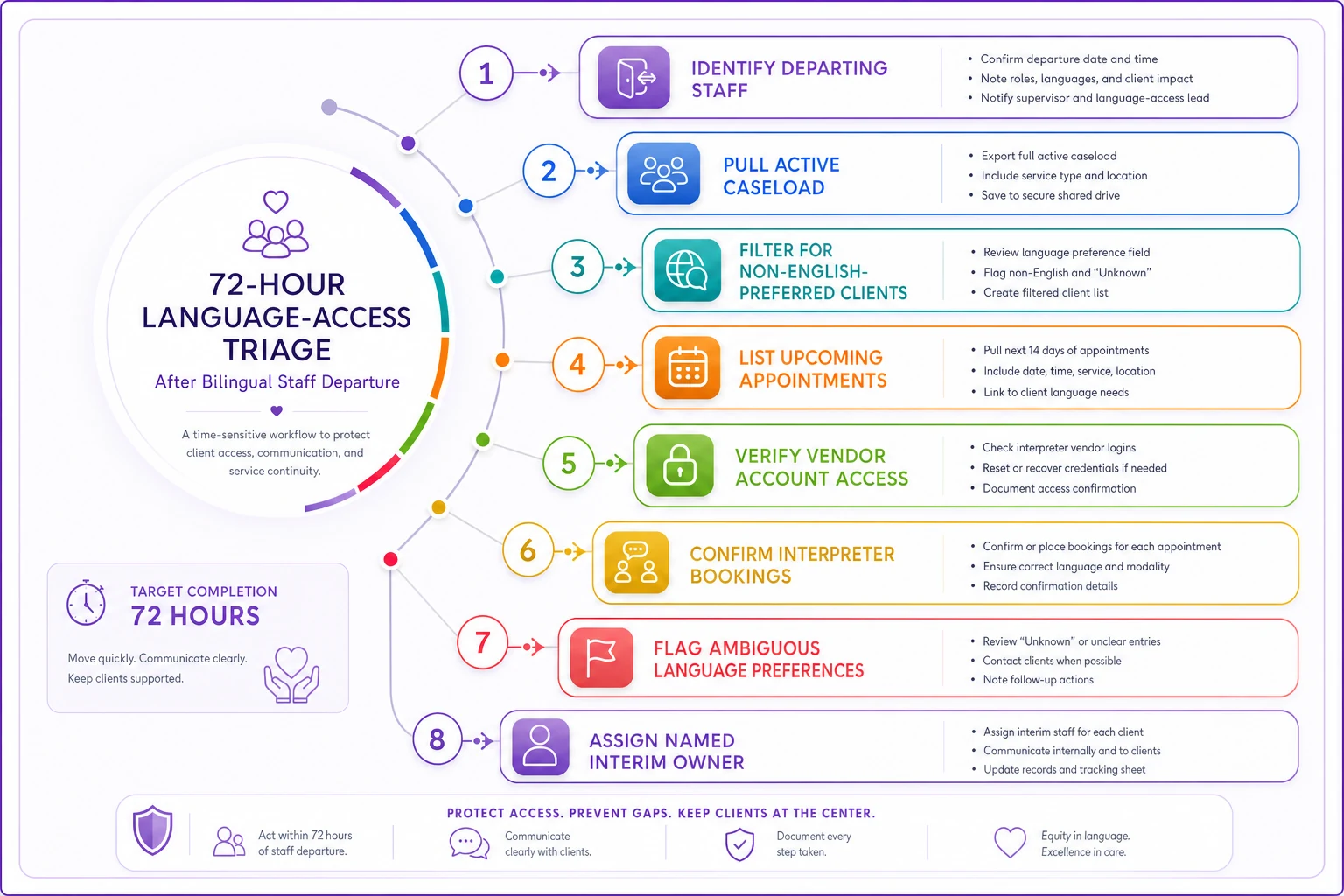
Do this in the first 72 hours:
-
[ ] Pull the departing person's active caseload and filter for any client with a non-English preferred language.
-
[ ] Identify every scheduled appointment in the next 14 days for those clients.
-
[ ] Confirm you have working access to every interpreter vendor account — login, billing contact, and the after-hours booking method. If you don't, request a password reset today, not next week.
-
[ ] For each upcoming appointment, confirm an interpreter is actually booked. Do not assume the departing staffer left it queued.
-
[ ] Flag any client whose language preference is vague ("Chinese" instead of Mandarin/Cantonese, "African languages," "Spanish" where an indigenous language may apply).
-
[ ] Assign a named interim owner for booking. One person. Not "the team."
Here's a simple visual to keep the triage steps clear while you run them.
That last point matters more than it looks. "The team will cover it" becomes "nobody covered it" because coverage without a name attached is coverage that doesn't exist. Pick one interim owner even if it's the supervisor personally for two weeks.
Note flags: making language needs survive the handoff
A failure that shows up in audits constantly: the language preference is technically in the record, but buried in a narrative note from eight months ago, not in a structured field. The new person opens the case, sees nothing obvious, and defaults to English.
The fix is to make language needs loud at the case level, not hidden in prose. If your records already carry structured flags, verify them during turnover. If they don't, this is the moment to add them.
At minimum, every case for a client with language needs should carry a visible flag showing:
| Flag element | Why it has to be explicit |
|---|---|
| Preferred spoken language and dialect | "Spanish" hides Mam, K'iche', Q'anjob'al; "Chinese" hides Cantonese vs Mandarin |
| Preferred written language | Some clients speak one language but read another, or don't read either |
| Interpreter modality preference | In-person vs video vs phone — trauma survivors often refuse phone |
| Interpreter gender preference | Common in medical and DV cases; easy to lose in handoff |
| Do-NOT-use-family-as-interpreter marker | Critical for confidentiality; often only known informally |
Put the language and DO-NOT-use-family flags on the case summary header so interim owners see them immediately without opening notes.
That last row is the one that gets people. When coverage is thin, the tempting shortcut is to let a client's adult child interpret. For most sensitive casework that's a compliance and safety problem, and the departing staffer may have been the only one who knew a particular family should never go that route.
For more detail on structuring this at the note level, the guide on culturally and linguistically appropriate notes covers the phrasing conventions and interpreter workflow documentation that make these flags actually usable by whoever picks up the case next.
Client re-consent: the step everyone skips
This is the part that gets missed, and it carries the most legal exposure. When a bilingual staffer facilitated a client's consent — for services, for information sharing, for records release — and that consent was interpreted and documented by them, you need to be able to defend that the client understood what they were signing.
If the person who provided or interpreted that consent is gone and there's any ambiguity, you re-consent. Not for everyone — for the affected subset.
Who needs re-consent during turnover:
-
Clients whose consent was verbally interpreted by the departing staffer with no independent interpreter of record.
-
Clients whose consent documentation is incomplete or can't be verified now that the staffer is gone.
-
Clients on active information-sharing agreements with partner agencies where the language of the agreement was interpreted informally.
-
Any client where the file suggests consent may have relied on a family member interpreting.
The re-consent workflow itself is straightforward but must use a qualified interpreter, not the interim staffer's best guess at translation:
-
Book a qualified interpreter (vendor is fine — this is not the moment to improvise).
-
Re-present the specific consent that's in question, interpreted in full.
-
Document the interpreter used, their ID or vendor reference, the date, and the client's confirmation.
-
Note in the record that this was a turnover-triggered re-consent, so the audit trail is clear.
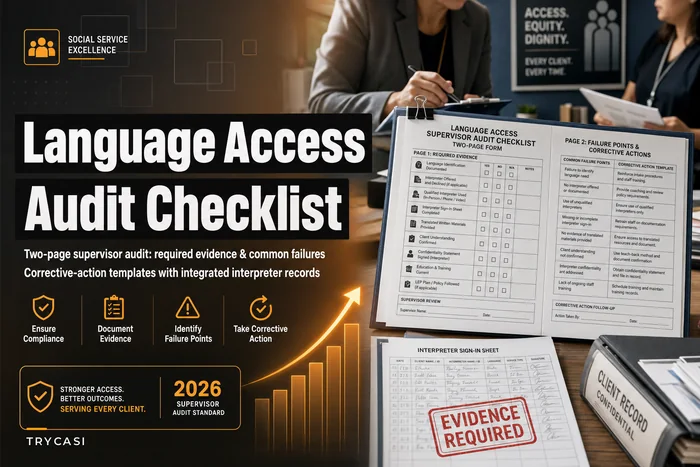
The mistake is treating re-consent as bureaucratic box-checking and rushing it. It's the one step that protects both the client and the agency when a file gets reviewed later. If your consent documentation practices have gaps, running a full language-access audit checklist for client records alongside the turnover response is worth doing — turnover tends to surface the same weak points an audit would anyway.
A real scenario
A mid-sized family services program — around 12 caseworkers, roughly 600 active clients — lost its only full-time bilingual coordinator with two weeks' notice. She carried the interpreter booking function for the whole team informally, on top of her own caseload of about 40 families.
For the first month after she left, nobody had run the triage above. Interpreter bookings for her former caseload dropped off almost entirely because no one knew the video vendor's account was under her personal login. Two clients missed benefits recertification appointments because the interpreter simply never showed — nobody had booked one. During a later chart review, roughly a dozen consents on her caseload couldn't be verified as properly interpreted.
The recovery wasn't complicated once someone owned it. A supervisor took the interim booking role for six weeks, reset the vendor credentials in the first two days, and worked through the affected caseload flagging language needs into structured fields. The re-consent list came to about 15 clients, cleared over three weeks using vendor interpreters. Nothing heroic — just the checklist, run late instead of on time. The whole scramble would've been a half-day of prep if the workflows hadn't lived in one person's head.
The 30/60-day restoration plan
Immediate triage keeps clients covered. Restoration makes sure you're not back in the same hole the next time someone leaves. Split it into two phases.
By day 30 — stabilize:
-
Interim booking owner confirmed and functioning; vendor access verified and not tied to any individual's personal login.
-
Entire departed caseload reviewed for language flags; structured fields populated.
-
Re-consent list built and at least half cleared.
-
Vendor contacts, account details, booking procedures, and after-hours process written down in a shared location — not a personal inbox.
By day 60 — rebuild resilience:
-
Re-consent list fully cleared and documented.
-
Language-access booking process documented as an SOP any trained staffer can follow.
-
At least two people cross-trained on interpreter booking and vendor accounts, so the function is never a single point of failure again.
-
New hire (or reassigned staff) onboarded specifically on language-access workflows, not just their caseload.
-
Language flags added to your standard intake so preferences get captured in structured fields from day one going forward.
The point of the 60-day mark is to end the concentration risk. The reason turnover hit so hard the first time is that one person owned everything. If you finish restoration with the same setup — just a new single owner — you've rebuilt the same fragility.
When to move fast and when you can breathe
Not every turnover needs the full response, and reading that correctly saves real effort.
Move fast (full checklist, interim owner today) when:
-
The departing person was the primary or only interpreter-booking contact.
-
They carried a caseload with a meaningful share of non-English-preferred clients.
-
Vendor accounts or credentials were tied to them personally.
You can move more deliberately when:
-
Booking was already centralized and documented, and the departing person just used the shared system.
-
Language flags already live in structured fields and don't depend on anyone's memory.
-
Vendor access is institutional, not personal.
If you're in the second bucket, turnover is a scheduling adjustment instead of a crisis. Most teams find out which bucket they're in only when someone quits.
A note on where systems help
None of this requires software to be correct, but the failure mode described above is almost always a knowledge-storage problem. Language preferences in someone's head instead of a structured field. Vendor logins in a personal inbox. Consents buried in free-text notes that can't be filtered or found.
A case management platform that stores language and interpreter preferences as structured, flaggable fields — and keeps booking and consent records attached to the case rather than to a person — turns turnover from a scramble into a handoff. The value isn't automation for its own sake. It's that the next person can open a case and immediately see what the client needs, without having to reconstruct it from someone who already left. That's the whole game during a vacancy: making the knowledge survive the person.
Closing
The clients most exposed during staff turnover are the ones who already have the least room for error — people who can't just call the office and explain what went wrong, because the office doesn't speak their language and the one person who did just left. Continuity for them isn't a nice-to-have. It's the difference between a covered appointment and a missed recertification.
Run the 72-hour triage the day you learn about a departure. Build the re-consent list before the file review forces you to. And use the 60-day window to make sure the next person to leave doesn't take your entire language-access function with them.
Ready to transform your social services workflow?
Join 500+ agencies using TryCasi to improve case outcomes, enhance collaboration, and reduce administrative burden.