


Three months ago, a case manager in Queens showed me her documentation nightmare. She had seventeen Bengali-speaking families, twelve Spanish-speaking clients who preferred medical terminology in English, and a handful of Mandarin speakers who needed simplified characters for written materials. Her case notes? A mess of Google Translate attempts, handwritten interpreter corrections, and sticky notes marking which phrases offended which families.
The kicker: she'd accidentally used a mental health assessment template with cultural assumptions that made zero sense for half her caseload. Questions about "feeling blue" confused non-English speakers. References to individual therapy goals clashed with families expecting collective decision-making. The interpreter had to spend twenty minutes explaining why the intake form asked about alcohol when the family was Muslim.
This isn't rare. Most social workers juggle 40-60 cases across multiple languages and cultural backgrounds. Standard documentation templates fail spectacularly when your Tuesday involves a Haitian family navigating housing court, a Korean elder refusing services due to shame concepts, and a Syrian refugee who needs every document translated but only trusts specific dialect interpreters.
Why standard templates break down
The core issue runs deeper than translation. Documentation systems assume a kind of cultural neutrality that doesn't actually exist. Every intake form, assessment tool, and case note template carries embedded assumptions about family structure, decision-making, emotional expression, and help-seeking behavior.
Take the standard "emergency contact" field. Simple, right? Except when working with extended family systems where the eldest uncle makes medical decisions, the youngest daughter handles paperwork, and the neighbor translates. Or consider "presenting problem" sections that expect linear explanations when many cultures describe issues through circular narratives or metaphors.
Language preference goes beyond picking "Spanish" or "Chinese" from a dropdown. A family might want:
-
Medical terms in English but emotional discussions in Tagalog
-
Written materials in simplified Chinese but verbal updates in Cantonese
-
Documents in formal Arabic but conversations in Egyptian dialect
-
Children interpreting for routine matters but certified interpreters for legal issues
Most case management systems can't capture any of this. Workers end up maintaining shadow systems – Excel sheets, personal notebooks, Post-it note codes – to track what actually works for each family.
Building language preference data fields that actually work
Forget the single "preferred language" dropdown. Real culturally appropriate documentation needs layered preference fields that reflect how families actually communicate.
Eliminate case management chaos.
TryCasi helps you organize, monitor, and report on every case efficiently and securely.
- Centralized case tracking
- Automated client notifications
- Team task coordination
No credit card required
Start with communication context mapping. Create separate fields for:
Verbal preferences by situation:
-
Routine check-ins
-
Medical discussions
-
Legal matters
-
Crisis intervention
-
Educational planning
-
Mental health conversations
Written material preferences:
-
Forms and applications
-
Educational handouts
-
Appointment reminders
-
Service explanations
-
Rights and responsibilities
Interpreter requirements:
-
Family interpreter acceptable (specify which topics)
-
Professional interpreter required (note gender/age preferences)
-
Specific dialect needs
-
Industry terminology familiarity required
-
Cultural broker needed beyond translation
One agency discovered their Somali families needed three completely different communication approaches: young mothers preferred texted appointment reminders in English, elderly clients required verbal updates in Somali from female interpreters, and teenage boys only engaged through male youth workers who understood both languages plus gaming terminology.
The solution wasn't complicated – they added checkbox fields for "Communication Context Preferences" with options to note specific requirements. Their no-show rate for Somali families dropped by roughly 40% once workers could quickly reference who needed what type of outreach.
Template modifications for cultural context
Standard assessment templates need structural changes, not just translation. The typical linear question format – problem, history, goals, interventions – assumes Western therapeutic frameworks that can alienate families from different cultural backgrounds.
Consider this housing assessment rewrite:
Standard version:
-
"What is your current housing problem?"
-
"How long has this been an issue?"
-
"What have you tried to resolve it?"
Culturally-adapted version:
-
"Tell me about your family's living situation"
-
"Who is affected and how?"
-
"What does stable housing mean for your family?"
-
"Who in your community has offered help?"
The second version allows for collective narrative, acknowledges extended family impact, and recognizes informal support systems. It pulls the same information but through a framework that actually resonates.
Here's a practical template modification for intake notes:
| Standard Field | Cultural Adaptation | Why It Matters |
|---|---|---|
| Client Name | Names (formal/informal/preferred) | Many cultures use different names in different contexts |
| Household Members | Family/Household Constellation | Captures fluid living arrangements, extended family roles |
| Employment Status | Work/Income Activities | Includes informal economy, family businesses, seasonal work |
| Mental Health History | Wellness and Coping Approaches | Reduces stigma, includes traditional healing, family support |
| Goals | Family Priorities and Hopes | Shifts from individual to collective framing |
| Barriers | Challenges Facing the Family | Acknowledges systemic issues, not individual deficits |
The second version allows for collective narrative, acknowledges extended family impact, and recognizes informal support systems. It pulls the same information but through a framework that actually resonates.
Interpreter workflow documentation
Most agencies document interpreter use poorly. A note saying "interpreter present" tells you nothing about communication quality, family dynamics, or what got lost in translation.
Build interpreter documentation workflows that capture:
Pre-session briefing (2-3 minutes):
-
Family's dialect and regional variations
-
Sensitive topics to approach carefully
-
Technical terms needing explanation
-
Cultural context affecting discussion
During-session notation:
-
Concepts requiring extended explanation
-
Family disagreements about translation
-
Nonverbal communication notes
-
Terms with no direct translation
Post-session debrief (5 minutes):
-
Communication challenges encountered
-
Cultural dynamics observed
-
Recommendations for future sessions
-
Terms to pre-explain next time
Here's a quick visual workflow for interpreter documentation.
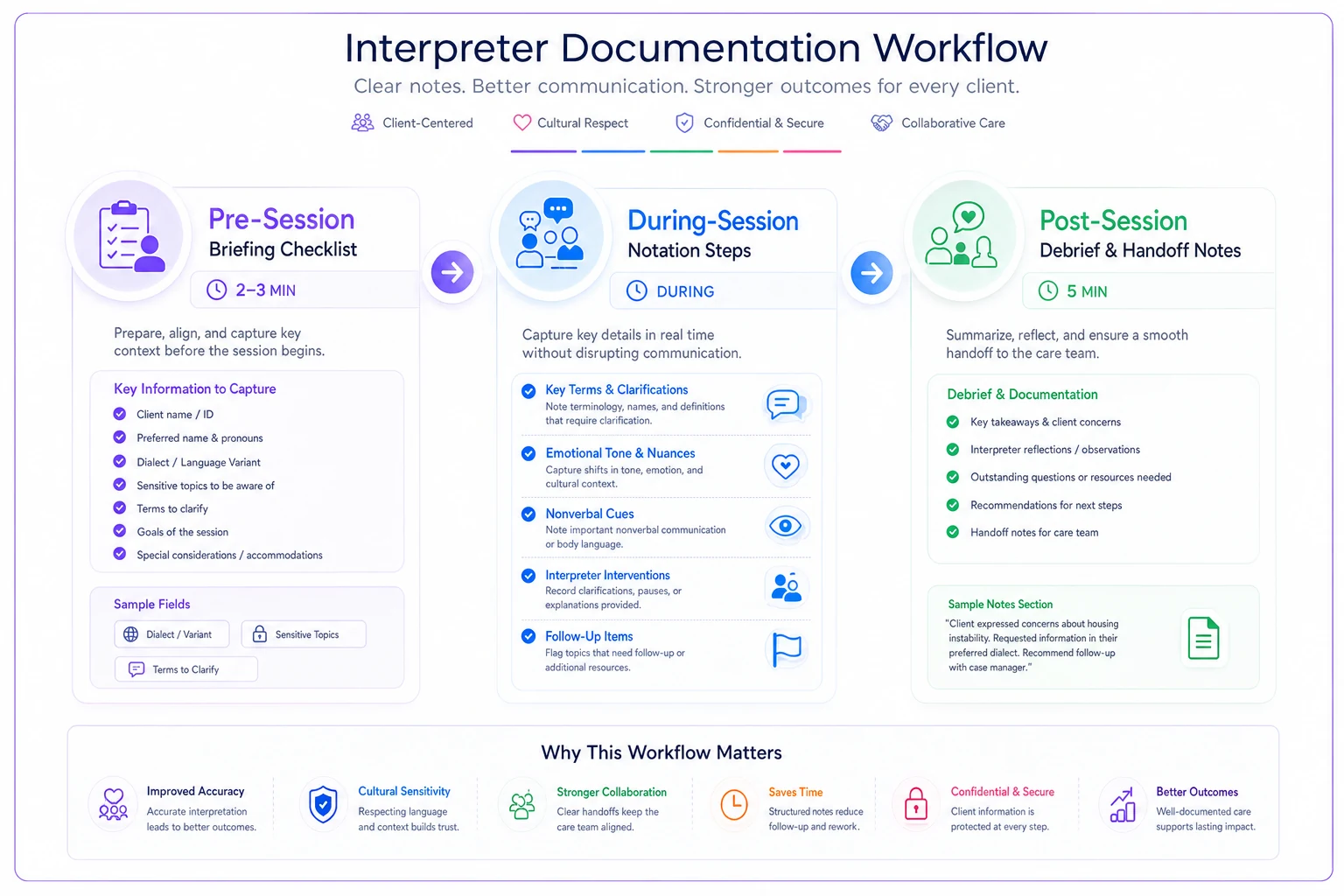
A mental health team in Brooklyn started using this workflow with their Russian-speaking families and discovered several families were confused about therapy goals because the interpreter kept translating "coping skills" as "survival tactics" – completely changing the therapeutic frame. Once documented, the team could prep interpreters with preferred terminology before sessions.
Phrasing conventions that reduce friction
Certain phrases in case notes create problems across cultures. Not through mistranslation, but because the embedded assumptions don't carry over conceptually.
Common problematic phrases and alternatives:
-
"Client is non-compliant" Better
"Family following different health practices" or "Alternative approach being used"
-
"Refuses services" Better
"Declined current service option" or "Seeking different support approach"
-
"Poor insight into problem" Better
"Different understanding of situation" or "Alternative explanation of challenges"
-
"Resistant to intervention" Better
"Current approach not matching family needs" or "Requires modified engagement strategy"
-
"Inappropriate affect" Better
"Emotional expression differs from clinical expectation" or "Cultural norms affecting presentation"
These aren't just politically correct alternatives. They shift from deficit-based to descriptive language that maintains clinical utility while reducing cultural bias baked into the phrasing.
Real-world scenario: Multi-family documentation
A family services agency in California works with roughly 180 Vietnamese families – most refugees from different regions with varying dialects, education levels, and documentation status.
Their old system: one interpreter for all Vietnamese families, standard English assessment forms translated word-for-word, case notes following county templates.
Problems showed up fast:
-
Northern and Southern Vietnamese families couldn't always understand each other's dialects
-
Direct translation of mental health terms created stigma
-
Forms asked about individual goals when families made collective decisions
-
Case notes labeled normal cultural practices as "concerning"
Their rebuilt system:
-
Language preference matrix Tracked dialect, formality level, written script preference (traditional or simplified), and context-specific language choices. Families could indicate "Vietnamese for family matters, English for medical terms."
-
Cultural consultation notes Added fields for recording cultural context affecting service delivery. Example: "Grandmother is decision-maker, requires formal address, prefers morning appointments before temple."
-
Modified templates Rewrote assessments to allow narrative responses, added family strength sections, included questions about community resources and traditional supports.
-
Interpreter protocols Created pre-session briefing forms, documented interpretation challenges, tracked which interpreters worked best with which families based on dialect and cultural familiarity.
Results after eight months:
-
Engagement rate increased from around 60% to 85%
-
Families reported feeling "heard and understood" in satisfaction surveys
-
Workers spent less time clarifying miscommunications
-
Service plans better incorporated family and cultural resources
Families reported feeling "heard and understood" in satisfaction surveys
Creating sustainable documentation practices
The trap most agencies fall into: building elaborate cultural documentation systems that frontline workers can't actually maintain. A case manager with 55 families doesn't have time for thirty-page cultural assessment tools.
Build lightweight documentation that captures essential information:
Quick cultural context fields:
-
Decision-maker(s) in family
-
Communication style (direct/indirect)
-
Important cultural/religious considerations
-
Previous negative system experiences
-
Strength and resource notes
Phrase banks for common scenarios: Create pre-written, culturally-reviewed phrases for common documentation needs. Workers select and modify rather than writing from scratch.
Interpretation quality flags: Simple checkboxes: Clear communication / Some confusion / Significant barriers / Cultural broker needed
Update triggers: Note when preferences need review: After crisis / Change in family composition / New interpreter / Service transition
Use short codes for frequent cultural preferences (e.g., "M-F" for male-female interpreter preference) so workers can record details quickly during busy intakes.
Build lightweight documentation that captures essential information:
Technology and workflow integration
Most digital case management systems still can't handle multilingual documentation properly. The workarounds workers build – parallel spreadsheets, paper notes, constant copy-pasting – become their own operational burden.
Operational software with AI automation can cut down a lot of this mechanical work. Instead of manually tracking language preferences across multiple systems, platforms with built-in workflow automation can flag when a family's documented preferences don't match scheduled interpreter services. Some agencies have started using AI-assisted platforms that learn from corrections over time, suggest more culturally appropriate phrasing, and flag when a standard template might not be the right fit for a specific family's context.
None of this replaces human judgment. But when a worker types a case note and the system automatically checks it against the family's documented communication preferences – prompting them to verify which language was used for which topics before the note is finalized – that's a real reduction in error and rework. It handles the mechanical tracking so workers can focus on the actual case.
Measuring documentation quality
Most agencies track the wrong metrics – number of translated forms, interpreter hours used, diversity training completed. Those measure activity, not effectiveness.
Better indicators:
Communication clarity metrics:
-
Families requesting clarification (should decrease)
-
Appointment no-shows after written reminders
-
Consent forms signed without additional explanation needed
-
Service plan modifications due to misunderstanding
Engagement quality markers:
-
Families initiating contact
-
Self-reported understanding of services
-
Participation in optional programs
-
Referral acceptance rates
Worker efficiency measures:
-
Time spent clarifying previous notes
-
Duplicate documentation efforts
-
Interpreter scheduling corrections
-
Documentation revision frequency
Critical incident tracking:
-
Services refused due to cultural misunderstanding
-
Complaints about documentation bias
-
Interpreter disputes about translation
-
Cultural consultation requests
Track these monthly, looking for patterns by language group, worker, and service type. One team discovered their Spanish-speaking families had strong engagement across most services but consistently lower participation in mental health programs. The issue turned out to be the mental health assessment template – clinical terms that didn't translate well, while other service areas used plain language.
Common implementation mistakes
Agencies eager to improve cultural documentation often stumble in predictable ways:
-
Over-engineering intake systems Creating twenty-page cultural assessments that frontline workers skip entirely. Keep initial documentation simple, add depth over time.
-
One-size-fits-all translation Assuming all Spanish speakers need the same terminology, or that professional translation alone solves communication problems.
-
Ignoring informal interpreters Many families prefer trusted community members over professional interpreters for certain topics. Document these preferences rather than forcing professional interpretation in every situation.
-
Cultural stereotype templates Creating rigid templates based on cultural generalizations. A Filipino family might have completely different preferences than another Filipino family.
-
Waiting for perfect systems Begin with basic preference fields and phrase modifications, build sophistication gradually. Agencies that wait for a complete solution usually don't start at all.
Begin with basic preference fields and phrase modifications, build sophistication gradually. Agencies that wait for a complete solution usually don't start at all.
Moving forward
Culturally appropriate documentation isn't about perfection – it's about steady operational improvement. Start with language preference fields that capture real family needs. Modify templates to allow cultural narrative styles. Build interpreter workflows that document nuance, not just attendance. Create phrase conventions that describe without judging.
The agencies getting this right aren't the ones with the most elaborate systems. They're the ones whose workers can quickly reference how each family prefers to communicate, whose documentation captures cultural strengths alongside needs, and whose case notes actually make sense to families when translated back.
Documentation is a tool for service delivery, not compliance. When case notes accurately reflect cultural context and linguistic preferences, workers spend less time clarifying miscommunications and more time helping families navigate systems.
The goal isn't culturally neutral documentation – that's not achievable. The goal is culturally conscious documentation that acknowledges difference, captures nuance, and supports effective service delivery across all the communities you serve.
Your Tuesday morning shouldn't involve guessing whether the Chen family prefers simplified or traditional characters, wondering if "feeling stressed" translates properly for your Arabic-speaking clients, or hoping the new interpreter understands the difference between formal and informal Vietnamese. Good documentation eliminates that guesswork, creating clear operational workflows that respect cultural difference while maintaining clinical utility.
Ready to transform your social services workflow?
Join 500+ agencies using TryCasi to improve case outcomes, enhance collaboration, and reduce administrative burden.