

A placement fails on a Thursday afternoon. The landlord backs out, the shelter bed disappears, the family unit breaks down, or the "confirmed" unit turns out to have a mold problem nobody flagged. Now you've got a client without stable housing, a partner agency waiting on you, and a case that needs decisions today — not at next week's team meeting.
The problem isn't that people don't care. It's that most teams don't have a fast, repeatable way to run a contingency conversation. They call an emergency huddle, six people show up, everyone talks for forty minutes, and somehow nobody leaves knowing who's calling the backup landlord or whether the client has a safe place to sleep tonight.
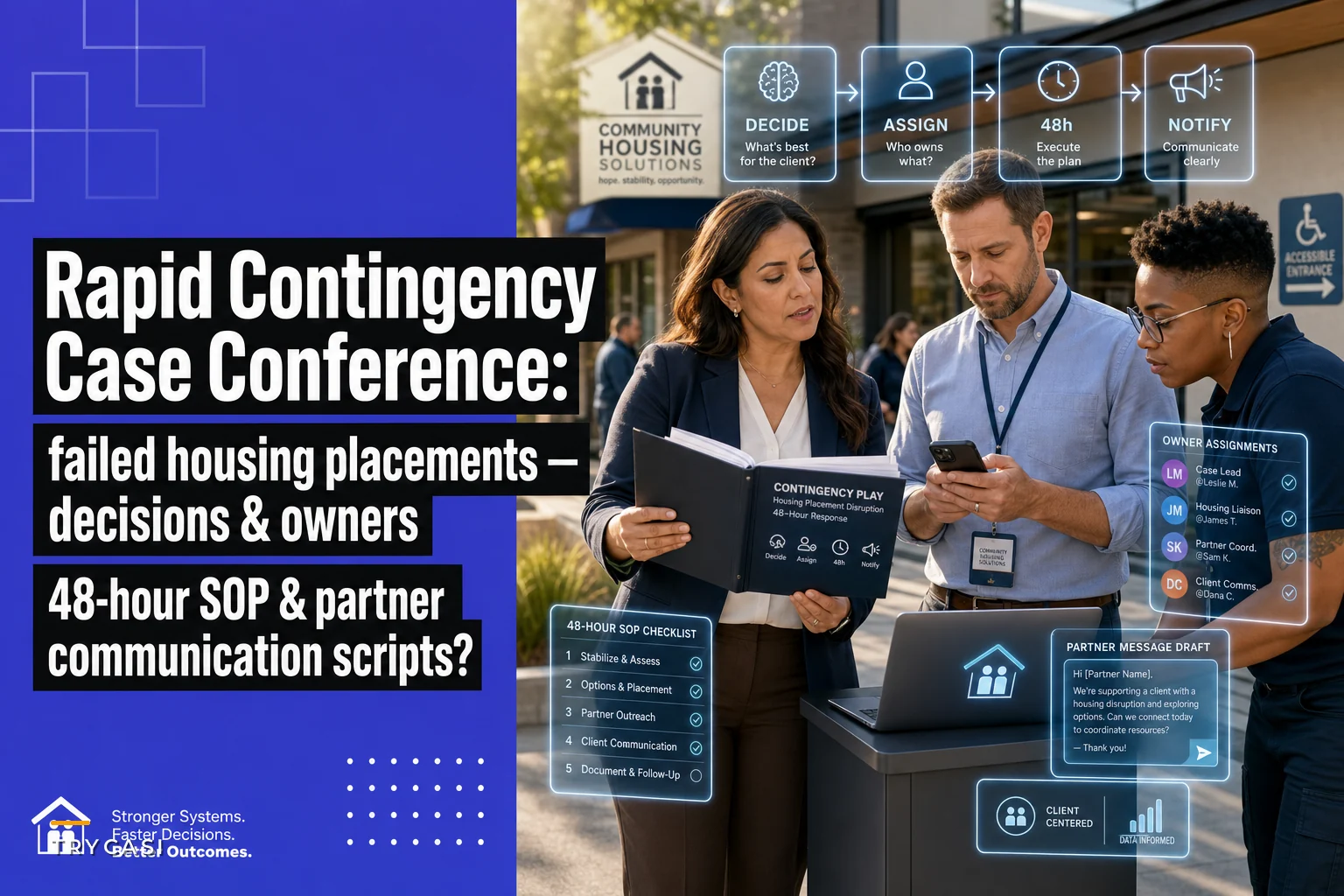
This is a template problem, not a talent problem. Below is a housing placement contingency meeting template built to run in 20 minutes or less, plus a 48-hour action SOP and the partner scripts that keep re-placement moving instead of stalling in voicemail limbo.
Why failed placements turn into slow-motion disasters
Placement failures rarely blow up because the situation is unsolvable. They drag because the response is disorganized in three specific ways.
No single owner walks out with the case. In a lot of contingency huddles, responsibility gets diffused across everyone in the room, which in practice means nobody. People assume the case manager who set up the original placement will fix it, but that person might be off the next day, or already buried under four other active crises.
The clock isn't named. "Let's find something soon" is not a deadline. Without a hard 48-hour marker, the case quietly slips down the priority list while newer intakes pull attention. By the time someone circles back, the client has already spent two nights somewhere unsafe.
Partners get told too late, or too vaguely. When a placement fails, the partner agency that referred the client — or the one that was supposed to receive them — often finds out through a chain of soft messages. Nobody wants to be the one to say "it fell through," so the communication gets slow and diluted, and the partner can't help you re-place because they don't know the real status.
What tends to happen across social service teams is that the meeting itself is usually fine. It's the structure that's missing. A good contingency conference is closer to an air-traffic-control call than a discussion — short, decision-forced, and owner-assigned.
The consequences nobody puts on paper
The immediate cost is obvious: a client sleeps somewhere they shouldn't. But the operational damage runs deeper and rarely gets tracked.
Eliminate case management chaos.
TryCasi helps you organize, monitor, and report on every case efficiently and securely.
- Centralized case tracking
- Automated client notifications
- Team task coordination
No credit card required
A single failed placement that isn't resolved quickly tends to generate three to five extra follow-up tasks — re-verifying eligibility, re-collecting documents that expired, re-explaining the situation to a new landlord, re-confirming benefits. A placement that could have been salvaged in 48 hours can turn into a two- to three-week re-placement cycle when the response drags.
There's a relationship cost too. Landlords and partner agencies remember which caseworkers communicate clearly under pressure. Go quiet on a landlord after a placement collapses and they'll be slower to offer you the next unit. One property manager who feels left in the dark can quietly close the door on a dozen future placements.
And then there's the client's trust, which is the hardest thing to rebuild. Someone who agreed to a placement, packed up, and then watched it fall apart is now more skeptical of the next option you bring them. Speed and clarity in the first 48 hours does a lot of the work of keeping them engaged instead of disappearing.
The contingency case conference template (20 minutes)
Keep the room small. You need the case owner, a supervisor or decision-maker with authority to approve spending or exceptions, and one person who owns partner communication. Anyone else is optional. The whole point is to force decisions, not brief a committee.
-
Status (3 min). Where is the client right now, tonight? Are they safe? This is a yes/no. If the answer is "not safe," everything else pauses until you have a same-night solution.
-
What failed and what's still usable (4 min). Name the specific reason the placement collapsed and confirm what parts of the case are still valid — approved budget, verified income docs, benefit eligibility, the client's stated preferences. You don't want to rebuild things that are still good.
-
Decisions (5 min). Pick the re-placement path. Backup unit? Different program? Temporary bridge while the main option gets fixed? Choose one primary and one fallback. Don't leave with three "maybes."
-
Owner assignments (3 min). Every action gets a name and a time. Not "we'll follow up" — "Maria calls the backup landlord by 10am tomorrow."
-
Partner and client comms (5 min). Decide exactly who tells the partner agency and the client, using what message, by when.
Here's the one-page decision grid that keeps the meeting honest:
| Decision point | Options | Owner | Deadline |
|---|---|---|---|
| Client safe tonight? | Yes / Emergency placement now | Case owner | End of meeting |
| Primary re-placement path | Backup unit / New program / Bridge | Case owner | 24 hrs |
| Fallback path | Named alternative | Supervisor | 24 hrs |
| Budget/exception approval | Approved / Escalate | Supervisor | End of meeting |
| Partner notification | Who + which script | Comms owner | 2 hrs |
| Client update | Who + how contacted | Case owner | 4 hrs |
If a row leaves the meeting without a name and a time, the meeting isn't done.
Here's a quick visual of the 20-minute meeting flow.
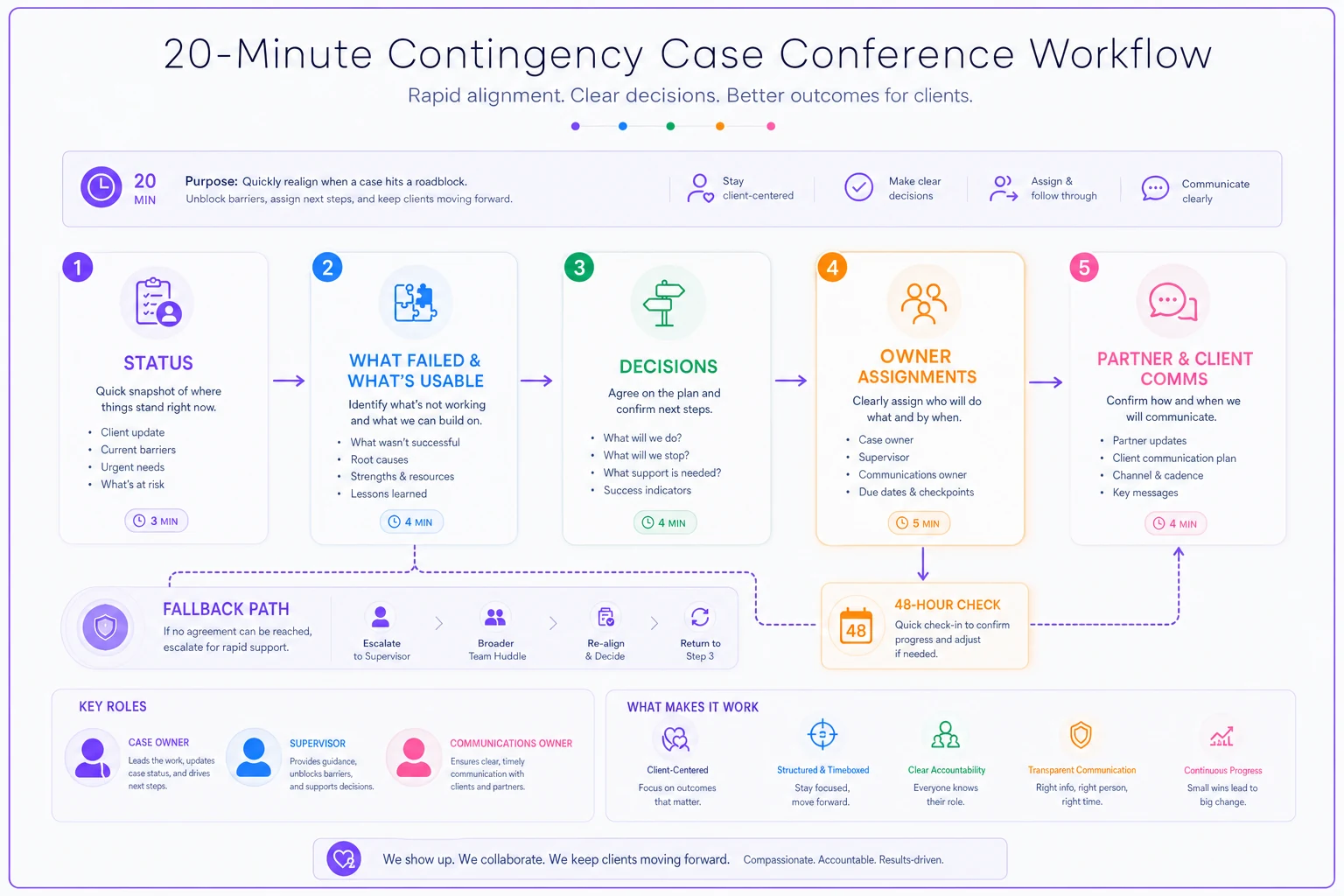
Use this flow during the call.
The 48-hour action SOP
The template sets direction. The SOP is what keeps things moving after everyone leaves the room. Think of it as three checkpoints across two days.
Hour 0–2:
-
Case owner confirms client's immediate safety and location
-
Comms owner notifies the affected partner agency with the real status
-
Supervisor confirms any budget or exception approval in writing
Hour 2–24:
-
Case owner contacts primary re-placement option and logs the response
-
Fallback owner warms up the secondary option so it's ready, not cold
-
Any expired or missing documents get flagged for re-collection
Hour 24–48:
-
Confirm or discard the primary path — no lingering "waiting to hear back"
-
If primary is dead, activate fallback immediately; don't schedule another meeting
-
Update the client and the partner with a concrete next step
-
Log the outcome so the case history is clean if it needs escalation
The single most important rule in this SOP: at the 24-hour mark, kill or confirm the primary path. The most common failure isn't picking the wrong option — it's leaving the first option "pending" for three days while a landlord who was never going to say yes keeps you hanging.
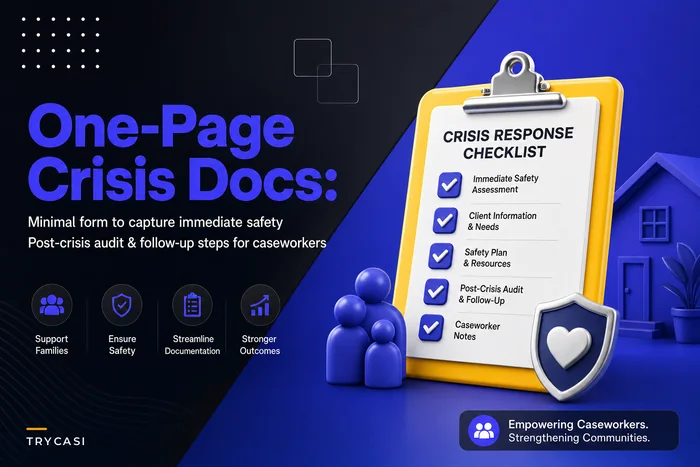
Clean documentation earns its keep here too. If the situation involved a safety issue, capturing it properly at the moment matters, and a lightweight approach like a one-page crisis documentation and post-crisis audit form keeps you from losing the thread when the case moves fast.
Partner communication scripts
The reason partner comms go soft is that the message feels like an admission of failure. It isn't. A placement falling through is normal; going quiet about it is the actual mistake. Short, direct scripts remove the emotional hesitation.
To the receiving/partner agency when a placement fails:
> "Quick update on [client initials / case ID]: the placement at [unit/program] fell through today because [one-line reason]. Client is [safe tonight / being placed in emergency housing now]. We're pursuing [primary path] and have [fallback] ready. I'll confirm status by [time/date]. Is there anything on your end that speeds up re-placement?"
That last question matters. It turns a status update into a working request, which is how partners actually help.
To a landlord you want to keep for the next placement:
> "I wanted to let you know directly that [placement] didn't work out because [reason]. I appreciate you holding the unit, and I'd like to keep you in mind for our next client who fits. Can I follow up with you when the right match comes up?"
You're protecting the relationship, not apologizing your way out of it.
To the client:
> "The place we lined up didn't come through, and I'm sorry — that's frustrating. Here's what's happening right now: [safe location tonight]. My next step is [action] by [time], and I'll check in with you at [time]. You don't need to do anything except [one small thing, if any]."
Naming a specific next check-in time is what keeps the client from spiraling. Vagueness is what makes them disengage.
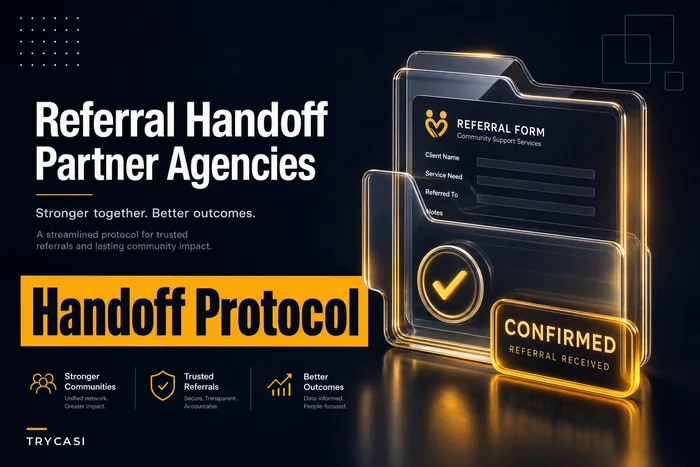
The cleaner your handoff information is, the smoother these calls go. Teams that already run a solid referral handoff protocol with partner agencies — required fields, timelines, confirmation loops — find contingency calls much easier because the partner already has the context and you're just updating status, not re-explaining the whole case.
A real scenario
A mid-sized housing stabilization program running around 40–50 active placements at a time, with two or three failing in a typical month. Before they tightened this process up, a failed placement took roughly 9 to 12 days to re-place — mostly because the first contingency huddle produced discussion but no owners, and partners heard about failures late.
They adopted the 20-minute template and the 24-hour "kill or confirm" rule. Nothing fancy — a shared one-page grid, named owners, and the partner scripts pinned somewhere staff could grab them fast.
Within a couple of months, average re-placement time dropped to around 3 to 4 days. Two landlords who'd previously stopped returning calls started offering units again, mostly because they were getting straight, timely communication when things went sideways instead of silence. The client no-show rate on replacement viewings improved too, which the team credited to the specific "I'll check in at [time]" language in the client script.
The numbers weren't dramatic on paper. But the difference between a 10-day and a 4-day re-placement is often the difference between keeping a client engaged and losing them entirely.
When this tight format makes sense — and when it doesn't
This template is built for genuine contingency situations: a placement that was live and collapsed, where the client's housing status is now uncertain. That's where speed and forced decisions pay off.
It's a bad fit for routine case review or long-term planning. If you try to run reflective, complex cases through a 20-minute decision grid, you'll cut off the discussion those cases actually need. Don't force a nuanced family situation into a five-block sprint.
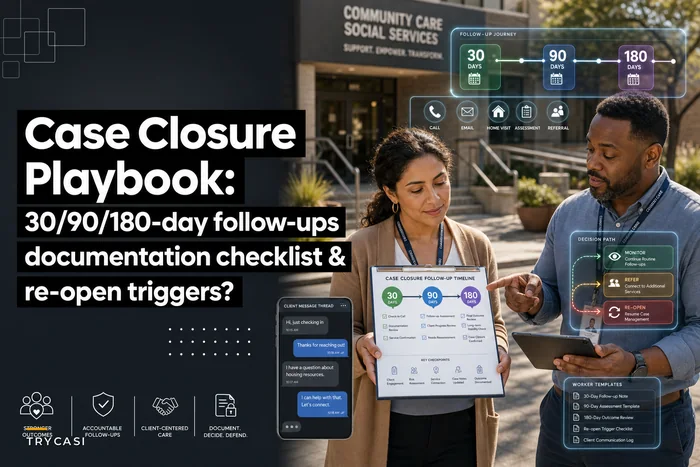
It's also not the right tool when the "failure" is really a slow drift — a client who's gradually disengaging, or a placement that's technically active but wobbling. Those belong in a different workflow, closer to structured follow-up. If a case is winding down or approaching stability, the checkpoints in a case closure playbook with 30/90/180-day follow-ups fit better than an emergency conference.
Who should skip this entirely: solo caseworkers with no partner network and no backup inventory. The template assumes you have at least a fallback option and someone with approval authority. If you don't, your bottleneck is capacity, not meeting structure — and a faster meeting won't fix an empty pipeline.
Keeping the template alive after the first month
The honest failure mode here isn't the design of the template — it's that teams use it for two weeks and then drift back to unstructured huddles.
A few things keep it sticky. Keep the one-page grid physically or digitally in front of people during the call, so the structure is impossible to ignore. Store the partner scripts somewhere staff can grab them in seconds — friction is what kills good scripts. And once a month, take a quick look at re-placement times. If they're creeping back up, it usually means the "kill or confirm at 24 hours" rule has quietly slipped, and that one rule tends to carry most of the speed.
None of this requires new software or a big process overhaul. It's a small template, a hard deadline, and the willingness to tell a partner the truth quickly. When a placement fails — and they will — that combination is what turns a two-week scramble into a two-day fix.
Ready to transform your social services workflow?
Join 500+ agencies using TryCasi to improve case outcomes, enhance collaboration, and reduce administrative burden.