


The domestic violence call comes in at 2:47 AM. Emergency placement needed. Safety plan required. Multiple agencies involved. Your caseworker has maybe twelve minutes to document everything before the next crisis hits.
Most crisis documentation templates run eight pages minimum. They ask for narrative descriptions, detailed timelines, comprehensive assessments. Meanwhile, your worker is standing in a hospital corridor trying to capture critical safety information on their phone while coordinating with police, finding emergency shelter, and keeping the client calm.
That disconnect creates dangerous gaps. Workers skip fields. Critical safety steps get missed. Follow-up falls through the cracks. Post-crisis audits become guessing games because the initial documentation was either incomplete or scattered across multiple systems.
The operational breakdown during crisis moments
Crisis documentation tends to fail at three predictable points. During the actual crisis, when workers need to capture immediate safety concerns but get stuck in lengthy forms. In the 24-48 hours after, when details fade but formal reports aren't due yet. And during post-crisis review, when supervisors can't verify whether safety protocols were actually followed.
Take a typical mental health crisis response. The worker arrives on scene. Client is experiencing acute psychosis. Family members are present. Police are involved. The worker needs to document:
-
Immediate safety assessment
-
Danger to self or others
-
Current medications and compliance
-
Support system present
-
Environmental hazards
-
De-escalation attempts
-
Transport decision
-
Receiving facility notification
Standard documentation has these elements scattered across intake forms, risk assessments, incident reports, and case notes. By the time everything gets entered, critical details are lost or contradicted across documents.
The verification problem compounds it further. A week later, reviewing the case, supervisors can't confirm whether specific safety steps actually happened. Did someone contact the psychiatrist? Was the medication list verified with the pharmacy? Did the family receive crisis resources? The documentation might reference these steps, but there's no clear trail connecting any of it.
Why traditional crisis forms miss the mark
Most agencies inherit their crisis documentation from state requirements, accreditation standards, or risk management protocols designed around lawsuits, not operations. These forms prioritize comprehensive narrative over actionable information. They're built for liability coverage, not safety verification.
Eliminate case management chaos.
TryCasi helps you organize, monitor, and report on every case efficiently and securely.
- Centralized case tracking
- Automated client notifications
- Team task coordination
No credit card required
One mental health agency tracked their crisis documentation workflow closely. Average time to complete standard crisis paperwork: 47 minutes. Average time actually available during a crisis: around 8 minutes. The math doesn't work.
Workers adapt by creating their own shortcuts. Sticky notes. Personal notebooks. Voice memos. Text messages to themselves. The information exists somewhere, just scattered across unofficial channels. When something goes wrong and a state reviewer shows up, none of that counts.
The legal team wants everything documented. Operations needs workers focused on safety. Quality requires verification steps. The worker just wants to help the client without drowning in paperwork. The crisis response documentation template ends up as a battlefield between competing priorities, and nobody really wins.
Building a minimal viable crisis form
More fields and better training aren't the answer. Radical simplification is. One page. Essential elements only. Clear verification steps.
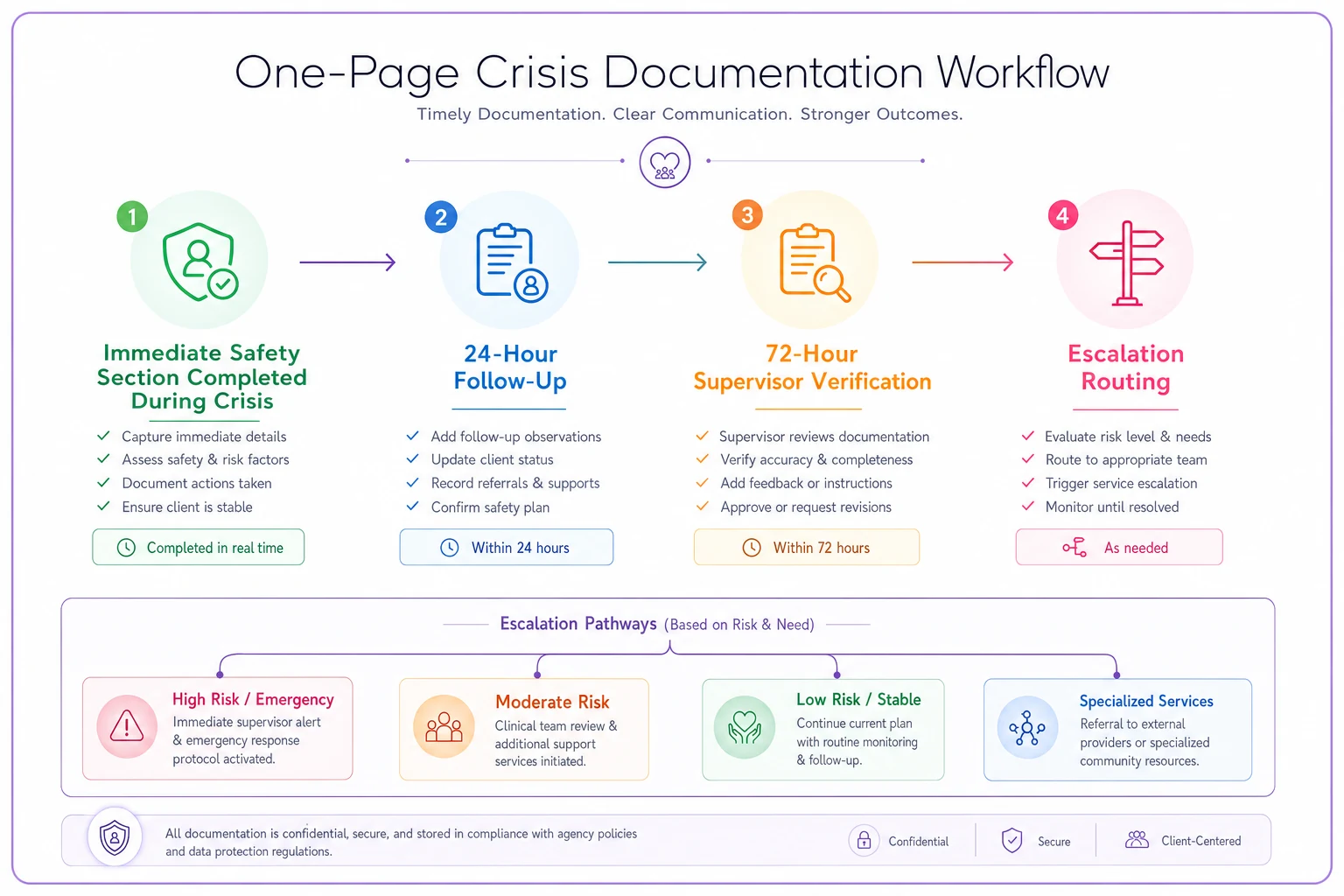
This diagram shows the simple three-step workflow for the one-page form.
Here's what actually works:
Immediate Safety Section (complete during crisis)
-
Client identifier (name/ID)
-
Date/time/location
-
Presenting crisis (one line)
-
Immediate danger
Yes/No - To self? Y/N - To others? Y/N - From others? Y/N
-
Safety interventions taken (checkboxes)
- [ ] Removed weapons/means - [ ] Separated parties - [ ] Called emergency services - [ ] Administered medication - [ ] Applied restraints - [ ] Other: _
-
Current location of client
-
Worker name and contact
That's it for the crisis moment. No narratives. No assessments. Just safety facts.
24-Hour Follow-Up Section (complete next day)
-
Client status
- [ ] Hospitalized (facility: __) - [ ] Released home - [ ] Placed in shelter/facility - [ ] Whereabouts unknown - [ ] Deceased
-
Safety plan created
Y/N - Documented where: __
-
Medications verified
Y/N - With whom: __
-
Support system contacted
Y/N - Who: __
-
Follow-up appointment scheduled
Y/N - When: __
72-Hour Verification Section (supervisor completes)
-
Safety plan reviewed
Y/N
-
Medications confirmed
Y/N
-
Support system engaged
Y/N
-
Services connected
Y/N
-
Risk factors addressed
Y/N
-
Next review date
__
Each section takes under five minutes. The whole form fits on one page or one mobile screen.
The audit trail that actually functions
Post-crisis audits usually fail because they're retrospective investigations rather than built-in verifications. The minimal form embeds audit steps directly into the workflow itself.
Within 24 hours, a different worker or supervisor must verify the follow-up section. They can't just check boxes — they need to document specifics: which facility, whose prescription, what appointment. That creates natural quality control without bolting on a separate audit process.
The 72-hour verification forces another touchpoint. Someone besides the crisis worker must confirm that safety elements are actually in place. Not "safety plan discussed" but "safety plan documented in file." Not "medications addressed" but "prescription filled per pharmacy confirmation."
A homeless services agency tested this with their street outreach team. Crisis encounters previously generated three or four different reports taking 30-45 minutes total. The one-page form captured the same safety information in under ten minutes. More importantly, their post-crisis follow-through improved by roughly 40% because the verification steps were built into the form itself, not tacked on as an afterthought.
Operational patterns that support minimal documentation
The form only works if surrounding operations support it. You need clear protocols for what happens after each section gets completed.
Immediate routing:
-
Crisis section completed → automatically alerts supervisor
-
24-hour section due → reminder sent to assigned worker
-
72-hour verification due → escalates if not completed
Information flow:
-
Crisis documentation should feed directly into
-
- Safety plans
-
- Risk assessments
-
- Treatment planning
-
- Supervision reviews
-
- Incident analysis
Don't make workers re-enter the same crisis information into multiple systems. The one-page form should populate other required documentation where possible.
Training focus:
-
Instead of training on comprehensive documentation, focus on
-
- Recognizing the essential safety elements
-
- Using verification checkpoints
-
- Escalating when verification fails
-
- Converting crisis data into ongoing treatment
Workers need maybe 30 minutes of training on the form itself. The real training investment goes into the surrounding workflows.
Common implementation failures
The minimalist approach breaks down when agencies try to add "just one more field." The elder care agency that turned the one-page form into three pages because they wanted detailed medical history. The child welfare team that added narrative sections for court documentation. The substance abuse program that required detailed relapse triggers during crisis.
Every addition seems reasonable in isolation. Medical history matters. Courts need narratives. Relapse triggers inform treatment. But crisis documentation serves a different purpose than comprehensive assessment, and mixing those objectives destroys the tool's effectiveness.
Another failure pattern: implementing the form without changing verification workflows. If supervisors don't actually complete the 72-hour verification, if the 24-hour follow-up stays optional, if there's no consequence for incomplete sections, you've just created a shorter form that still doesn't get filled out properly.
The technology trap catches agencies too. They want the form integrated into their case management system, which takes months. They want automated workflows, which requires IT approval. They want electronic signatures, which needs a security review. Meanwhile, workers keep struggling with existing documentation. Start with paper or a basic digital form. Prove the concept. Then integrate technology.
Measuring what matters in crisis response
How do you know if minimal crisis documentation actually improves safety? Track these metrics:
| Metric Category | What to Measure |
|---|---|
| Completion rates | % of crisis encounters with documentation completed, 24-hour and 72-hour follow-up rates |
| Time metrics | Minutes from crisis to documentation, days to complete full audit cycle, weekly crisis paperwork hours |
| Safety outcomes | Re-crisis within 30 days, safety plan implementation rate, medication compliance post-crisis, support system engagement |
A community mental health center tracking these metrics saw their re-crisis rate drop from 34% to 22% within 90 days of implementing minimal documentation. Not because the form was magical, but because workers could focus on safety interventions rather than paperwork, and because the built-in verifications caught gaps before they turned into repeated crises.
Real scenario: Youth crisis team implementation
A youth mobile crisis team serving three counties faced escalating documentation requirements after a critical incident. Their existing process required:
-
Initial crisis assessment form (4 pages)
-
Risk evaluation tool (2 pages)
-
Safety plan template (3 pages)
-
Incident report (2 pages)
-
Supervisor review form (1 page)
Average documentation time per crisis: 55 minutes. With 8-10 crisis calls per shift, workers were spending more time writing than intervening.
They piloted the one-page crisis form with half their team for 60 days. Results:
-
Documentation time dropped to 12 minutes average
-
24-hour follow-up completion went from 60% to 95%
-
72-hour verification caught 18 safety gaps that would have been missed
-
Worker overtime decreased by roughly $3,400 monthly
-
No increase in critical incidents or complaints
The key wasn't just the shorter form. The built-in verification steps meant supervisors caught issues like medications not being restarted, families not receiving crisis numbers, and safety plans not being documented in the primary record. These gaps existed before — they were just hidden inside incomplete documentation.
Technology considerations for crisis workflows
Paper forms work fine for initial implementation, but operational software can shift crisis documentation from a compliance burden into an actual safety tool. The right platform can auto-populate client identifiers, timestamp entries automatically, route forms for verification, and trigger alerts when follow-ups are missed.
Auto-populate what you can.
Resist the temptation to over-engineer it. One youth services agency spent six months customizing their case management system for crisis documentation, adding fields for every possible scenario. Workers reverted to paper because the digital form took too long to load and navigate during an actual crisis.
A better approach: keep the digital version as minimal as the paper form. Use technology for routing and verification, not for collecting more data. Auto-populate what you can. Make mobile-responsive forms that work on phones in hospital corridors. Build in offline capability for areas with poor connectivity.
The verification workflow particularly benefits from AI-assisted automation. Instead of hoping supervisors remember to check 72-hour verifications, the platform can queue those tasks automatically, escalate if missed, and track completion rates without manual oversight — which removes a whole category of follow-up that currently falls on already-stretched supervisors.
Integration with existing documentation
The minimal crisis form doesn't replace all documentation requirements. Detailed assessments, comprehensive treatment plans, and formal reports still have their place. The crisis response documentation template works as the foundation that feeds those other documents.
Think of it as operational triage. The one-page form captures what matters in the moment and immediately after. Then, when the crisis stabilizes, workers can complete comprehensive documentation using the verified information from the crisis form as their starting point.
This prevents the common problem where crisis narratives written days later contradict what actually happened. The minimal form gives you a factual anchor that everything else builds on.
When minimal documentation makes sense (and when it doesn't)
This approach works best for:
-
Mobile crisis teams
-
Emergency response social workers
-
After-hours crisis coverage
-
Hospital social workers
-
Shelter intake during crisis
-
Police co-response teams
It's less appropriate for:
-
Planned interventions
-
Comprehensive assessments
-
Court-ordered evaluations
-
Formal incident investigations
-
Clinical treatment documentation
The distinction matters. Don't force minimal documentation into situations that require detailed analysis. But equally, don't burden crisis response with comprehensive documentation requirements that compromise the actual safety work.
Moving from concept to implementation
Start with a pilot. Choose one team or one shift. Run the minimal form alongside existing documentation for 30 days. Track what matters: completion rates, time savings, safety outcomes, and verification success.
Expect pushback from multiple directions. Quality assurance will worry about compliance. Legal will fear liability. Supervisors might resist the added verification responsibilities. Workers might distrust anything that looks like more oversight.
Address those concerns with data, not arguments. Show that verification catches safety gaps. Demonstrate that minimal documentation actually increases compliance because workers complete it. Prove that focused safety information serves legal protection better than incomplete comprehensive forms.
The one-page form won't capture every detail or satisfy every stakeholder. But it will ensure that during those critical moments when safety hangs in the balance, workers can document what matters and verify that clients actually get the help they need. The gap between crisis reality and documentation requirements doesn't have to exist — and with the right crisis response documentation template, minimal, focused, and verification-driven, agencies can protect both clients and workers while building a foundation for effective post-crisis care.
Ready to transform your social services workflow?
Join 500+ agencies using TryCasi to improve case outcomes, enhance collaboration, and reduce administrative burden.