


You've got a client who needs housing assistance, mental health support, and food security services. Three partner agencies are ready to help. The referral forms get sent. Then nothing happens for two weeks.
The housing agency says they never got complete information. Mental health claims they're waiting on consent forms. Food security processed everything but the client never showed up because nobody told them when to come. Your client falls through every crack in the system. This isn't about bad agencies or lazy caseworkers. It's about operational gaps that kill momentum when clients need help most. After watching hundreds of referral processes across community organizations, the pattern is obvious: agencies lose clients during handoffs because nobody agreed on what information moves, when it moves, or who confirms receipt.
Why partner agencies drop the ball (and it's not their fault)
Most social service agencies are running referral processes built for a different era. Paper forms, faxed documents, phone tag between caseworkers. The average handoff involves at least four different communication methods and zero standardization.
What typically happens: Agency A sends whatever fields they think matter. Agency B needs different fields. Agency C has their own intake form that duplicates 70% of what's already been collected. Everyone's working hard, but the client experiences a maze of redundant questions, conflicting appointments, and dropped connections.
The worst part is that each agency thinks they're being thorough. Housing wants income verification going back 90 days. Mental health needs a specific diagnostic code. Food security requires proof of residence. Without a shared protocol, every referral becomes a game of telephone where critical information gets lost or just delayed indefinitely.
Smaller community organizations feel this the hardest. Unlike large hospital systems with dedicated referral coordinators, they rely on frontline workers juggling 30+ cases at once. When a referral requires three follow-up calls, two emails, and a faxed form, it's not happening reliably. That's just reality.
Mandatory fields that actually prevent dropped referrals
After looking at referral failures across multiple agencies, certain fields consistently determine whether a handoff succeeds or falls apart:
Eliminate case management chaos.
TryCasi helps you organize, monitor, and report on every case efficiently and securely.
- Centralized case tracking
- Automated client notifications
- Team task coordination
No credit card required
Core Client Information
-
Legal name and preferred name
-
Date of birth (not just age)
-
Primary language and interpretation needs
-
Best contact method with a backup option
-
Safe times to contact
Referral Context
-
Primary need in one sentence
-
Timeline urgency (immediate/routine/preventive)
-
Previous attempts at this service
-
Current case manager name and direct line
-
Client awareness and consent status
Service Requirements
-
Specific services requested (not general categories)
-
Known barriers (transportation, childcare, work schedule)
-
Documentation client already has
-
Documentation still needed
-
Mobility or accessibility requirements
Most agencies ask for way more than this. Income history, family composition, medical records, housing history. That comprehensive data has its place, but not in the initial handoff. The goal is getting the client connected — not completing their entire assessment before they walk through the door.
One mental health clinic cut their referral abandonment rate from 45% down to around 12% by reducing required fields from 47 to roughly these 15 core items. Clients could fill in the rest at their first appointment instead of having referrals stall waiting on paperwork.
Timeline protocols that keep momentum
Timing kills more referrals than missing information does. Without clear deadlines, referrals sit in limbo while clients lose hope and stability.
The 24-48-72 Rule
-
Within 24 hours
Receiving agency confirms receipt and reviews for completeness
-
Within 48 hours
Initial client contact attempt with appointment options
-
Within 72 hours
Referring agency receives a status update
That might sound aggressive until you think about what the alternative looks like. A domestic violence survivor waiting two weeks for transitional housing intake. A family with empty cupboards waiting ten days to get enrolled in food assistance. An elderly client's medication running out while mental health services process paperwork.
Escalation Triggers
-
No acknowledgment at 24 hours → Referring worker calls directly
-
No client contact at 72 hours → Supervisor-to-supervisor conversation
-
No service connection at 7 days → Case conference required
The key is making these timelines operational policy, not suggestions. One regional coalition implemented automated reminders that flag overdue referrals. Their average connection time dropped from 11 days to 4 days — not because workers suddenly cared more, but because the system made delays visible and impossible to ignore.
Confirmation loops that close the feedback gap
The black hole problem happens when sending agencies never find out what happened to their clients. Did they connect? Get services? Drop out? Without feedback loops, agencies keep referring into the void.
Three-Point Confirmation
-
Receipt confirmation (within 24 hours) "We received John Smith's referral on [date]. Sarah Johnson is the assigned worker. She'll attempt contact by [date]."
-
Connection confirmation (within 72 hours) "Contact successful/unsuccessful. Appointment scheduled for [date] / Unable to reach, will retry [date]."
-
Outcome confirmation (within 14 days) "Client engaged with services / Client declined services / Client did not attend, case closed."
Simple? Yes. Commonly done? Almost never.
A food bank network implemented this three-point system across 12 partner agencies. Within three months, they found out 30% of their referrals were going to wrong locations because of address confusion. They'd been losing clients for years without knowing why. A basic confirmation loop caught it.
Bi-directional responsibility
-
Warm handoff when possible (three-way call or joint meeting)
-
Client prep about what to expect
-
Follow-up if no confirmation comes back
-
Check-in with the client after the referral goes out
A solid referral handoff protocol makes both agencies accountable for the connection — not just the moment the form gets sent.
Sample forms that actually work in practice
Frontline workers need concrete tools. Here's a referral form structure that's been tested across multiple agency types:
Section 1: Quick Scan (top of form)
| Field | Value/Options |
|---|---|
| URGENT? | □ Yes □ No |
| Safety concern? | □ Yes □ No |
| Today's date: | _ |
| Referral expires: | _ |
Section 2: Basic Info
| Field | Value/Options |
|---|---|
| Client name: | _ |
| DOB: | _ |
| Phone: | _ |
| Safe to call? | □ Yes □ No □ Specific times: _ |
| Preferred language: | _ |
Section 3: Referral Specifics
| Field | Value/Options |
|---|---|
| Service needed: | [Checkbox list of specific services] |
| One-sentence need: | _ |
| Appointment flexibility: | □ Mornings □ Afternoons □ Evenings □ Weekends |
| Transportation: | □ Has own □ Needs bus pass □ Needs ride service |
Section 4: Handoff Details
| Field | Value/Options |
|---|---|
| Referring worker: | _ |
| Direct line: | _ |
| Email: | _ |
| Client knows about referral? | □ Yes □ No |
| Client wants service? | □ Yes □ Unsure □ Exploring options |
Notice what's not there: lengthy narratives, comprehensive histories, subjective assessments. Those belong in case files, not referral forms.
Building confirmation workflows into daily operations
The hardest part about implementing a protocol isn't designing it — it's making it stick when everyone's overwhelmed.
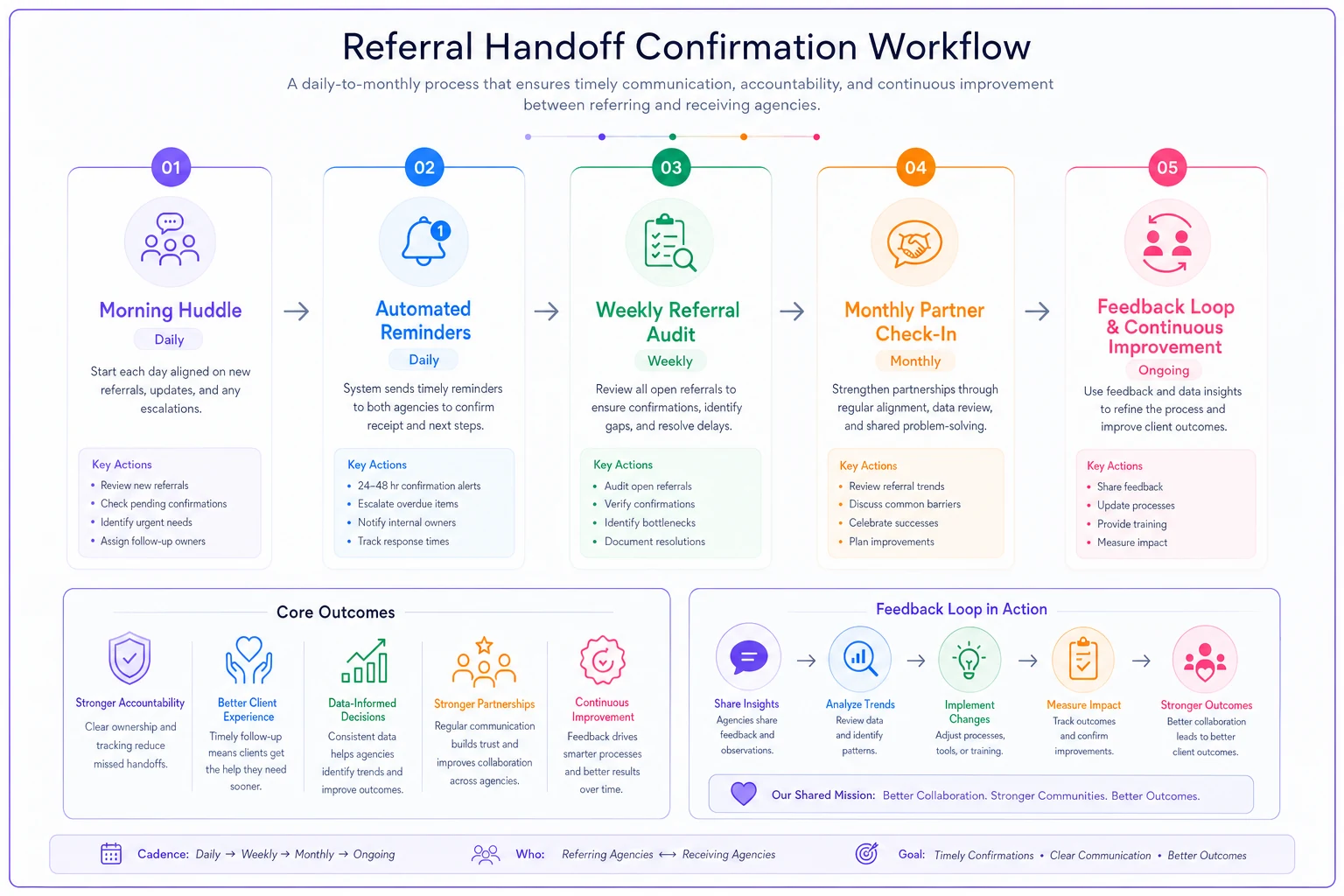
Morning huddle integration
-
Two minutes, that's it
-
- New referrals received yesterday
-
- Overdue confirmations needed today
-
- Failed connections that need a retry
Weekly referral audit
-
Every Friday, roughly 15 minutes
-
- List all referrals sent that week
-
- Check confirmation status
-
- Flag missing feedback
-
- Send one bulk follow-up email
Monthly partner check-in
-
First Monday of the month
-
- Review referral success rates with each partner
-
- Identify pattern problems
-
- Adjust protocols based on actual failures — not assumptions
One mental health agency started tracking confirmations on a simple spreadsheet. Within two months, they found out their biggest partner had been receiving referrals at an old fax number. They'd been sending referrals nowhere for six months. A five-minute monthly check would have caught it immediately.
Quick visual of the daily/weekly/monthly confirmation workflow.
They'd been sending referrals nowhere for six months. A five-minute monthly check would have caught it immediately.
Tech solutions that reduce manual tracking
Manual tracking breaks down fast once you're managing 50+ active referrals across multiple partner agencies. Spreadsheets and sticky notes were never meant to handle that load.
Modern referral management platforms — including AI-powered operational tools — can automate the entire confirmation loop. Automatic acknowledgment emails when referrals come in. Scheduled reminders when confirmations are overdue. Dashboard views showing status across all partners. These aren't flashy features — they're basic workflow automation that eliminates the manual chase.
Some agencies have cobbled together decent solutions with existing tools. One coalition uses a shared Google Sheet with automatic email triggers. When someone marks a referral "sent," it emails the receiving agency automatically. If status isn't updated within 48 hours, both agencies get notified. Not sophisticated, but it cut their lost referral rate by around 60%.
For agencies ready for something more robust, AI-assisted operational platforms can identify patterns in failed referrals, flag referrals at risk of dropping out based on historical data, and help workers prioritize their time more effectively. The automation isn't making decisions — it's surfacing the right information at the right moment so workers can act on it.
Common protocol failures and their fixes
The "We'll call them" breakdown Agencies promise to contact clients directly but never specify when or how many attempts. Fix: Define exact outreach protocol — three attempts over five days using two different contact methods.
-
The consent confusion Referral sent without clear consent, receiving agency won't proceed. Fix: Include consent status on every referral with the date obtained and scope covered.
-
The wrong contact trap Referral has the office phone, client only answers their cell. Fix: Always collect two contact methods and best times to reach.
-
The service mismatch Client needs Service A, gets referred for Service B because the categories were vague. Fix: Use specific service names, not general buckets. "Sliding-scale therapy with CBT focus" not just "mental health services."
The documentation delay Referral stalls waiting for documents the client doesn't have. Fix: Separate "must have to start" from "can provide later."
Measuring whether your protocol actually works
Track three numbers:
-
Referral acknowledgment rate (should be >95%)
-
Client connection rate (should be >70%)
-
Service engagement rate (should be >50%)
If acknowledgment is low, the confirmation system is broken. If connection is low, the timelines are too long. If engagement is low, either the referrals are wrong or client prep is failing. A homeless services coalition tracked these metrics for six months. Their acknowledgment rate was 98% — solid. Connection rate was 71% — acceptable. But engagement sat at 31%, which was a real problem. Digging deeper, they found clients were connecting but showing up to three-hour waits and complex paperwork on arrival. They shifted to appointment-based intake and engagement jumped to 58%.
Making handoff protocols stick long-term
New protocols fail when they get layered on top of existing chaos. They succeed when they replace something worse. Instead of adding confirmation requirements to your current process, replace the process entirely.
Start with one partner agency. Get it working smoothly before expanding. Pick your most reliable partner first — early wins matter for building momentum. Keep the documentation simple. One-page protocol summary. One-page form. One-page tracking sheet. If it takes more than five minutes to understand, it won't be used consistently under pressure.
Train in pairs, not big groups. Have workers practice the protocol together. Pair experienced staff with newer workers. The goal is building real skill, not checking a training box. Review and adjust every quarter. Protocols that never change become irrelevant. Every three months: What's breaking? What's unnecessary? What's missing?
The compound effect of reliable handoffs
When referral handoffs actually work, the impact stacks up. Clients connect faster, which reduces crisis escalation. Workers spend less time chasing confirmations, which frees capacity for direct service. Agencies build trust with each other, which makes every future collaboration smoother.
The biggest impact, though, is on clients who've already been let down by systems before. When someone makes a referral and it actually goes somewhere — appointment scheduled, service connected, need addressed — it rebuilds the belief that asking for help is worth it.
The protocol here isn't perfect for every situation. Rural agencies might need longer timelines. Crisis services might need shorter ones. The specifics matter less than having a clear, shared agreement about how referrals move between partners.
Most agencies genuinely want to improve their referral processes. They just need a concrete starting point and some evidence it's worth the effort. The forms, timelines, and confirmation loops described here have been tested and adjusted across dozens of implementations. They work because they're simple enough to follow on a busy Thursday afternoon and comprehensive enough to prevent the most common failures.
Your referral handoff protocol for social services doesn't need to be complex. It needs to be clear, consistent, and confirmed. Start with one partner, track the basics, and build from there. The clients who make it through because of that protocol will be worth every operational adjustment required.
Ready to transform your social services workflow?
Join 500+ agencies using TryCasi to improve case outcomes, enhance collaboration, and reduce administrative burden.