

Most social-service teams don't have a learning problem. They have a memory problem.
Something goes wrong — a client falls through a referral gap, a home visit gets scheduled during a family's court date, a data field gets entered three different ways by three different caseworkers. Someone notices. Maybe it even gets discussed in supervision. And then the caseload moves on, the person who noticed leaves eighteen months later, and the same thing happens again to a different family.
That's the real failure mode. Not a lack of good ideas. A lack of any system that captures what the team already figured out and turns it into something the next person can actually use.
Organizational learning in social services isn't about training days or annual reflection retreats. It's the plumbing connecting "we noticed a problem" to "we tried a fix" to "we wrote down what worked so nobody has to rediscover it." When that plumbing is missing, every improvement dies with the person who thought of it.
This is a walkthrough of how that system breaks, and how to build one that survives turnover, caseload spikes, and the general chaos of frontline work.
Where the learning actually leaks out
Let me trace how a typical improvement gets lost, because the failure is rarely dramatic. It's a slow leak.
A caseworker notices that families referred to the housing partner keep getting bounced back for missing income documentation. She mentions it to her supervisor. The supervisor agrees it's annoying and says she'll "flag it." Two weeks later the supervisor is buried in a licensing audit and forgets. The caseworker, meanwhile, has started quietly collecting the income docs herself before referring — a genuinely good workaround — but she never tells anyone because it just became part of how she works.
Six months later she transfers to another unit. Her replacement doesn't collect the docs upfront. The bounce-backs start again. Nobody connects it to the earlier problem because there's no record it was ever a problem.
That's three separate leaks in one story:
-
The observation leaked — it was verbal, so it depended on one person's memory during a busy week.
-
The fix leaked — it lived in one person's head as a habit, never documented.
-
The pattern leaked — because neither the problem nor the fix was recorded, the recurrence looked brand new.
The informal "we just tell each other" method works fine at 4–5 people and collapses somewhere around 12–15. And the point where verbal knowledge stops scaling is usually the same point where nobody has noticed it stopped, because it degrades gradually.
The four pieces a learning system actually needs
You don't need a fancy framework. You need four connected pieces, and the connections matter more than the pieces themselves.
Eliminate case management chaos.
TryCasi helps you organize, monitor, and report on every case efficiently and securely.
- Centralized case tracking
- Automated client notifications
- Team task coordination
No credit card required
-
A way to run small experiments so a fix is tested, not just guessed at.
-
A way to convert incidents into decisions so bad events produce changes instead of blame.
-
A place to store what you learned so it outlives the person who learned it.
-
Clear ownership so someone is actually responsible for each piece moving.
Skip any one and the whole thing rots. A knowledge repo with no ownership becomes a graveyard of half-finished documents. Experiments with nowhere to store results become forgotten spreadsheets. Incident reviews with no repo turn into venting sessions.
Each piece below is meant to be something you can run on Monday, not a theoretical model.
PDSA that a caseworker will actually fill out
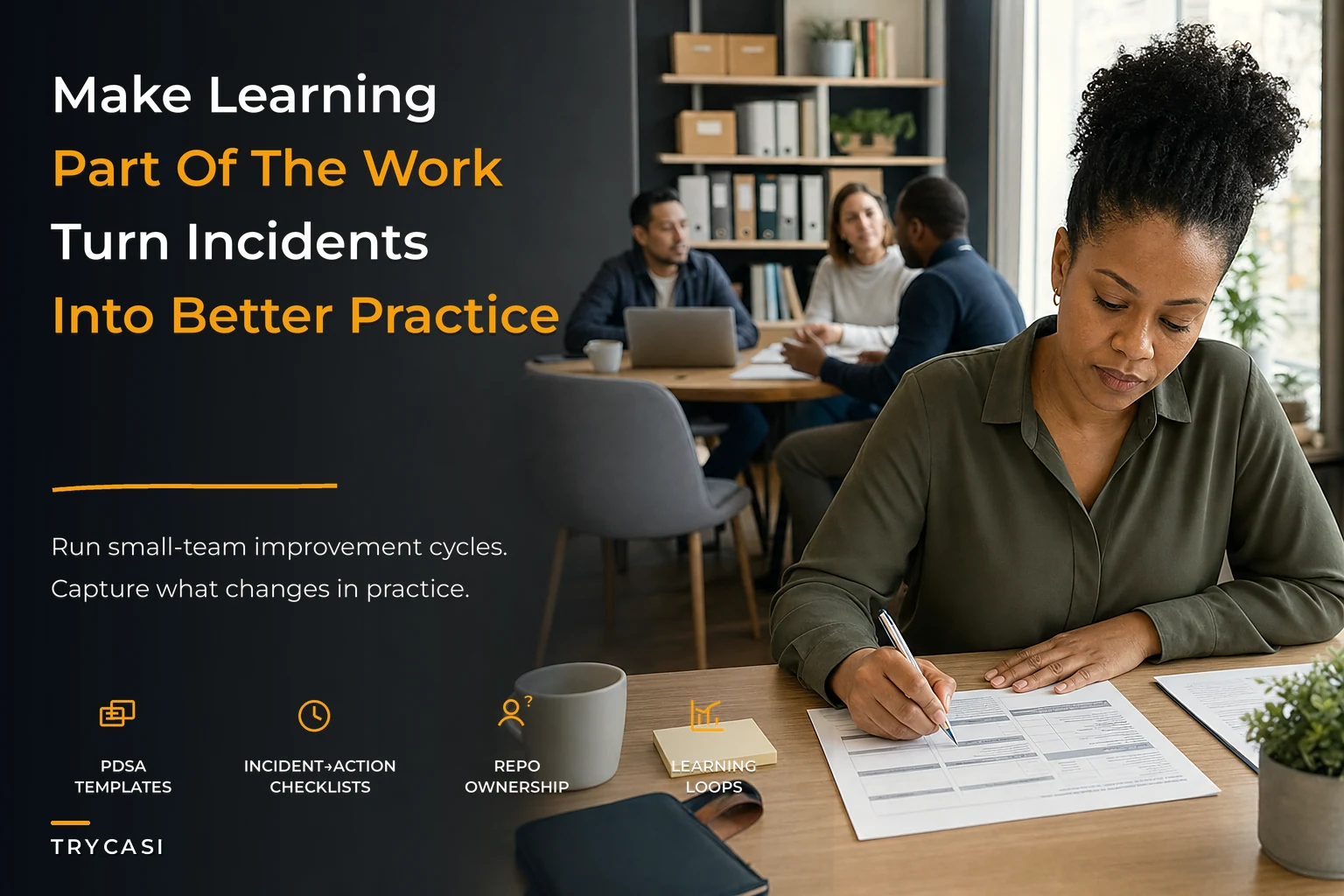
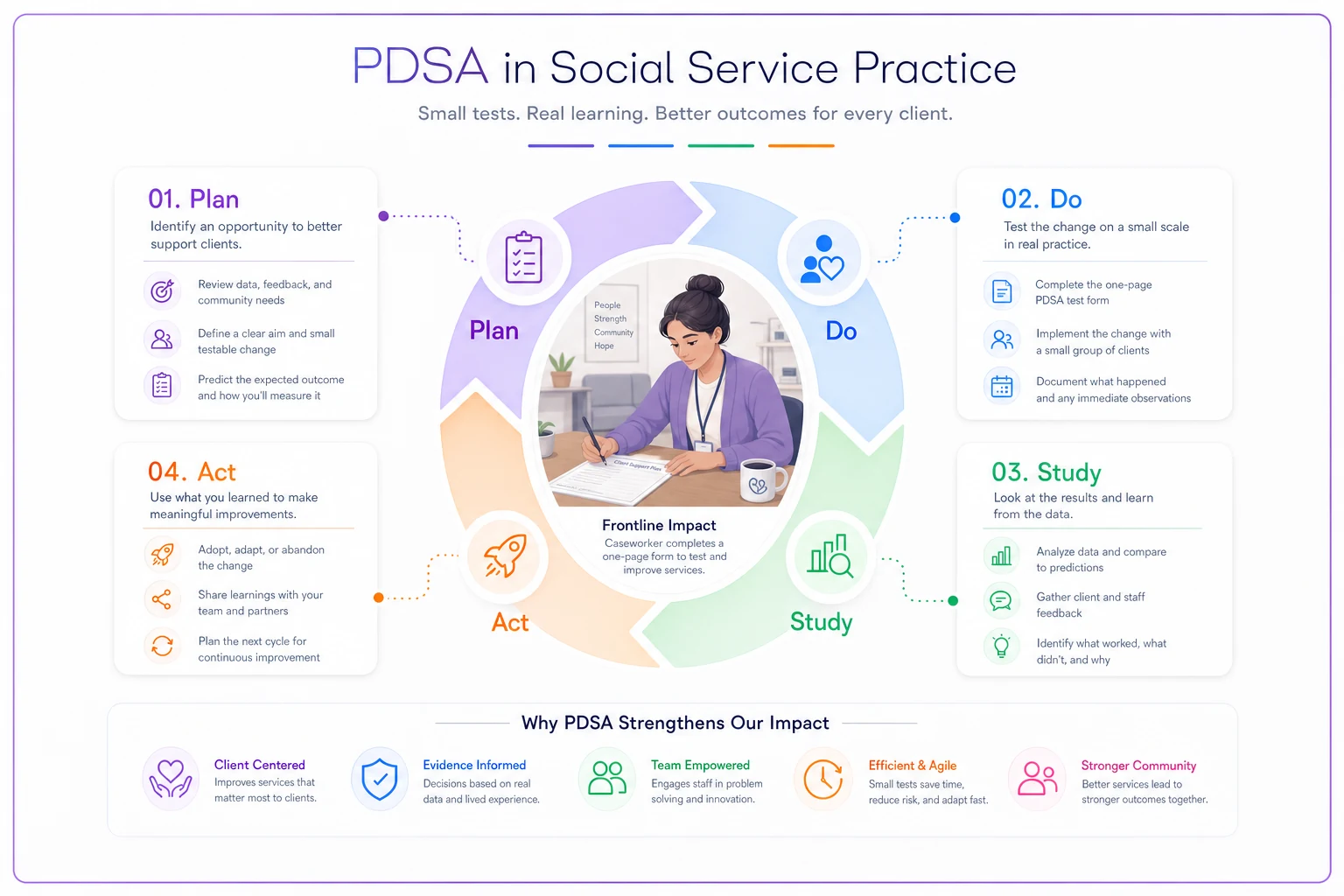
Plan-Do-Study-Act gets a bad reputation in social services because it usually arrives dressed up as a quality-improvement bureaucracy nobody has time for. The trick is stripping it down until a caseworker can complete one on a single page in about ten minutes.
Here's the field-ready version:
Plan
-
What's the specific problem, in one sentence? (Not "communication issues" — "families miss the first housing appointment about a third of the time.")
-
What one change are we trying?
-
What do we expect to happen?
-
How will we know? (Pick one number you can actually count.)
Do
-
Who tried it, with how many cases, over what window?
Study
-
What actually happened vs. what we expected?
-
What surprised us?
Act
-
Keep it, kill it, or tweak and rerun?
Scope a PDSA to a small, specific sample so it's quick to run and yields actionable evidence.
The most common mistake is scoping too big. A team decides to "fix intake." That's not a PDSA, that's a strategic plan. A real PDSA is: "For the next 15 intakes, we'll send a reminder text 24 hours before the appointment and see if the no-show rate moves." Small, cheap, reversible. If it fails you've lost nothing. If it works you've got evidence, not an opinion.
A typical example: a team running roughly 40 new intakes a month suspected their consent paperwork was the reason first appointments ran long. Instead of overhauling the process, they tested a pre-filled consent packet on the next 20 intakes. Appointment length dropped by about 12–15 minutes on average. That's a keep. It took one caseworker, two weeks, and a single page of documentation.
A quick visual of the PDSA flow:
A typical example: a team running roughly 40 new intakes a month suspected their consent paperwork was the reason first appointments ran long. Instead of overhauling the process, they tested a pre-filled consent packet on the next 20 intakes. Appointment length dropped by about 12–15 minutes on average. That's a keep. It took one caseworker, two weeks, and a single page of documentation.
Incident → action one-pagers
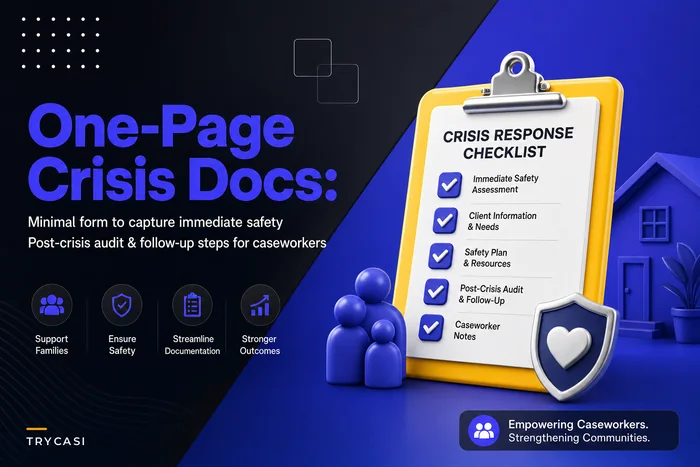
Crisis documentation is its own discipline — capturing safety and immediate next steps in the moment is a different job, and there's a good breakdown of that in the one-page crisis documentation and post-crisis audit approach. What I'm talking about here is what happens after the dust settles: turning the incident into an organizational change instead of a personnel issue.
The failure pattern is predictable. An incident happens, there's an emotional debrief, someone gets implicitly blamed, everyone feels bad, and no process changes. The next person makes the same mistake under the same conditions and everyone acts surprised.
The one-pager fixes this by forcing the conversation away from "who" and toward "what in the system allowed this."
Incident → Action one-pager fields:
-
What happened (facts only, no interpretation)
-
What conditions made it possible (staffing, tools, unclear handoff, missing info)
-
What we're changing as a result
-
Who owns the change
-
When we'll check if it worked
-
Where this is stored so it's findable later
The single most important field is "conditions that made it possible." A worker missing a mandatory check-in isn't usually a discipline problem — it's usually a caseload problem, a calendar problem, or a handoff problem. Once you name the condition, the fix becomes obvious and reusable. When you name the person, you get a one-time apology and a guaranteed repeat.
One pattern worth naming: teams that store incident one-pagers in the same place as their PDSA results start noticing that certain incidents keep pointing at the same underlying condition. Three separate "missed handoff" incidents in a quarter isn't three mistakes — it's one broken handoff process asking to be redesigned. You only see that if the records live together.
The knowledge repo: keep it embarrassingly simple
This is where most teams overthink it and end up with nothing. They spend two months debating the perfect wiki tool, never agree, and default back to shared drives full of files named intakeprocessFINALv3USETHISONE.docx.
A working repo for a small-to-mid team needs exactly four sections:
| Section | What lives here | Update trigger |
|---|---|---|
| How we do things | Current SOPs and workflows | When a PDSA gets a "keep" |
| What we tried | PDSA results, both wins and failures | End of each experiment |
| What went wrong | Incident one-pagers and their fixes | After each incident review |
| Who owns what | Roles, decision rights, review dates | When roles change |
Notice that failed experiments get their own visible home. That's deliberate. Most teams only record wins, which means someone re-runs a failed experiment every couple of years because there's no record it already flopped. Documenting what didn't work is often higher-value than documenting what did — it saves the team from repeating expensive dead ends.
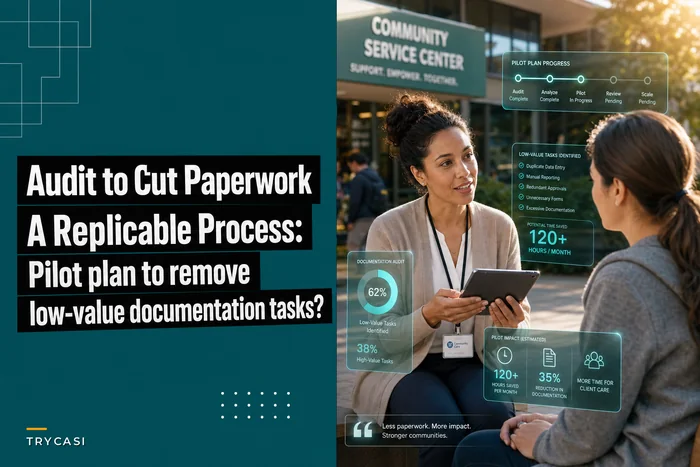
The other discipline that keeps a repo alive: every document has an owner name and a "last reviewed" date at the top. No owner, no trust. A workflow doc nobody has touched in three years is worse than no doc, because people follow it assuming it's current. When you're doing the periodic work of trimming low-value documentation — and the audit-to-cut-paperwork process is a solid method for that — stale repo docs are exactly the kind of thing you want to catch and either update or delete.
The repo only works if it's maintained. A quarterly sweep to confirm owners are current and pull dead documents is worth more than any structural decision you make about the tool itself.
Governance without a bureaucracy
"Governance" sounds heavy for a 20-person agency. It isn't. It just means three questions have clear answers: who can propose a change, who can approve it, and who maintains the record.
For a small-to-mid team, four lightweight roles cover it:
-
Contributor — any frontline staff member. Can file a PDSA or an incident one-pager. This should be everybody. If only supervisors can propose improvements, you've cut off the people who actually see the problems.
-
Reviewer — usually a supervisor. Decides whether a proposed change becomes an official SOP or needs another test cycle.
-
Repo owner — one named person responsible for the knowledge repo staying organized and current. Often part of an existing admin or QA role, not a new hire.
-
Sponsor — a leadership person who protects the time for this work. Without them, learning cadences get cancelled the first busy week and never come back.
The sponsor role is the one people skip and the one that decides whether any of this survives. Learning work has no external deadline, so it loses every scheduling fight against court dates, audits, and crises unless someone with authority defends the calendar space.
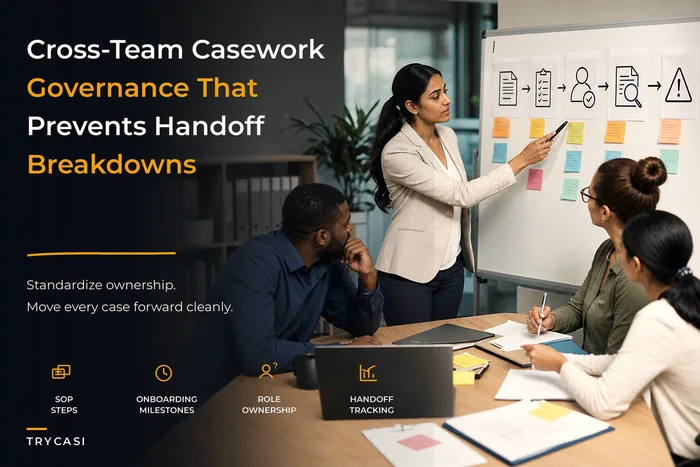
This connects to broader casework governance — the same clarity you'd want in a cross-team casework governance playbook around SOPs and handoff ownership applies here. A learning system is really just governance pointed at improvement instead of daily operations.
Meeting cadences that produce decisions, not discussion
The whole system runs on rhythm. Three cadences, each with a distinct job:
-
Weekly (15 minutes, within existing team meeting) One standing question — "anything worth an incident one-pager or a small experiment this week?" Not a full review. Just a catch so observations don't leak out during a busy week the way they did in the housing story earlier.
-
Monthly (45 minutes) Review open PDSAs, close finished ones, review any incident one-pagers, and decide what becomes an SOP. This is the decision meeting. Every item leaves with a status: keep, kill, rerun, or escalate. No item is allowed to "stay open" without a next action and a date.
-
Quarterly (90 minutes) Pattern review. Look across the quarter's incidents and experiments for repeating conditions. This is where you catch the "three missed handoffs = one broken process" signal. Retire stale repo docs. Confirm owners.
The mistake that kills cadences is letting the monthly meeting become a status update instead of a decision meeting. If people leave saying "we talked about it," you've built a discussion habit, not a learning system. Every meeting should end with fewer open items than it started with, or at least a clear reason why something's still open.
Where tooling actually helps
None of this requires software. Plenty of teams run it on a shared drive and a recurring calendar invite, and that's genuinely fine at smaller scale.
Where it starts to strain is around coordination — remembering which PDSAs are still open, making sure incident one-pagers actually link to the case they came from, surfacing the pattern that three incidents share a root cause. That's manual work, and manual coordination is exactly what erodes first when the caseload spikes.
This is where an operational platform earns its place — not by replacing the thinking, but by handling the remembering. When your case management system can attach an incident one-pager to the actual case record, tag experiments by theme, and flag when related incidents pile up in a quarter, the pattern-spotting stops depending on one sharp person noticing. AI-assisted features that cluster similar incidents or nudge you when a PDSA has sat open for six weeks take the administrative drag off the repo owner so the learning cadence doesn't collapse under its own paperwork.
The point isn't automation for its own sake. It's that the system keeps running on a bad week, which is exactly when learning usually stops.
When this makes sense — and when it doesn't
Worth building if:
-
You're past roughly 10–12 staff and verbal knowledge-sharing is visibly failing
-
You've had the same problem recur after someone left
-
Turnover is real and institutional memory keeps walking out the door
Probably overkill if:
-
You're a 4-person team where everyone genuinely knows everything
-
You're in the middle of an acute crisis surge — stabilize first, build the learning system after
Who should not start here: teams without a sponsor willing to protect meeting time. Building templates and a repo without protected time produces a beautiful, empty system that everyone ignores by month two. Get the calendar commitment before you get the templates.
A real scenario
A mid-sized family-services agency — about 18 caseworkers across three units — kept hitting the same wall: referrals to their two main partner agencies bounced back roughly a quarter of the time, usually for incomplete documentation. Everyone knew it was a problem. Nobody owned fixing it.
They started small. One incident one-pager per bounce-back for a month. By the end they had around a dozen documented, and the "conditions" field on almost all of them pointed at the same thing: the required-fields list for each partner lived in nobody's head consistently. Different workers assumed different requirements.
The fix wasn't dramatic — a one-page required-fields checklist per partner, stored in the repo, owned by the intake lead. They ran it as a PDSA on the next batch of referrals. Bounce-backs dropped to somewhere around 8–10%. Not perfect, but a clear, documented, reusable win.
The part that mattered most came later. When the intake lead left about eight months on, her replacement inherited the checklist and the reasoning behind it in the repo. The knowledge didn't leave with her. That's the whole point — not the checklist itself, but that the checklist survived the person who made it.
The real takeaway
Organizational learning in social services fails quietly. There's rarely a dramatic collapse — just a slow, invisible drip of good ideas leaving with the people who had them, and old problems returning wearing new faces.
The fix isn't more meetings or more documentation. It's a small, connected set of habits: test changes instead of guessing, turn incidents into decisions instead of blame, write down what you learned somewhere findable, and give someone the authority to protect the time it takes. Get those four working together and your team stops rediscovering the same problems every couple of years.
The teams that hold onto their hard-won knowledge aren't smarter than the ones that lose it. They just built the plumbing to keep it.
Ready to transform your social services workflow?
Join 500+ agencies using TryCasi to improve case outcomes, enhance collaboration, and reduce administrative burden.