

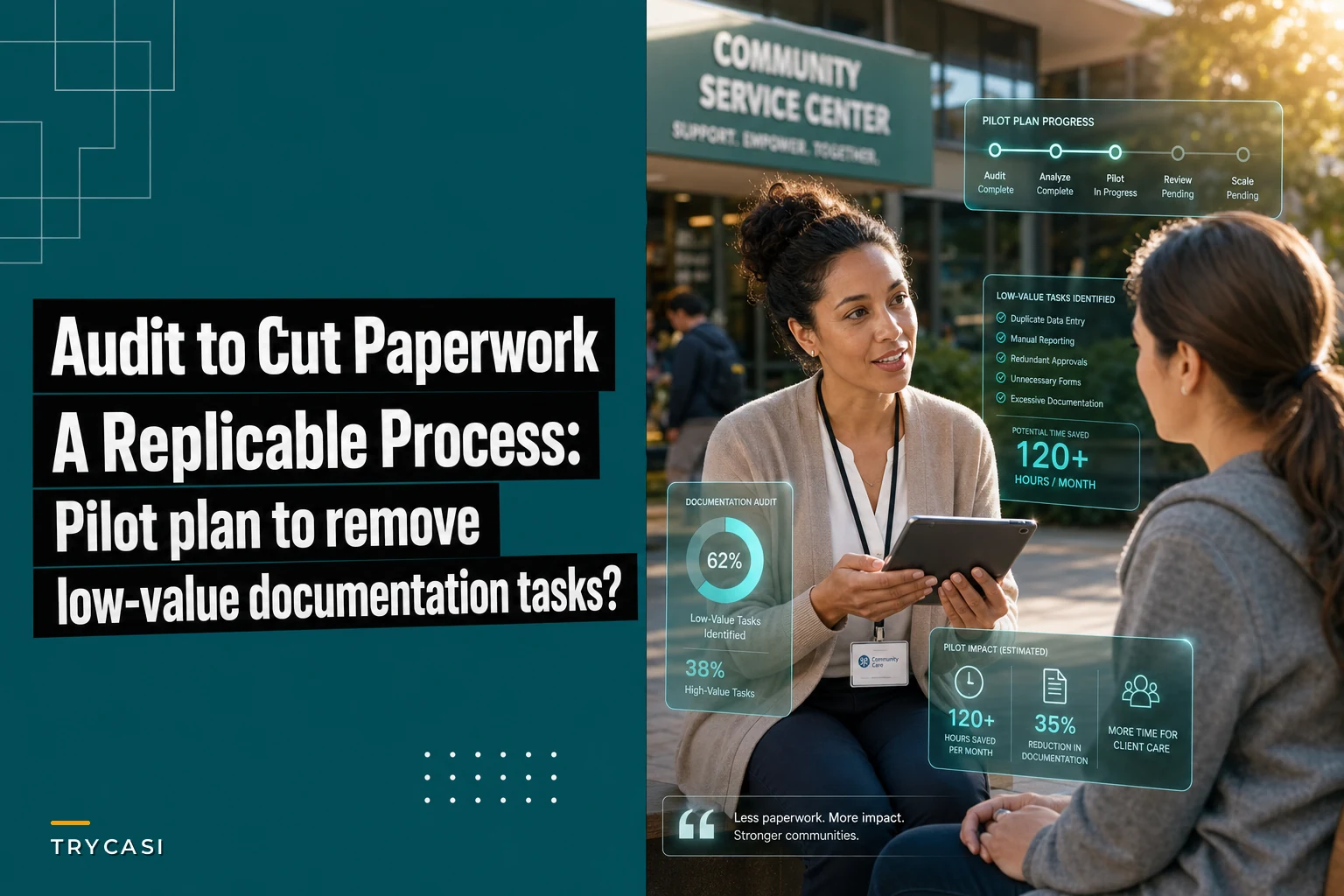

Social service documentation is a weird beast. Everyone knows there's too much of it, yet removing even one form feels nearly impossible. Teams spend months in meetings discussing what to cut, then nothing changes because someone always insists a particular form is "required for compliance" or "might be needed someday."
Documentation reviews that actually change things instead of creating more committees
The real problem isn't identifying unnecessary paperwork. Most social workers can point to at least five forms they fill out that nobody reads. The problem is building a process that actually removes documentation instead of just debating it endlessly.
Traditional documentation audits follow a predictable path to nowhere. Leadership announces a "paperwork reduction initiative." A committee forms. They meet weekly for three months, build a spreadsheet listing every form in existence, debate each one into the ground, then conclude that everything is somehow essential. Six months later, social workers are filling out the same redundant forms — plus a new one tracking their participation in the documentation review process.
Why documentation audits fail before they start
This happens because most audits ask the wrong question. They ask "Is this document important?" instead of "What actually happens if we stop doing this?"
Eliminate case management chaos.
TryCasi helps you organize, monitor, and report on every case efficiently and securely.
- Centralized case tracking
- Automated client notifications
- Team task coordination
No credit card required
Fear of removing something that might matter paralyzes the whole thing. Legal worries about liability. Program managers worry about losing funding. QA worries about accreditation. Meanwhile, case managers are spending three hours a day on documentation that could be spent with clients.
The working backwards approach
Start with time, not forms. You need to understand where documentation time actually goes before you decide what to cut.
Daily Documentation Log
-
Form/system name
-
Time spent (minutes)
-
Primary purpose (compliance, communication, tracking, billing)
-
Who reads it (specific role, not department)
-
Frequency (daily, per visit, weekly, as needed)
Keep it simple. A spreadsheet or even paper works fine. You want rough data, not perfect measurement.
Keep the Daily Documentation Log simple to encourage consistent tracking.
After one week, you'll see patterns that surveys and committees never surface. That intake assessment everyone complains about might only take 15 minutes, while the "quick" progress note system eats 45 minutes per client because of constant crashes and duplicate entry requirements.
Building your audit framework
Once you understand where time goes, score each documentation task across two dimensions.
Value Score (1-5)
-
5
Directly required for client safety or legal compliance
-
4
Used for critical decisions or funding
-
3
Supports care coordination
-
2
Nice to have but not essential
-
1
Nobody knows who uses this
Time Cost (1-5)
-
5
Over 30 minutes per instance
-
4
15-30 minutes
-
3
10-15 minutes
-
2
5-10 minutes
-
1
Under 5 minutes
Frequency Multiplier
-
Daily
multiply time cost by 5
-
Per client visit
multiply by 3
-
Weekly
multiply by 1
-
Monthly or less
multiply by 0.5
Plot everything on a simple grid. High time cost plus low value equals immediate elimination candidates. Low time cost plus high value stays untouched. Everything in the middle needs a closer look.
The stakeholder conversation that actually works
Most documentation exists because someone, somewhere, once needed it for something. Finding that person and understanding their actual current needs changes everything.
Skip the group meetings. Schedule 20-minute one-on-one conversations with specific stakeholders:
Opening (2 minutes)
-
"Walk me through the last time you actually used this document"
-
"What specific information did you need from it?"
-
"How often do you really look at these?"
-
"What would happen if you didn't have this exact format?"
Alternative exploration (5 minutes)
-
"Could you get this information another way?"
-
"Would a monthly summary work instead of daily reports?"
-
"What if we captured just these two data points instead of all fifteen?"
Close (3 minutes)
-
"If we had to cut this by 50%, what's absolutely essential?"
Write down the answers immediately. You'll find that the billing department only needs two fields from that 30-field assessment. The state auditor hasn't reviewed those quarterly reports in years. The program director just wants caseload numbers, not detailed narrative summaries.
Creating your pilot elimination list
After stakeholder conversations, you'll end up with three categories:
Quick wins
-
Documents nobody actually reads
-
Duplicate information captured elsewhere
-
Reports that can be automated from existing data
Negotiable reductions
-
Forms that can be shortened
-
Daily tasks that can become weekly
-
Narrative requirements that can become checkboxes
Sacred cows
-
Genuine compliance requirements
-
Funding-tied documentation
-
Client safety protocols
Start your pilot with one quick win and one negotiable reduction. Don't try to change everything at once.
The pilot structure that prevents rollback
Most paperwork reduction pilots fail because they're too ambitious or too vague. A working pilot needs clear boundaries:
Scope Definition
-
Two specific documentation tasks
-
One team (8-12 people maximum)
-
60-day trial period
-
Clear rollback criteria
Success Metrics
-
Time saved (measured, not estimated)
-
No compliance violations
-
No funding impacts
-
Team satisfaction scores
Safety Mechanisms
-
Weekly check-ins for the first month
-
Clear escalation process if issues arise
-
Documentation backup plan
-
Stakeholder update schedule
Write a one-page pilot plan that everyone signs off on. Include exactly what's being eliminated or reduced, who's participating, how you'll measure success, and what triggers a rollback.
Running the pilot without chaos
PILOT TIMELINE ────────────────────────────────────────────────────────── Week 1–2 │ Remove documentation. Nothing else changes. Week 3–4 │ Collect daily feedback. Track real concerns vs. anxiety. Week 5–6 │ Measure actual time savings. Watch for task backfill. Week 7–8 │ Check with stakeholders. Did anything actually break? ──────────────────────────────────────────────────────────
Weeks 1 and 2: Remove the documentation but keep everything else the same. Don't introduce new systems or processes at the same time. Just stop doing the eliminated tasks.
Weeks 3 and 4: Gather quick daily feedback. "Any problems today without [eliminated form]?" Most concerns will be anxiety about change, not actual operational problems.
Weeks 5 and 6: Measure real time savings. Are case managers actually spending less time on paperwork, or did other tasks expand to fill the gap?
Weeks 7 and 8: Check with stakeholders who supposedly needed the eliminated documentation. Did they notice? Did anything break?
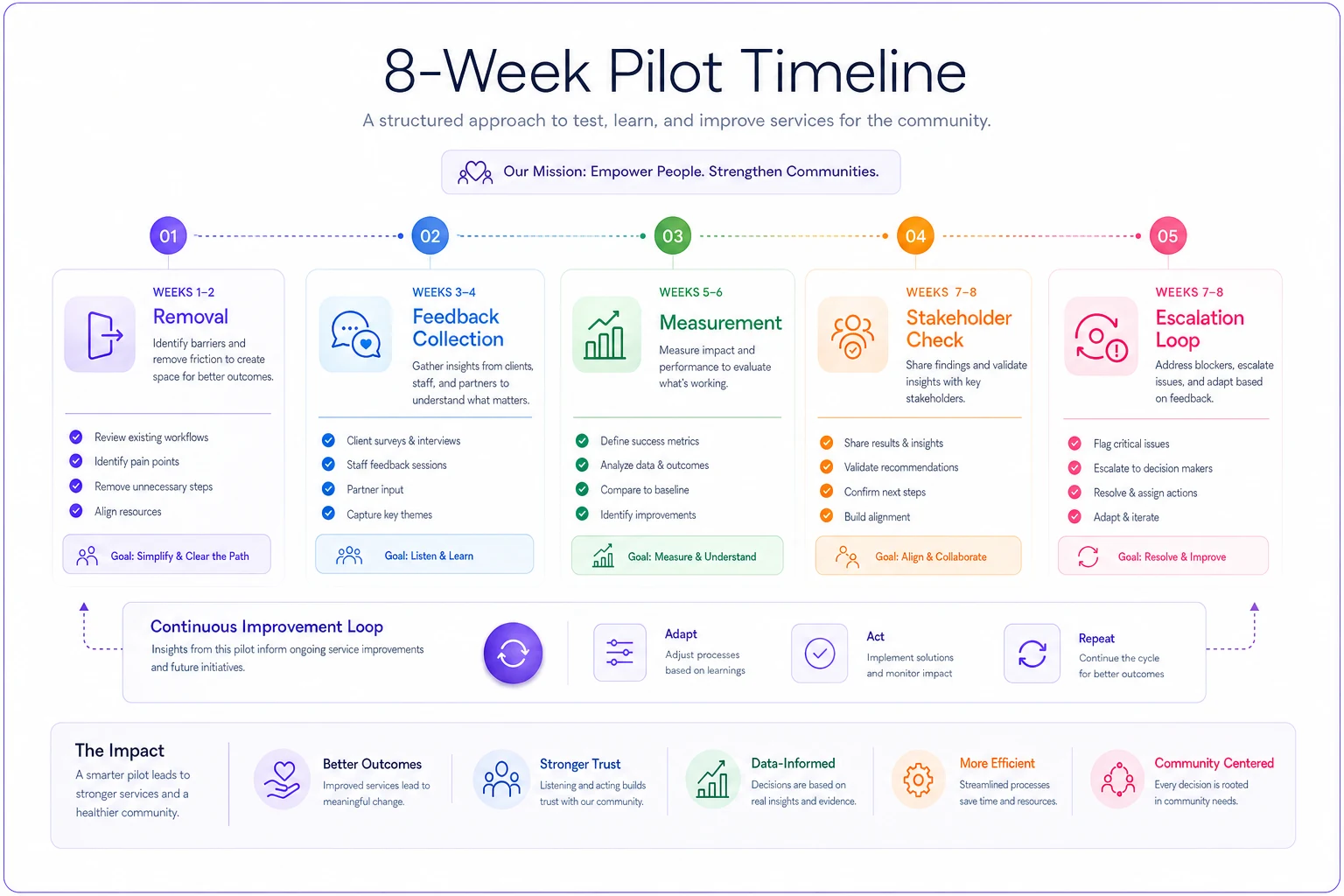
A simple visual of the pilot timeline and checkpoints.
Track issues in a simple log:
| Date | Issue | Impact | Resolution | Prevented by keeping form? |
|---|---|---|---|---|
| [Date] | [What happened] | [Who affected] | [How fixed] | [Yes/No] |
Most issues resolve without the eliminated documentation. The few genuine problems usually need process changes, not more paperwork.
Scaling beyond the pilot
A successful pilot creates momentum. Case managers start asking what else can go. Other teams want in. Leadership sees time savings translate to better client outcomes.
Scale carefully:
Expand gradually
-
Add one team at a time
-
Wait 30 days between expansions
-
Document lessons from each phase
Adjust for team differences
-
What works for family services might not work for adult protective services
-
Rural teams may have different documentation needs than urban ones
-
Grant-funded programs may have non-negotiable requirements
Create standard reduction templates
-
If intake forms can be shortened for one program, build a template for others
-
If daily logs can become weekly summaries in one unit, test it elsewhere
-
If narrative notes can be replaced with structured fields, standardize the format
Scale carefully:
The technology piece nobody talks about
Sometimes keeping bad documentation is easier than fixing bad systems. That 20-field assessment form might only need 5 fields, but if your case management system requires all 20 to save the record, you're stuck.
Before eliminating documentation, check system dependencies:
-
Can you leave fields blank without breaking reports?
-
Will removing this form affect integrations with other systems?
-
Do automated workflows depend on this data?
AI-powered operational software can reduce documentation burden without requiring a full system overhaul. Natural language processing can pull required data points from brief case notes instead of forcing structured entry. Automated reporting can compile compliance documentation from existing operational data. Smart forms can skip irrelevant sections based on case type.
But technology isn't always the answer. Sometimes a shared spreadsheet replaces a complex documentation system. Sometimes eliminating a form entirely beats automating it. Don't default to a tech solution just because one exists.
Measuring what matters
Six months into documentation reduction, measure these specific outcomes:
Direct time savings
-
Average documentation time per case (before vs. after)
-
Percentage of shift spent on paperwork
-
Time from service delivery to documentation completion
Quality indicators
-
Client contact hours
-
Case plan completion rates
-
Team satisfaction scores
-
Compliance audit results
Unexpected benefits
-
Faster case transfers
-
Reduced training time for new staff
-
Improved data accuracy (less documentation often means better documentation)
-
Lower turnover
Don't just track hours saved. Track what people do with those hours. If case managers spend recovered time on client engagement, that's the real win. If they just fill the time with other admin tasks, you've got a bigger operational problem to deal with.
Common resistance patterns and real responses
"But we've always done it this way" usually means "I'm afraid of getting in trouble for not doing this." Address the fear, not the habit. Get written confirmation that specific documentation isn't required and share it widely.
"The state requires this" often isn't accurate. Pull the actual regulatory language. You'll frequently find the state requires "documentation of service delivery," not your specific 10-page form. Design minimal compliance documentation that meets the actual requirement.
"What if we get audited?" is valid but usually overblown. Most auditors care about service delivery and client outcomes, not paperwork volume. Document your elimination decision-making. If an auditor questions missing paperwork, show them pilot data demonstrating better client outcomes with less documentation.
"We need this for quality assurance" might be partially true. But QA can often work with samples rather than universal documentation. Instead of every case manager documenting every interaction in detail, QA can review recorded sessions or do periodic deep dives on specific cases.
When documentation reduction goes wrong
Not every elimination attempt works out. A mental health team removed daily progress notes, assuming weekly summaries would be enough. Three weeks in, a client crisis revealed pattern changes that weekly summaries had completely missed. They reinstated daily notes but shortened them to structured checkboxes with one narrative field for exceptions.
A child welfare unit eliminated home visit preparation forms. Case managers started arriving unprepared, missing safety concerns and forgetting follow-up items. They brought back a simplified one-page checklist — two minutes to complete versus the original 15.
These aren't really failures. They're data about what documentation actually serves an operational purpose versus what exists through organizational inertia.
Building lasting change
Documentation reduction isn't a one-time project. It needs ongoing attention to stop paperwork from creeping back in. New regulations, grant requirements, and quality initiatives constantly threaten to add forms back into the workflow.
-
Quarterly — Review any new documentation added since the last review
-
Annually — Re-audit the highest time-cost documentation across teams
-
Ongoing — Require written justification for any new documentation requirement before it gets introduced
Establish a "documentation budget." If someone wants to add a new form or reporting requirement, they need to identify what existing documentation gets cut or reduced to make room for it.
Celebrate the wins. When a team recovers five hours a week through documentation reduction, make it visible. Share what case managers are doing with that time. Track improvements in client outcomes. Make the connection between less paperwork and better service delivery hard to ignore.
The path to meaningful documentation reduction isn't through endless committees or comprehensive reviews. It's through small, measured experiments that prove certain paperwork really doesn't matter. Once teams experience the relief of eliminated documentation without negative consequences, momentum builds on its own.
Your social workers didn't get into this field to become data entry specialists. Every hour spent on unnecessary documentation is an hour taken from client service. The process outlined here won't eliminate all paperwork — some documentation truly is essential. But it will help you identify and remove the bureaucratic burden that serves no one, and give your team more time to do what they actually came here to do.
Ready to transform your social services workflow?
Join 500+ agencies using TryCasi to improve case outcomes, enhance collaboration, and reduce administrative burden.