

Most social service teams don't fall apart at the frontline. Caseworkers usually know how to run an intake, make a triage call, or close a file cleanly. Where things quietly break is the layer above that — the connective tissue between what happens on the ground and what a funder expects to see in a quarterly report, or what an auditor wants documented six months later.
You can have a genuinely good triage rubric and still miss a funder deliverable because nobody mapped the triage timestamp to the reporting field. You can run excellent supervision and still fail a compliance gate because the evidence lived in someone's head instead of a system. The gap isn't skill. It's the absence of an operating model that treats casework, funding, and compliance as one connected machine instead of three separate departments that happen to share clients.
This is the pillar view: how a casework operating model in social services actually holds together, where it splits apart under load, and what a leader needs to build so the frontline rituals feed the reporting and budgeting cycles automatically instead of through last-minute scrambles.
Why casework, funding, and compliance drift apart
The three sit on different clocks, and that's the root of most of the pain.
Casework runs on client time — someone shows up in crisis, a home visit happens Tuesday, a placement fails Thursday. Compliance runs on regulatory time — annual re-credentialing, audit windows, mandated timelines that don't care about your caseload. Funding runs on contract time — quarterly deliverables, spend-down deadlines, unit counts due on the 15th.
When these three clocks aren't stitched together, leaders end up managing them reactively. A typical pattern: a program manager realizes in week 11 of a quarter that they're 40 units short of a contracted deliverable, so they push the team to close cases faster, which creates thin documentation, which then surfaces in the next audit as a compliance finding. One clock robbed the other.
What tends to happen on small teams is that nobody actually owns the mapping. The intake coordinator owns intake. The supervisor owns supervision. The finance person owns the budget. But the line connecting "this intake field" to "this funder metric" to "this audit requirement" belongs to no one — until it fails, and then it belongs to everyone at once.
The four frontline rituals, and what each one owes upstream
The cleanest way to build the model is to take the rituals your team already runs and make explicit what each one produces for compliance and funding. Not new work — just naming the downstream obligations that were always there.
Eliminate case management chaos.
TryCasi helps you organize, monitor, and report on every case efficiently and securely.
- Centralized case tracking
- Automated client notifications
- Team task coordination
No credit card required
| Frontline ritual | Compliance gate it feeds | Funder deliverable it feeds | Staffing / budget implication |
|---|---|---|---|
| Intake | Consent on file, eligibility verified, mandated-reporter check | New-client counts, demographic reporting, eligibility mix | Intake capacity caps total caseload growth |
| Triage | Risk-level documentation, timely-response mandates | Priority-population served, response-time metrics | High-acuity mix drives staff-to-case ratios |
| Supervision | Case review evidence, clinical oversight requirements | Fidelity/quality measures, service-quality reporting | Supervisor ratio is a fixed cost that scales in steps |
| Closure | Outcome documentation, retention/exit rules | Outcome metrics, cost-per-outcome, re-engagement rates | Closure pace affects capacity to accept new referrals |
The insight buried in that table: every column is coupled. If your triage skews toward high-acuity because a referral partner changed their screening, your staff-to-case ratio has to shift, your response-time compliance gets harder to hit, and your cost-per-outcome for the funder goes up. One change ripples across all three clocks. Leaders who see the ripple early adjust staffing before the quarter ends. Leaders who don't find out when the numbers land wrong.
Leaders who see the ripple early adjust staffing before the quarter ends. Leaders who don't find out when the numbers land wrong.
Where the model breaks at scale
At five caseworkers, you can hold the whole thing in your head. The supervisor knows who's behind on documentation, roughly where the unit counts sit, and which files an auditor would flag. Coordination happens in the hallway.
-
The mapping goes tribal. Only one or two long-tenured people know which intake field maps to which funder report. When they're out, reporting stalls.
-
Compliance becomes a quarterly fire drill. Nobody's checking gates continuously, so the two weeks before an audit turn into a document hunt across inboxes, shared drives, and paper files.
-
Funding deliverables get discovered late. The unit shortfall shows up when there's no runway left to fix it, forcing the fast-closure/thin-documentation trap.
-
Budget assumptions decouple from real caseload. The staffing plan was built on an acuity mix that no longer matches reality, so you're either overstaffed on low-acuity work or drowning on high-acuity.
None of these are frontline failures. They're all coordination failures — the model didn't scale because it was never written down. A team of eight can survive on memory. A team of twenty cannot, and the transition point is exactly where most agencies get blindsided.
Building the annual operational calendar
The single highest-leverage artifact a leader can build is a calendar that overlays all three clocks on one page. Not three separate calendars — one, with the frontline volume patterns underneath and the compliance and funding deadlines on top.
A workable version has four layers:
-
Layer 1 — Funder deliverables every reporting deadline, spend-down date, and renewal by month.
-
Layer 2 — Compliance gates re-credentialing windows, audit periods, mandated review cycles.
-
Layer 3 — Predictable caseload swings the seasonal patterns you already know (referral spikes after benefit cutoffs, summer drop-offs, winter housing surges).
-
Layer 4 — Staffing reality planned leave, hiring lead times, training periods.
Stack these and the collisions jump out immediately. You'll spot the quarter where a major report is due during your predictable referral spike while a supervisor is on planned leave. That's a staffing problem you can solve in advance — pull a temp, front-load documentation, shift a deadline conversation with the funder — instead of discovering it mid-crisis.
Most teams build the funding calendar and the compliance calendar separately, in different tools, owned by different people. Merging them into one view is boring, unglamorous work that prevents more downstream chaos than almost anything else a leader can do.
Start with the funder deadlines layer first — it's the least flexible and drives other adjustments.
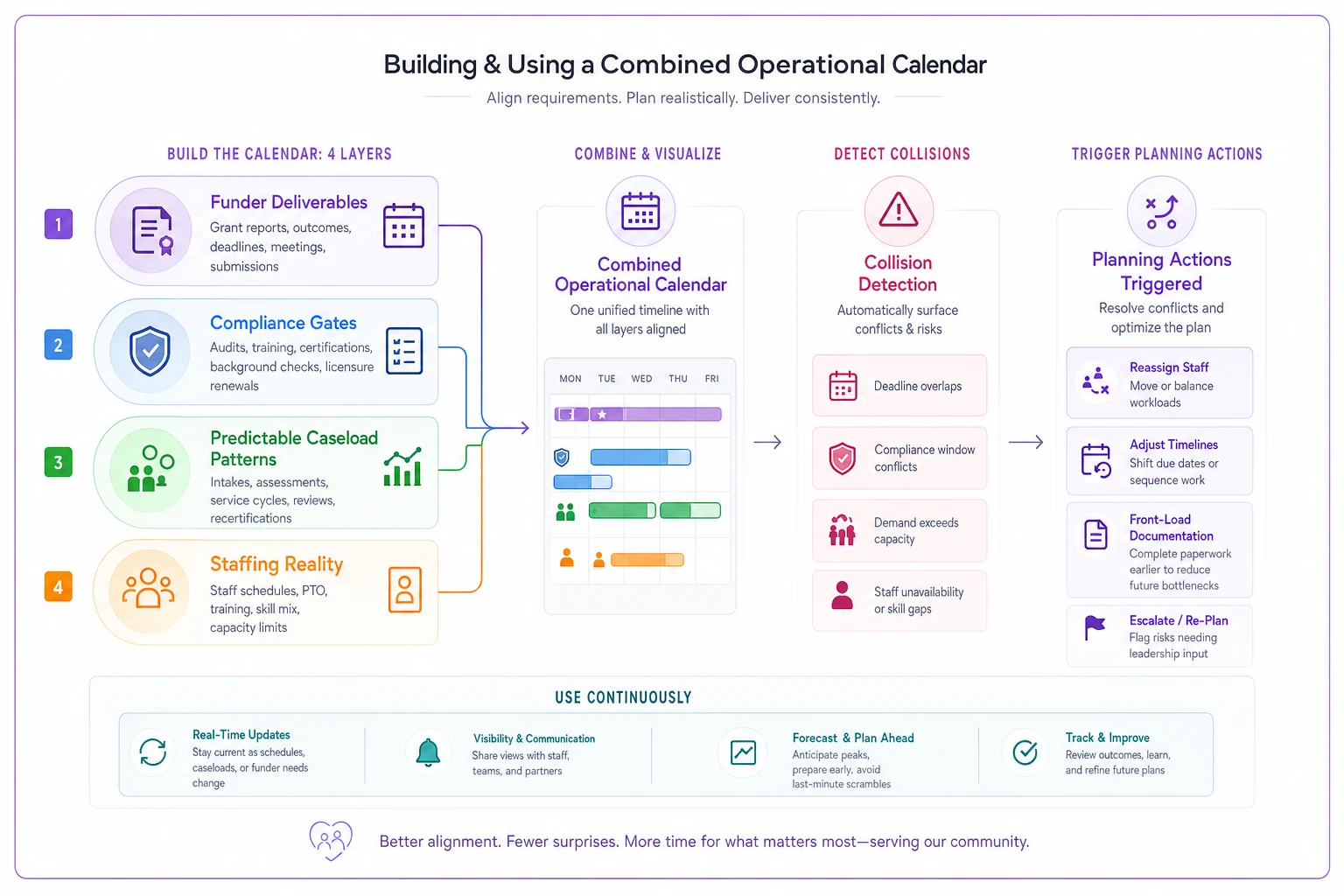
This visual shows how to spot collisions and act early.
The compliance gate checklists
Gates are the checkpoints where a case can't move forward until specific evidence exists. Writing them as checklists isn't about bureaucracy — it's so the evidence gets captured during the ritual, not reconstructed afterward.
A practical intake gate checklist:
-
[ ] Consent captured with correct version and date
-
[ ] Eligibility verified against current funder criteria
-
[ ] Mandated-reporter screen completed and logged
-
[ ] Priority-population indicators recorded (feeds funder reporting)
-
[ ] Assigned to correct program/funding stream
A closure gate checklist:
-
[ ] Outcome fields completed against the measurement framework
-
[ ] Exit reason coded consistently
-
[ ] Follow-up schedule set (feeds retention metrics)
-
[ ] Re-open triggers documented
-
[ ] Final unit/service counts reconciled to the funding stream
The mistake most teams make is treating these as a final review step — something a supervisor checks at closure. By then the intake evidence is weeks old and half of it is missing. Gates only work when they're enforced at the moment of the ritual, which is also where your framework for measuring outcomes has to plug in — the outcome fields you report on have to be the same fields the closure gate requires, or you'll capture data twice and reconcile it forever.
A real scenario
A mid-sized family services agency — around 16 caseworkers across two contracts — kept passing audits but always by the skin of its teeth. Every quarter, the two weeks before the funder report turned into a scramble: the program director pulling files, chasing missing consents, and manually tallying units across a spreadsheet and two case files that never quite agreed.
The actual problem wasn't documentation quality. Intake was collecting data in a format that didn't match the funder's reporting categories, so someone had to re-map roughly 300 cases by hand each quarter. That re-mapping ate somewhere around 30–40 hours of senior staff time every cycle and introduced errors — a few of which became audit findings.
The fix wasn't more staff. They rebuilt the intake fields to match the funder's reporting taxonomy exactly, then set the closure gate to require the same outcome fields the report needed. After two quarters, the pre-report scramble dropped from a two-week ordeal to roughly a day of review. Senior staff time went back into supervision. No new hires, no new software — just aligning the fields at the two ends of the case so the middle didn't need reconstructing.
A lot of what feels like a compliance burden is really a data-modeling mismatch between where information is captured and where it's reported.
Where a case management system actually fits
None of this requires software to design. You can build the calendar, the gate checklists, and the field mapping on paper and they'll work. But at scale, holding gates open across 300+ active cases by hand is where things quietly slip.
The role a platform plays here is narrow and specific: it enforces the gates at the point of the ritual, keeps the field mapping consistent so intake data lands where the funder report needs it, and surfaces the collisions on your operational calendar before they become fire drills. Instead of a supervisor manually checking whether consent is on file for every case, the system won't let a case advance past intake without it. Instead of hand-tallying units, the counts roll up because the fields were structured to match the deliverable from the start.
The honest caveat: a system amplifies whatever model you feed it. If your gates are vague and your field mapping is a mess, software makes the mess faster, not cleaner. That's why the sequencing matters — design the operating model first, then adopt tooling against it. Teams that rush the tool before the model tend to struggle, which is exactly why a phased rollout approach matters more than the feature list.
When this level of structure makes sense — and when it doesn't
Build the full model when:
-
You're running more than one funding stream with different reporting requirements
-
Your team has crossed roughly 12–15 staff and hallway coordination is failing
-
Audits or reports consistently trigger last-minute scrambles
-
Different people own intake, funding, and compliance with no clear mapping between them
Hold off — or keep it lightweight — when:
-
You're a small team of four or five where one person can genuinely see the whole picture
-
You have a single, simple funding contract with straightforward reporting
-
You're mid-crisis; stabilize operations before formalizing the model
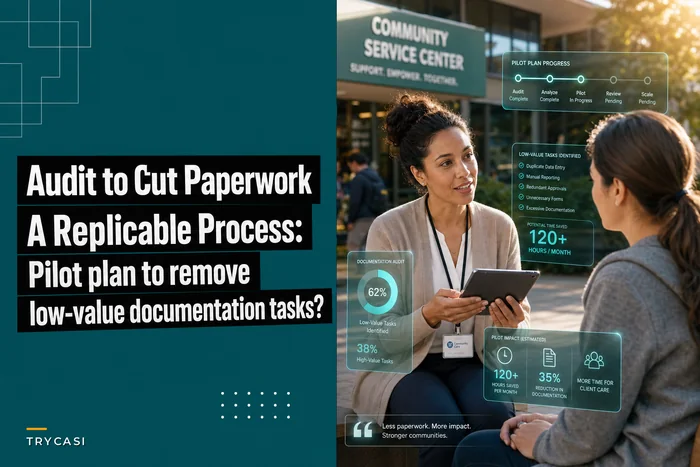
Who should be careful: teams tempted to build the entire calendar, every gate, and full field mapping in one sprint. That usually stalls. The mapping between intake and funder reporting is the highest-value piece — start there. And before adding more documentation to enforce gates, run an audit to cut low-value paperwork first, because the goal is to make existing work feed compliance, not pile on new forms.
Pulling it together
The agencies that run smoothly aren't the ones with the most dedicated staff or the strictest compliance culture. They're the ones where the frontline rituals were deliberately connected to the reporting and budgeting cycles — so a completed intake automatically produces the evidence a funder and an auditor will eventually ask for. No reconstruction, no scramble.
That's the whole point of an operating model: not another layer of oversight, but a design that makes the three clocks — client time, compliance time, funding time — tick together instead of colliding. Start with the calendar that shows the collisions. Add gate checklists that capture evidence at the moment of the ritual. Fix the field mapping between intake and reporting. Everything else — the staffing math, the funder relationships, the audit readiness — gets noticeably easier once those three pieces are in place, and holds together as the team grows past the point where memory alone can carry it.
The agencies that run smoothly aren't the ones with the most dedicated staff or the strictest compliance culture. They're the ones where the frontline rituals were deliberately connected to the reporting and budgeting cycles — so a completed intake automatically produces the evidence a funder and an auditor will eventually ask for. No reconstruction, no scramble.
That's the whole point of an operating model: not another layer of oversight, but a design that makes the three clocks — client time, compliance time, funding time — tick together instead of colliding. Start with the calendar that shows the collisions. Add gate checklists that capture evidence at the moment of the ritual. Fix the field mapping between intake and reporting. Everything else — the staffing math, the funder relationships, the audit readiness — gets noticeably easier once those three pieces are in place, and holds together as the team grows past the point where memory alone can carry it.
Ready to transform your social services workflow?
Join 500+ agencies using TryCasi to improve case outcomes, enhance collaboration, and reduce administrative burden.