


Something strange happens when a single-site casework program decides to go multi-site. The things that made the original site work — a supervisor who knew every open case, a shared drive everyone understood, an unspoken culture around "how we do notes here" — quietly stop working. Not dramatically. Nobody wakes up one morning to find the system broken. It just erodes. A field means one thing at Site A and something slightly different at Site C. A QA step that was religious at the founding office gets skipped at the new one because nobody formally owned it there.
The hard part of learning to scale digital casework across sites isn't the software. It's that the operating model that worked at one location was never written down. It lived in people's heads. The moment you add sites, you're forced to make implicit things explicit — and most programs discover they have no shared definition of "done" for almost anything.
This piece covers the system that keeps quality consistent when you're running the same casework model across five locations with five different staffing realities: the role grid, the acceptance-test matrices, the cross-site QA rituals, the rollout waves, and the budget reality that usually gets glossed over until it's too late.
Why the single-site model quietly breaks
At one site, coordination is basically free. People overhear each other. A worker can tap a supervisor on the shoulder. Exceptions get handled by walking across the room. None of that scales, and the breakage is predictable once you know what to look for.
The first thing to go is definitional consistency. "Open," "closed," "high-risk," "contacted" — these feel obvious until two sites use them differently. One site marks a case contacted after a voicemail; another only after a live conversation. Now your cross-site dashboard is comparing numbers that aren't the same unit. Leadership looks at a report showing Site B closing cases 40% faster and draws exactly the wrong conclusion, when the real story is that Site B just codes closure earlier.
The second thing to break is ownership of quality checks. At the founding site, QA was a person — usually the longest-tenured supervisor who caught things by instinct. That instinct doesn't copy-paste. New sites inherit the forms but not the judgment. Documentation quality diverges, and it does so silently for months until an audit or a serious incident surfaces it.
Third is data trust. Once numbers from different sites stop reconciling, people stop believing the system of record and rebuild their own shadow spreadsheets. The official platform becomes a compliance checkbox while real operational truth lives in offline files. Once that split happens, multi-site coordination is effectively dead, because there's no shared reality to coordinate around.
Scale doesn't create new problems so much as it removes the human glue that was hiding the old ones.
The regional vs central role grid
Before any rollout timeline matters, you need to decide who owns what. Most failed multi-site expansions skip this and try to figure it out as they go, which means every decision becomes a negotiation and nothing gets standardized.
Eliminate case management chaos.
TryCasi helps you organize, monitor, and report on every case efficiently and securely.
- Centralized case tracking
- Automated client notifications
- Team task coordination
No credit card required
The useful mental model is to split responsibilities into three buckets: things that must be identical everywhere (central), things that must flex to local conditions (regional), and things that belong to the individual site. Get this wrong in either direction and you pay for it — too central and sites feel steamrolled and disengage; too local and you don't actually have one program, you have five separate ones that happen to share a name.
Here's a grid that holds up reasonably well in practice:
| Responsibility | Central (HQ) | Regional Lead | Site Supervisor |
|---|---|---|---|
| Field definitions & data standards | Owns | Enforces | Follows |
| Case acceptance criteria ("done" rules) | Owns | Enforces | Follows |
| Risk/escalation thresholds | Owns core; allows local overlays | Adapts to local resources | Applies |
| Staffing & caseload balancing | Sets ceilings | Owns allocation | Flags capacity |
| QA ritual cadence | Designs | Runs calibration | Executes checks |
| Local partner relationships | — | Supports | Owns |
| Tooling config & permissions | Owns | Requests changes | Uses |
| Reporting definitions | Owns | Validates | Supplies data |
The pattern worth noticing: central should own definitions and thresholds, regional should own allocation and adaptation, and sites should own execution and relationships. When central tries to own local partner relationships, it fails. When sites try to own field definitions, you lose comparability. The regional layer exists specifically to translate central standards into local reality — it's not bureaucratic middle management, it's the connective tissue that keeps standardization from becoming tone-deaf.
One common mistake is standing up the regional role too late. Programs often expand to four or five sites first and then realize they need regional leads. By then, each site has invented its own way of working, and the regional lead's first year is spent un-inventing things — which breeds resentment on all sides. Put the regional layer in before you think you need it.
Acceptance-test matrices: defining "done" across sites
This is the piece most programs never build, and it's probably the single highest-leverage artifact for consistency. An acceptance-test matrix is a structured answer to the question: "How do we know a case, a note, or a handoff meets standard — and does that answer hold at every site?"
Instead of a vague policy document, you write testable criteria. Each row is something that must be true, phrased so that two different people at two different sites would score it the same way.
A simplified intake acceptance matrix might look like this:
| Test | Pass criteria | How it's checked | Who checks |
|---|---|---|---|
| Consent captured | Signed/verbal consent logged with date + method | Field-level validation | System + supervisor |
| Core fields complete | All 12 minimum fields populated | Required-field rules | System |
| Risk score recorded | Score entered with rationale note | Spot-check | Supervisor |
| Duplicate check done | Search-before-create confirmed | Weekly audit | Regional |
| Language need captured | Preferred language + interpreter flag set | Spot-check | Supervisor |
The specific rows aren't the point — yours will look different. The point is that "a good intake" becomes a set of binary checks that mean the same thing in every office. When you can test it, you can compare it. When you can compare it, you can actually coach to it.
Build a separate matrix for each critical workflow: intake, case notes, escalation, handoff, closure. Keep them short — eight to twelve tests each. The temptation is to make them exhaustive, which guarantees nobody uses them. A matrix someone can run in two minutes gets run. A thirty-item checklist gets skipped, and then you're back to instinct-based QA.
Keep them short — eight to twelve tests each.
Where modern case management platforms earn their keep is enforcing the mechanical half of the matrix automatically — required fields, consent flags, duplicate warnings — so human reviewers only spend attention on the judgment calls. If you're working through how field-level validation and audit scripts fit together across partners and sites, the data governance playbook for small social-service networks covers mechanics worth pairing with this.
Cross-site QA rituals and calibration
An acceptance matrix only stays meaningful if people interpret it the same way over time. They won't, not automatically. Scorers drift. Site A's supervisor gets stricter about case notes; Site D's gets more lenient after a brutal caseload quarter. Within six months your "standardized" scoring has quietly diverged again.
The fix is calibration — a recurring ritual where supervisors score the same cases and then compare. It sounds academic. In practice it's the most useful thing on this list.
A workable monthly calibration exercise:
-
Pull 3–5 anonymized real cases (varied difficulty) before the session.
-
Each supervisor scores them independently against the acceptance matrix — no discussion yet.
-
Compare scores side by side. Highlight every disagreement.
-
Discuss only the disagreements. Not to declare a winner, but to clarify the standard. Usually the matrix wording was ambiguous and needs tightening.
-
Update the matrix with the clarified language.
-
Log the drift. Track how often sites disagreed this round versus last — falling disagreement rates mean your standard is stabilizing.
The first few calibration sessions are uncomfortable because disagreement rates are high. Supervisors disagreeing on a third or more of scored items early on isn't failure — that's the measurement working. The goal isn't zero disagreement, it's shrinking, explainable disagreement.
Layer in a lighter weekly ritual too: each site supervisor spot-checks a small sample of cases against one matrix, and the regional lead reviews a thin slice across all sites to catch systemic drift. Monthly calibration aligns judgment; weekly spot-checks catch day-to-day slippage. You need both — monthly calibration without weekly checks lets errors pile up between sessions.
One caveat worth naming: if you're running two sites with the same two supervisors who talk daily, formal calibration is overhead you don't need. You're already calibrated by proximity. This ritual earns its cost at roughly four or more sites, or whenever supervisors stop knowing each other's work firsthand.
Wave-based rollout, not a big bang
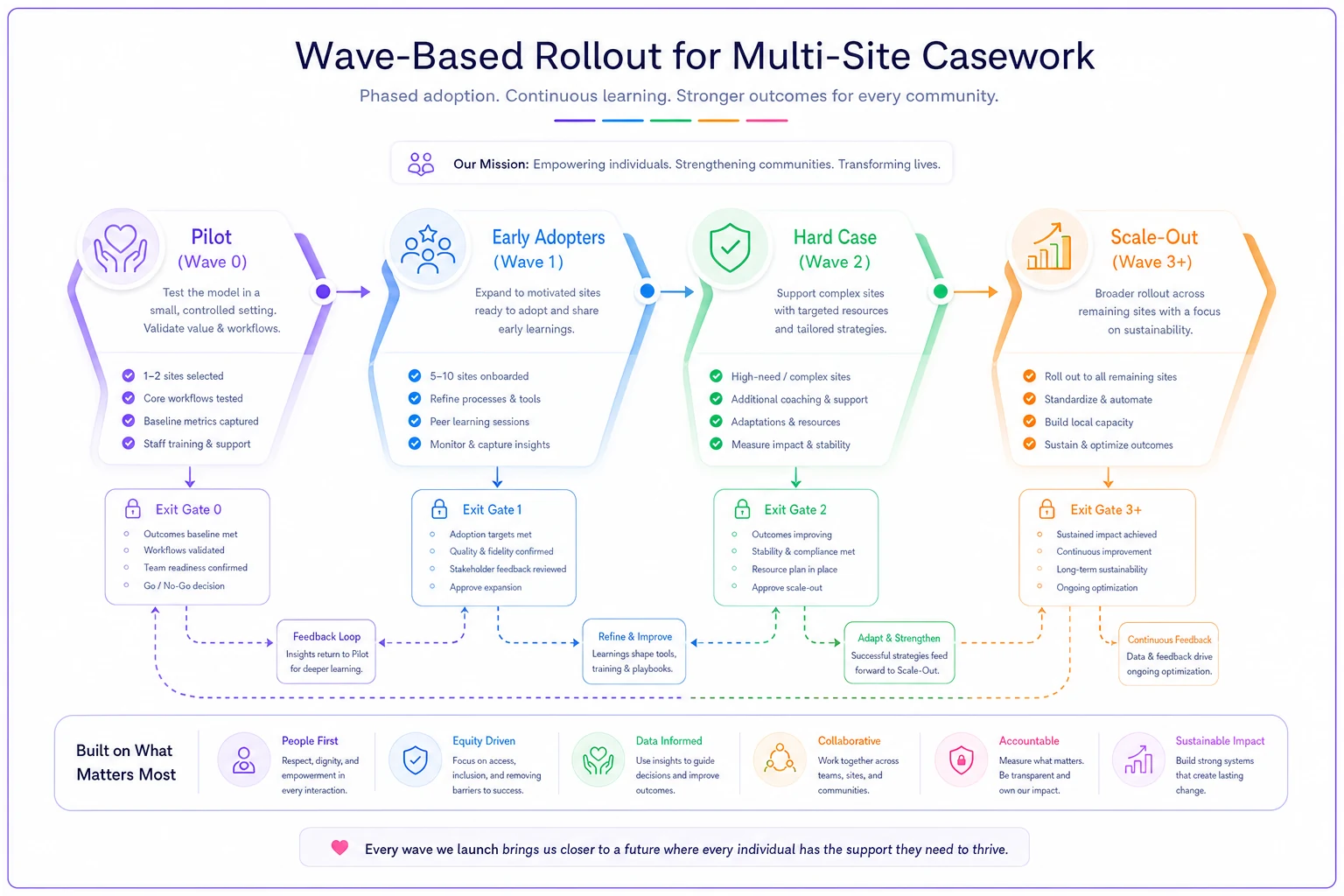
Turning on all sites at once is the most common way programs blow up a multi-site launch. Every problem surfaces simultaneously, support can't keep up, and the sites that struggle poison the perception of the whole initiative. Waves fix this by turning the rollout into a series of learning loops instead of one large gamble.
Here's a simple workflow diagram of that wave process.
-
Wave 0 — Pilot (one site, 4–6 weeks) Ideally the founding site, or a strong mid-sized one. The goal is to pressure-test the acceptance matrices and tooling config against reality, not to prove success. Expect to rewrite things.
-
Wave 1 — Early adopters (one or two sites, 6–8 weeks) Pick sites with engaged supervisors who'll give honest feedback. First real test of whether the standard travels to people who didn't build it.
-
Wave 2 — The hard case (one site) Deliberately include a site you expect to struggle — understaffed, high turnover, weak existing data habits. If the model only works at your best sites, it doesn't actually work.
-
Wave 3+ — Scale-out (remaining sites) By now the matrices are battle-tested, training is refined, and known failure modes have fixes. Later waves should get progressively smoother; if they don't, stop and diagnose before continuing.
Each wave needs an exit gate. You don't start the next wave until the current one hits defined acceptance thresholds — calibration disagreement below a set level, core data-quality fields passing, supervisors confirming they can run the rituals without heroics. Skipping the gate to "stay on schedule" is how you ship instability to five sites instead of fixing it at one.
A lot of the sequencing discipline here — phased migration, supervisor quick-wins, adoption milestones — overlaps with software adoption specifically. If your waves are also introducing new tooling, the low-friction rollout playbook for case management software pairs naturally with this operating model, and the broader human side of getting staff to actually change how they work is covered in the change-management playbook for digital transformation in casework operations.
A real scenario
A regional family-services nonprofit ran one strong office and absorbed three smaller programs over about a year, landing at four sites and roughly 60 caseworkers. The founding site's data was clean; the three additions each tracked cases differently, and two leaned heavily on offline spreadsheets. Leadership's first consolidated report was unusable — closure rates that couldn't be compared, duplicate clients across sites, no shared definition of "high-risk."
They didn't buy new software first. They built intake and closure acceptance matrices, stood up a regional lead over the three newer sites, and started monthly calibration. Early sessions had supervisors disagreeing on well over a third of scored items, especially around closure and risk coding.
Over roughly two quarters, calibration disagreement dropped to somewhere in the low-teens percentage-wise. Duplicate clients across sites fell sharply once a search-before-create check became a hard acceptance criterion. The practical payoff wasn't some dramatic headline metric — it was that leadership could finally trust a single cross-site report, and the regional lead could spot a struggling site in weeks instead of discovering it at the annual audit. Caseworkers at the acquired sites also stopped maintaining shadow spreadsheets, because the shared record finally reflected what they actually meant.
Nothing here was fast or magical. It was mostly the unglamorous work of making implicit standards explicit and then checking them on a cadence.
Sample budget thinking
Programs consistently underbudget the coordination cost of going multi-site and overbudget the tooling. The role grid, calibration time, and regional oversight are the real expense — and they're ongoing, not one-time.
-
Regional lead capacity — often the largest line item. Whether it's a new hire or carved-out time from an existing role, it's recurring.
-
Supervisor QA/calibration time — a few hours per supervisor per month, indefinitely. Easy to forget because it's distributed across people.
-
Tooling/config — real cost, but usually smaller than people expect if you're configuring an existing platform rather than building from scratch.
-
Rollout support — concentrated during waves, then tapers off.
-
Training refresh — recurring, especially at sites with high turnover.
The mistake is treating this as a project budget with an end date. A multi-site operating model is an operating cost. The calibration and QA rituals aren't a launch activity you finish; they're the thing that keeps quality from drifting a year from now.
When this whole model is a bad idea
Not every program should industrialize like this.
-
If you're at two sites with tight informal communication, heavy matrices and formal calibration add overhead you don't need yet. Proximity is already doing the job.
-
If your sites genuinely do different work — not the same model in different places, but fundamentally different programs — forcing one acceptance standard across them is a mistake. Standardize within like-for-like clusters, not across the board.
-
If leadership won't commit to the exit gates, don't start the wave model at all. A wave rollout where gates get overridden for schedule pressure is worse than an honest big-bang launch, because it wears the appearance of discipline without the substance.
The honest test: do your sites need to produce comparable, trustworthy data and consistent client experiences? If yes, you need this system. If the sites can legitimately operate independently, keep things light and don't manufacture coordination that isn't actually required.
Pulling it together
The core shift in learning to scale digital casework across sites is accepting that coordination stops being free. At one site, shared understanding is a byproduct of people being in the same room. At five, it has to be engineered — through role clarity about who owns definitions versus allocation versus execution, through acceptance-test matrices that make "done" mean the same thing everywhere, through calibration rituals that stop scoring from drifting, and through wave-based rollout that turns every expansion into a controlled learning loop.
None of these pieces work alone. A role grid without acceptance matrices gives you clear ownership of undefined standards. Matrices without calibration decay within months. Calibration without wave-based rollout means you're trying to stabilize five sites simultaneously instead of one. The programs that scale well are usually the ones that built the boring coordination infrastructure a little earlier than felt necessary — before the cracks got expensive to fix.
Ready to transform your social services workflow?
Join 500+ agencies using TryCasi to improve case outcomes, enhance collaboration, and reduce administrative burden.