



Most small networks don't fall apart on their own data. They fall apart at the seams — the moment a record leaves your case management system and lands in a partner's spreadsheet, a funder's report, or a volunteer coordinator's inbox. Inside your four walls, you might already run clean validation, decent audits, and a role matrix that makes sense. But the second another organization touches that data, your governance stops at the door and theirs may not exist at all.
That gap is where the real risk lives. A consent flag that means "verbal only" in your system quietly becomes "full release" when a partner re-enters it. A date-of-birth field that's locked and validated on your side gets typed freehand on theirs. Nobody's being careless. It's just that governance was built for one agency, and the work happens across five.
This is a playbook for closing that gap — not with a 40-page policy binder nobody reads, but with the operational pieces that actually hold: supervisor enforcement checklists, vendor and partner scorecards, data-sharing agreement templates that non-lawyers can use, field validation rules that survive a handoff, and a quarterly audit routine that produces corrective action instead of a shrug.
Why field-level rules break the moment they leave your building
If you've already set up internal controls — and if you haven't, the lightweight data governance approach for small teams is the place to start — you know the drill. Required fields, dropdowns instead of free text, a monthly audit script, someone who owns each data domain.
The pattern that trips up almost every network: those controls are system-enforced internally and trust-enforced externally. Your intake worker literally cannot save a record without a consent type selected. But when you send that record to a housing partner, you're emailing a PDF or a CSV. Their intake worker retypes it. There's no dropdown on their end. There's no validation. There's just a person, a keyboard, and a Tuesday afternoon.
-
A "Y/N" consent field becomes "yes, I think so" in a partner's notes
-
Race and ethnicity categories that match your funder's taxonomy get flattened into whatever the partner's dropdown allows
-
A client's preferred name — carefully captured on your side — reverts to their legal name three agencies down the chain
-
Redaction rules you follow religiously (see the operational consent workflows for how those decision trees should run) get ignored because the partner never agreed to them in the first place
None of these blow up immediately. They surface six months later during a funder audit, or worse, when a client asks why the wrong information followed them somewhere.
The core insight: governance that isn't shared isn't governance. It's a local preference.
The four layers that actually hold across a network
Think of network-wide governance as four layers, each one catching what the layer above missed. Most small networks have layer one and skip the rest.
Eliminate case management chaos.
TryCasi helps you organize, monitor, and report on every case efficiently and securely.
- Centralized case tracking
- Automated client notifications
- Team task coordination
No credit card required
| Layer | What it controls | Who owns it | Common failure |
|---|---|---|---|
| Field validation | Data quality at entry | Whoever runs the CMS | Only enforced internally, not on partner side |
| Data-sharing agreements | What can move where, and under what consent | Program director + partner lead | Signed once, never revisited, too vague to enforce |
| Supervisor enforcement | Whether the rules are actually followed | Frontline supervisors | Treated as "when I have time" instead of a routine |
| Quarterly audit + correction | Catching drift and fixing it | Governance owner (usually a director) | Audit happens, findings get filed, nothing changes |
The layers connect in a specific way. Field validation defines what "good" looks like. The data-sharing agreement makes that definition binding across organizations. Supervisor enforcement is the weekly reality check. And the quarterly audit is the feedback loop that tells you whether the first three are working or slowly rotting.
Skip the agreement layer and your validation rules only apply to you. Skip enforcement and your agreements are decorative. Skip the audit and you never find out either way until something breaks in front of a funder.
Supervisor enforcement checklists that don't die after week three
The honest problem with enforcement is that supervisors are the busiest people in the building. Ask them to "review data governance compliance" and it never happens. Ask them to run a five-item checklist tied to a specific moment in their existing week, and it sticks.
The trick is anchoring enforcement to work supervisors already do — case reviews, referral sign-offs, supervision meetings — instead of creating a new task.
-
Pull three recent partner-outbound records. Check that consent type matches what's documented in the case note, not just what's in the field.
-
Spot-check one inbound partner record. Did the fields you require actually come back populated? Or did they send a half-empty referral?
-
Verify one redaction. Pick a record that should have had something withheld and confirm it was.
-
Confirm the data-sharing agreement covers what actually moved this week. New partner? New data type? Flag it.
-
Log anything off in a shared, low-friction place — a single running sheet, not a formal report.
That's maybe ten to fifteen minutes. The reason it works is that it's sampling, not auditing everything. A supervisor who checks three records a week across a caseload of 60–80 active cases will surface systemic problems long before the quarterly audit does. One agency caught a partner who'd been silently dropping the "interpreter needed" flag on every returned referral — spotted it in week two of running spot-checks, not in a compliance review months later.
Anchor the checklist to an existing weekly supervision touchpoint so it becomes routine, not an extra task.
The mistake most networks make: they build a beautiful checklist and give it to no one specifically. If the checklist doesn't have a named owner and a fixed slot in the week, it's a document, not a control.
Vendor and partner assessment scorecards
Not every partner deserves the same level of data access, and pretending they do is how networks over-share. A grief support group receiving one anonymized referral a month is not the same risk profile as a medical partner pulling full clinical histories. Your governance should reflect that.
-
Storage — Do they store client data somewhere secure, or in a personal Google Drive?
-
Access control — Can they say who on their team sees what, or does everyone see everything?
-
Consent handling — Do they honor the consent scope you send, or treat any received data as fair game?
-
Breach response — Do they even have a plan? Would they tell you?
-
Staff turnover discipline — When someone leaves, do accounts get shut off, or do old logins linger?
The point isn't to gatekeep good partners out. It's to match access to capability. A partner scoring low on storage but high on consent handling might still receive referrals — just de-identified ones, or through a secure portal instead of email. A partner scoring low across the board shouldn't be receiving anything with a name on it until they fix it.
When this makes sense: any time you're sharing identifiable client data with more than two or three external organizations, especially when a funder requires you to demonstrate due diligence on your partners.
When it's overkill: a two-person network with a single referral partner they've worked with for a decade. Don't build a scorecard bureaucracy for a relationship a phone call could handle. Governance overhead should scale with the number of connection points, not with anxiety.
Who should not do this alone: the frontline caseworker. Scoring a partner is a program-director-level decision because it affects what the whole network can and can't send. Frontline staff feed observations up; leadership makes the call.
Data-sharing agreement templates non-lawyers can actually use
Most small networks either have no written data-sharing agreement or have one so dense that nobody involved understands what it permits. Both are dangerous in the same way — the people doing the actual sharing don't know the rules.
A usable agreement template answers five plain questions in plain language:
-
What data moves? Name the fields. "Client name, DOB, referral reason, consent status." Not "relevant client information."
-
Under what consent? Reference the specific consent language you use. If your consent doesn't cover this partner, the data doesn't move — full stop.
-
In which direction? One-way to them? Two-way? This matters more than people expect, because inbound data quality is where a lot of the mess enters.
-
How is it transmitted and stored? Secure portal, encrypted email, whatever — but it's written down and both sides agreed.
-
What happens when it ends? Deletion, return, retention period. The partnership ending shouldn't leave client data floating in someone's old system forever.
The thing that makes these agreements stick: write them so a new supervisor can read it and know exactly what to enforce. If your data-sharing agreement is only intelligible to the person who negotiated it, it's a liability the day that person leaves. Tie each agreement's data list directly to the field validation rules on your side, so "what we agreed to share" and "what our system is set up to share" are the same thing.
Field validation rules that survive the handoff
Internal validation is solved for most teams. The unsolved problem is validation across the boundary. You can't force a partner's system to enforce your dropdowns. So you enforce at the gate instead.
Here's the workflow that closes it:
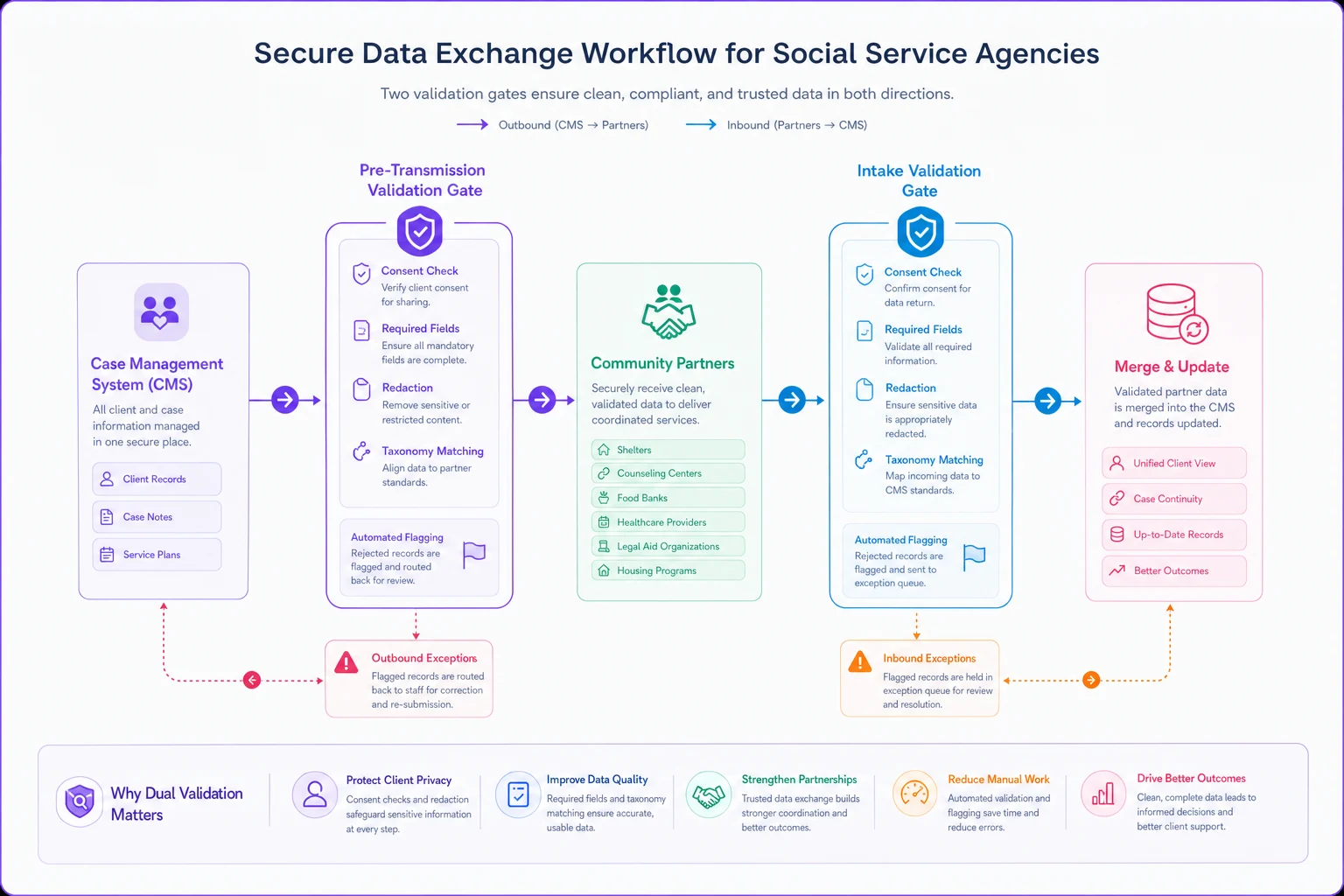
This diagram shows the pre-transmission and intake validation gates and how records move and get flagged.
Before any batch of records leaves your system, it passes a pre-transmission validation check — either automated or a quick manual pass against a fixed list. The check confirms: consent field populated and matching the agreement scope, required fields present, redaction applied where rules demand it, taxonomy matching what the receiving partner uses. Records that fail don't go. They kick back for correction.
On the inbound side, you run the mirror image. Partner records don't get merged into your live data until they pass an intake validation gate. Missing required fields, mismatched consent, freehand entries in structured fields — those get flagged and returned to the partner, not silently absorbed. This one habit prevents most cross-agency data rot, because the moment you start returning bad referrals with a specific reason, partners tighten up fast.
This is also where lightweight automation earns its keep — not as a flashy add-on, but as the thing that runs the pre-transmission and intake gates consistently. A platform that applies your validation rules automatically at the boundary, flags mismatches before a human has to eyeball them, and logs every rejected record means your supervisors spend their time reviewing exceptions instead of manually re-checking every field. The rules are yours; the automation just makes sure nobody skips them on a busy day.
The quarterly audit and corrective-action routine
An audit that produces a report nobody acts on is worse than no audit — it creates the illusion of governance. The whole value is in the corrective-action loop that follows.
A quarterly routine that actually changes things runs like this:
-
Sample across the network. Pull records from each active partner relationship — inbound and outbound. You don't need all of them; a reasonable sample per partner surfaces the patterns.
-
Test against the agreement. For each record
did the data that moved match what the data-sharing agreement permits? Was consent scope honored? Did validation hold?
-
Categorize findings. Not "12 problems." Instead
which are one-off human errors, which are systemic (this partner always drops this field), which are agreement gaps (you're sharing something no agreement covers).
-
Assign corrective action with an owner and a date. A finding without a named owner and a deadline is a finding that repeats next quarter.
-
Re-check next quarter. Did the correction hold? If the same partner shows the same gap twice, that's a scorecard downgrade, not another gentle reminder.
The most common mistake here is treating every finding as an individual mistake to be corrected quietly. Systemic findings need systemic fixes — a changed template, a re-negotiated agreement, a downgraded access level. If your audit keeps generating the same finding, the problem isn't the caseworkers. It's the system that keeps letting the error through.
Tie this loop into how you measure everything else too. Data governance quality is an operational outcome worth tracking alongside your service outcomes — the framework for measuring social services outcomes works just as well for "percentage of partner records that passed validation" as it does for client-level results.
A real scenario: a five-agency housing and benefits network
A small housing-stability network — one lead agency, four partners handling benefits enrollment, legal aid, food access, and mental health referrals — was drowning in duplicate and conflicting client records. Roughly 450 active clients, and the lead agency estimated that around a third of shared records had at least one field that didn't match across systems. Consent status was the worst offender. Nobody trusted the shared data, so caseworkers re-verified everything by phone, which added 20–30 minutes per shared case.
They didn't buy a bigger system. They put in the four layers.
-
Built a one-page data-sharing agreement with each partner, listing exact fields and consent scope.
-
Ran partner scorecards; two partners were storing data in shared personal drives and got moved to a secure intake form for anything identifiable.
-
Gave each supervisor the five-item weekly spot-check, anchored to their existing referral review.
-
Stood up pre-transmission and intake validation gates so bad records bounced instead of merging.
-
Ran the first quarterly audit and produced eight corrective actions, each with an owner.
Within about two quarters, the mismatched-field rate dropped from roughly a third of records to well under 10%. The phone re-verification mostly stopped for standard cases. The funder audit that had triggered the whole effort came back clean — the network could show not just clean data, but a documented, repeatable process for keeping it clean.
The clean data mattered. But what leadership actually valued was the process — because a process survives staff turnover in a way that one meticulous caseworker never can.
What changes as the network grows
Governance overhead grows with connection points, not with client volume. A network with 200 clients and one partner is simple. A network with 200 clients and six partners has fifteen possible data-sharing relationships to manage, and every new partner multiplies the surface area.
Small networks that scale without a shared governance system tend to hit the same wall around the fourth or fifth partner. That's where informal trust stops working, where "I'll just email Sarah" turns into a compliance gap, and where a single funder audit can surface problems that took two years to accumulate. The networks that scale cleanly treat the four-layer system as infrastructure — built before they need it, maintained quarterly, and enforced weekly by supervisors who have exactly five things to check.
Data governance in social services isn't a policy document. It's a set of small, repeated habits that hold your network's data together at the exact points where it would otherwise fall apart — the handoffs. Get the four layers running, keep them lightweight, and the whole thing stays boring in the best possible way.
Ready to transform your social services workflow?
Join 500+ agencies using TryCasi to improve case outcomes, enhance collaboration, and reduce administrative burden.