



A child welfare caseworker sits across from a mother who needs emergency housing assistance. The mother agrees to share her information with the housing authority. Simple enough, right?
By the time the caseworker navigates three different consent forms, checks two policy manuals, and calls their supervisor twice, forty-five minutes have passed. The mother is frustrated. The housing referral is delayed. And somewhere in that bureaucratic maze, the wrong information might still get shared anyway.
The caseworker needs to figure out: which specific data fields can be shared? Does this consent cover the children's medical records mentioned in the assessment? What about the domestic violence incident from three months ago that's technically part of the case file but not relevant to housing?
This scenario repeats thousands of times daily across social services agencies. Not because caseworkers are incompetent or systems are badly designed, but because consent workflows in social services operate where legal requirements crash into operational pressures and human complexity. Traditional business consent models completely fall apart when you're managing consent for vulnerable populations across multiple service providers.
Most agencies are drowning in complexity that wasn't designed for the way social services actually work.
The operational reality of consent in social services
The consent workflows most social services agencies use today were built for a different era. They assume linear case progression, single-point consent decisions, and clear organizational boundaries. None of which exist in modern social services delivery.
A family enters the system through child protective services. They need mental health support, substance abuse treatment, housing assistance, and employment services. Each provider requires different consent parameters. The mental health provider can't share therapy notes but can confirm attendance. The substance abuse program operates under federal confidentiality rules that override state requirements. The housing authority needs income verification but shouldn't access mental health diagnoses.
Now multiply this complexity by a caseload of 30-40 families, add emergency situations where consent rules might flex, factor in mandated reporting requirements that override consent, and you start to understand why frontline workers spend nearly 30% of their time just managing information sharing permissions.
Traditional approaches treat consent as a one-time checkbox exercise. Sign this form, we'll share your information as needed. Social services consent operates more like a living organism that evolves with each interaction, service addition, and case development.
Where consent systems fracture at scale
Small agencies might manage consent through individual relationships and manual tracking when handling 50-100 cases. But watch what happens as operations grow.
Eliminate case management chaos.
TryCasi helps you organize, monitor, and report on every case efficiently and securely.
- Centralized case tracking
- Automated client notifications
- Team task coordination
No credit card required
At around 200 active cases, informal consent tracking systems start showing cracks. Workers begin missing consent updates. Information gets shared with providers who no longer have active consent. Expired consents aren't caught until an audit reveals dozens of violations.
By 500 cases, you're seeing systematic consent failures. Different workers interpret consent scope differently. One thinks the general consent covers employment verification, another doesn't. Updates to consent status take days to propagate through the system. Crisis interventions operate in consent gray zones that nobody wants to document.
At 1,000+ cases, consent management becomes its own operational burden. Agencies hire dedicated staff just to track consent status. They implement complex spreadsheet systems that immediately become outdated. They create elaborate paper trails that satisfy auditors but don't actually prevent inappropriate information sharing.
The real problem isn't volume—it's complexity multiplication. Every new service provider added to the network creates exponential consent permutations. A network with 10 service types has 45 possible bilateral sharing relationships. Add 5 more services, and suddenly you're managing 105 different consent pathways. Each with its own rules, restrictions, and documentation requirements.
The math gets ugly fast.
Building role-based consent architectures that actually work
Effective consent workflows in social services start with role-based access principles, not individual permissions. Instead of trying to manage consent between every caseworker and every data element, you create consent templates based on professional roles and service relationships.
Core consent template structure:
| Role Type | Default Access | Conditional Access | Never Access |
|---|---|---|---|
| Primary Caseworker | Demographics, service history, case notes | Mental health details (with specific consent) | Protected therapy notes, sealed records |
| Referring Agency | Service dates, compliance status | Assessment summaries (if relevant to referral) | Internal case notes, other provider records |
| Emergency Responder | Safety alerts, medical conditions, medications | Recent incident reports | Historical trauma details, non-emergency medical history |
| Administrative Staff | Contact info, appointment schedule | None | All case content, assessment data |
This matrix approach means frontline workers make fewer individual consent decisions. They identify the role, apply the template, then handle only the exceptions. It reduces decision fatigue and creates consistency across workers.
Templates alone aren't enough though. You need decision trees that guide workers through consent exceptions. Not the flowchart-style decision trees that look impressive on conference room walls but are useless in practice. Real operational decision trees that frontline staff can navigate under pressure.
-
1. Is there immediate danger to client or others? - Yes → Share minimum necessary information to ensure safety - No → Continue to step 2
-
2. Is this a mandated reporting situation? - Yes → Follow mandated reporter protocol (consent not required) - No → Continue to step 3
-
3. Does existing consent cover this specific disclosure? - Yes → Verify consent is current (within 6 months) and proceed - No → Continue to step 4
-
4. Can service be provided without this disclosure? - Yes → Provide service without sharing information - No → Seek verbal consent and document, or delay service
Notice how this tree operates in practice, not theory. It acknowledges that workers make these decisions quickly, often without complete information. It provides clear paths rather than endless branches.
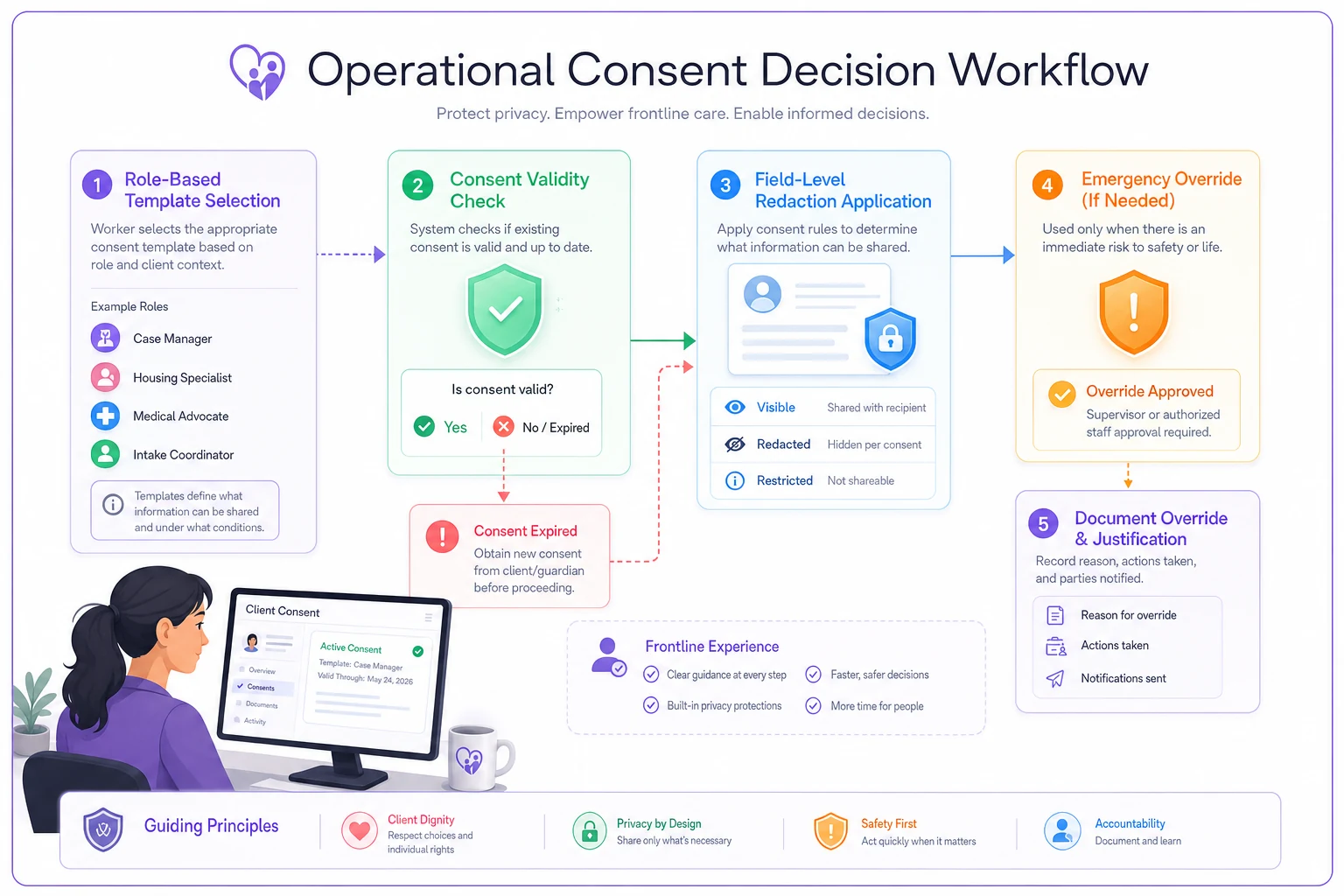
A simple visual like this helps workers memorize the four-step approach under pressure.
Practical redaction practices for frontline operations
Redaction in social services isn't about blacking out documents with markers anymore. Modern redaction operates at the data field level, requiring sophisticated understanding of what information is actually necessary versus what's typically shared out of convenience.
The challenge is that most case management systems weren't built with granular redaction in mind. They generate reports that include everything or nothing. So agencies develop workaround redaction practices that technically meet requirements but create operational nightmares.
A housing provider needs verification that a family is receiving services. The caseworker can't send the full case report (contains protected health information) or the summary report (includes details about domestic violence). So they manually create a custom letter confirming service enrollment. This takes 20 minutes. Multiply by dozens of similar requests weekly, and you've got caseworkers spending full days just creating redacted documents.
Smart redaction practice builds standard redacted templates for common scenarios:
Service Verification Template (Housing/Employment) The template includes client name, enrollment date, expected completion. It excludes diagnosis, treatment details, family dynamics.
Court Report Template (Custody/Criminal) The template includes compliance status, attendance, general progress. It excludes therapy content, medical specifics, third-party information.
Inter-Agency Referral Template (Service Coordination) The template includes presenting needs, relevant history, service goals. It excludes unrelated case history, other provider details, investigation findings.
Maintain versioned redaction templates and a quick-change log to track updates after regulatory or court feedback.
Maintaining these templates as living documents that evolve with regulatory changes and operational lessons learned is crucial. One agency discovered their court report template was over-sharing after a judge mentioned details in open court that should have remained confidential. They adjusted the template within days, preventing future disclosures.
These aren't perfect solutions, but they're workable ones.
Minimum necessary datasets for service coordination
The concept of "minimum necessary" information sharing sounds simple until you try to operationalize it across multiple service providers with different definitions of necessary.
A substance abuse treatment provider considers attendance data the minimum necessary for reporting to child welfare. But child welfare wants to know if the parent appears impaired during visits—information the treatment provider considers beyond minimum necessary. Meanwhile, the court wants both pieces of information plus drug test results, creating three different interpretations of "minimum necessary" for the same case.
Building minimum necessary datasets requires mapping actual information needs against service delivery requirements. Not what providers want to know, but what they need to know to deliver their specific service.
A transportation service helping clients get to appointments needs pickup/dropoff addresses, appointment times, mobility requirements, and emergency contact information. They don't need why the client is receiving services, case history, medical diagnoses (unless mobility-related), or family dynamics.
This seems obvious, yet transportation providers routinely receive full case summaries "just in case." This over-sharing creates unnecessary privacy risks and violates the minimum necessary principle.
The problem is that "just in case" becomes the default when nobody wants to be responsible for not sharing something that might have been relevant later. But that's not how minimum necessary works.
Decision support tools that work under pressure
Frontline caseworkers make consent decisions when stressed, rushed, and dealing with crisis situations. The elegant policy manual sitting on the shelf is useless when a school counselor calls needing immediate information about a child's trauma history to prevent a behavioral crisis.
Practical decision support tools recognize these operational realities. They provide quick-reference guides optimized for common scenarios, not comprehensive legal documentation.
Can Share WITHOUT Additional Consent:
-
1. Mandated reporting situations
-
2. Immediate safety threats
-
3. Court-ordered disclosures
-
4. Treatment team coordination (with existing ROI)
Need Verbal Consent (Document Later):
-
1. Emergency medical situations
-
2. Crisis intervention coordination
-
3. Temporary placement arrangements
Always Need Written Consent:
-
1. Substance abuse treatment records
-
2. Mental health therapy notes
-
3. Information to family members
-
4. Media or public disclosure
This isn't legally comprehensive, but it covers 90% of daily decisions. Workers can reference it quickly without disrupting client interactions.
The key is accepting that you can't prepare workers for every possible scenario. You prepare them for the common ones and give them clear escalation paths for the unusual ones.
The technology gap in consent management
Most case management systems treat consent as a binary state—you have it or you don't. But operational consent in social services functions more like a spectrum with conditions, exceptions, and expiration dates.
Modern consent management requires systems that understand role-based access controls tied to consent templates, automatic consent expiration and renewal workflows, granular field-level sharing permissions, audit trails that capture not just what was shared but why, and emergency override protocols with documentation requirements.
The gap between what agencies need and what their systems provide creates the shadow IT phenomenon—workers maintaining separate spreadsheets, using personal phones for quick consultations, sharing information through unofficial channels because official ones are too cumbersome.
One mid-sized agency tracked their actual information sharing patterns for a month. They discovered over 60% of routine information exchanges happened outside their official case management system because the system's consent workflows added 15-20 minutes to each interaction. Workers weren't being careless—they were being practical.
AI-enhanced operational platforms are starting to make a real difference here. Not by replacing human judgment in consent decisions, but by automating the administrative burden around consent management. AI can track consent expirations, flag potential sharing violations before they happen, and generate properly redacted documents based on recipient role and consent status.
An AI-powered consent workflow might automatically recognize that an information request from a housing provider triggers a specific redaction template, check current consent status, apply appropriate field-level redactions, and generate the response document. What took a caseworker 20 minutes becomes a 30-second review and approval.
The technology exists. The implementation is the hard part.
Real-world implementation challenges
Rolling out new consent workflows in an operating social services agency is like changing the engine on a moving car. You can't stop serving clients while you retool operations.
A regional child welfare agency with roughly 800 active cases attempted a consent workflow overhaul. They started with comprehensive training, beautiful new templates, and detailed decision trees. Within two weeks, workers had reverted to old practices. Why? The new system added steps without removing friction from existing workflows.
The second attempt took a different approach. They identified the three most common consent scenarios (service verification, court reporting, and inter-agency referral) and built streamlined workflows just for those situations. Once workers experienced faster, cleaner consent handling for routine tasks, they became advocates for expanding the system.
The gradual implementation revealed unexpected challenges. Different units had developed their own informal consent interpretations over years. The therapy team considered parental consent sufficient for sharing with schools. The investigation unit required separate educational releases. Standardizing these practices required delicate negotiation and compromise.
You can't force cultural change overnight. But you can make better practices easier than worse ones.
Compliance without paralysis
Regulatory compliance around consent often paralyzes operations. Agencies become so focused on avoiding violations that they stop sharing information necessary for service coordination. This risk-averse approach might satisfy auditors but fails clients who need integrated services.
The balance point requires clear documentation of decision-making rationales, not just decisions themselves. When a caseworker shares protected information during a crisis, the question isn't just "did you have consent?" but "why did you determine this disclosure was necessary and appropriate?"
Building this documentation into workflows—rather than treating it as an additional step—makes compliance sustainable. A simple prompt in the case management system: "Brief reason for emergency disclosure" with pre-populated common options creates an audit trail without disrupting crisis response.
Good compliance systems protect agencies AND clients. Bad ones just protect agencies.
Measuring consent workflow effectiveness
Most agencies measure consent management through violation counts—how many times did we incorrectly share information? This negative metric misses the operational impact of overly restrictive consent practices.
-
Time from service request to information sharing
-
Percentage of referrals completed without consent delays
-
Worker time spent on consent administration
-
Client complaints about information sharing (too much OR too little)
-
Service coordination gaps due to consent barriers
One agency discovered their violation rate was near zero, but service coordination suffered because workers were too afraid to share anything. They adjusted their metrics to track "appropriate sharing opportunities missed"—situations where sharing was permitted and would have benefited the client but didn't happen due to confusion or risk aversion.
Sometimes being too careful creates different problems. Finding the right balance matters more than perfect protection at any cost.
Building consent into service culture
Consent workflows in social services aren't just about compliance or operations—they're about respect for client autonomy within systems that often strip away control. Getting consent right means clients feel heard and respected, not processed and managed.
This requires shifting from consent as barrier to consent as engagement tool. Each consent conversation becomes an opportunity to explain how information sharing supports service goals. Clients who understand why their information needs to be shared and how it will be protected are more likely to provide meaningful consent rather than blanket agreement or refusal.
Training frontline workers to have these conversations—not just process forms—transforms consent from administrative burden to therapeutic tool. A caseworker who can clearly explain why the housing authority needs income verification but not medical history builds trust while obtaining appropriate consent.
When clients understand the system, they work with it instead of against it.
Moving forward with practical consent management
The path forward for consent workflows in social services isn't about perfect systems or complete automation. It's about building practical tools that support frontline decision-making while protecting client privacy and promoting service coordination.
This means accepting that consent management will always involve judgment calls and gray areas. The goal isn't eliminating discretion but supporting it with clear frameworks, practical tools, and systems that reduce administrative burden without sacrificing protection.
Agencies that get this right stop treating consent as a compliance checkbox and start seeing it as core operational infrastructure. They invest in training, tools, and technology that make consent management easier, not just more documented. They measure success through service delivery improvements, not just violation avoidance.
Agencies struggling with consent workflows aren't failing because they don't care about privacy or don't understand regulations. They're drowning in complexity that traditional approaches can't handle. Moving forward requires acknowledging this complexity while building systems simple enough for stressed caseworkers to navigate consistently.
Whether through role-based templates, AI-assisted redaction, or practical decision trees, the focus must remain on supporting frontline workers who make hundreds of consent decisions weekly. Get that right, and compliance follows. Get it wrong, and no amount of policy documentation or training will prevent the informal workarounds that create real privacy risks.
Agencies that thrive in this environment will be those that bridge the gap between regulatory requirements and operational reality, building consent workflows that protect privacy while enabling the service coordination vulnerable populations desperately need.
Ready to transform your social services workflow?
Join 500+ agencies using TryCasi to improve case outcomes, enhance collaboration, and reduce administrative burden.