

Most casework transformations don't fail because the software was bad. They fail because the org bought a new system and asked people to keep doing their old jobs on top of it. Nobody redesigned the roles. Nobody re-scoped what a caseworker actually owns versus what the tool now handles. So the new platform becomes another window everyone keeps open but nobody trusts, and six months later the agency is running two systems in parallel — the official one and the real one living in spreadsheets and someone's inbox.
That's the pattern worth understanding before you touch a single configuration screen. Digital transformation change management in social services is mostly a role and coordination problem wearing a technology costume. The tech is the easy part. The hard part is that you're changing what dozens of people do every day, how supervisors spend their coaching time, and how you'll even know if any of it stuck.
This is the roadmap I'd hand a director who's about to lead one of these efforts and doesn't want to be back at square one next fiscal year.
Why these projects quietly fall apart
A typical example: an agency rolls out a new case management platform, runs two weeks of training, declares go-live, and moves on. For about a month, usage numbers look fine because everyone's still in "new tool" mode. Then caseloads spike, a couple of experienced staff leave, and people revert. The intake coordinator goes back to her personal tracking sheet because it's faster under pressure. A supervisor stops enforcing note timeliness because he's covering three vacant desks. Within a quarter, the "single source of truth" has holes in it, and leadership starts hearing that "the system doesn't work."
The system worked fine. What broke was everything around it. The caseworker still has the same 30-plus tasks she had before, plus the new data entry, minus any of the manual steps the platform was supposed to eliminate. That's not transformation. That's addition.
The rollouts that survive tend to share three traits: roles were genuinely redesigned (not just retrained), supervisors were coached to manage the transition and not just the caseload, and someone tracked adoption with numbers honest enough to be uncomfortable.
Start with role redesign, not training
Training teaches people to use a tool. Role redesign changes what they're accountable for. Skip the second one and the first one wears off fast.
Eliminate case management chaos.
TryCasi helps you organize, monitor, and report on every case efficiently and securely.
- Centralized case tracking
- Automated client notifications
- Team task coordination
No credit card required
Before go-live, every affected role needs a redesign worksheet. It doesn't have to be complicated — a one-page document per role answering four questions:
-
What tasks does this role stop doing because the platform now handles them?
-
What tasks does this role start doing that didn't exist before?
-
What tasks stay the same but now happen in a different place?
-
What decisions does this role own that used to be ambiguous?
That fourth one is quietly the most important. In most agencies, decision ownership is fuzzy — who decides a case is ready to close, who approves a referral, who resolves a data conflict. A transformation is a rare chance to nail that down, and if you don't, the new system just makes the ambiguity more visible and more frustrating.
A simple role-redesign template
| Field | Example for an Intake Coordinator |
|---|---|
| Role | Intake Coordinator |
| Tasks removed | Manual duplicate-check across spreadsheets; paper consent filing |
| Tasks added | Verifying auto-flagged duplicates; confirming consent status in-system |
| Tasks relocated | Initial assessment now entered directly, not transcribed later |
| New decision ownership | Owns "ready to assign" flag; escalates ambiguous eligibility |
| Time impact (est.) | ~40 min/day freed from duplicate checks, ~15 min added on verification |
| Biggest risk | Reverting to personal tracker under high volume |
The "time impact" row matters more than people expect. If you can't articulate roughly how a role's day changes — where minutes are freed and where they're added — you haven't actually redesigned the role. You've just moved furniture. And staff can tell immediately.
One pattern worth naming: the roles that lose the most manual work are often the ones that resist hardest, because that manual work was how they felt in control. A coordinator who spent years being the person who "knew where everything was" doesn't necessarily celebrate when the system knows instead. That's a status shift, not just a workflow shift. Call it out during redesign or it'll surface later as passive resistance.
Supervisors are the actual pivot point
If there's one place these projects live or die, it's the front-line supervisor. They're the ones who either reinforce the new way daily or quietly let it slide because they're drowning. Most transformation plans give supervisors a training session and nothing else — no support for how to lead people through change, which is a completely different skill than managing a caseload.
You need a coaching cadence for supervisors specifically about the transition, running alongside their normal supervision work. If you don't already have a structured rhythm for that, the 30/60/90 supervision model built to prevent burnout is a solid foundation to layer transition coaching onto.
Supervisor coaching agenda — first 90 days
Keep these short and focused. Not another meeting that gets cancelled.
Weeks 1–2 (weekly, 30 min):
-
Review each direct report's redesign worksheet — does the person actually understand what changed?
-
Identify who's at highest reversion risk and why
-
Practice one "correction conversation" script (how to redirect someone back to the system without shaming them)
Weeks 3–6 (biweekly, 30 min):
-
Walk through actual adoption numbers for their unit
-
Surface workarounds — not to punish, but to understand why the workaround felt necessary
-
Escalate systemic friction (if five people invented the same workaround, the process is wrong, not the people)
Weeks 7–12 (biweekly, 45 min):
-
Shift from compliance to quality — are notes actually better, or just present?
-
Coach on recognizing and reinforcing staff who've genuinely adapted
-
Start building the habits that outlast the project team
The workaround conversation in weeks 3–6 is the most valuable one and the most often skipped. When someone builds a shadow spreadsheet, that's data. It's telling you the official workflow has a gap. Punish it and you lose the signal. Good supervisors treat workarounds like bug reports.
Adoption KPIs that tell you the truth
Most agencies measure adoption with login counts. Logins tell you almost nothing. Someone can log in every day and still route the real work around the system.
You want KPIs that measure whether the work actually happens in the platform, and whether the quality is real. Split them into three buckets:
Usage depth (is the work happening in-system?)
-
% of new cases fully created in-platform within 24 hours (target
climbing toward 90%+ by month 3)
-
% of case notes entered within the SLA window vs. entered late in batches
-
Number of active shadow trackers still in use (target
trending to zero)
Quality (is the data trustworthy?)
-
% of required fields completed accurately on spot-check (sample around 10 cases per unit monthly)
-
Duplicate case rate before vs. after
-
Referral records with complete confirmation loops
Behavior (are people actually adapting?)
-
% of staff who've stopped using their old method entirely
-
Supervisor-reported reversion incidents per unit
-
Time-to-complete for a standard intake, tracked monthly
A realistic trajectory: usage depth climbs fast in month one, dips in month two when real caseload pressure hits, then recovers in month three if supervisor coaching is doing its job. If you don't see a month-two dip, either your numbers aren't honest or the volume hasn't hit yet. The dip isn't failure. Not planning for it is.
One caution — don't publish these numbers as a leaderboard between units too early. Under pressure, teams game whatever you rank them on. You'll get 100% "on-time" notes that are three words long. Measure quality alongside quantity from day one, or you'll optimize for the wrong thing.
A quick real scenario
A mid-sized agency — roughly 40 caseworkers across four units — moved from a patchwork of spreadsheets and an aging database to a single cloud platform. Their first attempt the year before had stalled; usage had drifted back to about half the team within four months.
The second time, they led with role redesign. Every role got a worksheet. The intake team turned out to be spending close to an hour a day on manual duplicate checks the new system could handle automatically — so they reassigned that freed time to verification and same-day assignment, which had been a chronic bottleneck.
Supervisors ran the transition coaching cadence and, critically, surfaced workarounds instead of hiding them. Two shadow spreadsheets turned out to be tracking a partner-referral field the team hadn't configured properly. Fixing that config killed the need for the workaround entirely.
By month four, duplicate case creation had dropped by roughly two-thirds, and same-day intake assignment went from happening maybe half the time to being the clear default. Adoption held above 85% because the new way was genuinely faster once the roles matched the tool. Nobody was fighting the system to do their job.
For the mechanics of the rollout itself, the phasing and migration side is worth pairing with a proper low-friction rollout playbook with a 30/60/90 adoption SLA, since role redesign and technical rollout have to move in step.
When this level of effort makes sense — and when it doesn't
When it's worth the full playbook:
-
You're replacing a core system multiple roles depend on daily
-
You've had a failed or half-adopted rollout before
-
Caseloads are high enough that reversion under pressure is a real risk
-
Multiple units or partner agencies have to coordinate through the same data
When it's overkill:
-
You're adding a small feature or a single-team tool
-
Fewer than a handful of people are affected and workflows barely change
-
The change is temporary or a short pilot
Who should NOT lead this the way many do: Anyone treating it as an IT project. If the project owner is purely technical and nobody owns the role and people side, it will underdeliver no matter how clean the configuration is. The lead needs authority over how jobs are defined, not just how the software is set up.
There's also a staffing reality worth naming. Transformation lands very differently on a stable team than on one with heavy turnover and vacant desks. If half your unit is temporary coverage, redesign is harder because there's less institutional muscle to reshape. That connects to the bigger retention picture — the economics in this career ladders and caseload rules retention model are worth understanding before you assume your team is stable enough to absorb a major change.
The 12-month sustainment checklist
Most transformations get intense attention for 90 days and then go quiet — right when the real test begins. Sustainment is where the earlier work either compounds or evaporates.
Months 1–3 (Establish):
-
[ ] Every role has a completed redesign worksheet, reviewed with the person
-
[ ] Supervisor transition coaching cadence running on schedule
-
[ ] Baseline adoption KPIs captured before go-live for comparison
-
[ ] Shadow-tracker inventory documented (you can't retire what you haven't found)
Months 4–6 (Stabilize):
-
[ ] Month-two dip identified and addressed unit by unit
-
[ ] Config gaps behind workarounds fixed
-
[ ] Quality KPIs added alongside usage KPIs, not after
-
[ ] First cohort of new hires onboarded directly into the new way (no legacy training)
Months 7–9 (Embed):
-
[ ] Redesigned roles reflected in updated job descriptions and evaluations
-
[ ] Supervisor coaching shifts from compliance to quality
-
[ ] Shadow trackers effectively at zero, or a documented reason why not
-
[ ] Adoption KPIs stable through at least one high-volume period
Months 10–12 (Sustain):
-
[ ] Transformation team hands ownership to line management
-
[ ] Onboarding materials fully reflect current-state roles, not project-era ones
-
[ ] Annual review of whether freed time actually got reallocated or quietly re-absorbed
-
[ ] Decision on next iteration based on real usage data
That last item — checking whether freed time got reallocated — is the one almost nobody circles back to. You freed the intake team roughly an hour a day. Where did that hour go? If it silently got eaten by rising caseload with no deliberate decision, you got efficiency but no strategic gain. Naming where the recovered capacity goes is what turns a tool swap into an actual operating improvement.
The through-line
Strip this all the way down and casework transformation is three linked systems, not one project. Role redesign defines what the work is. Supervisor coaching determines whether people actually do the work that way under pressure. Adoption KPIs tell you the truth about both. Pull on any one of them alone and the other two drag it back to the old state.
Here's a quick visual to keep the sequence clear.
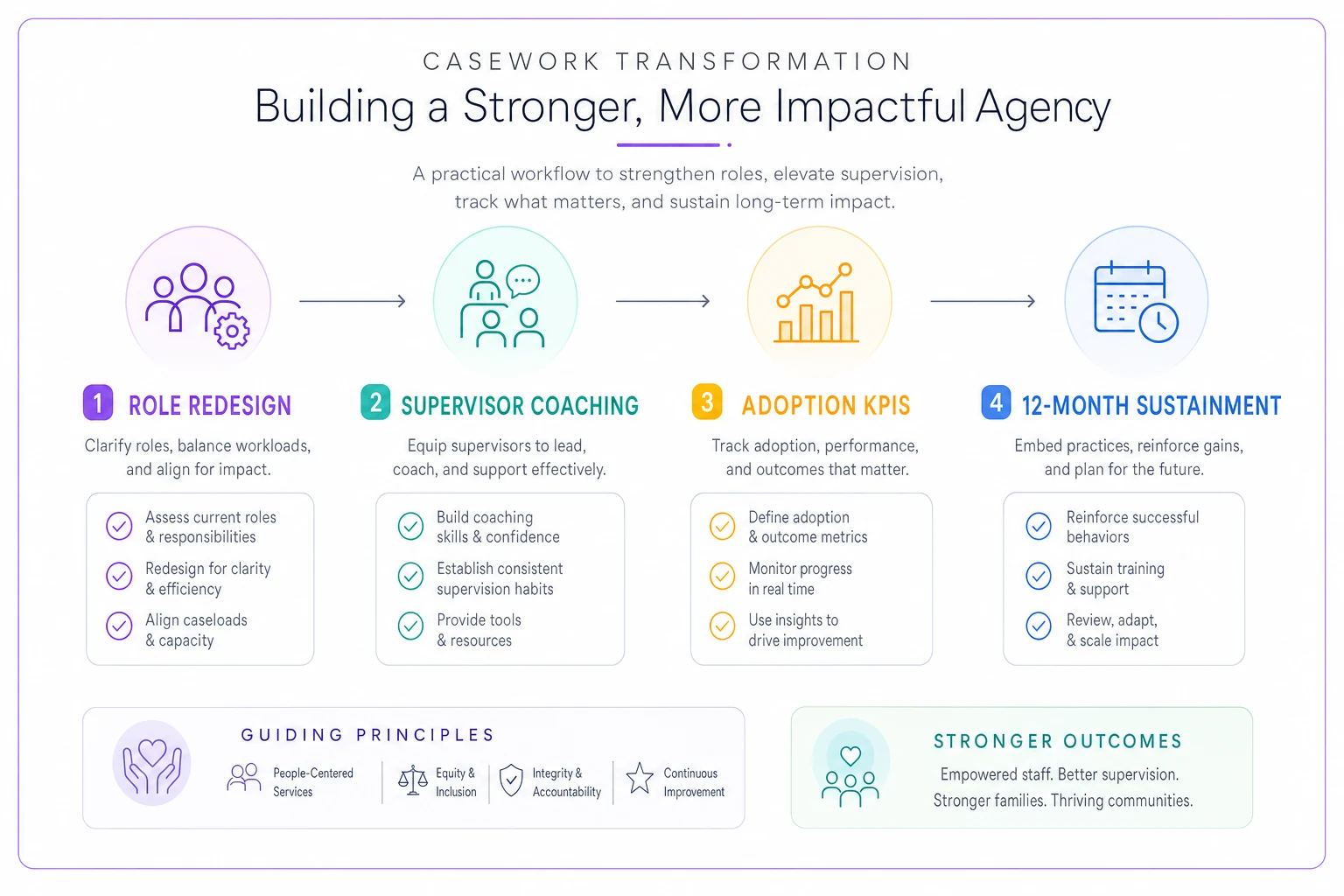
Use this as a one-page artifact to show stakeholders where effort needs to land across people, managers, and measurement.
The agencies that get this right aren't the ones with the fanciest software. They're the ones who understood, before go-live, that they were redesigning jobs and reshaping how supervisors spend their attention — and who kept measuring honestly long after the launch buzz wore off. The technology makes a well-designed system faster. It can't rescue a badly designed one.
Ready to transform your social services workflow?
Join 500+ agencies using TryCasi to improve case outcomes, enhance collaboration, and reduce administrative burden.