


Most multi-agency partnerships don't fail because people stop caring. They fail because nobody wrote down who owns what, what "urgent" actually means to each partner, and what happens when a referral disappears into another agency's inbox for eleven days.
You've probably lived this. A housing partner promises a warm handoff, your caseworker sends the packet, and then silence. Two weeks later the client calls you — not them — asking why nobody followed up. Now you're doing damage control on a process you thought you'd handed off.
The frustrating part is that everyone in these networks is usually competent. The breakdown is structural. When three, five, or nine agencies share clients but not accountability, coordination becomes a game of assumptions. This article lays out a governance blueprint you can adopt more or less as-is, with reproducible artifacts: minimum data-exchange clauses, a partner roles matrix, a shared SLA matrix, and a quarterly partner review ritual. Sample MOU language, acceptance tests, and a review agenda are included so you're not starting from a blank page.
Why multi-agency coordination breaks (and why it gets worse as you add partners)
There's a pattern that shows up across social-service networks: coordination costs don't grow linearly with the number of partners. They grow closer to the number of relationships between partners. Two agencies have one relationship to manage. Five agencies have ten. That's why a network that ran fine with three partners suddenly feels chaotic at six or seven.
Each new partner brings its own intake language, its own definition of "high priority," its own consent forms, and its own idea of how fast a callback should happen. Without a shared frame, every handoff becomes a small negotiation. Multiply that across a caseload and you get the complaints everyone recognizes: duplicated assessments, clients re-telling their trauma four times, referrals that stall, and no obvious person to escalate to.
A few structural failure points worth naming:
-
No shared data-exchange floor. Partner A sends a referral with a name and a phone number. Partner B needs risk level, consent status, and last contact date before they can act. The gap gets filled by phone tag.
-
Undefined ownership at the handoff. Everyone assumes the other agency now owns follow-up. Nobody does.
-
SLAs that exist only in one agency's head. Your team thinks 48 hours is reasonable. The partner thinks a week is generous. Neither wrote it down.
-
No standing review. Problems get addressed reactively — during a crisis, in a heated email thread — instead of a calm quarterly conversation.
If you've already tightened your internal handoffs through something like a governance playbook for cross-team casework, you know how much smoother things get inside one organization. The blueprint below extends that same discipline across organizational lines, which is harder because you can't simply mandate compliance — you have to negotiate it.
The four artifacts, and how they connect
The mistake most networks make is treating governance as one big document nobody reads. A 40-page MOU gets signed once and buried. What actually works is a small set of living artifacts, each doing one job, each referencing the others:
Eliminate case management chaos.
TryCasi helps you organize, monitor, and report on every case efficiently and securely.
- Centralized case tracking
- Automated client notifications
- Team task coordination
No credit card required
-
Minimum data-exchange clauses — what information must travel with every shared client.
-
Partner roles matrix — who is accountable, consulted, or informed for each shared function.
-
Shared SLA matrix — agreed response and resolution times, tiered by urgency.
-
Quarterly partner review ritual — the standing meeting where the first three get inspected and adjusted.
These four aren't independent. The data-exchange clause feeds the SLA — you can't meet a 24-hour response target if the referral arrives with half the fields blank. The roles matrix tells you who to hold to the SLA. The quarterly review is where you catch drift in all three before it hardens into resentment. Skip any one and the others degrade.
The diagram below shows how the four artifacts feed each other in a cycle.
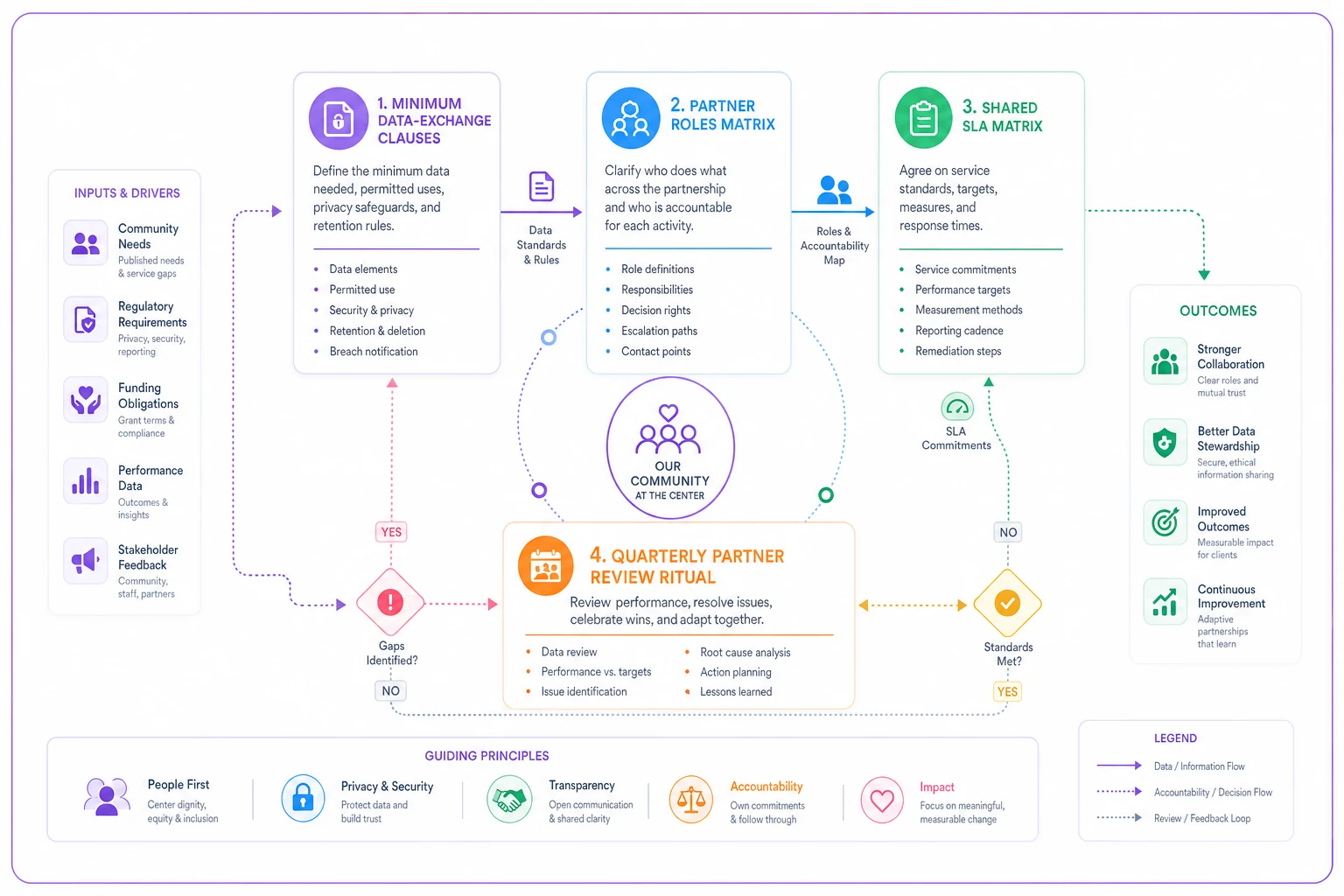
See the cycle as a heartbeat: data enables SLAs, SLAs require named owners, and the quarterly ritual inspects and updates both.
Artifact 1: Minimum data-exchange clauses
This is the foundation, and it's usually the weakest part of real networks. A referral that arrives incomplete doesn't just slow one case — it forces the receiving agency to re-collect information the client already gave someone else, which is exactly the kind of duplication that erodes trust over time.
Define a minimum data set that every partner agrees must accompany a shared client. Not everything — just the floor below which a handoff is considered incomplete and can be sent back. A workable minimum usually includes:
-
Client identifier (shared ID or agreed matching fields)
-
Consent status and scope (what can be shared, with whom, for how long)
-
Presenting need and risk level
-
Last contact date and contact method
-
Assigned worker and their agency
-
Any active safety flags
If your network has already built something like a shared intake dataset blueprint, reuse those field definitions here rather than creating a parallel standard. The whole point is one shared vocabulary, not one per agency.
Sample MOU language — data exchange
> "Each Party agrees that any client referred to another Party shall be accompanied by the Minimum Data Set as defined in Appendix A. A referral lacking any required Minimum Data Set field may be returned to the sending Party for completion within [1 business day] and shall not start the SLA response clock until complete. Parties agree to share only data for which valid, documented client consent exists, and to honor consent scope and expiration as recorded at intake."
The clause about the SLA clock not starting until data is complete is the part people forget, and it's the part that prevents gaming. Without it, a partner can technically "respond" to an incomplete referral by asking for the missing fields — resetting nothing — while the client waits.
For anything involving consent scope, data retention, or role-based access, anchor this artifact to a real data governance playbook for small social-service networks so you're not making privacy decisions ad hoc inside the MOU itself.
Artifact 2: The partner roles matrix
Once data moves cleanly, the next question is: who's accountable for what? A roles matrix answers this per function, not per person, so it survives staff turnover. The classic RACI format works well — Responsible, Accountable, Consulted, Informed — but keep it lean. A matrix with 30 rows won't get used.
Here's a compact example for a housing-and-behavioral-health network:
| Function | Lead Agency | Support Agency | Consulted | Informed |
|---|---|---|---|---|
| Initial referral & consent capture | Intake org (A) | — | Receiving agency | All partners |
| Housing placement | Housing org (B) | Case mgmt (A) | Behavioral health (C) | Client |
| Behavioral health assessment | BH org (C) | — | Case mgmt (A) | Housing org (B) |
| Crisis escalation | On-call agency (rotating) | All | — | All partners |
| Case closure decision | Case mgmt (A) | Housing (B), BH (C) | Client | All partners |
| Data-quality correction | Owning agency of record | — | — | Requesting agency |
The most useful column is "Accountable/Lead," because in real operations the failure usually isn't that nobody can act — it's that everybody assumes someone else will. Naming one accountable agency per function eliminates the diffusion of responsibility that kills warm handoffs.
Worth flagging: rotating functions like crisis escalation need an explicit schedule attached. Otherwise "rotating" quietly becomes "whoever picks up the phone," which means the most reliable partner burns out covering everyone else.
Artifact 3: The shared SLA matrix
This is where most networks discover they never actually agreed on anything. Everyone carries a private sense of "reasonable," and those senses are often wildly different. The shared SLA matrix forces that conversation into the open and produces numbers everyone has signed.
Tier your SLAs by urgency rather than setting one flat standard — a same-day crisis response and a routine benefits referral shouldn't share a clock. A practical three-tier structure:
| Urgency tier | Definition | Acknowledgment | First substantive action | Resolution / update |
|---|---|---|---|---|
| Tier 1 — Crisis | Immediate safety risk | 1 hour | 4 hours | Continuous until stable |
| Tier 2 — Priority | Time-sensitive need (housing loss imminent, etc.) | Same business day | 2 business days | 5 business days |
| Tier 3 — Routine | Standard referral / follow-up | 2 business days | 5 business days | 10 business days |
If your network serves populations where access barriers vary, layer this against an equity-adjusted approach so underserved groups don't get quietly deprioritized by a "neutral" clock that favors the easiest-to-reach clients.
Sample acceptance tests for SLAs
-
Referral round-trip test Send a clearly-marked synthetic referral. Does the partner acknowledge within the tier's window? Log the timestamp.
-
Incomplete-referral test Send a referral missing one required field. Is it correctly bounced without starting the SLA clock?
-
Escalation test Trigger a mock Tier 1 case. Does the on-call chain respond within an hour, and does the right accountable agency pick it up?
-
Consent-scope test Attempt to route data outside the consented scope. Does the receiving agency catch and refuse it?
Run these once at partner onboarding and spot-check one per quarter. A partner that passes onboarding but silently degrades over six months is the most common — and most invisible — failure mode.
Sample MOU language — SLA commitment
> "Parties adopt the Shared SLA Matrix (Appendix B) as the agreed standard for inter-agency response. SLA performance shall be measured from the timestamp at which a complete referral is received. Aggregate SLA performance shall be reviewed each quarter. Sustained performance below [85%] on any tier for two consecutive quarters shall trigger a joint corrective-action plan rather than penalty, with the goal of restoring service reliability."
Notice the framing: corrective-action, not penalty. In grant-funded networks with no real contractual leverage over each other, punitive SLAs are fiction. What actually moves behavior is visibility plus a structured, non-blaming conversation — which is exactly what the quarterly ritual provides.
Artifact 4: The quarterly partner review ritual
Governance decays without a heartbeat. The quarterly review is that heartbeat — a standing 90-minute meeting where the network inspects its own performance and adjusts the other three artifacts. Quarterly is the right cadence for governance-level issues; day-to-day referral quality should move faster, through something like a quick referral feedback loop, so the quarterly meeting doesn't get clogged with operational trivia.
Sample quarterly partner review agenda (90 minutes)
-
SLA scorecard review (20 min) — Each tier's performance by agency. Trends, not one-off misses. Acknowledge what's working before dissecting what isn't.
-
Handoff failure walkthrough (20 min) — Pick 2–3 real cases that stalled. Trace where the roles matrix or data set broke. No naming-and-shaming; the target is the process, not the worker.
-
Data-quality check (15 min) — Sample of shared referrals scored against the minimum data set. What field is chronically missing?
-
Acceptance-test results (10 min) — Report from the quarter's spot-checks.
-
Artifact amendments (15 min) — Vote on any changes to the SLA matrix, roles matrix, or data clauses. Record decisions.
-
Action items & owners (10 min) — Every action gets a name and a date. Read them back before closing.
The discipline that makes this work is documenting decisions and assigning a single owner to each action. A review that produces "we should all try harder" produces nothing. A review that produces "Agency B will add risk-level to their referral template by March 15, owner: Dana" produces change.
A realistic scenario: what changes when the blueprint is in place
Consider a mid-sized network — a case-management lead agency, two housing providers, and a behavioral health clinic — sharing roughly 60–80 active clients at any time. Before formalizing governance, their biggest complaint was stalled housing handoffs. Referrals from case management to the housing partners were acknowledged inconsistently, and about a third required a follow-up call just to confirm receipt.
Nobody was tracking it precisely, but caseworkers estimated they were spending several hours a week chasing referral status on cases that should have moved on their own. Clients were being re-assessed by the housing partner because incoming referrals were missing risk level and consent scope — so the client answered the same intrusive questions twice.
After adopting the minimum data set, a shared three-tier SLA, and a quarterly review, the change wasn't dramatic overnight. But it was real. Within two quarters, referral acknowledgment on Tier 2 cases became consistent enough that the "did you get it?" calls mostly stopped. Duplicate housing assessments dropped noticeably because risk and consent fields were now traveling with the referral. The quarterly review surfaced that one housing partner was consistently missing the SLA — not from negligence, but because referrals were landing in a shared inbox nobody owned. A simple roles matrix fix, naming an accountable intake coordinator, resolved it within a single review cycle.
The gain wasn't a headline number. It was fewer stalled cases, less caseworker time spent on coordination overhead, and clients not having to repeat their story to every new door.
Where technology fits (and where it doesn't)
None of these artifacts require software. You can run this entire blueprint on shared documents, a spreadsheet SLA scorecard, and a recurring calendar invite. Plenty of small networks do exactly that, and it beats no governance at all.
Where a shared case-management or referral platform earns its keep is in the measurement layer. Manually timestamping every referral to calculate SLA performance is tedious, and tedious things quietly stop happening. A system that logs when a referral was sent, when it was acknowledged, and by whom turns your quarterly scorecard from a guessing exercise into a report you pull in minutes. The same goes for enforcing the minimum data set — a form that won't submit without the required fields does more for data quality than any MOU clause ever will. The point isn't to buy tools; it's to remove the manual overhead that causes governance rituals to collapse under their own weight.
When this blueprint makes sense (and when it doesn't)
When it's worth the effort:
-
You share clients across three or more agencies and coordination already feels chaotic.
-
Duplicate assessments or stalled referrals are a recurring complaint.
-
You have at least one person per agency who can commit to the quarterly review.
-
Partners are roughly peers — no single agency can simply dictate terms.
When it's premature:
-
You have exactly one referral partner and a quick shared checklist would do. Full RACI matrices for a two-party relationship is over-engineering.
-
The partnership is brand new and still building basic trust. Start with the minimum data set and one simple SLA tier; add the rest once there's a working relationship to formalize.
Who should NOT lead this:
Anyone without buy-in from the other agencies' leadership. You can draft every artifact perfectly, but if partner directors haven't agreed to send someone to the quarterly review, the ritual dies on the calendar. Secure that commitment before writing a single MOU clause.
Getting started without boiling the ocean
Don't roll all four artifacts out at once. The sequence that tends to stick:
Schedule the first quarterly review before you've perfected anything.
-
Start with the minimum data set. It's the least political and delivers immediate relief from duplicate assessments.
-
Add the SLA matrix next, but only two tiers to begin — crisis and routine. Refine to three once you have real data.
-
Build the roles matrix from the handoffs that are actually breaking, not from every function you can imagine.
-
Schedule the first quarterly review before you've perfected anything. The review is where the artifacts get better; waiting until they're "ready" means they never are.
The networks that make this work aren't the ones with the fanciest documents. They're the ones that treat governance as a living practice — a small set of shared artifacts, inspected on a rhythm, adjusted honestly, and owned by named people. Coordination across agencies will never be automatic. But it can absolutely be reliable, and reliable is what your clients feel when they don't have to tell their story a fourth time.
The networks that make this work aren't the ones with the fanciest documents. They're the ones that treat governance as a living practice — a small set of shared artifacts, inspected on a rhythm, adjusted honestly, and owned by named people. Coordination across agencies will never be automatic. But it can absolutely be reliable, and reliable is what your clients feel when they don't have to tell their story a fourth time.
Ready to transform your social services workflow?
Join 500+ agencies using TryCasi to improve case outcomes, enhance collaboration, and reduce administrative burden.