

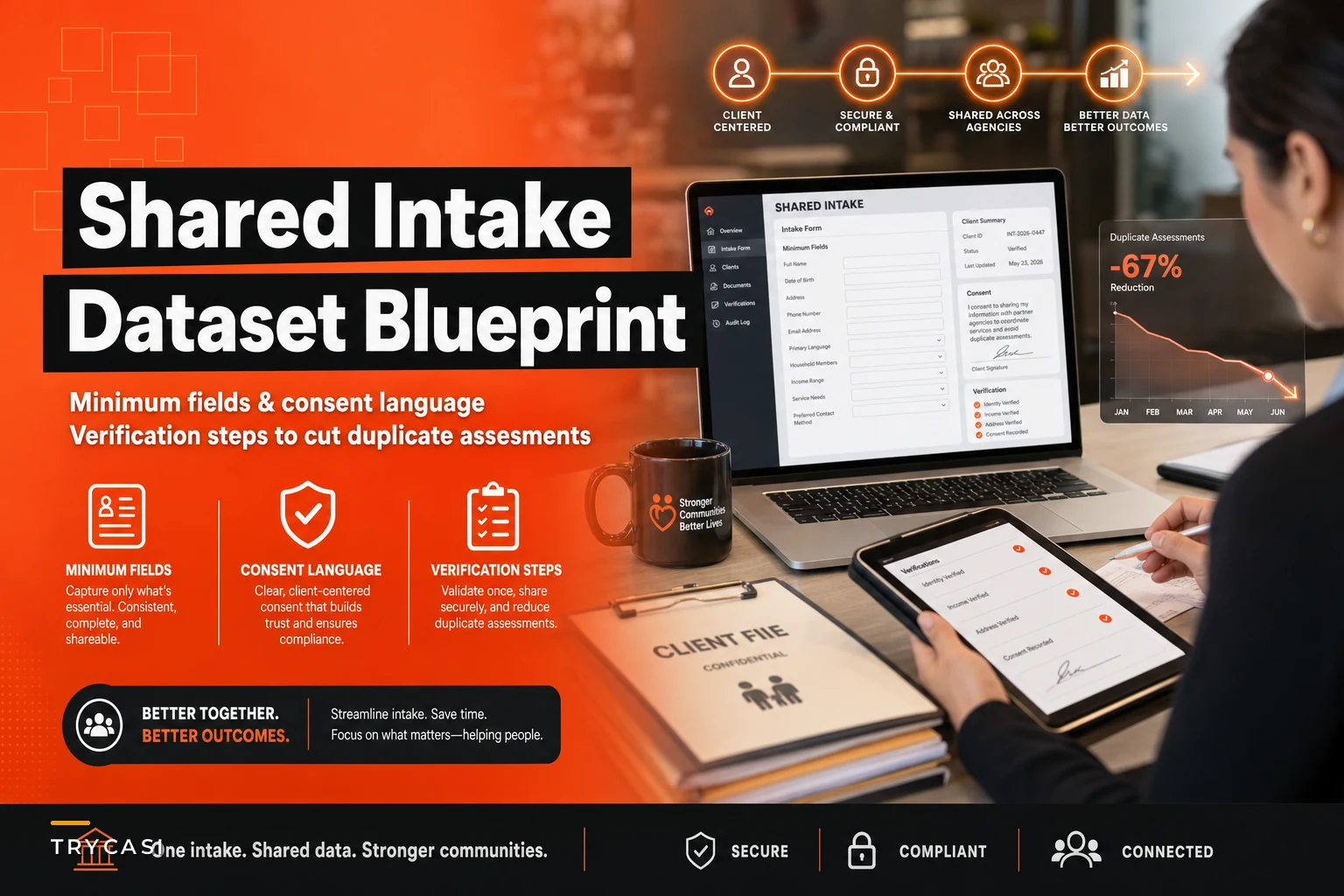

Walk into any coordinated entry meeting and you'll hear the same complaint: clients getting asked their birthdate, housing status, and income by every single provider they touch. Not because anyone enjoys redundant data collection, but because sharing client information between agencies feels legally terrifying and operationally impossible.
A shared intake dataset isn't about building some massive universal database. It's about defining the absolute minimum information multiple agencies can collect once and share legally—cutting those painful duplicate assessments that exhaust both clients and caseworkers.
The same pattern shows up across housing coalitions, health clinics, and benefits programs: agencies default to collecting everything from scratch because nobody's defined what can actually be shared, how to get proper consent, and what verification steps protect everyone involved.
Why intake duplication happens (beyond the obvious legal fears)
Most people assume duplicate assessments exist purely because of HIPAA or privacy concerns. That's only part of it. The real operational mess comes from three deeper issues that even well-funded collaboratives struggle with.
First, every agency uses slightly different field definitions. One organization's "household income" includes SNAP benefits, another doesn't. One defines "chronic homelessness" using HUD criteria, another uses state guidelines. Without standardized definitions, sharing data becomes meaningless—you can't trust that another agency's "verified income" matches what your funding source requires.
Second, consent processes are completely fragmented. A client signs one release for housing navigation, another for mental health services, a third for benefits enrollment. Each form uses different language, covers different time periods, allows different levels of sharing. Case managers spend hours tracking which consents allow what sharing with whom. Eventually everyone gives up and just re-collects everything.
The verification problem compounds all of this. When Agency A shares that a client has two dependents, Agency B has no idea whether that was self-reported, verified through documents, or pulled from an old database. Without knowing verification levels, receiving agencies can't use the data for eligibility determinations. So they ask again.
These aren't technology problems. They're coordination failures that happen when nobody defines the operational basics: what fields matter universally, what consent language works legally, and how to mark verification status clearly.
Building your minimum shared dataset: start with seven universal fields
Creating a shared intake dataset doesn't mean harmonizing hundreds of fields across dozens of forms. Start with the absolute minimum that every agency needs and can legally share under proper consent.
Eliminate case management chaos.
TryCasi helps you organize, monitor, and report on every case efficiently and securely.
- Centralized case tracking
- Automated client notifications
- Team task coordination
No credit card required
Across actual implementations in three different continuum of care regions, these seven fields consistently emerge as the core universal dataset:
1. Client unique identifier (not SSN) Generated ID that stays consistent across systems. Format: First 3 letters of last name + birth month/year + random 3 digits (SMI0387-429)
2. Basic demographics
-
Preferred name (not legal name initially)
-
Date of birth (month/year acceptable for initial screening)
-
Primary language
-
Household composition (number only, not names)
3. Current housing status Using standardized HUD categories:
-
Literally homeless (place not meant for habitation, emergency shelter, transitional housing)
-
At risk of homelessness
-
Fleeing domestic violence
-
Stably housed
4. Contact information
-
Best phone number
-
Can receive texts (yes/no)
-
Safe to leave voicemail (yes/no)
-
Alternative contact person + relationship
5. Priority populations (check all that apply)
-
Veteran
-
Youth under 25
-
Families with children
-
Chronic health condition
-
Disability (no specifics required)
6. Geographic service area
-
Current location (zip code or neighborhood)
-
Preferred service location if different
7. Last service contact
-
Most recent agency interaction
-
Date of last contact
-
Primary service received
Notice what's NOT in this minimum dataset: income details, specific diagnoses, criminal history, substance use, detailed trauma history. Those stay agency-specific based on program requirements.
The power comes from standardizing these seven areas completely. Every field has one definition, one format, one set of acceptable values. No interpretation needed.
Consent language that actually protects everyone
Generic release forms don't work for shared datasets. You need specific language that addresses multi-agency sharing while giving clients real control. Here's consent language tested across multiple jurisdictions:
Core consent paragraph:
"I authorize the agencies listed below to share the specific information marked on this form for the purpose of coordinating services and reducing duplicate assessments. This authorization allows two-way sharing between all marked agencies. I understand I can limit what information is shared and with which agencies by marking the options below."
Critical elements your consent must include:
Specific data elements authorized for sharing (checkbox list):
-
☐ Basic identity information (name, DOB, contact)
-
☐ Household composition
-
☐ Current housing situation
-
☐ Service history with participating agencies
-
☐ Benefits enrollment status
-
☐ Health insurance status
-
☐ Other
Specific agencies authorized (checkbox list):
-
☐ Coordinated Entry System
-
☐ [Local Housing Authority]
-
☐ [Health Clinic Name]
-
☐ [Mental Health Provider]
-
☐ [Benefits Enrollment Agency]
-
☐ Other
Duration and revocation clause:
"This authorization remains valid for 12 months from signature date unless I revoke it earlier. I can revoke this authorization at any time by submitting a written request to any participating agency. Revocation does not affect information already shared based on this authorization."
Voluntary participation statement:
"Signing this form is voluntary. I can refuse to sign without losing access to services from any individual agency. However, refusing may result in needing to complete separate intake processes at each agency."
Verification checkbox for case manager:
-
☐ Client ID verified through
☐ Photo ID ☐ Other document ☐ Collateral contact
-
☐ Consent form explained verbally in client's primary language
-
☐ Client received copy of signed consent
This language has survived legal review in multiple states because it specifies exactly what's being shared, with whom, for how long, and how to stop it. Clients maintain control while agencies get clear authorization.
Lightweight verification: three levels that work operationally
Verification doesn't mean demanding documents for everything. It means clearly marking what level of verification each data point carries, so receiving agencies can decide whether they need to re-verify.
Level 1: Self-reported Client states information, no documentation reviewed. Mark as: (SR) Example: "Household size: 4 (SR)"
Level 2: Observed or collateral Caseworker directly observes or confirms through collateral contact. Mark as: (OB) Example: "Currently unsheltered (OB) - outreach team confirmed camp location"
Level 3: Document verified Official documentation reviewed and dated. Mark as: (DV + date) Example: "Veteran status (DV 10/2024) - DD-214 on file"
This three-tier system works because agencies can quickly see what they're working with. A housing program requiring documented disability can see that disability status is currently (SR) and know they need to collect verification. A drop-in center providing basic services can accept (SR) data without concern.
One detail that matters: verification levels are marked at the field level, not the client level. Someone might have document-verified veteran status but self-reported income. Granular marking prevents confusion.
Verification decision tree for frontline staff:
-
Is this data point required for eligibility determination?
-
No → Accept any verification level
-
Yes → Check required verification level for your program
-
If shared data meets requirement → Use without re-verification
-
If shared data below requirement → Verify to required level
Document all verification decisions in case notes using this format: "Accepted shared data from [Agency] dated [Date]: [Field] verified at [Level]. Meets/does not meet program requirements for [Purpose]."
Verification decision workflow visualization:
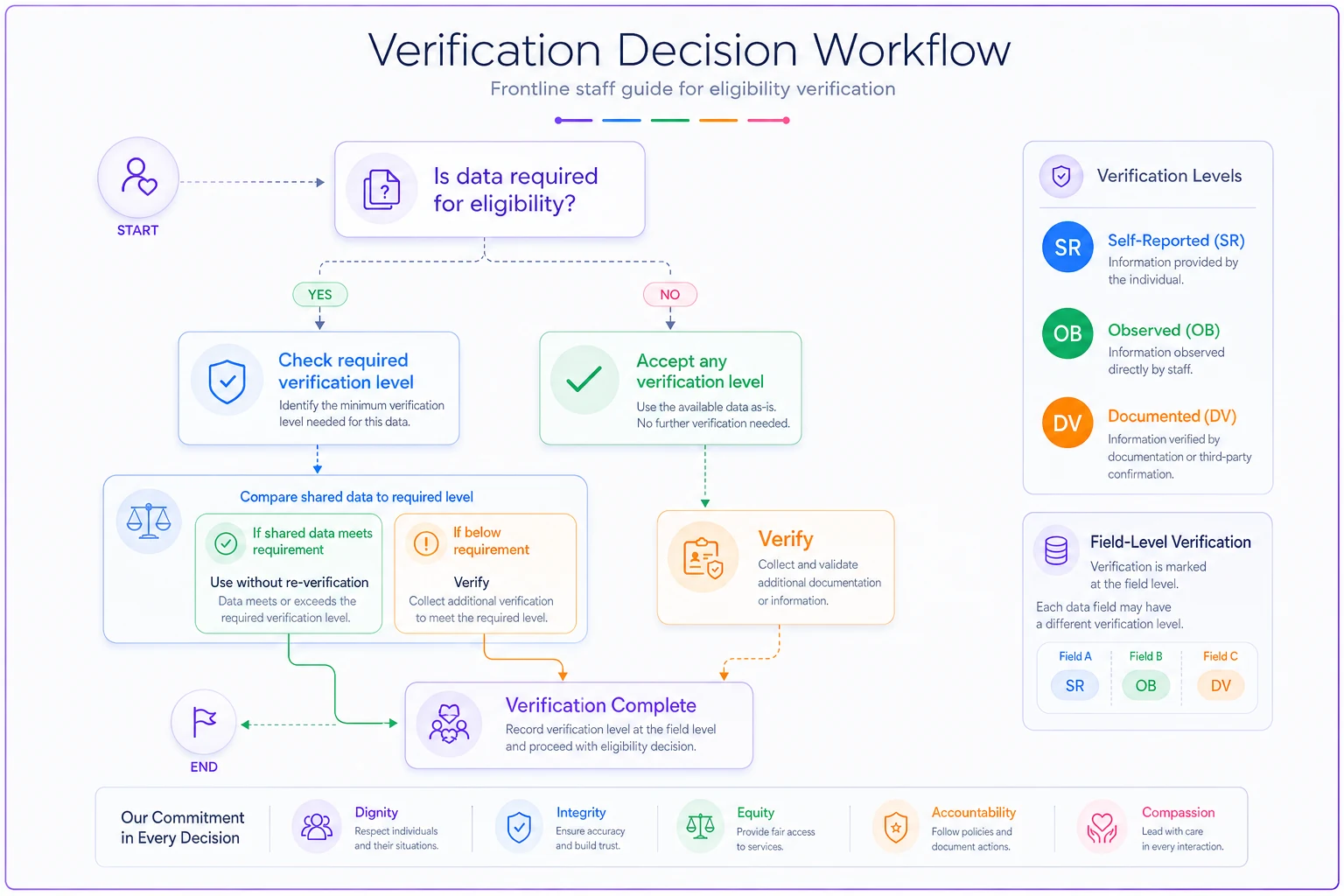
This three-tier approach and clear decision path help reduce unnecessary re-verification while keeping eligibility checks rigorous.
MOU template for operational implementation
The memorandum of understanding between agencies needs teeth—specific operational commitments, not vague partnership language. Here's an MOU structure that actually holds up:
Section 1: Data standardization commitments
-
Each participating agency agrees to
-
Use only the standardized field definitions in Appendix A
-
Update shared fields within 48 hours of client contact
-
Mark verification levels using the three-tier system
-
Maintain audit log of all data access for 3 years
Section 2: Operational responsibilities
Lead agency commits to:
-
Maintain centralized consent tracking system
-
Provide quarterly data quality reports
-
Host monthly coordination meetings
-
Handle client revocation requests within 24 hours
Partner agencies commit to:
-
Train staff on shared dataset procedures within 30 days
-
Designate single point of contact for data issues
-
Report data breaches within 2 hours
-
Participate in quarterly audits
Section 3: Data handling procedures
-
Access limited to staff with direct client service role
-
No bulk downloads permitted
-
Data retention follows strictest applicable regulation
-
Deletion procedures for client revocation
complete within 72 hours
Section 4: Quality assurance metrics
Tracked monthly:
-
Duplicate assessment rate (target
reduce 50% in 6 months)
-
Consent form completion rate (target
85%+)
-
Data verification accuracy (target
90%+ match on audit)
-
Client complaint rate related to data sharing (target
<2%)
Section 5: Dispute resolution
-
Issue escalation path
frontline → supervisor → agency leadership → coalition board
-
Response timeframes
24 hours for urgent, 5 days for standard
-
Termination clause
30-day notice, immediate for breach
This structure works because it ties specific commitments to measurable outcomes. No agency can claim they didn't understand expectations.
Common failure points in shared datasets (and simple fixes)
Failure: Staff revert to old intake forms
Even with solid agreements in place, frontline workers keep using their familiar 40-question intake out of habit. Muscle memory beats new procedures almost every time.
Fix: Create a two-stage intake process. Stage 1 is just the seven shared fields—takes under 5 minutes. Stage 2 is agency-specific supplemental questions. Staff keep their detailed forms but complete the shared dataset first. This respects existing workflows while ensuring core data gets collected consistently.
Failure: Consent forms get lost in the shuffle
Agencies scan consent forms into different systems, name files randomly, can't locate them during audits.
Fix: Use consent ID numbers tied to client IDs. Format: CID-MMYY-### (example: SMI0387-1024-001). Every consent form gets stamped with this ID. File naming becomes automatic. Tracking becomes trivial.
Failure: "Temporary" manual processes become permanent
Coalition says they'll start with paper forms and spreadsheets, then automate later. Three years pass. Still using the same spreadsheet.
Fix: Build automation triggers from day one, even if the full system isn't ready. When a consent form is logged, an automated email goes to partner agencies. When data is updated, a timestamp appears in the shared tracking sheet. These small automations prevent process decay before it starts.
The data quality audit that actually improves things
Audits that only identify problems waste everyone's time. You need audits that immediately feed back into process improvement.
Monthly 10-record audit process:
-
Verification check
Do marked verification levels match actual documentation on file? - If no: retrain on verification marking - If pattern: adjust verification definitions
-
Consent currency
Is there valid consent for all data shared in the past month? - If no: trigger consent renewal process - If pattern: adjust consent duration
-
Field consistency
Do shared fields match the agency's internal records? - If no: identify which system has correct data - If pattern: clarify field definition
-
Access log review
Did only authorized staff access these records? - If no: immediate access review - If pattern: retrain on access protocols
Results go into a simple tracker:
| Agency | Records Audited | Verification Accurate | Consent Current | Fields Match | Unauthorized Access |
|---|---|---|---|---|---|
| Housing Coalition | 10 | 8/10 | 10/10 | 9/10 | 0 |
| Health Center | 10 | 10/10 | 9/10 | 7/10 | 1 |
| Benefits Office | 10 | 9/10 | 10/10 | 10/10 | 0 |
Agencies below 80% on any metric get targeted technical assistance that month. No punishment—just immediate support to fix the process. The point of the audit isn't accountability theater, it's catching problems early enough to actually correct them.
When shared datasets save operations (real examples)
Coordinated entry in mid-size city (population ~200k):
Before shared dataset: 6 agencies, average client completed 6 separate intakes, 3-4 hours total assessment time, 40% dropped out before housing placement.
After implementing minimum dataset: the first-touch agency collects the 7 core fields in about 10 minutes, other agencies pull shared data and only collect supplemental information (15-20 minutes each), total assessment time dropped to around 90 minutes, and dropout rate fell to 22%.
The reduction happened because clients stopped feeling like they were starting over with every referral. Case managers spent less time on data entry and more on actual service planning.
Rural health and housing collaboration:
Three counties sharing a border region, clients frequently moving between service areas, constant re-enrollment in programs.
Implemented shared dataset with geographic flags. When clients moved counties, core information traveled with them. The receiving agency could see previous county services, current verifications, and active consents. Re-enrollment time dropped from about two weeks to two days. Clients maintained benefits continuity during moves.
Critical success factor: all three counties used identical field definitions and verification markers. No interpretation needed when client data crossed county lines.
The technical architecture you actually need
Forget complex data warehouses and API integrations at the start. A shared intake dataset can run on surprisingly simple infrastructure while you build toward fuller automation.
Minimum viable setup:
-
Secure shared drive with folder permissions by agency
-
Standardized spreadsheet template with locked formulas
-
Daily upload process (manual initially)
-
Basic access log (who downloaded what when)
-
Email notifications for updates
This setup costs basically nothing and can launch in about two weeks. As volume grows and funding appears, layer in automation gradually.
Next-level additions:
-
Web form for consent collection (auto-generates consent IDs)
-
Basic database to replace the spreadsheet (even Access works initially)
-
Automated verification flag when documents are uploaded
-
Daily sync instead of manual uploads
-
Role-based access controls
Shared datasets fail from over-engineering, not under-engineering. Start simple, prove value, then enhance. A perfectly designed system nobody uses helps nobody.
Making it stick: the 90-day implementation sprint
Shared dataset initiatives die from long planning cycles. A 90-day sprint gets you to live data sharing before momentum dies:
Days 1-30: Core agreements
-
Week 1
Convene agencies, review minimum 7 fields
-
Week 2
Legal review of consent language
-
Week 3
Finalize MOU, get executive signatures
-
Week 4
Create training materials, schedule sessions
Days 31-60: Pilot preparation
-
Week 5-6
Train pilot team (5 staff per agency maximum)
-
Week 7
Mock data sharing exercise with dummy records
-
Week 8
Fix issues identified in mock exercise
Days 61-90: Live pilot
-
Week 9-10
Begin with new clients only (no retroactive data)
-
Week 11
Expand to 25% of caseload
-
Week 12
Full implementation if metrics are met
Success metrics for full launch:
-
80%+ consent form completion
-
90%+ data fields properly formatted
-
Zero privacy breaches
-
70%+ staff report process is "same or easier" than before
Hit these metrics and scale to all staff. If not, extend the pilot by 30 days with targeted fixes.
Why this beats the alternatives
The typical alternatives all have fatal flaws.
Universal case management systems require all agencies to abandon their existing tools, cost hundreds of thousands of dollars, take years to implement, and usually fail because agencies resist changing core operations. Referral platforms without data sharing reduce warm handoff effectiveness, still require duplicate assessments, and clients feel bounced between agencies without continuity. Paper releases and faxing works legally but operationally it's a mess—forms get lost, data entry errors multiply, no audit trail, impossibly slow.
The minimum shared dataset approach works because it respects existing agency systems while solving the specific problem of duplicate assessment. Agencies keep their specialized tools but share core information efficiently.
Practical datasets beat perfect databases
The shared intake dataset for social services doesn't need to be comprehensive or technologically advanced. It needs to be clearly defined, properly consented, and consistently verified. Seven well-standardized fields with proper consent beat 100 fields that nobody trusts or maintains.
Most coalitions spend years debating what the perfect shared system would look like while clients sit through endless repeated questions. A minimal shared dataset—properly implemented with clear verification and consent—can cut duplicate assessments by roughly half within six months of consistent use.
Define your minimum fields ruthlessly, create consent language that legal and frontline staff both understand, establish three simple verification levels, and audit monthly for quality. Start with manual processes if needed. Add automation as you prove value.
Every week of delay means more clients answering the same questions again, case managers typing the same information again, and service systems operating inefficiently when coordination could be simple. The blueprint is here—pick your seven fields, schedule that first coalition meeting, and get started. Your clients are tired of repeating their stories.
Ready to transform your social services workflow?
Join 500+ agencies using TryCasi to improve case outcomes, enhance collaboration, and reduce administrative burden.