

Most small social-service teams don't have an incident problem. They have a fragmentation problem. When a data breach hits, one group scrambles. When a subpoena lands, a different person panics. When the case system goes down for six hours, the IT contractor gets a frantic call. And when a client walks into a genuine safety crisis, everyone drops everything with no written trace of who decided what.
Four different events. Four different reflexes. Zero shared architecture.
That's the actual failure. Not any single incident, but the fact that your organization responds to each category as if it's never happened before. The result is slow containment, inconsistent documentation, and — the part that burns you a year later — an evidence trail that can't survive an auditor, a regulator, or opposing counsel.
This article is about building one spine that handles all of it. Not four binders. One lifecycle: classify, escalate, contain, document, review. Sized for a team of 8, not a Fortune 500 security operations center.
Why four separate playbooks quietly fail
The reason small teams end up with fragmented response isn't laziness. It's history. Each type of incident arrives attached to a different function.
-
The breach shows up through IT or a vendor notification.
-
The subpoena shows up through the director or legal.
-
The outage shows up through whoever happens to be logged in.
-
The safety crisis shows up through a frontline caseworker.
So each one naturally gets owned by whoever caught it. And each owner builds their own habits. The IT person has a mental checklist. The director keeps a folder. The caseworker fills out whatever form exists that day.
The problem surfaces when two of these overlap — which happens more often than people expect. A ransomware outage is also a breach and may trigger mandatory notifications and may make a subpoenaed record temporarily unproducible. Now you've got four reflexes firing at once with no shared sequence, and people are arguing about who's in charge while the clock runs.
What tends to happen on teams of this size is that the first 90 minutes of any serious incident get spent not on containment but on figuring out who owns the response. That's the gap a unified architecture closes.
Start with a classification taxonomy, not a response plan
You can't escalate what you can't name. Before anyone writes a containment template, the team needs a shared vocabulary for what just happened. Keep it small — four to six categories with severity levels is plenty.
Eliminate case management chaos.
TryCasi helps you organize, monitor, and report on every case efficiently and securely.
- Centralized case tracking
- Automated client notifications
- Team task coordination
No credit card required
Here's a workable taxonomy for a small network:
| Category | What it covers | Primary clock | First owner |
|---|---|---|---|
| Data breach / exposure | Unauthorized access, lost device, misdirected PHI, vendor compromise | 72-hour notification | Data lead |
| Legal/records demand | Subpoena, court order, records request, discovery | Response deadline on the document | Director / designated legal contact |
| Service outage | Case system down, phones down, power loss, connectivity failure | 24-hour continuity | Operations lead |
| Client safety crisis | Immediate risk to client or staff, mandated reporting event | Immediate (minutes) | On-shift supervisor |
| Compound event | Any incident touching two+ categories above | Tightest applicable clock | Incident coordinator |
The compound category is the one most small teams forget, and it's the one that causes the worst outcomes. A lost laptop isn't just a breach — if that laptop held the only copy of records under a pending subpoena, you now have a legal problem stacked on a security problem. Naming "compound" as its own thing forces someone to say out loud: this is more than one incident, and the tightest deadline wins.
Name 'compound' as its own category to force someone to say out loud: this is more than one incident, and the tightest deadline wins.
Severity matters too. A misdirected email to one partner agency is not the same as an exposed database. A simple three-tier scale — contained / limited spread / wide or regulated exposure — tells everyone how hard to pull the alarm.
One escalation ladder, not four phone trees
The single biggest operational improvement a small team can make is collapsing every incident type into one escalation ladder. Same rungs, same roles, regardless of whether the trigger is a subpoena or a server outage.
The ladder doesn't need to be complex. It needs to be unambiguous about two things: who gets notified, and who can make decisions at each level.
-
Detection — Whoever notices logs it immediately (timestamp, what they saw, nothing more). No judgment required at this stage.
-
Triage — The first owner for that category classifies it using the taxonomy and assigns severity. This should happen within 30 minutes for anything above "contained."
-
Activation — If severity is limited-spread or higher, the incident coordinator is named. For small teams this is usually one of two or three cross-trained people, not a dedicated role.
-
Decision authority — The coordinator has pre-defined authority to take containment actions without a meeting: pull a system offline, pause a workflow, lock an account, call a partner. Pre-authorization is the whole point — you don't want to be hunting for permission at hour two.
-
Notification — External obligations (regulators, clients, legal, funders) are handled by named roles with pre-written templates.
A simple visual helps people remember the ladder.
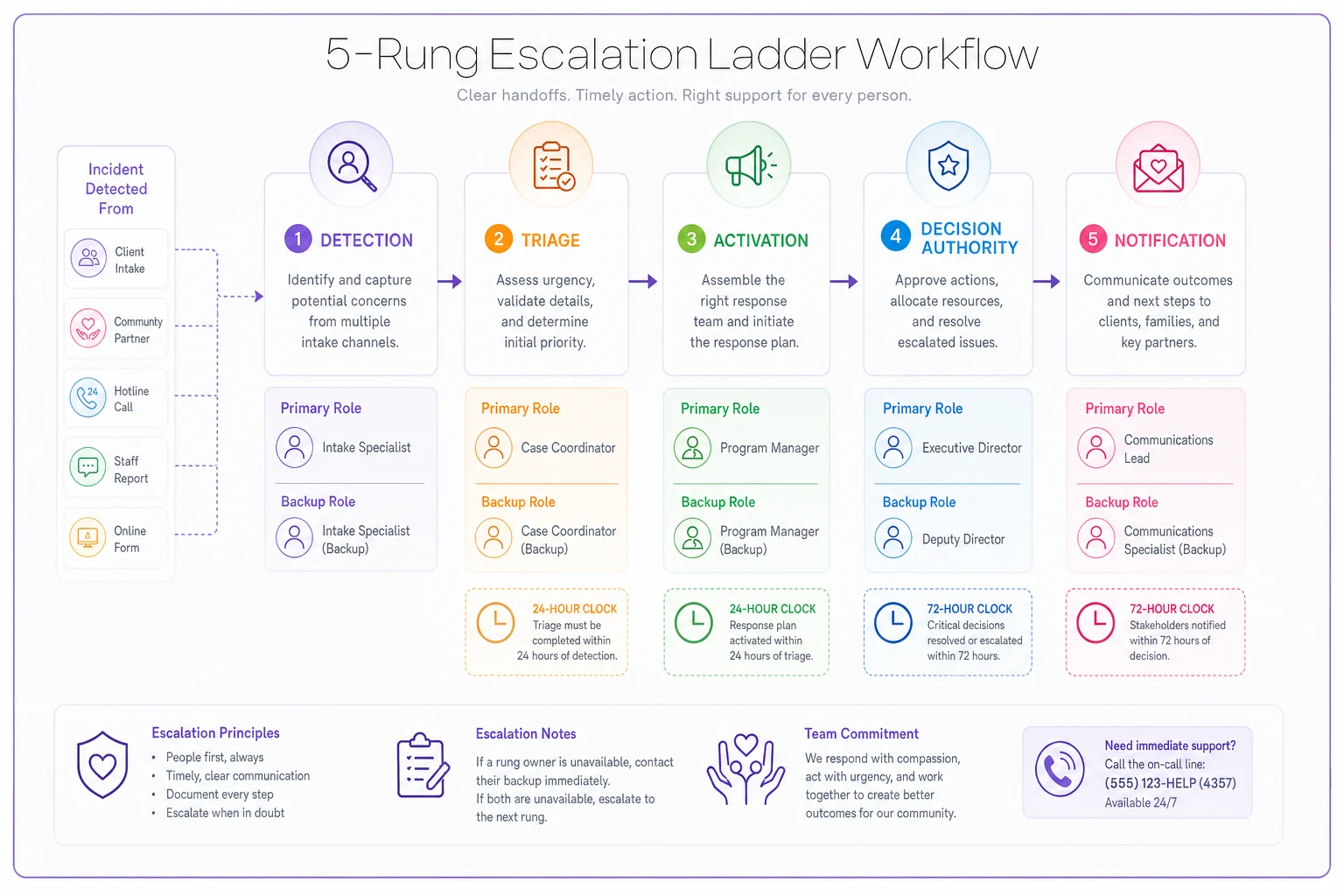
The mistake small teams make here is building the ladder but never deciding who holds decision authority when the director is unreachable. Incidents love to happen at 7pm on a Friday. If your ladder collapses the moment one person is on a plane, it isn't a ladder — it's a single point of failure.
Name at least two backups for the coordinator role. Write their names down. Review them quarterly.
The 24- and 72-hour containment templates
Two clocks run on most serious incidents: a 24-hour operational clock (stop the bleeding, keep services running) and a 72-hour obligation clock (the window in which most breach-notification and legal-response duties mature). Your containment templates should be built around both.
The 24-hour containment template should fit on one page and answer:
-
What is the immediate action to stop spread or restore service?
-
Who is executing it, and who is their backup?
-
What are we temporarily not doing, and who covers those cases?
-
What's the fallback if the primary fix fails?
-
When is the next check-in (usually every 2–4 hours during an active incident)?
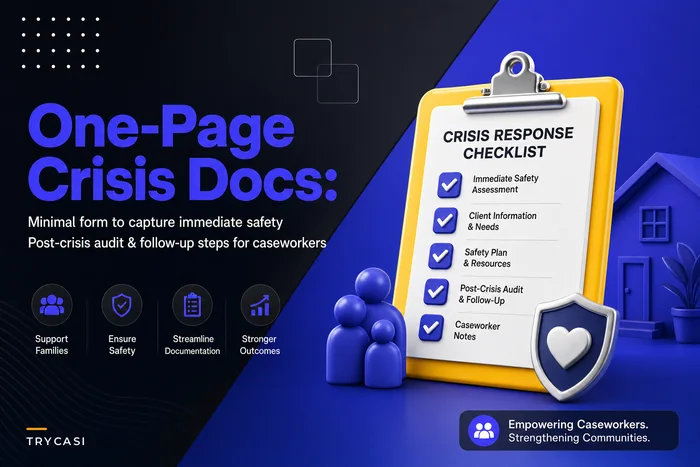
For an outage specifically, the continuity piece matters most. If your case system is down, caseworkers need a paper or offline fallback already defined — not invented mid-crisis. A short offline intake form and a rule like "capture on paper, enter within 24 hours of restoration" keeps the operation moving. A clean, minimal capture form like the one in our one-page crisis documentation and post-crisis audit approach keeps the record intact even when systems aren't.
The 72-hour obligation template is where legal and notification work lives:
-
What legal or regulatory deadlines attach to this incident, and when exactly do they fall?
-
Who has been notified internally, with timestamps?
-
What external parties must be notified, and by whom?
-
What is the factual summary as currently known (and what's still unconfirmed)?
-
Where is the evidence being preserved?
A hard rule worth adopting: separate facts from assessment in every template. During the first 72 hours, half of what you think you know turns out to be wrong. Templates that force you to mark something as confirmed versus suspected save you from notifying the wrong people or admitting to something that didn't happen.
Evidence-chain rules that survive an audit
This is the section most teams underbuild, and it's the one that actually determines whether an incident becomes a manageable event or a lasting liability.
-
Timestamp everything, immediately. Not reconstructed later. The log entry's own creation time is part of the evidence.
-
Preserve originals before you touch them. Don't edit the misdirected email, the corrupted file, or the affected record. Copy, then work from the copy.
-
One continuous incident log per event. Append-only. No deletions, no overwrites. If something was wrong, you add a correction entry — you don't erase the original.
-
Name who did what. Every action attributed to a person. "System taken offline at 14:12 by J. Okafor" beats "system was taken offline."
-
Chain of custody for anything physical. Lost device recovered? Record who had it, when, and where it's stored.
The deeper point: your evidence chain is only as strong as your everyday data discipline. Teams with clean access controls, defined ownership, and consistent logging already have most of what an incident requires — the incident just turns the dial up. If your baseline is messy, the incident exposes it. This is why incident governance and routine data governance aren't separate projects; the foundations in a solid data governance playbook for small networks are the same ones you lean on at hour two of a breach.
Consent and disclosure records deserve special mention here, because subpoenas and breach notifications both turn on what you were permitted to hold and share. If your consent workflows are clean, responding to a records demand is mostly retrieval. If they're not, every response becomes a research project. Teams that have tightened their operational consent workflows find that half the work of a subpoena response was done months in advance.
A real scenario
A regional family-services nonprofit — around 11 staff, roughly 400 active cases — had a staff member's laptop stolen from a car. It held offline copies of about 60 client records. No full-disk encryption on that particular device; it had slipped through onboarding.
Before they had a unified process, this would have played out as pure chaos: a frantic director, a week of arguing about whether notification was required, and a reconstructed timeline nobody trusted. Their previous process for a similar near-miss had taken close to two weeks to resolve and produced a timeline with obvious gaps.
With the architecture in place, the sequence was cleaner. The staffer logged detection within the hour. The data lead classified it — breach, limited-spread, compound, because two of those clients had pending legal matters. The coordinator was activated, remote-wiped the device, and started the append-only incident log. The 72-hour template surfaced the notification obligations early. Affected clients and the relevant authority were notified inside the window, with a factual summary that clearly separated confirmed from suspected.
The whole thing resolved in roughly four days instead of two weeks, and — more importantly — the evidence chain held up when a funder later asked about it. The device was still a mistake. But the response was no longer a second disaster on top of the first.
A governance review cadence sized for small teams
Incident architecture rots without review. But small teams can't sustain monthly tabletop exercises, and they shouldn't try. The goal is a cadence light enough to actually happen.
-
Per incident A short post-incident review within a week of closure. Three questions only — what worked, what slowed us down, what do we change. Thirty minutes, documented.
-
Quarterly Verify the escalation ladder names are current, backups still exist, and templates still match reality. This is also when you re-confirm who holds decision authority.
-
Annually One walk-through of a compound scenario. Not a full simulation — a tabletop conversation. "A ransomware attack takes the system down and one of the locked records is under subpoena. Go." You'll find the gaps in ten minutes.
The pattern worth watching for in reviews: the same rung failing repeatedly. If triage is always slow, the taxonomy is probably too fuzzy. If notifications always run late, your templates aren't pre-written enough. If decision authority keeps stalling, your backup roles are fiction. Reviews aren't about blame — they're about finding which rung keeps bending.
When this architecture makes sense — and when it doesn't
It makes sense when you're past the point where one person can hold the whole response in their head. For most teams that's somewhere around 6–8 staff, or the moment you're handling regulated data across more than one site. If you've already had one incident that resolved slowly and painfully, you're probably overdue.
It's overkill when you're a two- or three-person operation with a single system and no outside partners. At that size, a one-page incident log and a phone call is your architecture. Don't build a five-rung ladder for a team that fits in one room.
Who should be careful: teams that build this and then let it go stale. A polished unused incident framework is worse than an honest sticky note, because it creates false confidence. If you can't commit to the quarterly review, build something smaller that you actually maintain.
The quiet payoff
The real value of a consolidated incident lifecycle isn't the paperwork. It's that when something genuinely bad happens — and over a few years, something will — the team doesn't lose its first two hours deciding who's in charge. They classify, they escalate on one known ladder, they contain against two clocks, and they leave behind a record that holds up.
Most incident governance in social services comes down to this: deciding the hard questions before the hard day, and writing them down somewhere everyone can find them. The incident still happens. It just stops being a second crisis on top of the first.
Most incident governance in social services comes down to this: deciding the hard questions before the hard day, and writing them down somewhere everyone can find them. The incident still happens. It just stops being a second crisis on top of the first.
Ready to transform your social services workflow?
Join 500+ agencies using TryCasi to improve case outcomes, enhance collaboration, and reduce administrative burden.