



Most small agencies don't fail at data ethics because they're careless. They fail because nobody ever drew a clear line between "this is fine" and "stop, somebody needs to sign off on this." Decisions get made in hallways. A caseworker shares a client's address with a landlord partner because it felt helpful in the moment. A new analyst pulls three years of outcome data into a spreadsheet to play around with it. None of these people are acting in bad faith. The system just never told them where the edges were.
That's the gap this framework is trying to fill. Not a policy binder nobody reads — an actual decision structure with stop triggers, rollback criteria, and sign-off points that supervisors can use without calling a lawyer every single time. The goal is reproducibility: two different supervisors, facing the same situation six months apart, should land on the same decision.
Why ethical data stewardship breaks in small social services
The honest reason data stewardship falls apart in small agencies isn't that people don't care about ethics. It's that the ethical reasoning lives inside one or two experienced people's heads and never got written down as a repeatable process.
You can usually spot the pattern fast. The director "just knows" when a data request smells wrong. The senior supervisor instinctively pumps the brakes when a partner asks for something unusual. That instinct is real expertise — but it doesn't scale, and it doesn't survive turnover. When that person is on leave, burns out, or quits, the judgment disappears with them. The staff left behind either freeze up or guess.
-
A request comes in that's slightly outside normal — a researcher wants anonymized records, a funder wants client-level detail, a partner wants to merge intake files.
-
There's no defined threshold for what triggers a pause.
-
The person who received the request decides on their own, usually under time pressure.
-
Nobody logs the decision or the reasoning behind it.
-
Six months later, no one can reconstruct why that data went where it went.
The through-line is that ethical stewardship got treated as a value instead of a workflow. Values are necessary, but they don't tell a frontline worker what to do at 4:45pm on a Friday when a partner agency is pushing for a file.
What actually breaks as you grow
At three staff, informal works. Everyone's in the same room. The director hears about most decisions. At twelve staff across two sites with four partner agencies, the informal system silently collapses — and often nobody notices until something goes wrong.
Eliminate case management chaos.
TryCasi helps you organize, monitor, and report on every case efficiently and securely.
- Centralized case tracking
- Automated client notifications
- Team task coordination
No credit card required
The coordination math trips people up. With a tiny team, you might have a handful of data touchpoints per week where a real judgment call happens. Scale to a dozen caseworkers plus active partners and you might have fifty or sixty of those moments weekly. If each one depends on individual judgment, you've got fifty-plus chances for inconsistency and no two people applying the same standard.
-
Consistency across people. Two caseworkers handle an identical consent question differently. One redacts, one doesn't. Now your records are uneven and you can't defend either choice.
-
Traceability. When something gets questioned — by a client, a board member, an auditor — nobody can reconstruct who approved what and why.
-
Reversibility. A bad data-sharing decision gets discovered three weeks later, but there's no defined process to pull it back, notify affected clients, or document the correction.
That third one is the quietest problem. Most small agencies have zero rollback capability. Once data leaves, it's gone, and the only "response" is an apologetic email and crossed fingers.
This connects directly to the foundational work in lightweight data governance for small teams — role matrices and field validation give you the structure, but a decision-matrix and gate system give you the moment-to-moment behavior that structure is supposed to produce.
The core idea: gates, not rules
A rule says "never share client data without consent." Fine, but reality is messier than rules. A gate is different. A gate asks: given what's in front of you right now, does this decision require a stop, a sign-off, or is it green-lit?
Gates work better than rules in small agencies for one reason: they match how decisions actually arrive — as specific situations, not abstract categories. You're not trying to anticipate every possible scenario. You're classifying the one in front of you into a small number of response tiers.
-
Green — proceed, log it, no sign-off needed.
-
Yellow — pause, supervisor sign-off required before proceeding.
-
Red — stop entirely; escalate to the data steward (usually the director or a designated lead); may trigger rollback if already in motion.
The whole framework below is just a way of reliably sorting decisions into those three buckets and knowing what each one demands.
The decision matrix (ready to copy)
This is the heart of it. The idea is that any staff member can find the row that matches their situation and immediately know the tier and the required action. Adapt the thresholds to your context, but keep the structure intact.
| Situation | Tier | Required action | Sign-off |
|---|---|---|---|
| Sharing data with a client about their own case | Green | Verify identity, log the disclosure | None |
| Internal access within defined role boundaries | Green | Proceed, access auto-logged | None |
| Sharing a single client's info with an existing partner under a signed agreement | Green | Confirm consent on file, log | None |
| New partner requests client-level data (no agreement yet) | Yellow | Pause until MOU + consent confirmed | Supervisor |
| Any request to combine/merge datasets across agencies | Yellow | Pause, review field list, minimize | Supervisor |
| Request for data about clients who haven't consented | Red | Stop; escalate | Data steward |
| Funder or researcher wants identifiable records | Red | Stop; requires written justification + steward review | Data steward |
| Bulk export of records (more than ~10 clients at once) | Yellow | Pause; document purpose and destination | Supervisor |
| Sharing data involving a minor or safety-sensitive case | Red | Stop; escalate | Data steward |
| Correcting/deleting a record after a complaint | Yellow | Pause; follow rollback protocol | Supervisor |
| Any request that "feels off" but doesn't fit a row | Yellow | Default to pause | Supervisor |
That last row matters more than people expect. The default for anything unclassified should be yellow, not green. Ambiguity resolves toward caution. Teams that default ambiguous situations to "go ahead" are the ones that end up reconstructing disasters.
Stop and rollback triggers
A stop trigger is any condition that halts a data action regardless of who initiated it or how urgent it feels. Write these down explicitly, because under pressure people talk themselves out of stopping.
-
The client's consent status can't be confirmed in writing.
-
The requester can't articulate a specific, legitimate purpose.
-
The data would include someone other than the intended client — household members, third parties.
-
The destination is unencrypted or outside your approved channels.
-
The request involves a safety-sensitive case (DV, child welfare, immigration).
-
Anyone on the team raises a concern — one objection is enough to pause.
Rollback is the part almost nobody builds, and it's what separates a mature stewardship system from a collection of good intentions. Rollback criteria define when you actively reverse a data action and what that reversal involves.
-
Freeze — stop any further movement of the affected data within one business day.
-
Scope — document exactly what was shared, with whom, and when.
-
Recall — formally request deletion or return from the recipient in writing, with a response deadline.
-
Notify — inform the affected client(s) in plain language.
-
Log — record the incident, the cause, and the correction.
-
Review — close the loop by fixing the gate that let it through.
Writing rollback down in advance means you're making calm decisions about panicked situations before they happen. That's the part most agencies skip, and it's consistently the thing they wish they'd done when something actually goes sideways.
Supervisor sign-off checklists
Sign-offs fail when they become rubber stamps. The fix is a short, specific checklist the supervisor must actually tick — not just a signature line. Keep it to things that can be verified in under two minutes.
Yellow-tier sign-off checklist:
-
[ ] Consent on file matches the exact data being shared
-
[ ] Requester and their authority confirmed
-
[ ] Purpose is documented and specific (not "for their records")
-
[ ] Only minimum necessary fields included
-
[ ] Destination channel is approved and secure
-
[ ] Disclosure logged with date, recipient, and purpose
-
[ ] If this is a recurring request, an agreement or MOU exists
Red-tier escalation checklist (data steward):
-
[ ] Written justification received and reviewed
-
[ ] Legal or consent basis clearly identified, even informally
-
[ ] Alternatives to sharing identifiable data considered — aggregation, de-identification
-
[ ] Client safety impact assessed
-
[ ] Decision and reasoning documented regardless of outcome
The documentation habit is doing quiet heavy lifting throughout all of this. Even when the answer is "yes, share it," writing down why is what makes the decision reproducible and defensible later. This is also where your existing operational consent workflows plug in — the decision tree tells you whether to proceed, the consent workflow tells you how to do it cleanly.
MOU clauses you can lift directly
You don't need a lawyer to put basic protective language into a partner agreement. These aren't a substitute for legal review on high-stakes contracts, but for routine partner data-sharing, having something written beats the handshake arrangements most small agencies rely on.
Purpose limitation:
> "Data shared under this agreement will be used solely for [specific purpose] and will not be repurposed, resold, or used for any secondary analysis without prior written consent from the originating agency."
Minimum necessary:
> "Each party will request and share only the minimum data fields required to deliver the agreed service. Requests for additional fields require a written amendment to this agreement."
Deletion and return:
> "Upon termination of this agreement or completion of the stated purpose, each party will delete or return all shared client data within [30] days and confirm completion in writing."
Breach notification:
> "In the event of unauthorized access, disclosure, or loss of shared data, the affected party will notify the other party within [48 hours] and cooperate on remediation."
Consent withdrawal:
> "If a client withdraws consent, both parties will cease using that client's data and, where feasible, delete previously shared records within [15] days of notification."
Fill in the brackets with your own numbers. The clauses themselves give supervisors something concrete to point to when a partner pushes past the agreed scope. For the broader multi-party picture, the data governance playbook for small networks covers how these agreements fit into a wider partner structure.
Where the gates plug into your SOPs
A decision matrix sitting in a shared drive does nothing. The gates have to be physically inserted into the workflows where decisions actually happen.
-
At intake — the consent-capture step gets a gate
is consent broad enough for likely downstream sharing? If not, flag it now.
-
At referral or handoff — before any file leaves, the yellow-tier checklist runs.
-
At data export — any export above your threshold forces a pause and a logged purpose.
-
At partner requests — all inbound requests route through a single intake point, not whoever happens to answer the phone.
-
At case closure — a check on retention
what gets kept, what gets deleted, under what timeline.
The design principle here is simple: embed the gate at the exact moment the decision is made, not in a policy document someone reviews once a year. If the pause doesn't happen inside the workflow, it doesn't happen at all.
This is also where software earns its place. A case management or governance platform that logs access automatically, flags bulk exports, and routes partner requests to a sign-off queue removes the dependence on people remembering to pause. The gate becomes a step in the system rather than a habit you're hoping sticks. Automatic logging and routing make reproducibility real instead of aspirational — and that's genuinely hard to achieve on paper alone.
Route partner requests through a single intake queue so they can't bypass the gate by asking someone directly.
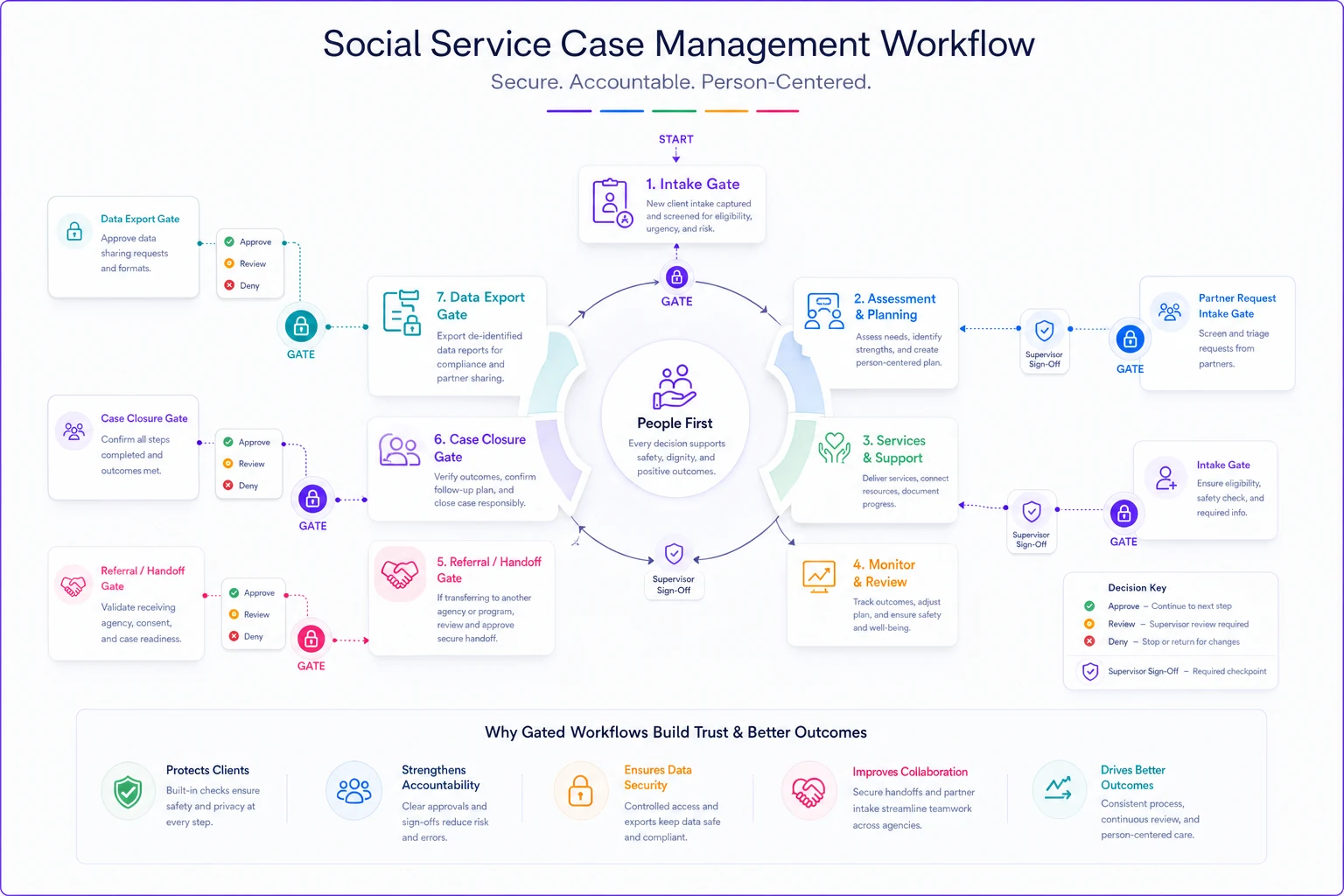
Automatic logging and routing make reproducibility real instead of aspirational — and that's genuinely hard to achieve on paper alone.
A real scenario
A small housing-stability program, around nine staff across two offices, had an informal arrangement with three landlord partners. Caseworkers shared tenant information directly by email when a placement was moving fast — rental history, income, sometimes case notes. It worked until a tenant complained that a landlord knew details about a prior domestic-violence situation she'd never authorized sharing.
When the director tried to investigate, there was no record of what had been shared, by whom, or when. It took roughly two weeks of digging through inboxes to piece together that a caseworker had forwarded a full case summary — safety details included — because the landlord "needed context." No bad intent. No gate, no sign-off, no rollback process.
They adopted a version of this framework. Partner requests now route to a single queue. Anything involving case notes or safety-sensitive detail hits red automatically. Exports above a handful of clients require a logged purpose. In the first few months, they caught two requests that would previously have gone through unexamined — one researcher wanting identifiable records, one partner quietly asking for fields outside the agreement. Both were paused at the right tier.
The change wasn't dramatic in effort. Roughly an hour of setup per staff member and a short checklist near each workstation. What changed was that decisions became consistent and traceable instead of improvised.
When this framework makes sense — and when it doesn't
When it makes sense: You have more than a handful of staff, you share data with outside partners, you've had turnover, or you've ever had a moment where someone asked "wait, were we allowed to share that?" If your stewardship currently depends on one experienced person's instincts, you need this before that person leaves.
When it's overkill: A solo practitioner or two-person team that genuinely sees every decision together probably doesn't need formal gates yet. Don't build bureaucracy for a problem you don't have. The better move is to build it right before you grow into the problem — which usually means around the time you add your fourth or fifth staff member or your second partner agreement.
Who should not try to run this as a pure paper exercise: Agencies that will write the matrix, file it, and never embed it into actual workflows. A decision matrix that lives in a binder is worse than nothing, because it creates the illusion of a system while changing no actual behavior. If you can't commit to inserting the gates into your real SOPs and logging decisions consistently, start smaller — just the stop triggers and a single sign-off point.
Ethical data stewardship in social services isn't primarily about having the right values — most small agencies already do. It's about converting those values into a set of repeatable decisions that don't depend on who happens to be in the room.
Gates, sign-offs, and rollback criteria are how good judgment survives staff turnover, time pressure, and growth. Start with the three tiers. Write your stop triggers. Build one sign-off checklist and insert it at your two highest-risk workflow points — probably partner requests and data exports. Add rollback criteria before you need them, not after. A working version can be running in a week, and you can do it without a lawyer. The expensive version is the one you build after the incident instead of before it.
Ready to transform your social services workflow?
Join 500+ agencies using TryCasi to improve case outcomes, enhance collaboration, and reduce administrative burden.