



Most teams treat outcomes and money as two separate worlds. The outcomes team tracks housing stability, employment, reduced ER visits. The finance team tracks units of service, invoices, and reimbursement cycles. These two worlds meet maybe twice a year — once at the annual report, once when a contract comes up for renewal — and the gap between them quietly costs agencies real money and real leverage.
The problem isn't that agencies lack indicators. Most have plenty. The problem is that those indicators live in dashboards nobody references when a funder asks, "Why should we pay you this rate?" or "What happens if you miss targets?" The indicators never got wired into the contract language, the invoice triggers, or the reserve math. So when the negotiation happens, you're arguing from vibes instead of from a system.
This piece is about closing that gap. Not with more measurement — you probably already measure enough — but by connecting the indicators you already have to the mechanics of funding: how you bill, when you trigger cost conversations, what acceptance tests go in the contract, how you plan reserves, and what you physically hand a funder across the table.
Why the indicator-to-funding gap keeps showing up
The pattern is almost always the same. An agency builds a decent outcomes framework — sometimes a genuinely good one — but builds it for program staff and the board, not for contracts. The language is therapeutic and descriptive. Contracts, meanwhile, get written by whoever handles compliance, using boilerplate from the last grant cycle. Nobody sits in the middle translating one into the other.
So you end up with outcome definitions that can't survive a contract audit. A funder asks what "stable housing" means and you have three slightly different definitions across three grants. Or your invoice is tied to units delivered, but your strongest selling point — that your clients stay housed at six months — isn't connected to a single dollar. You're leaving your best evidence off the invoice.
This usually happens because the people who understand the indicators and the people who understand the money sit in different meetings. When those meetings don't overlap, the translation never happens. The fix isn't a new committee. It's a mapping — a single document that ties each chosen indicator to a specific financial mechanism, so everyone's working from the same crosswalk.
The agencies that negotiate well aren't measuring more than everyone else. They've just connected their measurement to their money in a way they can show on two pages. That's really the whole trick.
What breaks when you scale without this mapping
A small program with one funder can get away with loose connections. The director knows the numbers, knows the funder, and the whole thing fits in her head. Add a second funder with different outcome definitions, a third contract with a different billing cadence, and a new program manager who inherited none of the context — and the informal system collapses.
Eliminate case management chaos.
TryCasi helps you organize, monitor, and report on every case efficiently and securely.
- Centralized case tracking
- Automated client notifications
- Team task coordination
No credit card required
Here's where it breaks, concretely:
-
Definition drift. The same indicator means different things in different contracts, so you can't aggregate your own performance. When a funder audits, you can't defend the number.
-
Invoice-outcome mismatch. You bill on units but get judged on outcomes. In renewal talks you have no data linking the two, so you can't argue for a rate increase.
-
Reserve blindness. Outcome-based or at-risk payments mean money is contingent. If you haven't modeled how much revenue is "at risk" against indicator performance, a bad quarter hits cash flow with no warning.
-
No acceptance tests. The contract says "deliver services" but never defines what "acceptable" looks like in measurable terms. So disputes become subjective, and you lose them.
The agencies that scale cleanly treat indicators, cost-per-case modeling, and contract language as one connected system rather than three separate documents. When those stay separate, every new contract adds complexity instead of reusing a template. That's the real tax of not mapping it — your tenth contract ends up being just as hard as your first.
The core mapping: indicator → financial mechanism
The heart of this is a crosswalk. For each indicator you've chosen to carry into funding, you decide exactly four things: how it touches invoicing, what cost trigger it sets off, what acceptance test it anchors, and how it affects reserves. Keep it boring and explicit.
| Indicator | Invoicing cadence link | Cost-per-case trigger | Contract acceptance test | Reserve implication |
|---|---|---|---|---|
| 6-month housing stability | 10% of unit payment withheld, released on quarterly stability report | Trigger review if cost-per-stable-exit exceeds band by 15% | ≥70% of exits stably housed at 6 months, verified by follow-up records | Hold reserve against the withheld 10% until milestone confirmed |
| Employment at 90 days | Flat outcome payment per verified placement | Review if cost-per-placement exceeds budgeted range two quarters running | ≥50% of job-ready clients placed within 90 days | Model placement payment as variable, not guaranteed, revenue |
| Reduced crisis contacts | Monthly unit billing, unchanged | Trigger caseload review if contacts rise against baseline | Demonstrated downward trend over two reporting periods | Minimal — this is a quality indicator, not a payment trigger |
| Follow-up completion rate | Tied to case-closure documentation sign-off | Review data-entry load if completion drops below 85% | 85% of closures have documented 30/90-day follow-up | None directly; protects against clawback risk |
The point of this table isn't the specific numbers — yours will differ. The point is the discipline of forcing every indicator to declare what it does in the money system. If an indicator can't fill in at least two of those four columns, it probably doesn't belong in the contract. It can still live in your internal dashboard; it just shouldn't be creating contractual obligations nobody can tie to a dollar or a decision.
One mistake worth naming: people try to wire every indicator into payment. Don't. Most indicators are for learning and management. Only a handful should carry money. The crosswalk helps you separate the two cleanly, which keeps your contracts legible.
Building the invoice triggers
Once the crosswalk exists, invoicing becomes mechanical instead of negotiated each cycle. The trigger logic is where a lot of agencies lose money quietly — they bill on a fixed cadence that ignores what their outcome data could actually justify.
-
Base units — billed on your normal cadence (monthly, biweekly), tied to delivered service. This is your floor and it should cover your fixed costs.
-
Milestone releases — portions of payment held against an indicator being met and verified, released when the acceptance test passes. This is where outcome data earns its keep.
-
Outcome payments — discrete payments tied to a verified result (a placement, a stable exit), billed when the evidence exists.
The workflow that makes this run looks roughly like this: at closure or milestone, the caseworker's documentation feeds a verification step; verification confirms the acceptance test passed; the passed test releases the held portion or generates the outcome line on the next invoice.
[Case closure or milestone event] ↓ [Caseworker documents outcome in case record] ↓ [Verification step — acceptance test checked against threshold] ↓ [Pass] → [Milestone release or outcome payment line generated on invoice] [Fail] → [Payment held; flag for supervisor review]
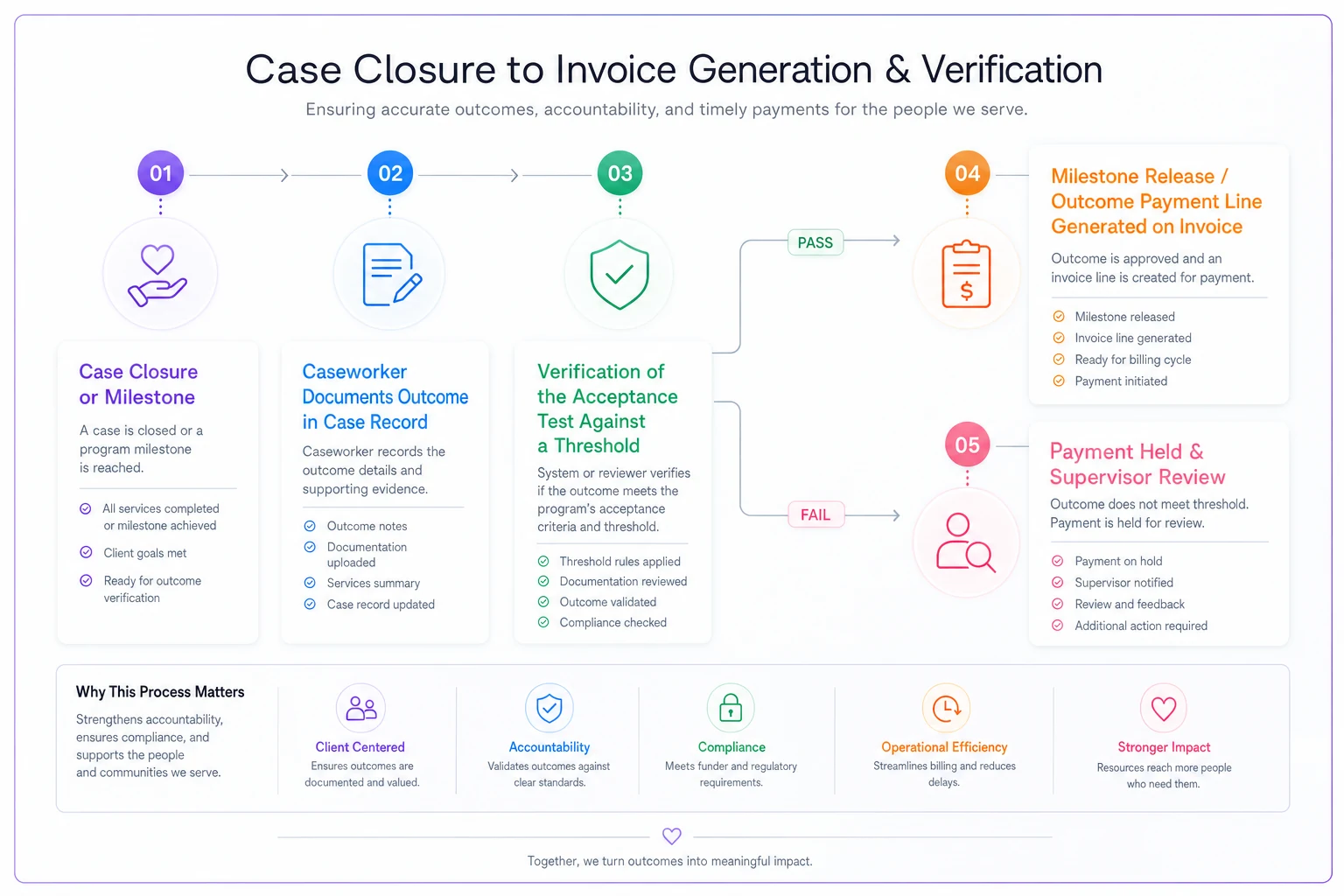
What kills this in practice is the handoff between "outcome recorded" and "invoice generated." If that handoff is manual and lives in someone's head, milestone revenue slips — payments get missed entirely or billed months late. This is exactly the kind of coordination gap where a case management platform that links outcome records to billing triggers removes a whole class of revenue leakage, because the invoice line can't exist without the verified record behind it.
The deeper benefit is traceability. When every outcome payment is wired to a documented acceptance test, your invoice becomes its own defense. An auditor asking "why did you bill this?" gets pointed straight at the record. No scramble, no reconstruction.
Reserve planning against at-risk revenue
The moment you accept withheld payments or outcome-contingent money, a portion of your revenue is no longer guaranteed. Most small agencies don't model this, and it's where a solid quarter of outcomes performance can quietly mask a real cash flow risk.
The math is simpler than it sounds. For each contract, tag revenue as either secured (base units, billed regardless) or at-risk (milestone releases and outcome payments, contingent on indicators). Sum the at-risk portion across contracts. That total is what your reserve planning has to account for, discounted by your realistic hit rate on those indicators.
A typical example: an agency with roughly $900k in annual contract revenue finds that about $140k of it is tied to outcome milestones. Historically they hit those milestones around 80% of the time. The prudent planning assumption isn't $140k — it's closer to $110k–$115k expected, with the difference held as a buffer against quarters where follow-up completion dips or placements run slow. Modeling it this way turns "we had a bad quarter" into a planned-for event instead of a surprise.
Tag revenue early as secured or at-risk and model reserves against realistic hit rates to avoid surprise cash shortfalls.
This is where aligning casework, funding, and compliance into one operating model pays off directly. If your outcome tracking, your billing, and your reserve assumptions all reference the same indicator definitions, your reserve plan updates as performance data comes in. When they're disconnected, finance is guessing at a buffer with no live signal from the field.
The two-page funder negotiation artifacts
Everything above is internal plumbing. The negotiation is where it shows up externally — and it should fit on two pages, not twenty. Funders don't read twenty.
The brief (one page). Top of page: the two or three indicators you're willing to stake payment on, each with its current performance and definition. Middle: the proposed invoice structure (base / milestone / outcome split). Bottom: what you're asking for — a rate, a term, a withholding percentage — stated plainly. The brief works because it leads with evidence and ends with an ask, so the funder can see exactly what they're buying.
The CLA (contract/acceptance language) sheet (one page). This is the draft language for the contract itself — acceptance tests written in auditable terms. For each staked indicator: the exact definition, the threshold, the verification method, and the payment consequence. Pulling this straight from your crosswalk means the language you negotiate is the language you can actually operate against later. The common failure is negotiating warm, aspirational language that your systems can't measure — then failing your own contract.
-
- [ ] Each staked indicator has one definition, used identically across brief, CLA, and invoice logic
-
- [ ] Every acceptance test names its verification source (which record, which report)
-
- [ ] The invoice structure separates secured from at-risk revenue explicitly
-
- [ ] Thresholds reflect your actual historical performance, not your hopes
-
- [ ] The reserve implication of every at-risk line is modeled before you agree to it
-
- [ ] The whole pack — brief plus CLA — fits on two pages
If you can hand a funder these two pages and walk them through the crosswalk behind them, you're negotiating from a system. That's a very different conversation than defending a number you can't source. Much of this rests on having a solid outcomes measurement framework with clear indicators and data cadence underneath — the negotiation artifacts are only as strong as the measurement feeding them.
When this makes sense — and when it doesn't
This whole approach is worth the effort when you have multiple funders, outcome-based or partially-contingent payments, or contracts coming up for renewal where rate matters. If you're managing a single small grant on fixed units with no outcome component, the full crosswalk is overkill — a simple definition sheet will do.
Staking payment on indicators you can't yet measure reliably is a bad idea. If your follow-up completion rate is shaky, don't put it in the contract as an acceptance test — you'll fail your own terms. Fix the measurement first, stake it later. Agencies that reverse this order end up in self-inflicted disputes.
One more caution: if your outcome definitions still drift across programs, don't bring them to a negotiation yet. Resolve the internal definition conflicts first. Walking into a funder meeting with three versions of "stable housing" undermines everything else on the page, no matter how clean the rest of the pack looks.
A short real scenario
A mid-sized housing-stability program ran four contracts, each with slightly different outcome language and all billed on flat monthly units. Their six-month stability rate was genuinely strong — around 74% — but it wasn't connected to a single dollar, and renewals were flat-rate with no room to argue.
They spent about six weeks building one crosswalk: three staked indicators, matching acceptance tests, and a base/milestone/outcome invoice split. They tagged roughly $130k of their annual revenue as outcome-contingent and built a reserve assumption around an 80% hit rate. Then they rebuilt their renewal brief down to two pages.
The result wasn't dramatic overnight. But on the next renewal, they went in with a CLA sheet showing their actual 74% stability performance against a 70% acceptance threshold — proof they could clear the bar with margin. That shifted the conversation from "justify your existence" to "here's what a rate increase buys you." They came out with a modestly better rate on two of the four contracts and, just as importantly, one consistent set of definitions they could defend in any audit. The measurement hadn't changed. The wiring had.
Bringing it together
The gap between outcome indicators and funding mechanics isn't a measurement problem — it's a connection problem. The indicators usually exist. What's missing is the crosswalk that forces each one to declare how it touches invoicing, cost triggers, acceptance tests, and reserves, plus the two short artifacts that carry all of that into a funder conversation.
Build the mapping once and it becomes reusable infrastructure: every new contract starts from the same definitions, every invoice defends itself, every reserve assumption has a live signal behind it. The agencies that handle indicators to funding social services well aren't the ones with the most dashboards. They're the ones who wired a handful of trustworthy indicators directly into how the money moves — and can show it on two pages when it counts.
Build the mapping once and it becomes reusable infrastructure: every new contract starts from the same definitions, every invoice defends itself, every reserve assumption has a live signal behind it. The agencies that handle indicators to funding social services well aren't the ones with the most dashboards. They're the ones who wired a handful of trustworthy indicators directly into how the money moves — and can show it on two pages when it counts.
Ready to transform your social services workflow?
Join 500+ agencies using TryCasi to improve case outcomes, enhance collaboration, and reduce administrative burden.