

Most eligibility errors don't come from fraud. They come from a caseworker staring at a slightly-off document at 4:40pm, unsure whether it clears the bar, making a judgment call that nobody else would have made the same way. Multiply that across a team of eight intake workers and you get a program where "eligible" means something different depending on who was at the desk.
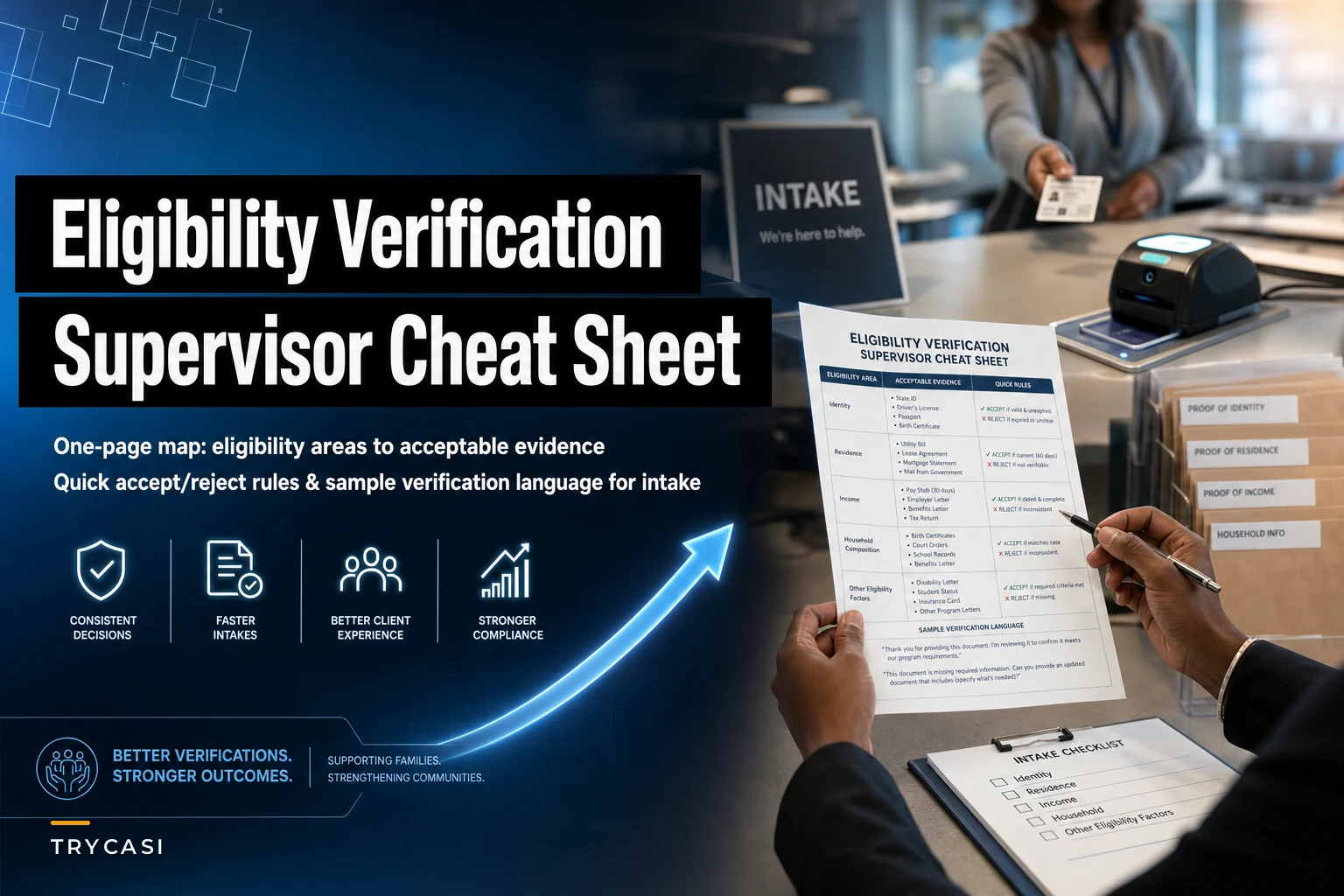
This is a supervisor's reference for closing that gap. Not a policy manual — those already exist and nobody reads them at intake. This is the thing you tape to the inside of a folder or pin above the desk so the fifth client of the day gets the same evidence standard as the first.
The real problem: silent inconsistency
The danger isn't the obvious reject. If someone shows up with no ID and no documents, every worker handles that the same way. The danger is the gray-zone document that one worker accepts and another kicks back.
A pay stub that's six weeks old. A utility bill in a roommate's name. A self-attestation of household size with no supporting paper. A bank statement the client partially redacted before handing it over. These are the decisions that quietly fracture a program's consistency, and they almost never show up in error reports until an audit pulls a random sample and finds identical situations handled four different ways.
What makes it worse is that the inconsistency is invisible to the workers themselves. Each person feels confident. Each thinks they're applying "the rule." The rule just lives differently in each head.
One pattern worth naming: the most experienced caseworkers tend to be more lenient on evidence, not less, because they've built up intuition about who's telling the truth. That intuition is often correct — and it's also exactly what fails an audit, because intuition isn't documentable. The goal of a cheat-sheet isn't to override good judgment. It's to make sure judgment leaves a paper trail that holds up.
The core reference table
This is the heart of it. Map each eligibility area to what counts, what's borderline, and what doesn't clear. Adapt the specifics to your program's actual funding rules — this is the shape, not the final text.
Eliminate case management chaos.
TryCasi helps you organize, monitor, and report on every case efficiently and securely.
- Centralized case tracking
- Automated client notifications
- Team task coordination
No credit card required
| Eligibility area | Strong evidence (accept) | Borderline (verify before accepting) | Does not clear (reject or escalate) |
|---|---|---|---|
| Identity | Current gov't photo ID; passport | Expired ID + secondary doc; ID with name variation | No photo ID and no secondary document |
| Income | 2 recent consecutive pay stubs; benefit award letter; tax return | Single stub; stub older than ~30 days; handwritten employer note | Verbal-only; no documentation of any kind |
| Residency | Current lease; utility bill (client's name); official mail dated within ~60 days | Bill in roommate/partner name + relationship statement; mail older than 60 days | PO box only; no dated proof of address |
| Household size | Birth certificates; school records; benefit records listing members | Self-attestation + one supporting doc (lease listing occupants) | Self-attestation alone with no corroboration |
| Disability status | Provider documentation; existing benefit determination | Older provider note (>12 months); pending application paperwork | Self-report only where program requires documentation |
| Citizenship/status | Documents per program's required list | Document copy where original is required; name mismatch | Missing required document class entirely |
The borderline column is the one that matters. "Accept" and "reject" mostly take care of themselves. The entire value of this sheet is giving workers a named middle category with a clear instruction: don't guess — verify, then document what you verified.
The three-second accept/reject rules
Workers don't have time to re-read a table on every document. So underneath the table, give them a handful of rules they can apply in seconds without looking anything up.
-
If a document is older than the stated window, it moves to borderline automatically. No exceptions based on "it's probably still accurate."
-
If the name on the document doesn't match the applicant exactly, stop and note the discrepancy before accepting. Hyphenation, maiden names, and typos all count.
-
If the client redacted or altered anything themselves, treat it as borderline — you may still accept it, but the alteration gets documented.
-
Self-attestation is never strong evidence on its own for any area where the program requires paper. It's a supplement, not a substitute.
-
When two workers would plausibly disagree, that's your signal to escalate, not to decide alone.
That last rule does more than any training session. It gives permission to escalate, which is the behavior that actually prevents silent inconsistency. Most gray-zone misfires happen because the worker felt they should be able to decide it themselves.
Sample verification language
The second half of the consistency problem isn't the decision — it's how the decision gets written down. Two workers can make the same correct call and document it so differently that an auditor can't tell they matched. Give people ready phrasing.
When accepting standard evidence:
> "Income verified via two consecutive pay stubs dated [date] and [date]. Employer and amounts consistent with application. Accepted."
When accepting a borderline document after verification:
> "Residency doc (utility bill) in partner's name. Client provided signed household relationship statement confirming shared address. Verified against lease listing both occupants. Accepted as borderline-cleared."
When requesting additional evidence:
> "Single pay stub provided; program requires two consecutive. Second stub or benefit letter requested. Eligibility pending additional documentation as of [date]."
When rejecting or escalating:
> "No dated proof of residency provided; PO box only. Does not meet residency standard. Escalated to supervisor for alternative-evidence review on [date]."
Same pattern across all four: name the document, name the standard, name the action, date it. Auditors aren't looking for perfect prose — they're looking for a chain they can follow. When every worker uses the same skeleton, random-sample audits stop surfacing "handled differently" findings because the documentation is uniform even when the situations vary.
A short workflow for borderline cases
Most intake flows handle clear-accept and clear-reject fine. The breakdown is always the borderline path, so spell it out explicitly:
-
Flag it borderline using the table's middle column — don't accept or reject yet.
-
Identify the one thing that would resolve it. A corroborating document, a relationship statement, a supervisor's sign-off. Pick the single cheapest path to resolution.
-
Attempt resolution during the same visit if possible. Asking for a second document while the client is sitting there beats a follow-up call that goes to voicemail three times.
-
If unresolved, record it as pending with the specific missing item and a follow-up date — never as a vague "needs more info."
-
Escalate if the worker and a peer would plausibly disagree. Supervisor makes the call and the rationale gets logged.
Here's a quick flow image you can pin above the desk.
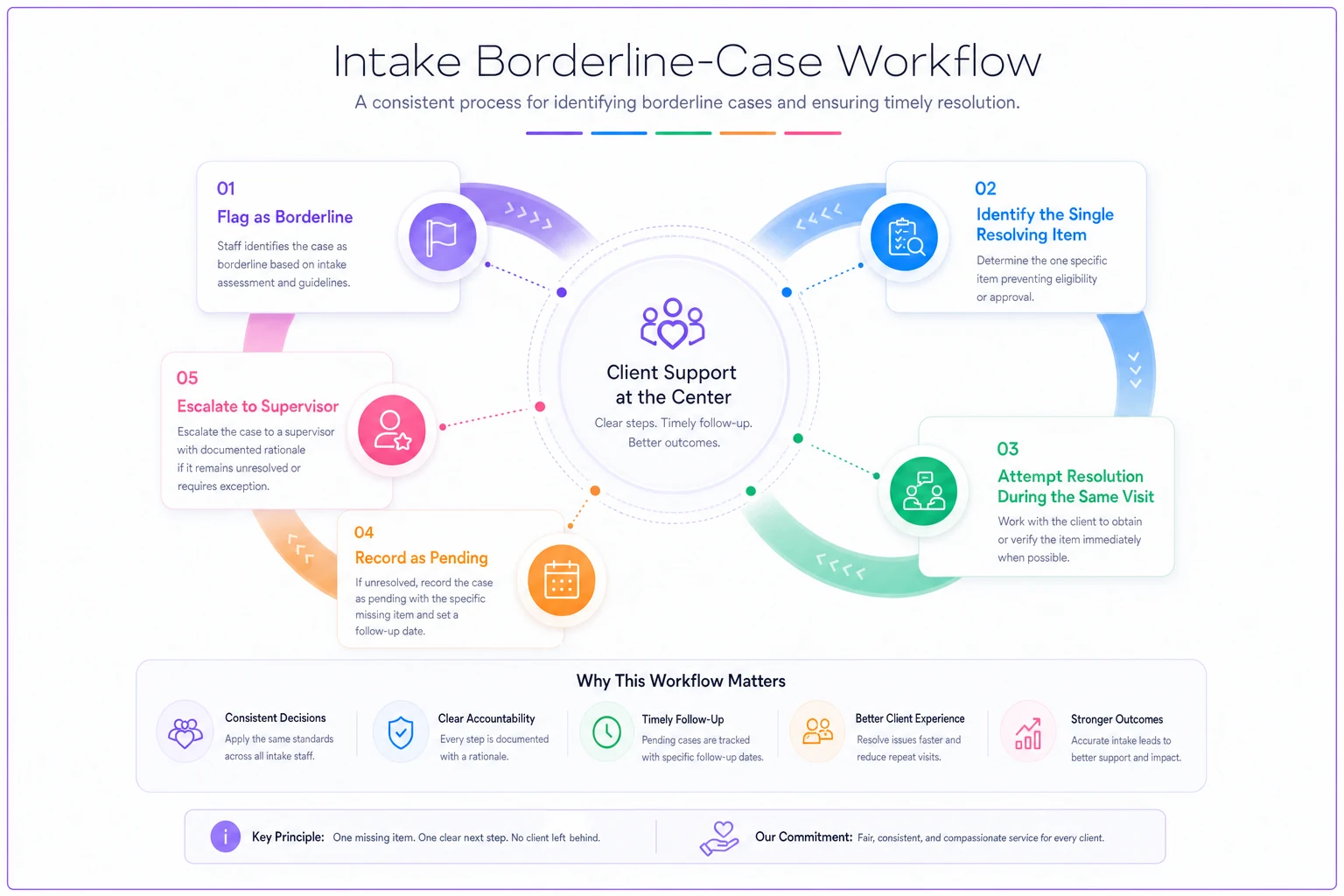
What quietly wrecks this workflow in practice is step 4 getting collapsed into step 3. Workers hate leaving things open, so they either accept-to-be-nice or reject-to-be-safe rather than parking it as genuinely pending. Pending is a legitimate, documentable state. Treat it like one.
Where this ties into your intake data
A cheat-sheet lives or dies on whether the fields in your system match the evidence categories on the sheet. If your intake form has a free-text "notes" box where residency verification is supposed to live, consistency is doomed no matter how good the reference is. Structured fields for evidence type, document date, and verification status make the cheat-sheet enforceable rather than aspirational.
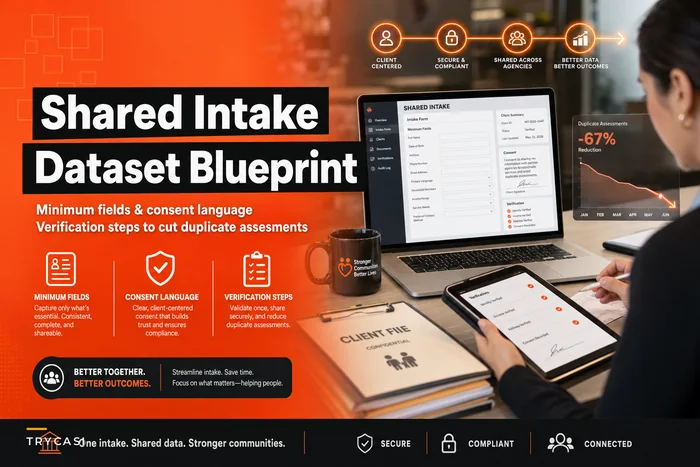
This connects directly to a well-designed shared intake dataset with minimum fields and verification steps — if the dataset captures which evidence cleared a given area, your cheat-sheet stops being a wall poster and becomes something you can actually audit against. The same logic applies when eligibility decisions travel between agencies; a clean referral handoff protocol with required fields and confirmation loops means the receiving team isn't re-verifying evidence that was already cleared, or worse, accepting a determination they can't see the basis for.
Make 'document date' and 'verification status' required structured fields so borderline cases can't be skipped at intake.
Case management platforms with field-level validation help here in a quiet way — flagging a document date that falls outside the window, or requiring a verification-status selection before the record can be marked eligible. Not about replacing judgment. It's about making the borderline category impossible to skip past at 4:40pm.
A realistic example
A mid-sized benefits program running roughly 120–150 intakes a month pulled a 30-case audit sample and found eligibility evidence had been documented inconsistently in about a third of borderline cases. Not wrong decisions, necessarily — unfollowable ones. Three workers, three different ways of noting the same type of residency verification, one of which an auditor couldn't trace at all.
They didn't rewrite policy. They printed a one-page version of the table above, added the five accept/reject rules, and laminated the sample verification language to the back. The borderline workflow went up on the wall by the intake desks.
Next quarterly sample, the documentation inconsistency findings dropped to a handful. The actual accept/reject decisions barely changed — they were mostly correct to begin with. What changed was that an outside reviewer could follow the reasoning on every file without calling the worker to ask "what did you mean here?" Follow-up time on audit queries dropped noticeably, and the supervisor stopped being pulled into re-explaining old decisions.
The lesson most teams miss: the win wasn't better decisions. It was legible ones.
When a cheat-sheet is the wrong tool
This approach assumes your eligibility rules are stable enough to map. A couple of situations where it backfires:
-
If your funding rules are actively in flux, a laminated sheet becomes dangerously out of date the moment a requirement changes, and workers trust it over the update email. Keep it digital and dated if your rules shift often.
-
If your real problem is under-trained staff and not inconsistency, a cheat-sheet papers over a training gap. New workers will apply the table mechanically without understanding why, and they'll mishandle anything that isn't on it.
-
If every case is genuinely unique — some specialized programs really are like this — forcing evidence into tidy categories creates false confidence. A reference works best where volume is high and the situations rhyme.
For the common case, though — a team doing steady intake volume under reasonably stable rules — a single well-built page does more for consistency than another all-staff training everyone forgets by the following week.
Bottom line
The goal isn't to make eligibility decisions harder or more bureaucratic. It's to make sure the standard doesn't drift depending on who's at the desk and how late in the day it is. A good eligibility verification cheat sheet for social services does three things at once: it names the borderline cases so they stop getting silently accepted or rejected, it gives people language that makes decisions auditable, and it turns escalation into a normal move instead of a sign of weakness.
Build the table around your actual rules, keep it to one page, and put it where decisions actually happen — not in a binder. The consistency you gain shows up later, quietly, when an audit sample comes back clean and nobody has to reconstruct what a note from three months ago was supposed to mean.
Build the table around your actual rules, keep it to one page, and put it where decisions actually happen — not in a binder. The consistency you gain shows up later, quietly, when an audit sample comes back clean and nobody has to reconstruct what a note from three months ago was supposed to mean.
Ready to transform your social services workflow?
Join 500+ agencies using TryCasi to improve case outcomes, enhance collaboration, and reduce administrative burden.