

The gap that ends up in a serious incident review is almost never "we had no plan." It's "the note said we tried, but nobody could tell if the attempt was real." A caseworker writes "called client, no answer" at 4:52pm on a Friday. Three weeks later that client is in crisis, and a reviewer is sitting across from you asking: What number did they call? Was consent on file for texting? Did anyone loop in the housing partner who'd flagged the risk? And the honest answer is often — we don't know, because nothing in the record proves it.
That's the specific problem this checklist addresses. Not outreach strategy, not no-show reduction (that's a different beast, covered in our piece on cutting no-shows for home visits). This is narrower and more uncomfortable: as a supervisor, how do you verify that outreach to a high-risk client was attempted, documented, escalated, and confirmed with partners — in a way that holds up when something goes wrong?
Why "we tried to reach them" quietly falls apart
Outreach documentation degrades in predictable ways, and almost all of them stay invisible until a case escalates.
The most common failure isn't laziness. It's that outreach lives in too many places. A text goes out from a personal phone. A call happens but gets logged hours later from memory. A partner agency confirms by email that they'd seen the client, but that email sits in one inbox and never touches the case file. Each individual action happened. The evidence of it didn't survive.
A second pattern: consent and contact-attempt logging get treated as separate chores. The caseworker records the attempt but never cross-checks whether the client had actually agreed to be contacted that way. You end up with technically-diligent outreach that was, on paper, a consent violation. For high-risk clients — DV survivors, clients with unsafe housing situations, people with protective orders — this isn't a paperwork nitpick. Texting the wrong number or leaving a voicemail at the wrong household can put someone in danger.
Third, and this is the one supervisors most often miss: escalation decisions don't get written down as decisions. A caseworker tries three times, gets nothing, and mentally decides "I'll try again Monday." That's a real risk judgment. But it never appears as one. There's no note saying "3 failed attempts over 48h, risk level moderate, decision to hold until Monday — rationale: no indicators of acute crisis." Without that, a reasonable judgment call looks, in hindsight, like neglect.
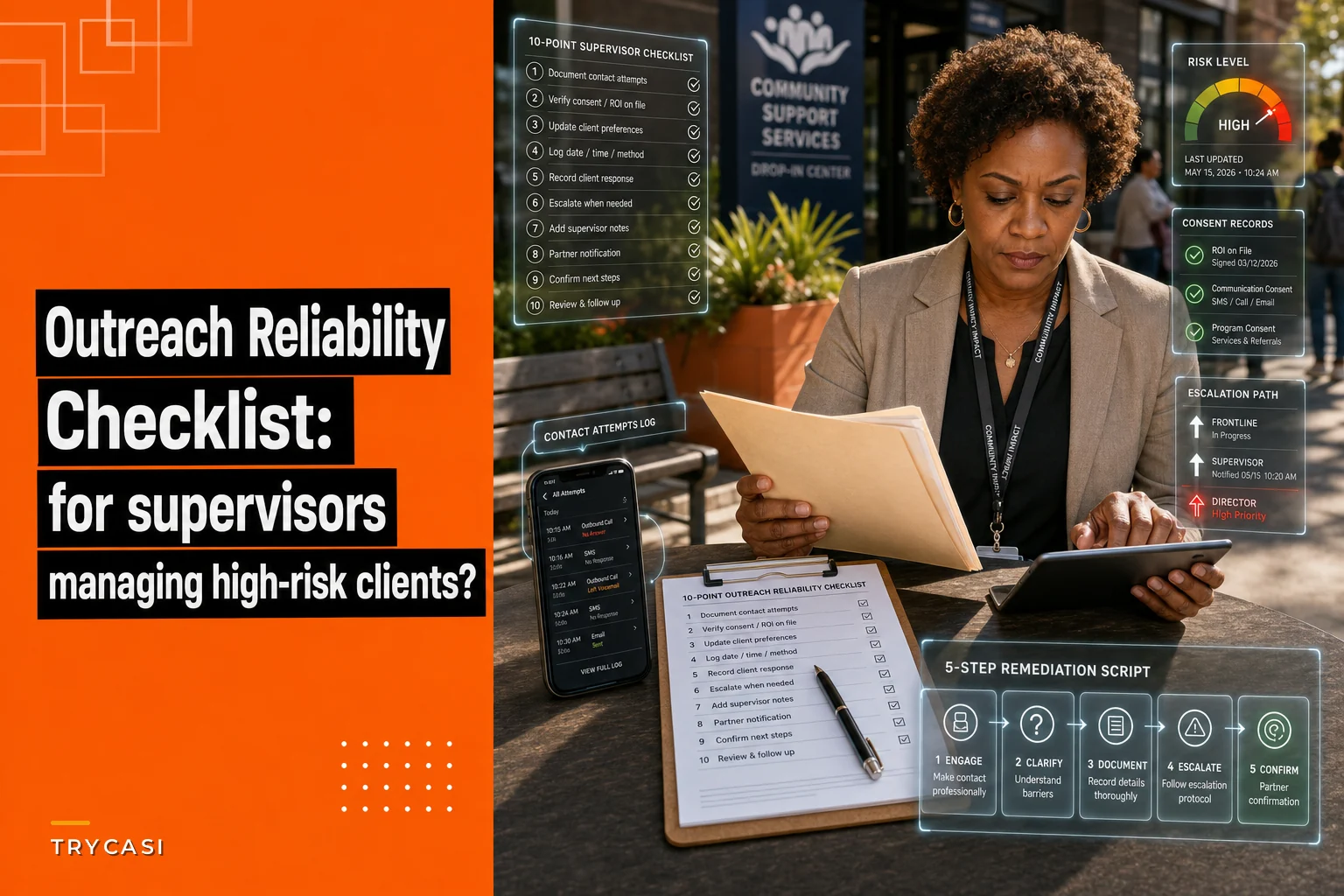
The 10-point supervisor checklist
This is built to be run by a supervisor doing spot-checks or case reviews — not as a self-report form the caseworker fills in. The whole point is independent verification. For each high-risk case you review, you're confirming the evidence exists, not that someone remembers doing it.
Eliminate case management chaos.
TryCasi helps you organize, monitor, and report on every case efficiently and securely.
- Centralized case tracking
- Automated client notifications
- Team task coordination
No credit card required
-
Consent-to-contact is on file and matches the method used. If the client was texted, there's documented SMS consent. If voicemail was left, there's a note that voicemail is safe for this client. The method of outreach can't exceed what consent covers.
-
Every attempt has a timestamp and a channel. "Called 2x" is not an attempt log. You want date, time, and channel (call / text / email / in-person / partner relay) for each individual try.
-
The contact detail used is the current, verified one. The number or address in the attempt matches the verified field in the record — not an old one. A surprising share of "unreachable" clients were reached at a number that was simply wrong in the system.
-
Failed attempts show what happened, not just that they failed. "No answer," "voicemail full," "number disconnected," and "answered, declined to engage" are four very different situations requiring four different next steps. The note distinguishes them.
-
Attempt spacing matches the client's risk tier. A high-risk client getting three attempts bunched into one afternoon, then silence for a week, is a red flag. The cadence should reflect the risk level, not the caseworker's calendar gaps.
-
At least one escalation note exists once the attempt threshold is hit. After the defined number of failed attempts (your agency sets this — often 3 within 72 hours for high-risk), there's a written risk judgment: current assessment, decision made, and rationale.
-
The escalation was routed to a named person, not a role. "Escalated to the team" is unverifiable. "Flagged to J. Okafor, 10/14, acknowledged same day" is. Someone specific received it and you can confirm they did.
-
Partner confirmations are captured in the case record. If a shelter, clinic, or probation officer reported contact with the client, that confirmation lives in the file — not just in someone's email — with source, date, and what was confirmed.
-
Contradictions between internal and partner records are reconciled. If your log says "unreachable 10 days" but the clinic says they saw the client on day 4, that gap is noted and resolved, not ignored. These contradictions are often the earliest warning sign that outreach is breaking down.
-
The whole thread is legible to someone who has never touched the case. The real test: could an on-call worker or a reviewer open this case cold and understand exactly what was tried, what's known, and what happens next? If not, it fails — no matter how much work actually went in.
One note on item 10: this is the one worth keeping even if you stripped out everything else. Outreach reliability ultimately comes down to whether the record survives a handoff. High-risk cases move between workers — coverage, vacations, turnover — and the file is the only thing that travels with the client.
What each item is actually catching
Each checklist point is aimed at a specific failure mode — and it's worth knowing which one, because when you find a gap, it tells you immediately what broke down and where to focus.
| Checklist point | The failure it prevents | How it usually shows up in a real review |
|---|---|---|
| Consent matches method | Contacting a client in an unsafe way | Text sent to a shared phone; no SMS consent on file |
| Timestamp + channel | "We tried" with no provable basis | "Called several times" — zero dates |
| Verified contact detail | Chasing a wrong number for weeks | Client reachable all along at updated number |
| What happened on failure | Repeating a useless action | 5 voicemails to a full mailbox |
| Spacing vs. risk tier | Gaps that look like neglect | 3 tries Monday, nothing until next week |
| Escalation note exists | Undocumented risk judgments | "Decided to wait" never written down |
| Named recipient | Escalation into a void | "Flagged to the team," no one owned it |
| Partner confirmation in file | Lost external evidence | Shelter confirmed contact, email never filed |
| Reconciled contradictions | Missing the earliest warning | Internal log and clinic record disagree |
| Legible to a stranger | Collapse on handoff | Cover worker can't tell what's been done |
The pattern across that table is consistent: almost every failure happens not because the work wasn't done, but because the proof didn't make it into a shared record. That's an operational problem, which means it has an operational fix.
The five-item remediation script for missed attempts
When a spot-check turns up a missed or unverifiable attempt, supervisors tend to react in one of two bad ways — either a vague "please be more careful" or a heavy, demoralizing writeup. Neither fixes the record or the behavior. A short, repeatable script works better. It's meant to take five minutes and produce an actual corrected trail, not just a conversation.
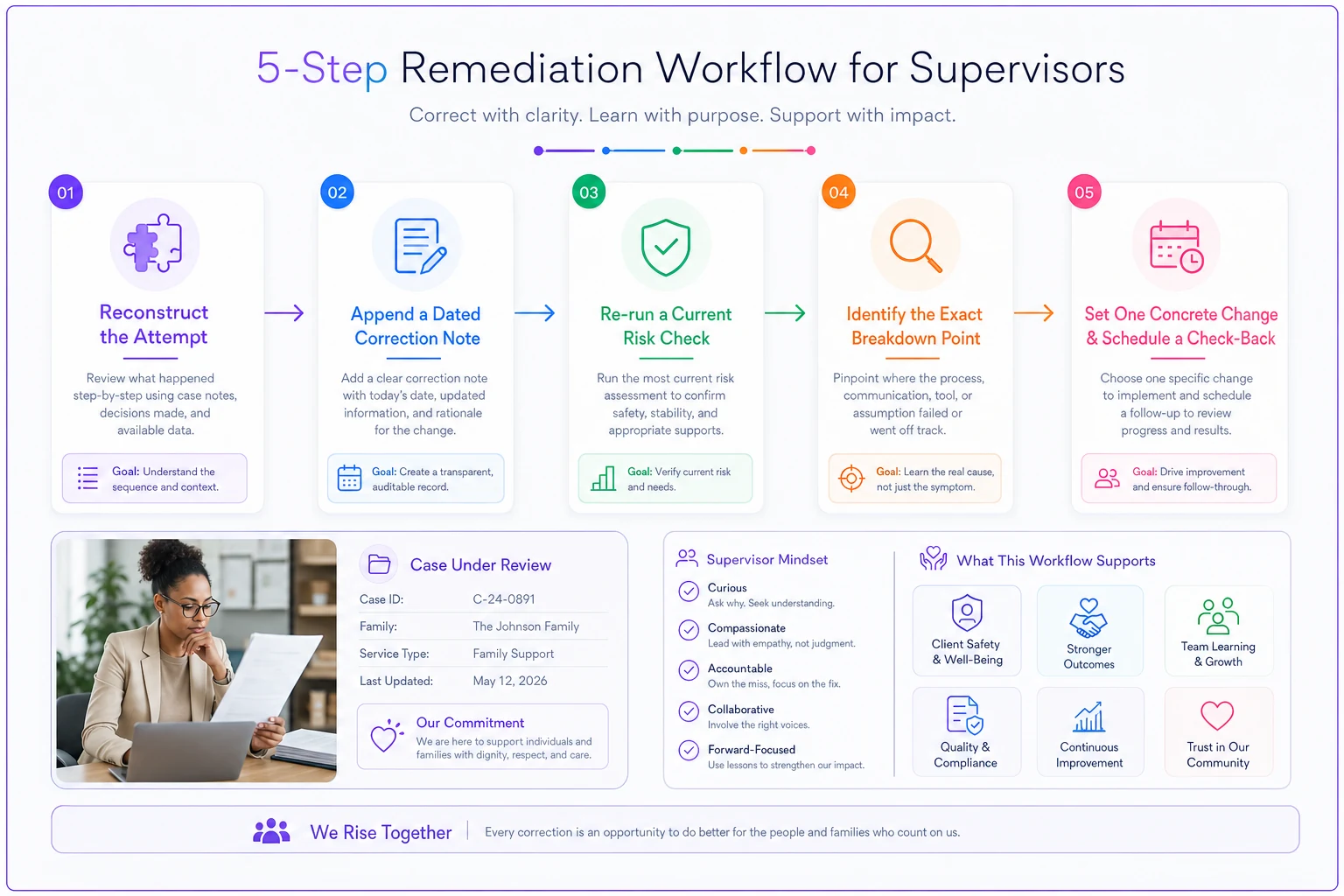
A quick visual of the five steps can help supervisors run the script consistently.
-
Reconstruct, don't accuse. Ask
"Walk me through what you remember trying on this one." You're rebuilding the actual sequence of events together. Most missed attempts are logging failures, not effort failures — lead with that assumption.
-
Backfill the record with a dated correction note. Whatever you reconstruct gets entered now, clearly marked as a retroactive entry with today's date and the dates it refers to. Never quietly edit history — you append. A corrected trail that's honestly labeled holds up; a silently altered one destroys trust in the whole file.
-
Re-run the current risk check immediately. A missed attempt on a high-risk client isn't just a documentation gap — it may mean a real gap in contact. Before anything else, confirm: is this client currently okay? If that can't be confirmed, the remediation pauses and this becomes an active outreach push right now.
-
Name the exact breakdown point. Pin down where the chain broke: no consent on file, attempt made but never logged, logged but never escalated, escalated but not confirmed. One specific breakpoint. This turns a fuzzy "do better" into a single fixable step.
-
Set one concrete change and a check-back date. Not five improvements. One. "Going forward, log the attempt before you leave the client's street, from the mobile app." Then put a date on your calendar to verify it stuck. One behavior, one follow-up.
The discipline is doing all five — including the risk re-check in step 3 — rather than jumping straight to "write it up next time." The script exists so that a missed attempt produces a repaired record and a confirmed-safe client, not just a note in a supervision log.
A real scenario
A mid-sized family services program — around nine caseworkers, roughly 40 active high-risk cases at any time — kept passing their internal audits and still had two near-miss incidents in a single quarter. Both involved clients flagged high-risk who went un-contacted for stretches that nobody caught until a partner agency called, alarmed.
When the supervisor started running something close to this checklist on a sample of cases each week, the picture got uncomfortable fast. Out of around 25 high-risk files reviewed in the first month, roughly a third had attempt logs that couldn't survive item 2 (no real timestamps), and nearly half were missing a filed partner confirmation that existed somewhere in an inbox. Several escalations had been "flagged to the team" with no named owner.
The caseworkers' effort wasn't the problem. They were reaching out. The attempts just weren't landing in a form that proved anything or survived a handoff. Over the next couple of months, with weekly spot-checks and the five-item remediation script applied to every miss, unverifiable attempt logs dropped to a handful. More importantly, contradictions between internal records and partner reports started getting caught within days instead of weeks. No dramatic transformation. Just a record you could actually trust.
Where tooling helps — and where it doesn't
A lot of this is behavioral and can't be automated away. A caseworker still has to make the call. But the evidence layer — timestamps, channel, consent-matching, partner confirmations landing in the right file — is exactly what leaks when it depends on memory and manual copy-paste across systems.
Prioritize configuring consent flags and automatic timestamps so outreach attempts are recorded at the point of contact.
Case management platforms with built-in outreach logging help here: attempts timestamp themselves when logged from a mobile app, consent flags can block an outreach method the client never agreed to, and escalations route to a named person with an acknowledgment trail instead of disappearing into "the team." Some platforms use lightweight automation to flag a high-risk case when the attempt cadence slips, or to prompt for a partner confirmation that's gone missing. The value isn't that the software does the outreach — it's that it makes the proof automatic, so your supervisor spot-checks stop turning up ghosts. That said, be honest about the limit. A platform that captures evidence well but isn't used consistently just produces better-formatted gaps. The checklist and the remediation habit come first; the tooling makes them cheaper to sustain.
When this level of rigor makes sense — and when it's overkill
This system is built for high-risk caseloads. Running the full 10-point verification on every routine case would bury your supervisors and generate paperwork nobody reads.
It makes sense when: you're managing clients where a missed contact can lead to real harm — safety-flagged clients, active crisis follow-ups, protective-order situations, clients mid-transition between placements or agencies. It also makes sense anywhere you've had a near-miss, because near-misses almost always expose a broken evidence chain before they expose a broken plan.
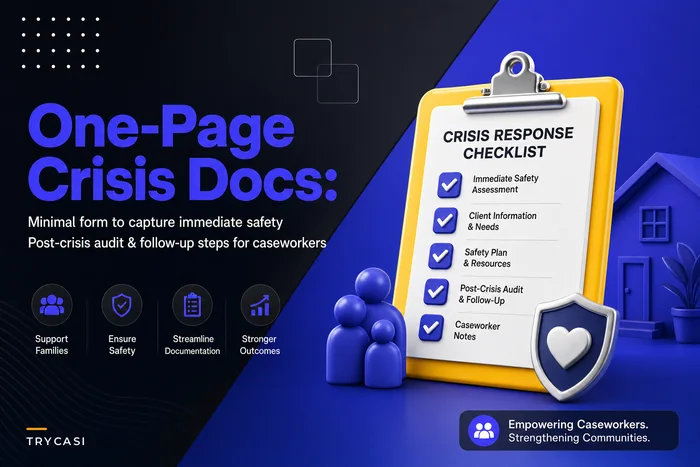
It's probably overkill when: the caseload is low-acuity, contact is frequent and stable, and a missed attempt carries no safety consequence. For those, a lighter approach — like the routines in our one-page crisis documentation and post-crisis audit — fits better than full per-attempt verification.
Who should not adopt this as-is: teams with no shared record system at all. If attempts live across personal phones, loose notes, and individual inboxes, this checklist will just confirm that over and over. Fix the shared-record foundation first, then layer the verification on top.
The point most reviews miss
When outreach to a high-risk client fails badly, the instinct is to ask whether people cared enough. Almost always they did. What failed was the ability to prove and reconstruct what happened — which means the fix isn't more effort, it's a tighter evidence chain and a supervisor who checks it before a crisis forces the question. Run the ten points on a sample every week, use the five-item script the moment you find a gap, and you'll catch the broken chains while they're still cheap to fix.
Ready to transform your social services workflow?
Join 500+ agencies using TryCasi to improve case outcomes, enhance collaboration, and reduce administrative burden.