


Most agencies don't decide to hand triage decisions over to a predictive model. It happens sideways. A vendor demos a scoring feature, someone turns it on in a pilot, and eighteen months later a risk score is quietly influencing who gets seen first, who gets a callback, and who ends up on a waitlist nobody's actively watching. Nobody signed off on that. It just accreted.
That drift is the real governance problem. Not the math inside the model — most caseworkers will never audit the math, and honestly they shouldn't have to. The problem is that the operational scaffolding around the score never got built. No threshold defining when a human overrides it, no rubric for what "the model is degrading" looks like, no line in the procurement contract requiring the vendor to explain a bad prediction. So the score becomes authoritative by default, because nothing structured ever contests it.
This is a playbook for the non-technical people who actually own the consequences: program managers, supervisors, and case management leads. You don't need to understand gradient boosting to govern predictive triage well. You need acceptance tests, human-in-the-loop thresholds, a monitoring rubric, override decision trees, and a vendor audit checklist that a team of six can actually run. That's what this covers.
Why predictive triage governance breaks in small social service teams
Big agencies fail at this because of bureaucracy. Small teams fail for the opposite reason — there's no one whose job is to say no to the model.
In practice, this usually happens when a program is understaffed and a predictive score feels like relief. Intake volume is up 30%, caseworkers are stretched, and a tool promises to sort the queue. The pressure to trust it is enormous, because the alternative is a human triaging 40 referrals a day on gut feel. So the score gets adopted not because it was validated for your population, but because your team was drowning.
The pattern that keeps showing up: the model was trained on data from a different region, a different eligibility mix, or a different service era. It performs "fine" on paper — decent accuracy overall — but it systematically under-scores a subgroup you serve heavily. Maybe it under-flags older clients living alone because the training data underrepresented them. Nobody notices for months, because there's no monitoring rubric checking performance by subgroup, only in aggregate.
What breaks at scale is coordination. A single caseworker overriding a score occasionally is fine. But when three caseworkers each quietly distrust the model and each work around it differently — one ignores it, one only uses it for extreme cases, one follows it religiously — you no longer have a triage process. You have three. And your outcome data becomes uninterpretable, because you can't tell whether a result came from the model, a workaround, or a coin flip.
Governance is what turns "everyone has their own relationship with the score" into a shared, documented system. It connects directly to work you may already have in place — a solid intake triage rubric for frontline social work gives you the human baseline that predictive scoring is supposed to augment, not replace. If you don't have that baseline written down, you have nothing to compare the model against.
Procurement acceptance tests: what to prove before go-live
The single highest-leverage governance moment is before you sign. Once the tool is embedded in daily workflow, ripping it out is politically and operationally painful — vendors know that the pilot is really the sale. Acceptance tests are how you keep leverage.
Eliminate case management chaos.
TryCasi helps you organize, monitor, and report on every case efficiently and securely.
- Centralized case tracking
- Automated client notifications
- Team task coordination
No credit card required
An acceptance test is a pass/fail condition you define, in your contract or SOW, that the tool must meet on your data before it goes into production. Not the vendor's benchmark data — yours. The mistake teams make is accepting vendor accuracy claims at face value. A model that's 88% accurate nationally can perform meaningfully worse on the 400 clients you actually serve.
A small-team acceptance test battery that doesn't require a data scientist to run:
-
Shadow-mode parity check. Run the model in the background for 60–90 days without letting it affect decisions. Compare its scores against your caseworkers' independent triage calls on the same cases. You're looking for where they disagree and why. If the model and your experienced staff disagree on more than a quarter of cases, that's not a tool you can trust yet — that's a research project.
-
Subgroup performance floor. Define the 3–5 populations you serve most (by age band, language, housing status, whatever matters for your program). The model must perform within an acceptable band for each group, not just overall. Set the floor before you see the results, so you're not tempted to move the goalposts.
-
Explainability test. Pick 10 real scored cases and ask the vendor to explain, in plain language, the top factors driving each score. If the answer is "the algorithm weighs many factors," that's a fail. You need to be able to explain a triage decision to a client or an auditor.
-
Stability check. Feed near-identical cases with one field changed. Does a small, irrelevant change swing the score wildly? Brittle models produce arbitrary triage, which is worse than no triage.
-
Data provenance test. Confirm what the model was trained on and when. A model trained on pre-pandemic service patterns may be scoring a completely different world.
Write the pass/fail thresholds into the contract with a right-to-exit if they're not met. That one clause changes the entire power dynamic of the pilot.
Human-in-the-loop thresholds: deciding where the human stays in charge
"Human in the loop" gets said constantly and means almost nothing without thresholds. A human sitting next to a screen rubber-stamping scores is not oversight. Real human-in-the-loop design specifies which decisions require human judgment and which don't, based on stakes and confidence.
The cleanest way to think about it is a two-axis grid: how confident is the model, and how high are the stakes if it's wrong.
| Model confidence | Low-stakes decision | High-stakes decision |
|---|---|---|
| High confidence | Model can proceed, logged for audit | Human reviews, model advises |
| Low confidence | Human reviews | Human decides, model input optional |
The insight most teams miss: the dangerous quadrant isn't low-confidence/high-stakes — everyone watches that one. It's high-confidence/high-stakes. A model that's wrong-but-certain does the most damage, because its confidence discourages scrutiny. A high, confident risk score on a case that turns out to be a false alarm can pull scarce resources away from a genuinely urgent client, and the confidence is exactly what makes staff stop questioning it.
So threshold rules should force human review specifically where consequences are irreversible or severe — safety concerns, service denials, anything that changes a person's access to housing or benefits — regardless of how confident the model is. Confidence buys you speed on low-stakes stuff. Never on the high-stakes stuff.
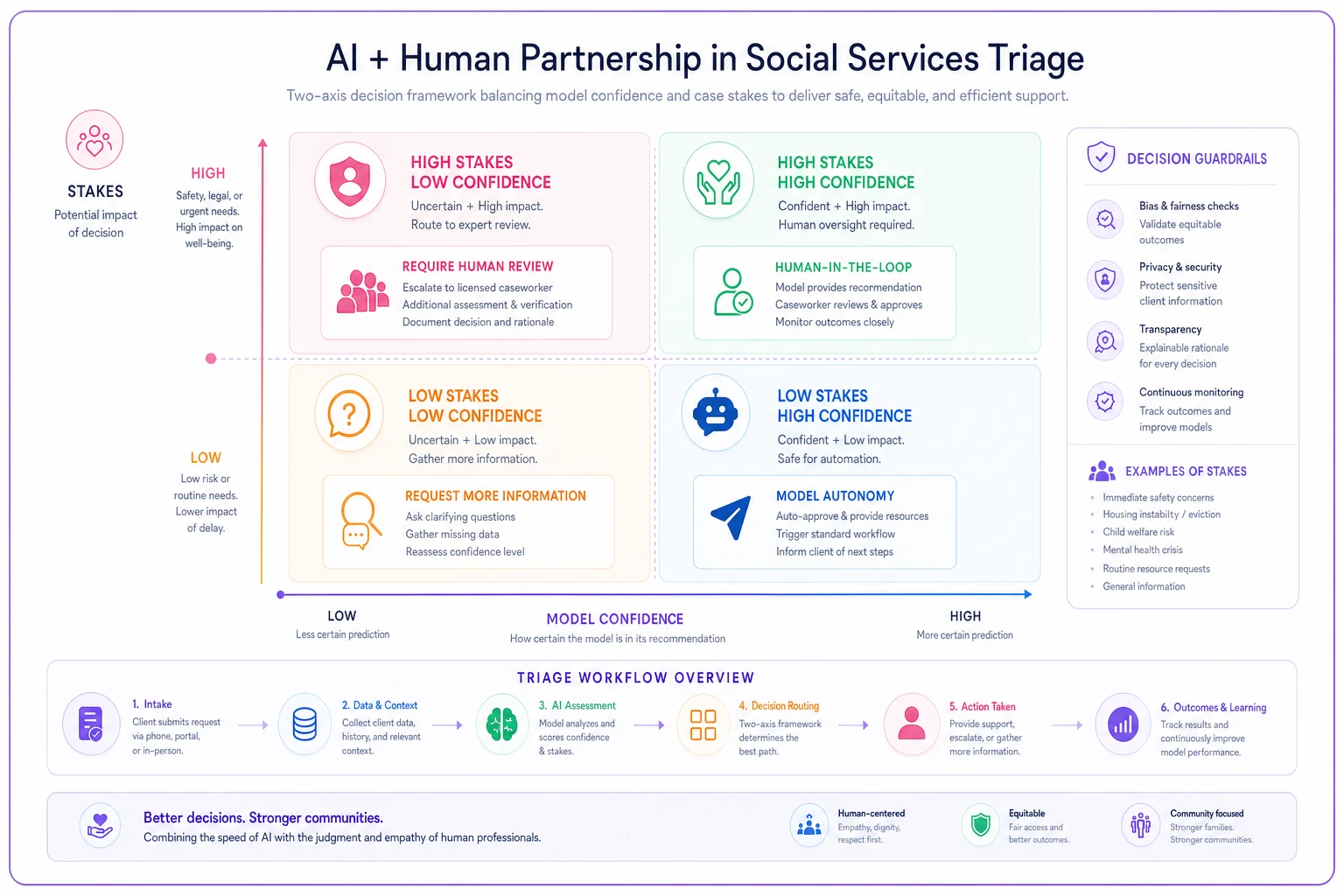
Set these thresholds explicitly and put them where staff can see them. A reasonable rule for small programs: any score that would move a client into or out of your top-priority tier requires documented human confirmation before it takes effect. That single rule prevents most of the silent-drift failures.
A monitoring rubric a team of six can actually run
Models decay. The population shifts, referral sources change, a partner agency starts sending a different mix of cases, and the model that passed acceptance testing slowly stops fitting reality. This is called drift, and it's not exotic — it's the normal life cycle of any predictive tool. The failure is having no routine that catches it.
Enterprise monitoring dashboards are overkill for a six-person team and usually go unwatched anyway. What works is a lightweight monthly rubric run by one designated person in about an hour.
Monthly monitoring checklist:
-
Override rate. What percentage of scores did staff override this month? A sudden climb means staff are losing trust — investigate before it becomes silent non-use.
-
Subgroup drift. Re-check performance on your key populations. Is any group's accuracy sliding relative to last quarter?
-
Score distribution shift. Are scores clustering differently than they were at launch? A distribution that's crept upward might mean the model is inflating risk, flooding your priority tier and defeating the point of triage.
-
Outcome linkage. For a sample of cases, did the high-scored ones actually turn out higher-need? This is the real test and the one most teams skip.
-
Complaint and anomaly log. Any case where staff felt the score was clearly off. Qualitative, but early warnings live here.
Run the monthly rubric as part of an existing audit or staff review so it doesn't become another meeting to schedule.
Tie this rubric to review structures you already run rather than inventing a new meeting. The monitoring routine sits naturally alongside sound data governance practices for small teams — role matrices, field-level validation, and monthly audit scripts. Model monitoring is just one more script in that rhythm, and it should feel that ordinary.
Teams that run this even imperfectly catch drift months earlier than teams waiting for something to "feel wrong." By the time it feels wrong, you've usually mis-triaged a lot of people.
Override decision trees: making disagreement structured, not personal
Overrides are where governance either works or collapses. If overriding the model feels like insubordination, staff stop doing it and start quietly ignoring the tool instead — which is worse, because now the disagreement is invisible. If overriding is a free-for-all, you lose consistency and your outcome data turns to noise.
The fix is a decision tree that makes overriding a normal, documented action with clear rules. Something a caseworker can follow in under a minute:
-
Does the score conflict with a hard safety signal you observed directly? (Disclosure of harm, unsafe living situation, medical crisis.) → Override up immediately. Document the observed signal. Human judgment always wins on directly observed safety.
-
Does the score conflict with your professional assessment, but no hard signal? → Flag for a second opinion. Don't override alone; get a supervisor or peer confirmation. This prevents both blind trust and lone-wolf triage.
-
Do you disagree but can't articulate why? → Follow the score, but log the discomfort in the anomaly log. Gut feelings are data; capture them without acting on them unilaterally.
-
Is the client contesting the priority level? → This routes to your consent and communication process, because the client's own account is legitimate input.
Every override should record: what the score said, what the human decided, and a one-line reason. That's it. Not a form that takes ten minutes — a dropdown and a text box. The override log becomes one of your most valuable governance assets, because it's ground truth on where the model and your team diverge, and it feeds directly back into acceptance re-testing.
Overrides also intersect with client rights. When a predictive score influences access to services, the client's ability to understand and contest that decision matters — which connects to how you've built your operational consent workflows. The redaction rules and frontline decision trees you already use for consent are the same muscle you need here.
Vendor audit checklist sized for small teams
You're not going to run a formal algorithmic audit with a six-person staff. But you can run a proportionate one that catches the things that actually burn small programs.
Ask every predictive triage vendor these, and keep their written answers on file:
-
What was the model trained on, and does it resemble our population? Get specifics on geography, time period, and demographic mix.
-
Can you show subgroup performance, not just aggregate accuracy? Refusal or vagueness is a red flag.
-
What happens when you retrain or update the model? You need notice before behavior changes under your staff's feet. A silent update can invalidate everything you validated.
-
Can we export our own override and outcome data freely? If your governance data is locked in their system, you can't audit them independently. Non-negotiable.
-
Who is accountable when a prediction contributes to a bad outcome? Get that in writing before something goes wrong, not during a crisis.
-
What's the exit process? How do you get your data out and turn the model off cleanly if you decide to stop.
The recurring mistake is treating the vendor relationship as one-time — buy, install, done. Predictive tools are living systems; the audit is annual, not just at procurement. Put a yearly re-audit on the calendar the day you sign.
When predictive triage actually makes sense — and when it doesn't
Not every program should be running predictive triage, and governance discipline includes knowing when to walk away.
It makes sense when: your intake volume genuinely exceeds human sorting capacity, you have a written human triage baseline to validate against, and you have someone who can own the monthly monitoring. Predictive triage augmenting a strong human process can meaningfully cut the time high-need clients wait — that's a real operational win.
It's a bad idea when: your intake volume is manageable by hand, your outcome data is too thin to validate the model against, or nobody on staff has the bandwidth to run monitoring. A model you can't monitor is a liability with a nice interface.
Who should not do this: brand-new programs without a stable process yet. You cannot govern a predictive layer on top of a process that isn't itself stable and documented. Get the human triage rubric solid first, run it for a year, then consider whether a model earns its place on top.
A short real scenario
A regional program handling housing-stability and benefits navigation — roughly 9 staff, around 350–400 active cases — turned on a vendor risk score during a staffing crunch. For the first several months it seemed to help. Then a supervisor doing a manual case review noticed something: nearly all the clients over 65 living alone were landing in the middle tier, even ones with obvious acute needs.
They ran a subgroup check they'd never done at procurement. The model was systematically under-scoring that group — it had been trained on a younger population. Because there'd been no human-in-the-loop threshold on tier changes, those cases had been quietly deprioritized for months.
They didn't scrap the tool. They added three things: a threshold requiring human confirmation on any priority-tier change, a monthly subgroup check in their existing audit routine, and an override log. Within a quarter, the override rate stabilized around 15% — high enough to show staff were genuinely using judgment, low enough to show the model was mostly useful. More importantly, the mis-tiering of older clients stopped, because a human was now in the loop exactly where the stakes were high. The tool didn't get smarter. The governance around it did.
Bringing it together
Predictive triage governance in social services isn't about controlling technology — it's about keeping human accountability intact while a scoring layer does some of the sorting. The score is an input. Your team, your thresholds, your monitoring, and your override rules are what turn that input into a defensible decision.
The whole system hangs together only if the pieces connect: acceptance tests set the entry bar, human-in-the-loop thresholds decide where judgment stays sovereign, the monitoring rubric catches decay, override decision trees keep disagreement structured, and the vendor audit keeps the relationship honest over time. Skip any one piece and the others weaken. Modern case management platforms can carry a lot of this scaffolding for you — logging overrides, flagging drift, exporting governance data — but the tooling only matters if the human framework is already decided. Build the framework first. Then let the software enforce it.
The programs that do this well aren't the ones with the most sophisticated models. They're the ones where a caseworker can look at a score, disagree with confidence, document why in fifteen seconds, and trust that their judgment still counts. That's what good governance protects.
Ready to transform your social services workflow?
Join 500+ agencies using TryCasi to improve case outcomes, enhance collaboration, and reduce administrative burden.