

Most agencies can prove a client signed something. Far fewer can prove a client understood it. That gap is where the real risk lives — in the uncomfortable distance between a signature on a consent form and a person who genuinely knows what happens to their information after they walk out the door.
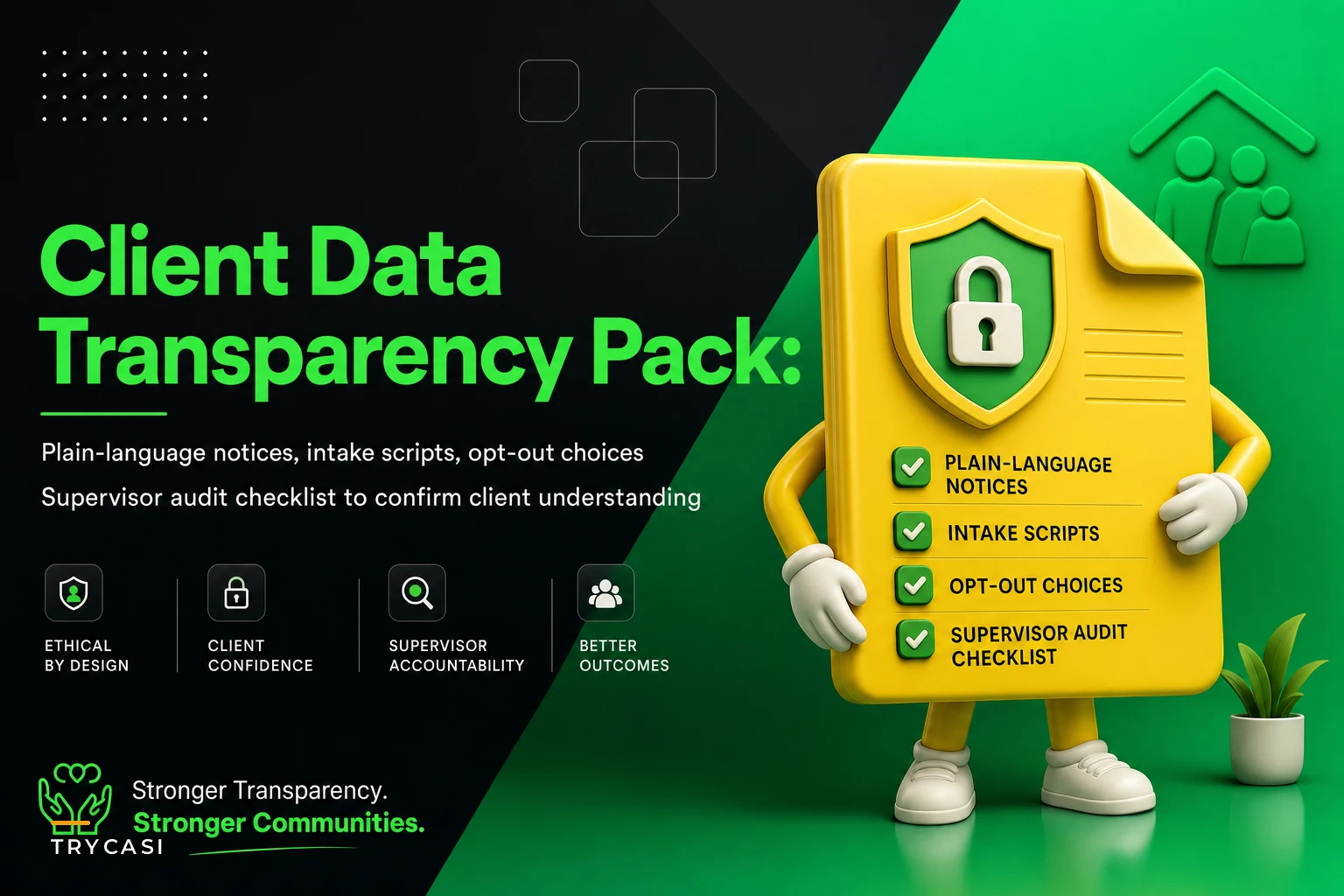
This pack is narrow on purpose. It covers one thing: giving clients real transparency about data use in a way that holds up to scrutiny, and giving supervisors a way to verify it actually happened. Not consent mechanics, not redaction rules, not partner data-sharing agreements. Just the transparency layer — the notices, the intake scripts, and the opt-out path — plus a checklist a supervisor can walk through to confirm the whole thing landed.
Where transparency quietly breaks down
The failure almost never looks like a failure in the moment. Intake goes fine. The client nods. The form gets signed. Everyone moves on.
The breakdown shows up three months later, when a client finds out their information was shared with a housing partner and says, genuinely surprised, "Nobody told me that." And technically, someone did — page 4, paragraph 2, in a block of text written at a 14th-grade reading level. The client initialed it. But they didn't understand it, and there's no record anywhere that the caseworker checked.
-
The notice does double duty and fails at both. Agencies write one dense document that tries to be a legal disclosure and a client explanation at the same time. It satisfies neither. Legal wants precision; the client needs plain language. One document can't serve both.
-
Intake staff ad-lib the explanation. Without a script, each worker explains data use differently. One spends four minutes on it, another says "and this part's just about your privacy, sign here." The quality of transparency depends entirely on who happens to do your intake that day.
-
Opt-out exists on paper but has no path. The notice says clients can opt out of certain data uses. Ask the front desk how, and you'll get a shrug. A right with no mechanism behind it is almost worse than no right at all.
-
Nobody checks. Supervisors review case notes for service content, deadlines, risk flags. They almost never spot-check whether the client actually understood the data-use conversation.
The common thread is that transparency gets treated as a document to produce rather than a conversation to have and verify.
The three pieces that actually work together
Real transparency needs three components that reinforce each other: a notice the client can read, a script so the conversation is consistent, and an opt-out path that functions. Here's how they differ in job and format.
Eliminate case management chaos.
TryCasi helps you organize, monitor, and report on every case efficiently and securely.
- Centralized case tracking
- Automated client notifications
- Team task coordination
No credit card required
| Component | What it's for | Who uses it | Format |
|---|---|---|---|
| Plain-language one-pager | Lets the client read and keep a human-readable summary of how their data is used | Given to client | Single page, 6th–8th grade reading level |
| Intake script | Keeps the verbal explanation consistent across every worker | Used by intake staff | Short talking points, 60–90 seconds |
| Opt-out workflow | Gives a real, trackable path to decline specific data uses | Client + staff + supervisor | Decision tree + logging step |
The one-pager is not your consent form and not your legal privacy notice. Keep the legal disclosure — you still need it. The one-pager sits on top as the thing a human being can actually absorb in two minutes.
The plain-language one-pager
Strip it down to what a client genuinely wants to know, which is almost never what the legal notice leads with. Clients care about four things:
-
Who sees my information? Name the categories — your agency, specific partner types, funders who audit files. Not "authorized parties."
-
What do you do with it? Coordinate services, report anonymized numbers to funders, check eligibility. Concrete verbs.
-
What can I say no to without losing services? This is the part clients most want and almost never get clearly.
-
How do I change my mind later? A phone number, a person, a form. Something they can act on.
A one-pager that answers those four questions in plain sentences does more for real transparency than ten pages of accurate legalese. Write it at a 6th-to-8th grade level and read it out loud — if you stumble, a client will too.
Read the one-pager aloud during training to catch phrasing staff stumble over; if it trips up you, it'll trip up a client.
One mistake worth flagging: agencies tend to soften these documents into reassurance. "We take your privacy very seriously." That line tells the client nothing and eats space you need for specifics. Cut it.
The intake script
> "Before we go further, I want to make sure you understand how we use your information, and I'll give you a one-page sheet to keep. > > We use your details to coordinate the services you're asking for. Some information gets shared with partner agencies when we're setting up a referral — I'll always tell you when that's happening. We also report numbers to our funders, but that's without your name attached. > > There are some things you can choose to say no to, and it won't affect the help you get here. For example, you can decline letting us contact you by text, or decline sharing with certain partners. Would you like me to walk through those options? > > If you ever change your mind about any of this, you call [name/number] and we update it. Any questions before we continue?"
Two things make this script work. First, it names the opt-out as a real choice, not a buried clause. Second, it ends with a question — "any questions?" — which is the small moment where comprehension either happens or doesn't. If you tie this into your broader intake flow, it pairs naturally with the detailed mechanics covered in operational consent workflows for social services, which handles the decision trees underneath the conversation.
The opt-out workflow
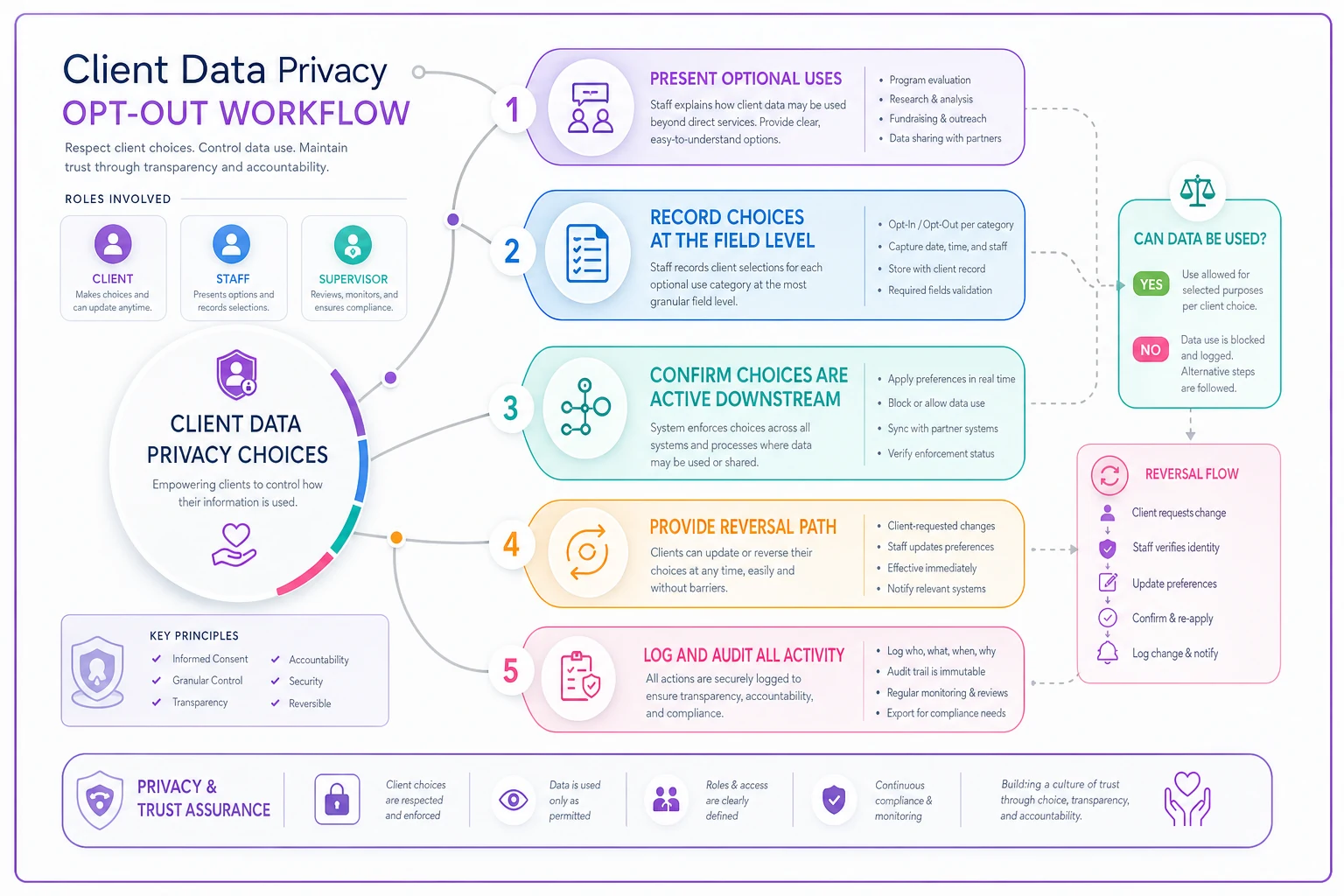
An opt-out right that nobody can execute is theater. The workflow needs three things: a clear list of what's actually optional, a way to record the choice, and a path to reverse it later.
-
Present the optional uses. During intake, staff names the specific things a client can decline — text contact, non-essential partner sharing, inclusion in certain outreach lists. Keep this list short and real; don't offer opt-outs you can't technically honor.
-
Record the choice at the field level. The client's decision gets logged against the specific data use, not as a vague note. "Client declined SMS contact on 3/14" — not "client has privacy concerns."
-
Confirm the choice is active. If a client opts out of text contact, the system shouldn't still be queuing them for SMS reminders two weeks later. The opt-out has to actually change behavior downstream.
-
Give a reversal path. Document how the client changes their mind, who they contact, and how long the update takes to take effect.
Step 3 is where most agencies quietly fail. A client declines text contact, and three weeks later an automated reminder goes out anyway because the opt-out lived in a case note nobody wired into the messaging list. For the specific mechanics of handling text and phone preferences cleanly, the SMS and phone consent playbook covers the audit-log and fallback side of this in detail.
Here's a simple visual of the opt-out workflow.
Step 3 is where most agencies quietly fail. A client declines text contact, and three weeks later an automated reminder goes out anyway because the opt-out lived in a case note nobody wired into the messaging list.
The supervisor audit checklist
This is the piece almost nobody builds, and it's what turns transparency from a hope into something verifiable. The idea is a short spot-check a supervisor runs on a sample of files — say five to eight files per caseworker per month — to confirm the transparency steps actually happened and landed.
Run through each sampled file:
-
[ ] Plain-language one-pager was given to the client (noted in file with date)
-
[ ] Intake note reflects the data-use conversation actually took place — not just "consent signed"
-
[ ] Optional data uses were presented to the client (staff can point to where)
-
[ ] Any opt-out choices are logged against the specific data use, with a date
-
[ ] Opt-out choices are actually active downstream (e.g., client who declined SMS is not on the text list)
-
[ ] Reversal path is documented and the client was told how to use it
-
[ ] For a subset of files, a quick client-side check
a follow-up call asking "do you remember what we shared about how your information is used?" — gauge whether it stuck
That last item is the one with teeth. You can audit paperwork all day and still not know whether clients understood anything. A handful of comprehension-check calls each month tells you more about your real transparency than a stack of signed forms. One pattern to watch for in the audit: files where everything is checked but every box was ticked in the same ten-second window with identical phrasing. That's a sign of back-filling, not real conversations. Vary your sampling and occasionally ask the caseworker to describe the conversation from memory.
A real scenario
A mid-sized family services program — around nine caseworkers, roughly 600 active cases — kept running into the same complaint during their annual funder review. Clients, when interviewed, often had no idea their information had been shared with referral partners. On paper, every file had a signed consent. In practice, comprehension was near zero.
They didn't rewrite their legal notices. They added the three-piece pack: a one-page plain-language sheet, a scripted 90-second intake explanation, and a logged opt-out path. Then supervisors ran the audit checklist on about six files each per month, including a few comprehension calls.
The first round of comprehension calls was rough — somewhere around half the clients still couldn't recall what had been shared. But the script and the one-pager gave supervisors something concrete to coach against, because now there was a defined standard to miss. By the third month, recall on those follow-up calls had climbed noticeably, and a couple of recurring opt-out failures — clients still getting texts after declining — got caught and fixed because the audit specifically checked downstream behavior, not just the note.
No dramatic transformation. But the next funder review went differently, and the agency could actually show how it verified client understanding rather than just pointing at signatures.
When this makes sense — and when it doesn't
When it's worth building: Any program sharing client data across partners, reporting to funders, or using automated contact. If a client could reasonably be surprised by where their information went, you need this.
When it's overkill: A tiny single-worker program with no data sharing and no automated outreach probably doesn't need a full audit cadence. The one-pager and a consistent explanation are enough; a formal monthly supervisor audit would be ceremony for its own sake.
Who should not just copy this blindly: Agencies in jurisdictions with specific statutory notice requirements. Build the plain-language layer on top of required legal notices — never as a replacement. The one-pager earns comprehension; the legal notice covers compliance. You need both.
A note on keeping it active
The hard part isn't writing the pack. It's keeping opt-out choices live as systems change. When an agency switches case management tools, adds a new referral partner, or turns on a new reminder feature, old opt-outs can silently stop working. The checklist item about verifying opt-outs are active downstream is your early-warning system for exactly that drift.
Where software helps here is quiet and specific: storing opt-out preferences at the field level so they travel with the client record, and wiring those preferences into whatever sends messages or triggers partner sharing — so a declined text contact can't accidentally get queued three weeks later. That's the integration that matters. Not a dashboard, not analytics — just making sure a "no" stays a no everywhere it needs to.
Bottom line
Transparency isn't the signature. It's whether the person on the other side of the table actually knows what's happening to their information and what they can decline.
The three-piece pack — a plain-language one-pager, a consistent intake script, and an opt-out path that actually functions — gives clients real understanding. The supervisor audit, especially the comprehension calls, is what proves it happened. Build both, and you move from "we have signed forms" to "we can show our clients understood" — which is a very different thing to be able to say when someone asks.
Ready to transform your social services workflow?
Join 500+ agencies using TryCasi to improve case outcomes, enhance collaboration, and reduce administrative burden.