


Text messaging genuinely transforms case management coordination—when it works. But getting proper SMS consent from social services clients involves more operational complexity than most platforms account for.
The consent challenge hits differently in social services than other sectors. A marketing team collecting opt-ins for promotional texts operates in a completely different universe than a case worker trying to coordinate emergency housing placement for someone whose phone got stolen last week. The legal requirements stay the same, but the operational reality creates gaps that standard consent workflows were never designed to handle.
After building SMS coordination systems for dozens of social service agencies, certain patterns keep breaking. Not because case workers skip steps or clients don't cooperate—but because real-world situations create scenarios that typical consent frameworks never anticipated.
The phone access problem nobody talks about
Most SMS consent guidance assumes consistent phone access. Social services reality: phones get disconnected, stolen, confiscated, lost, shared between family members, or borrowed from friends. A client enthusiastically opts in for appointment reminders on Tuesday, then shows up Thursday asking why you didn't call—their phone got shut off Wednesday morning.
Standard opt-in workflows fail in a few recurring ways.
Shared device situations emerge constantly. Three family members use one phone. Mom consents to texts about her benefits case. Teen daughter gets the messages. Dad deletes them thinking they're spam. Your audit log shows successful delivery, but communication completely breaks down.
Temporary numbers create consent chaos. Client gives you a TextNow number during intake. Two weeks later, the app expires the number due to inactivity. Someone else gets assigned that number. Now you're texting a stranger about confidential case information, even though your consent form shows valid authorization.
Emergency contacts blur consent lines. Client lists their sister as emergency contact with permission to receive case updates. Sister changes her number but doesn't tell anyone. New number owner starts receiving HIPAA-protected information. Your consent documentation says you can text that number, but reality says otherwise.
These aren't edge cases in social services. They're Tuesday afternoon problems.
Building consent workflows for unstable phone access
Effective SMS consent in social services requires documentation layers that general business communication never needs. The operational framework has to assume phone access will break, numbers will change, and standard verification won't work.
Eliminate case management chaos.
TryCasi helps you organize, monitor, and report on every case efficiently and securely.
- Centralized case tracking
- Automated client notifications
- Team task coordination
No credit card required
Two-channel verification becomes essential. Never rely solely on SMS confirmation for opt-in. When someone provides a phone number and consents to texts, send the standard opt-in confirmation text first—but immediately follow with verbal confirmation during the same interaction. Document both the text response and the verbal confirmation in your case notes. Include specific language: "Client verbally confirmed receipt of opt-in text at 2:45 PM and stated they want appointment reminders via SMS."
This redundancy feels excessive until the first audit request arrives asking how you verified consent when the client's phone records show no response to your opt-in text—because their prepaid plan had expired that day.
Consent expiration timelines protect against number recycling. Unlike marketing lists where old numbers just bounce, social services texts might reach the wrong person with confidential information.
Set consent expiration at 90 days for standard communication, 30 days for sensitive case information. Build re-verification into routine check-ins: "Are you still receiving texts at the 555-1234 number we have on file?" Document the confirmation with a timestamp.
When re-verifying, timestamp the verbal confirmation in case notes and include the confirming staff member's name.
Some agencies resist expiration timelines, worried about adding work. But re-verifying takes seconds during existing conversations, while a misdirected confidential text creates hours of incident documentation.
Scripts that actually work in the field
Generic opt-in scripts assume ideal conditions. These account for the communication barriers case workers actually encounter.
Initial consent script for stable situations: "We can send appointment reminders and case updates by text to help you stay connected with services. This includes your appointment times, document deadlines, and general case updates. Standard message rates apply based on your phone plan. Would you like to receive these text messages?" If yes: "What's the best phone number for texts? And can you confirm this phone belongs to you and isn't shared with others?"
Modified script for shared phone situations: "I see this phone is shared with family members. We can still send appointment reminders, but we'll keep them general without specific case details. The texts would say things like 'Reminder: Your appointment is tomorrow at 2 PM' without mentioning what kind of appointment. Would that work for you?" This maintains communication while protecting privacy. Document the limitation clearly: "Client consented to generic appointment reminders only due to shared device. No case-specific information authorized via SMS."
Fallback script when phone access is uncertain: "Since phone access sometimes changes, let's set up a backup plan. If we can't reach you by text, where should we leave messages? Some options: voicemail at a family member's number, email if you check it regularly, or paper notices at your residence." Get specific: "If texts to 555-1234 stop working, we'll leave voicemails at your mother's number 555-5678, which you've authorized for case communication."
Audit logs that survive scrutiny
Basic SMS platforms track delivery status. Social services operations need audit logs that tell the full communication story—especially when standard channels fail.
Every SMS interaction should document the following:
-
Timestamp of consent collection (not just date)
-
Method of consent (text reply, verbal, written)
-
Specific services covered by consent
-
Identity verification method used
-
Device ownership status (personal, shared, borrowed)
-
Backup communication plan if SMS fails
-
Re-verification dates
When phone access breaks, your audit log should show the complete fallback sequence. Example entry:
"March 3, 2:30 PM – SMS to 555-1234 failed (number disconnected). March 3, 2:35 PM – Checked alternate contact: sister at 555-5678. March 3, 2:40 PM – Left voicemail per client's documented fallback preference. March 3, 4:15 PM – Client called back from 555-9999 (friend's phone), confirmed receipt of voicemail."
This kind of documentation seems excessive right up until a compliance review asks why you kept texting a disconnected number.
Consent modification tracking captures the real-world changes that happen constantly. Clients switch between wanting texts and not wanting them based on their current phone situation. Don't just track the current state—track the full history. When someone claims they never consented to texts, you need the complete timeline:
"March 15 – Client suspended SMS consent due to lost phone. March 22 – Client resumed SMS consent with new number 555-4444. March 29 – Client modified consent to exclude appointment reminders (too many texts)."
Fallback protocols when everything breaks
Sometimes clients desperately need services but have zero stable phone access. Standard consent workflows completely break down, and you need documented protocols for these situations.
The library computer protocol works for clients who can access email at public computers but have no phone. Create a dedicated case communication email that clients can check weekly at the library. Set up email notifications that mirror SMS alerts but with longer lead times—"Your appointment is this Thursday" becomes "Your appointment is next Thursday" to account for less frequent checking.
Document this variance: "Client has no phone access. Authorized email communication to [email] with understanding of weekly check-in frequency. Appointment reminders sent 7 days in advance instead of standard 24 hours."
Physical location check-ins become the ultimate fallback. Partner with places clients visit regularly—shelters, food banks, community centers. Create a simple message board system where case workers leave sealed envelopes with appointment reminders or case updates.
"Client authorized message drops at St. Mary's Shelter front desk. Case worker leaves sealed envelopes marked with client's initials only. Client checks daily during dinner service."
Emergency override protocols handle true crisis situations where consent becomes secondary to immediate safety. Document clear scenarios where normal consent requirements get overridden:
-
Client in medical emergency and unconscious
-
Welfare check when client misses a critical medical appointment
-
Court-ordered communication requirements
Each override needs thorough documentation: "Attempted SMS to authorized number 555-1234 (no response). Attempted backup voicemail to 555-5678 (full mailbox). Client missed dialysis appointment. Contacted emergency contact (sister) at unauthorized number 555-9999 due to medical emergency protocol. Sister confirmed client transported to Regional Medical Center."
Good documentation here isn't just about compliance—it's proof that you followed a rational, humane decision process when the rules had to bend.
Technology adaptations for consent management
Manual consent tracking breaks down at scale. Most case management systems treat SMS consent as a simple yes/no checkbox. Real operations need more sophisticated tracking that standard platforms rarely provide.
The workflow requires multiple consent states beyond opted-in or opted-out:
| Consent State | Description |
|---|---|
| Active – verified | Number confirmed, consent current |
| Active – unverified | Awaiting opt-in confirmation |
| Suspended | Temporary phone loss |
| Limited | Appointments only, no case details |
| Expired | Needs re-verification |
| Override authorization | Emergency contact approved |
Building these states into your system prevents a common nightmare: sending confidential information to an opted-out number because someone forgot to update the spreadsheet. AI-powered operational platforms can track these complex consent states automatically—flagging when re-verification is needed or when fallback protocols should activate—without someone manually auditing a spreadsheet every week.
The system should automatically flag numbers that haven't responded in 30 days, require re-verification before sending sensitive information, track consent modifications with full history, generate audit reports showing complete communication attempts, and manage fallback sequences when primary channels fail.
Some agencies try to build this in spreadsheets. It works for a few weeks before the manual maintenance becomes overwhelming. Purpose-built software for social services operations handles these consent complexities without constant oversight.
Measuring consent workflow effectiveness
Track metrics that actually matter for compliance and communication quality.
| Metric | What It Tells You |
|---|---|
| Consent verification rate | % of opted-in numbers that receive and acknowledge test messages. Below 85% suggests phone access issues. |
| Re-verification compliance | Are expired consents being renewed on schedule? |
| Fallback activation frequency | How often backup methods are needed. High frequency may indicate SMS isn't the right primary channel for certain clients. |
| Incident rate per channel | Privacy breaches and misdirected messages, tracked by channel. |
One agency tracked their metrics for about six months and found roughly 68% of clients maintained stable phone access, around 23% needed periodic fallback protocols, and about 9% required permanent alternative communication methods. They had zero privacy incidents after implementing structured consent workflows.
The numbers weren't perfect, but they showed the system worked.
Common consent mistakes that create liability
Even experienced teams make these SMS consent errors.
Assuming verbal consent is enough. Verbal consent during a hectic intake seems sufficient until you need to prove authorization six months later. Always follow verbal consent with written confirmation—even if it's just detailed case notes: "Client verbally consented to SMS appointment reminders at 555-1234 during intake interview, witnessed by Case Worker Johnson."
Texting emergency contacts without explicit permission. The client listed their mom as emergency contact. Mom's having a medical emergency, so you text mom about the client's appointment. Wrong move—emergency contact designation doesn't automatically include consent for routine communication.
Continuing texts after reported phone changes. Client mentions they're getting a new phone next week. You keep texting the old number because they haven't given you the new one yet. Those texts might reach someone else who now has that recycled number.
Skipping re-verification for long-term clients. "We've been texting Jennifer for two years, she's fine with it." But Jennifer's daughter recently started using that phone primarily. Your messages about Jennifer's mental health appointments are now being read by her teenager.
When SMS consent workflows don't make sense
Sometimes the operational cost of proper SMS consent genuinely exceeds the communication benefit.
Extremely transient populations might change numbers weekly. The constant re-verification becomes a barrier to service delivery. Email or physical location check-ins might work better despite being less convenient.
Clients with significant privacy concerns often can't risk any digital trail. Domestic violence survivors, undocumented individuals, or those in witness protection might need completely analog communication despite having phone access.
Programs with minimal ongoing contact don't justify complex consent workflows. If you only communicate twice per year, the consent infrastructure might cost more than the benefit of those two text messages.
Crisis intervention services operate under different rules. When someone texts a crisis hotline, implied consent covers the immediate response. Follow-up requires explicit consent with all the standard documentation.
Building your consent implementation plan
Start with a pilot program targeting your most stable client population. Test scripts, document edge cases, refine audit procedures, then gradually expand to more complex situations.
-
Week 1–2 Draft scripts and fallback protocols
-
Week 3–4 Train staff and test documentation procedures
-
Week 5–8 Run pilot with 20–30 stable clients
-
Week 9–10 Review audit logs and refine based on issues found
-
Week 11–12 Expand to additional client segments
Budget roughly 15 minutes per client for initial consent setup and around 5 minutes monthly for maintenance and re-verification. That sounds like a lot until you compare it to the time spent on failed communication attempts and incident documentation.
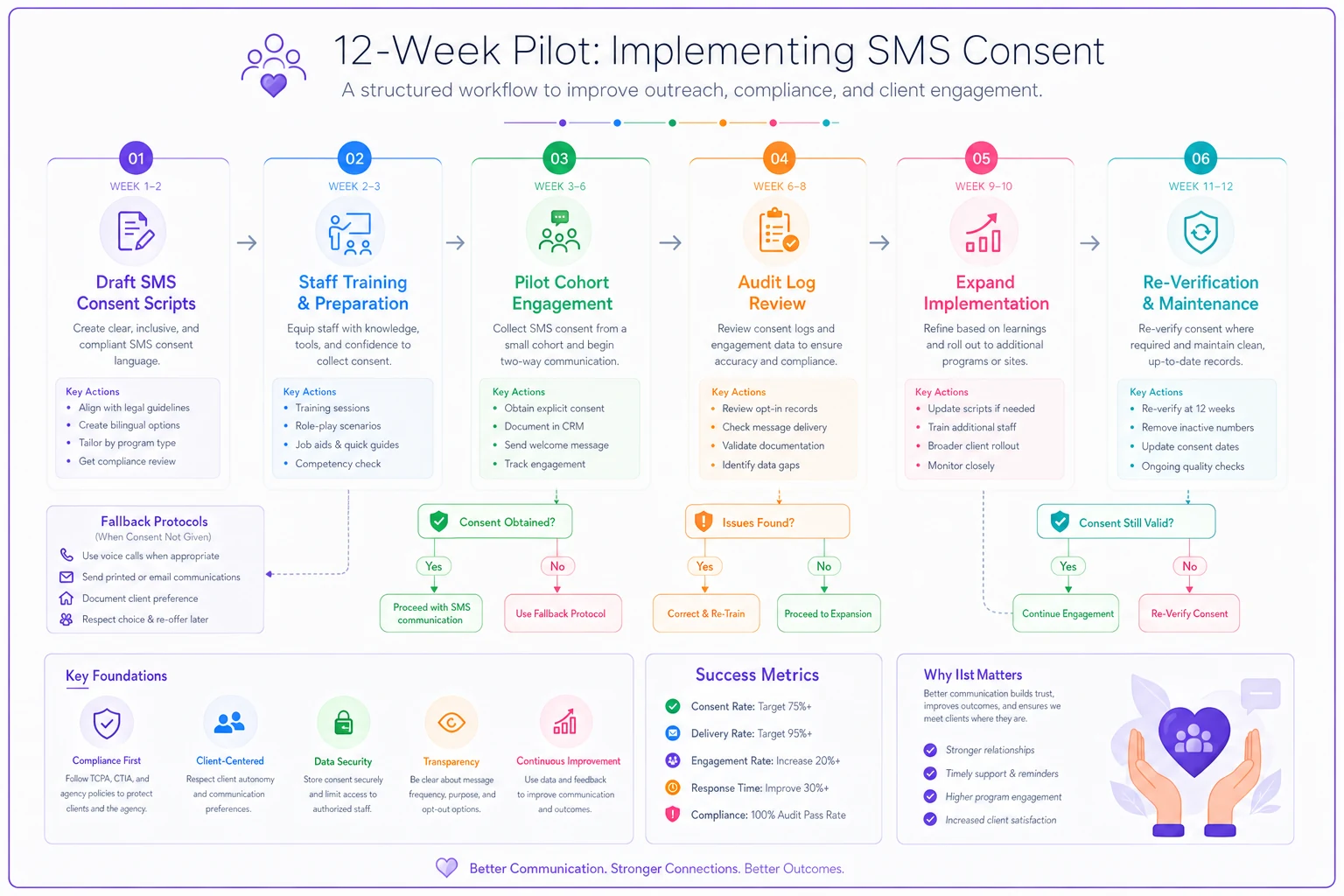
This diagram maps the pilot timeline and key verification and fallback decision points.
The agencies that get this right treat SMS consent as part of their core service delivery infrastructure, not an administrative afterthought.
The sustainability question
Proper SMS consent workflows for social services require more operational overhead than most agencies expect. But the alternative—privacy incidents, failed communications, compliance violations—costs significantly more in staff time and organizational risk.
Don't try to force SMS communication to work for everyone. Build robust consent and fallback protocols for clients who can actually use SMS effectively, and develop entirely different communication strategies for those who can't. Some agencies waste enormous energy trying to maintain SMS channels for clients with fundamentally unstable phone access. Better to acknowledge the limitation and build sustainable alternatives than to pretend digital solutions work universally.
Good consent management isn't about perfect documentation—it's about matching communication methods to client reality while maintaining compliance. Your audit logs should tell the story of real people with complex communication needs, not just checkbox compliance with regulations.
Because at the end of the day, the goal isn't compliant SMS messaging for its own sake—it's reliable communication that helps vulnerable clients access critical services, regardless of their phone situation.
Ready to transform your social services workflow?
Join 500+ agencies using TryCasi to improve case outcomes, enhance collaboration, and reduce administrative burden.