


Most vendor shortlists for social-service software are useless because they're built for the wrong size of agency. The free lists drift toward either bare-bones nonprofit CRMs that can't handle role-based access properly, or county-scale platforms priced for 500-seat deployments with six-month implementations. If you run a 40-person agency doing home visits, referrals, and outcome reporting to three different funders, neither end of that spectrum fits.
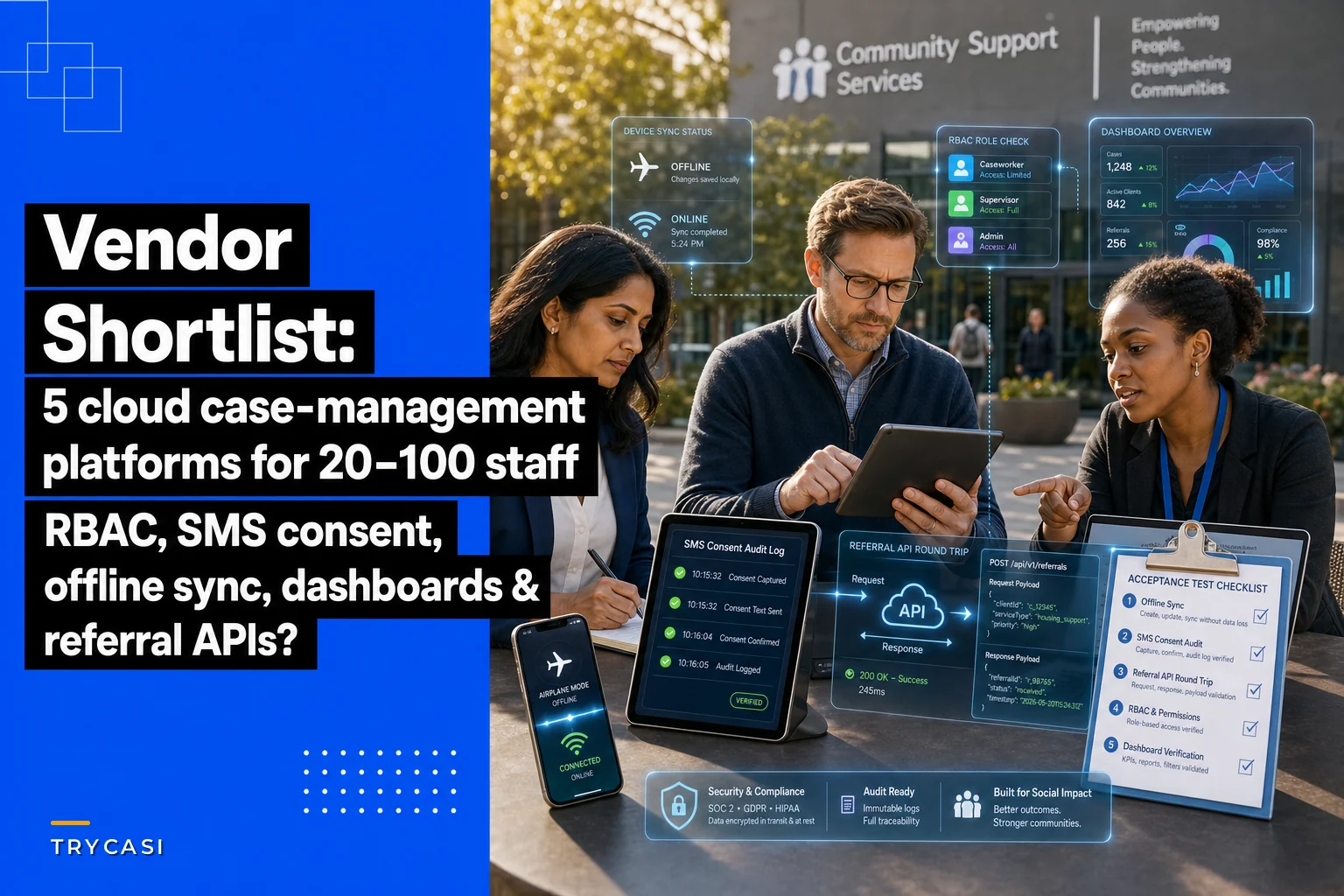
This is a working shortlist for the middle. Five platforms that can realistically serve a mid-sized agency, evaluated against the five things that actually break in the field: secure role-based access, SMS with proper consent logging, offline support for fieldworkers, outcome dashboards funders will accept, and a referral API that talks to partner systems without a fax machine involved.
For each vendor you get a short capability snapshot, one limitation worth catching during evaluation, and a rough monthly cost band with the assumptions behind it. Then an acceptance-test checklist you can hand to a vendor before signing, and negotiation notes for the parts of the contract that cost you later if you skip them.
The evaluation lens (read this before the vendor list)
A quick note on how these cost bands were built, because "monthly cost" means nothing without assumptions.
Every band below assumes:
-
50 licensed users (a reasonable midpoint for the 20–100 range)
-
Basic/standard support tier, not premium or dedicated success manager
-
Modest SMS volume
roughly 3,000–5,000 messages/month, which is what a 50-person agency running appointment reminders and check-ins tends to burn through
-
Annual billing where it lowers the rate (most vendors discount 10–20% for it)
-
No custom development baked in — implementation is separate and always negotiated
SMS volume is worth flagging specifically because it's the line item that catches agencies off guard. A platform can look affordable on licensing and then charge $0.02–$0.04 per outbound message on top. Once you're sending appointment reminders plus consent confirmations plus follow-up sequences, that adds up faster than most agencies budget for. If your outreach is heavy — multi-step reminder sequences, the kind that actually cut no-shows — model this at the high end.
One more thing worth saying plainly: the demo will always work. It runs on strong wifi with clean test data and a rep who knows exactly where to click. Your acceptance tests need to run on a bad rural connection with a real referral payload. That gap is where most buyer's remorse lives.
The Five Platforms
1. Casebook
Eliminate case management chaos.
TryCasi helps you organize, monitor, and report on every case efficiently and securely.
- Centralized case tracking
- Automated client notifications
- Team task coordination
No credit card required
Snapshot. Casebook is purpose-built for human services, which shows in how it handles person-centric records, relationships between clients, and configurable intake without forcing you into a sales-CRM data model. Role-based access is granular and the audit trail on record access is genuinely usable during compliance reviews. It handles outcome tracking and has an API for integration work, and the interface is one of the more caseworker-friendly options on this list.
Limitation to watch. Offline field capability is the soft spot. Confirm exactly what a fieldworker can do with no connection — many "mobile" claims in this category mean a responsive web view, not true offline record creation with conflict-safe sync. Test this on an actual dead-zone device, not the demo tablet.
Estimated monthly band. Roughly $2,000–$3,500/month for ~50 users at standard support, SMS billed separately or through an integration. Assumes annual billing.
2. Apricot (by Bonterra)
Snapshot. Apricot is one of the most established outcome-measurement platforms in the space, and its reporting and dashboard tooling is where it earns its keep — funders recognize the output and it handles multi-program outcome rollups well. Form-building is flexible enough to model most intake and assessment workflows without code. It scales comfortably across the 20–100 staff range.
Limitation to watch. Configuration complexity. Apricot's flexibility means implementation can drag, and self-service changes later require someone on staff who actually learned the tool. Budget for a real admin, not a volunteer who'll leave in eight months. Also confirm SMS is native versus a bolt-on, because consent-logging quality varies depending on how it's wired.
Estimated monthly band. Roughly $3,000–$5,500/month all-in for ~50 users, higher if you add premium reporting modules. Implementation is a separate and non-trivial line.
3. CharityTracker / ClientTrack (Eccovia)
Snapshot. Eccovia's tools are strong on coordinated care and referral networks, which matters if partner integration is central to your model. This is one of the better options if referrals in and out of partner agencies are a daily reality rather than an occasional thing. RBAC is mature and the platform is built with HMIS-style compliance environments in mind. Referral API and data-sharing across partner orgs is a genuine strength.
Limitation to watch. It can feel heavier than a 40-person agency needs, and pricing reflects that its natural home is larger continuums of care. Push hard on whether you're paying for network-scale features you won't use. Confirm the mobile and offline experience directly — coordinated-care platforms often assume connected environments.
Estimated monthly band. Roughly $3,500–$6,000/month for ~50 users depending on modules and referral-network scope. This one has the widest variance; get the quote scoped tightly.
4. Penelope (by Athena Software / Social Solutions lineage)
Snapshot. Penelope is a solid mid-market case management system with strong scheduling, service tracking, and billing-adjacent features, which makes it a good fit for agencies where clinical or billable services sit alongside case work. RBAC and audit logging are dependable. Reporting is capable, and it handles multi-program agencies without feeling like enterprise software.
Limitation to watch. The SMS and consent-logging piece is the thing to interrogate here — confirm whether consent capture, opt-out handling, and the audit trail are native or depend on a third-party messaging integration. If it's integrated, you need to see how the opt-out state syncs back and whether the consent log survives an audit. "Yes we do texting" is not an answer.
Estimated monthly band. Roughly $2,500–$4,500/month for ~50 users, standard support, annual billing.
5. Sumac (Silent Partner / Bonterra)
Snapshot. Sumac is the value option on this list — genuinely affordable for smaller mid-sized agencies and flexible across case management, intake, and outcome tracking. It covers the fundamentals of role-based access and reporting without a heavy implementation lift, which makes it attractive if you're moving off spreadsheets or an aging system and want to be live in weeks rather than quarters.
Limitation to watch. As you push toward the top of the 20–100 range and toward heavier referral-API and offline-field requirements, you'll feel the ceiling. Validate the referral integration and offline sync carefully — they may be adequate rather than robust. This is the platform where the acceptance tests below matter most.
Estimated monthly band. Roughly $1,200–$2,800/month for ~50 users. The lowest entry point on the list, with the tradeoff being that advanced integration needs stretch it.
Quick comparison
No single platform on this list is best at all five requirements — that's worth saying up front before looking at the table. Referral-network strength and low price tend to sit at opposite ends. Rich outcome dashboards usually come with heavier configuration. Use this to quickly spot where each vendor is likely to disappoint you, not to pick a winner.
| Platform | Strongest area | Weakest area to test | Est. monthly (50 users) |
|---|---|---|---|
| Casebook | Caseworker UX, RBAC audit | True offline sync | $2,000–$3,500 |
| Apricot | Outcome dashboards | Config complexity / SMS native? | $3,000–$5,500 |
| Eccovia (ClientTrack) | Referral network, coordinated care | Overbuilt for small agencies | $3,500–$6,000 |
| Penelope | Service tracking + scheduling | SMS consent logging depth | $2,500–$4,500 |
| Sumac | Price, fast rollout | Referral API + offline ceiling | $1,200–$2,800 |
The right question isn't "which is best" — it's "which requirement, if it fails, breaks my operation." A referral-heavy agency has a different answer than a field-visit-heavy one. Rank your five requirements before you rank the vendors.
The acceptance-test checklist
This is the part you actually hand to a vendor. Don't sign until each of these has been run against your data on your conditions — not a canned demo. Insist on running them yourself or watching them live. The five tests below are ordered by how often agencies skip them and regret it.
Here's a quick visual of the acceptance-test workflow.
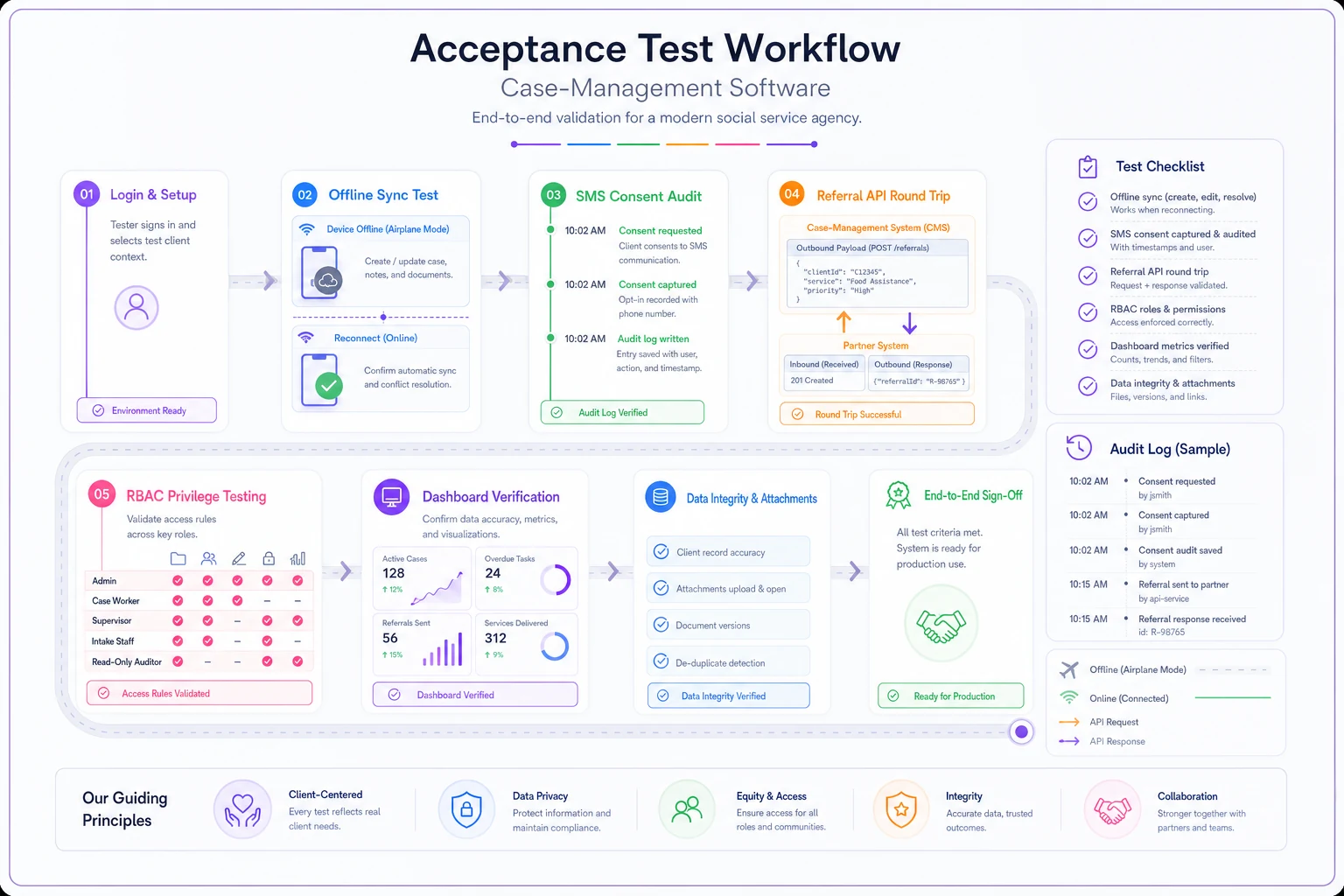
The five tests below are ordered by how often agencies skip them and regret it.
-
Offline sync test. Put a device in airplane mode. Create a new client record and a new visit note. Reconnect. Confirm the record syncs, appears server-side, and — critically — test a conflict: edit the same record on two devices offline, then reconnect both. See how the platform handles the collision. "It just takes the last one" is a data-loss risk you want to know about now.
-
SMS opt-in / opt-out audit trail. Opt a test number in. Send a message. Reply STOP. Then try to send again and confirm the system blocks it. Pull the audit log and verify it shows the timestamped consent, the opt-out event, and who or what triggered each. The log surviving an audit is the whole point — a text feature without a defensible consent record is a liability, not a feature. If you've already built consent scripts and workflows, this test should mirror them exactly.
-
Referral API round trip. Send a real referral payload out to a partner (or a test endpoint) and confirm it arrives complete — required fields intact, no silent field-dropping. Then confirm the return leg: does an accepted or declined status come back into the record automatically, or does someone have to re-key it? One-way referral APIs are common and quietly useless. You want the confirmation loop closed. This is exactly where a defined referral handoff protocol pays off, because you'll know precisely which fields must survive the trip.
-
RBAC privilege test. Log in as a restricted role — say, a volunteer or intake clerk — and actively try to reach records and fields they shouldn't see. Test field-level restriction, not just screen-level. A lot of platforms hide a field from the UI but expose it in exports or reports. Run an export as the restricted user and check what leaks.
-
Dashboard verification. Load a sample outcome dataset and build the exact report one of your funders requires. Then check the number by hand against the raw data. Dashboards that produce plausible-but-wrong aggregates are worse than no dashboard, because nobody catches it until a funder does.
Each of these takes under two hours to run. Skipping them because the demo looked good is exactly how agencies end up locked into a contract with a system that breaks on the first rainy-day field visit.
Procurement negotiation tips
The subscription price is rarely where you get hurt. The damage lives in implementation, migration, and the SLA — the three things vendors are happiest to leave vague.
Implementation. Get it fixed-fee with a defined scope and a go-live date, not time-and-materials. Ask specifically what "implementation" includes: form building, workflow config, RBAC setup, training hours. Vendors love to quote a low implementation number that covers setup but not the configuration you actually need to operate. Tie a portion of the implementation payment to acceptance-test sign-off, not just to "system is turned on."
Data migration. This is the most under-scoped line in every contract in this category. Nail down who cleans the data, how many records, how historical case notes map to the new fields, and — the big one — who's responsible if migrated data comes across malformed. Ask for a test migration of a data sample before full cutover. Agencies routinely discover their old notes don't map cleanly only after go-live, when it's expensive to fix.
SLA targets. Don't accept a generic "99.9% uptime" and stop there. Pin down:
-
Support response times by severity — a system-down ticket and a cosmetic bug should not have the same clock.
-
What counts as "down" — degraded performance during a busy intake morning matters even if the server technically responds.
-
Data export rights and format on exit — get, in writing, that you can pull your full data in a usable format if you leave, at no punitive fee. This single clause is your leverage at every renewal.
Tie a portion of the implementation payment to acceptance-test sign-off.
One negotiation move that works: bring your acceptance-test checklist into the sales process before signing. A vendor confident in their product will run the tests with you. Resistance to running a plain offline-sync or referral-round-trip test tells you more than any feature sheet.
When each choice actually makes sense
Go value-tier (Sumac) when you're escaping spreadsheets or a dying legacy system, your referral and offline needs are modest, and speed-to-live matters more than deep integration. Just budget to reassess as you grow toward 100 staff.
Go outcome-heavy (Apricot) when funder reporting is your operational pain and you have — or will hire — someone to own the configuration. Don't buy it if nobody on staff will learn to administer it.
Go referral-network (Eccovia) when cross-partner referrals are daily and central, and you're coordinating care across multiple orgs. Skip it if referrals are occasional — you'll pay for network scale you don't touch.
Go caseworker-first (Casebook) when field usability and clean audit trails are the priority and you can accept whatever offline capability testing reveals.
Go service-tracking (Penelope) when billable or scheduled services sit alongside case work — but pressure-test the SMS consent logging hard.
The workforce-shortage era has made tool choice higher-stakes than it used to be, because thinner teams can't absorb a bad system with manual workarounds the way over-staffed agencies once could. If you're evaluating during a staffing crunch, the operational-continuity framing in the case management workforce-shortage playbook is worth reading alongside this — the tool that survives short-staffing is the one that reduces re-keying and manual coordination, not the one with the longest feature list.
A short real scenario
A regional family-services agency with about 45 staff ran a proper acceptance test before committing — mostly because a previous rollout years earlier had gone sideways. During the referral round-trip test, they found the shortlisted platform sent referrals out fine but silently dropped two custom fields their largest partner required, and returned no acceptance status at all. On paper the integration "worked." In practice it would have meant a caseworker re-keying every referral confirmation by hand — call it a couple hundred referrals a quarter, each one a chance to lose a client in the gap.
That single failed test changed the decision. They shifted to a different platform on the list where the round trip closed properly, and negotiated the referral configuration into the fixed-fee implementation scope. The measurable win was that referral confirmations stopped falling through, and the intake team got back roughly half a day a week they'd have spent re-entering statuses. The point isn't which platform they picked. It's that a ninety-minute test caught a flaw the demo hid completely.
Bottom line
There's no single right platform on this list — there's a right platform for your top-ranked requirement, and a set of tests that tell you the truth the sales process won't. Rank your five needs honestly, build the cost band with your real SMS volume, and run the acceptance checklist against your own data before a signature goes anywhere near a contract. The agencies that regret their choice almost always skipped the tests because the demo looked fine. The demo always looks fine.
Ready to transform your social services workflow?
Join 500+ agencies using TryCasi to improve case outcomes, enhance collaboration, and reduce administrative burden.