

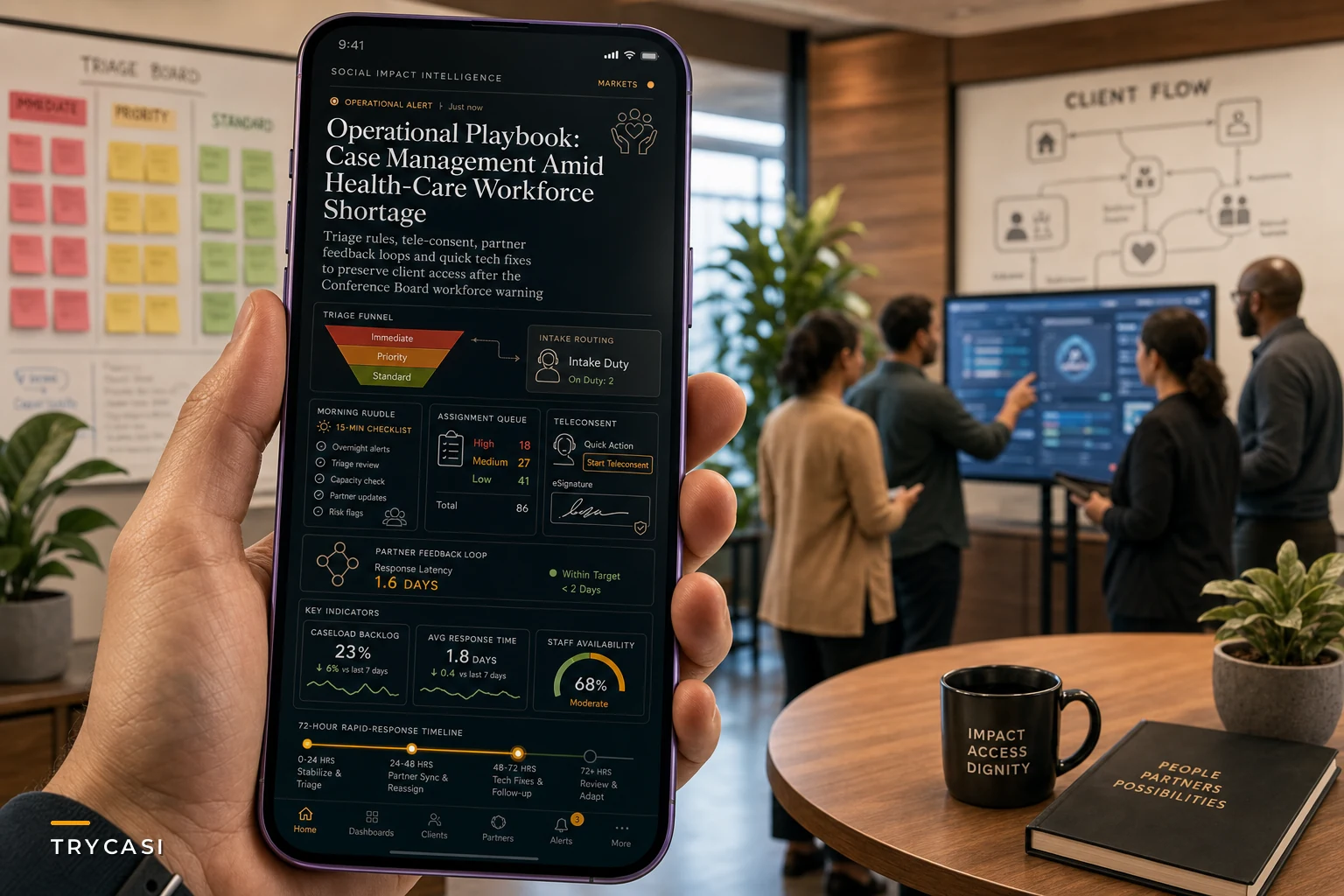

The Conference Board published a sobering analysis this week that confirms what frontline social workers already know: the healthcare workforce shortage case management teams are experiencing isn't temporary. They're tracking persistent job openings across clinical roles that directly affect your referral networks—the behavioral health specialists, housing navigators, and medical providers your clients depend on.
For case management teams, this creates an immediate operational squeeze. Partner organizations can't fill positions. Your own team is stretched covering vacant caseloads. Clients wait longer while their situations deteriorate. And the traditional response—just hire more staff—isn't working when qualified candidates aren't available.
What makes this particularly brutal in social services is the cascade effect. When a mental health provider has a three-month waitlist, your client's housing instability gets worse. When a substance abuse counselor position sits vacant for six months, other team members absorb those cases on top of 40+ client loads they're already carrying. The system breaks at its weakest points first.
The Hidden Cost of Coverage Plans
Most agencies default to redistributing caseloads when someone leaves. Split 60 clients among three remaining case managers, add 20 each—problem solved. Except it never works that cleanly.
Operationally, it's messier than it looks on paper. Those three case managers spend the first two weeks just figuring out where each new client stands. They're calling through outdated contact lists, reviewing months of case notes, trying to rebuild trust with clients who just lost their primary support person. Meanwhile, their original caseloads get less attention. Documentation falls behind. Safety checks get postponed.
One agency I watched closely lost four case managers over three months. By the time all the cases were redistributed, remaining staff were each managing close to 85 clients. The documentation backlog alone took six months to clear—and they started losing funding because required reports weren't filed on time.
The math never works when you're just moving cases around. You need workflows that fundamentally change how much time each interaction requires.
Triage Protocols That Actually Stick
Building a triage system during a staffing crisis feels impossible, but the alternative—every case manager making individual priority calls—burns more time than the structure would have cost. The agencies maintaining client access right now have clear, documented decision trees for case assignment and urgency levels.
Eliminate case management chaos.
TryCasi helps you organize, monitor, and report on every case efficiently and securely.
- Centralized case tracking
- Automated client notifications
- Team task coordination
No credit card required
Start with intake triage categories:
Immediate (same-day response):
-
Active safety concerns
-
Medication interruption risks
-
Utility shutoffs within 48 hours
-
Eviction proceedings this week
-
Medical appointments requiring prior authorization today
Priority (24-48 hour response):
-
Benefits expiring within 7 days
-
Housing applications with deadlines this week
-
Court dates requiring documentation
-
Prescription refills needed within 5 days
Standard (3-5 day response):
-
Routine recertifications
-
Non-urgent referral requests
-
General resource navigation
-
Transportation coordination for future appointments
The key difference between this and a typical priority matrix? These categories tie directly to operational workflows. Immediate cases route to whoever's on intake duty that day. Priority cases get distributed at the morning huddle. Standard cases enter the regular assignment queue.
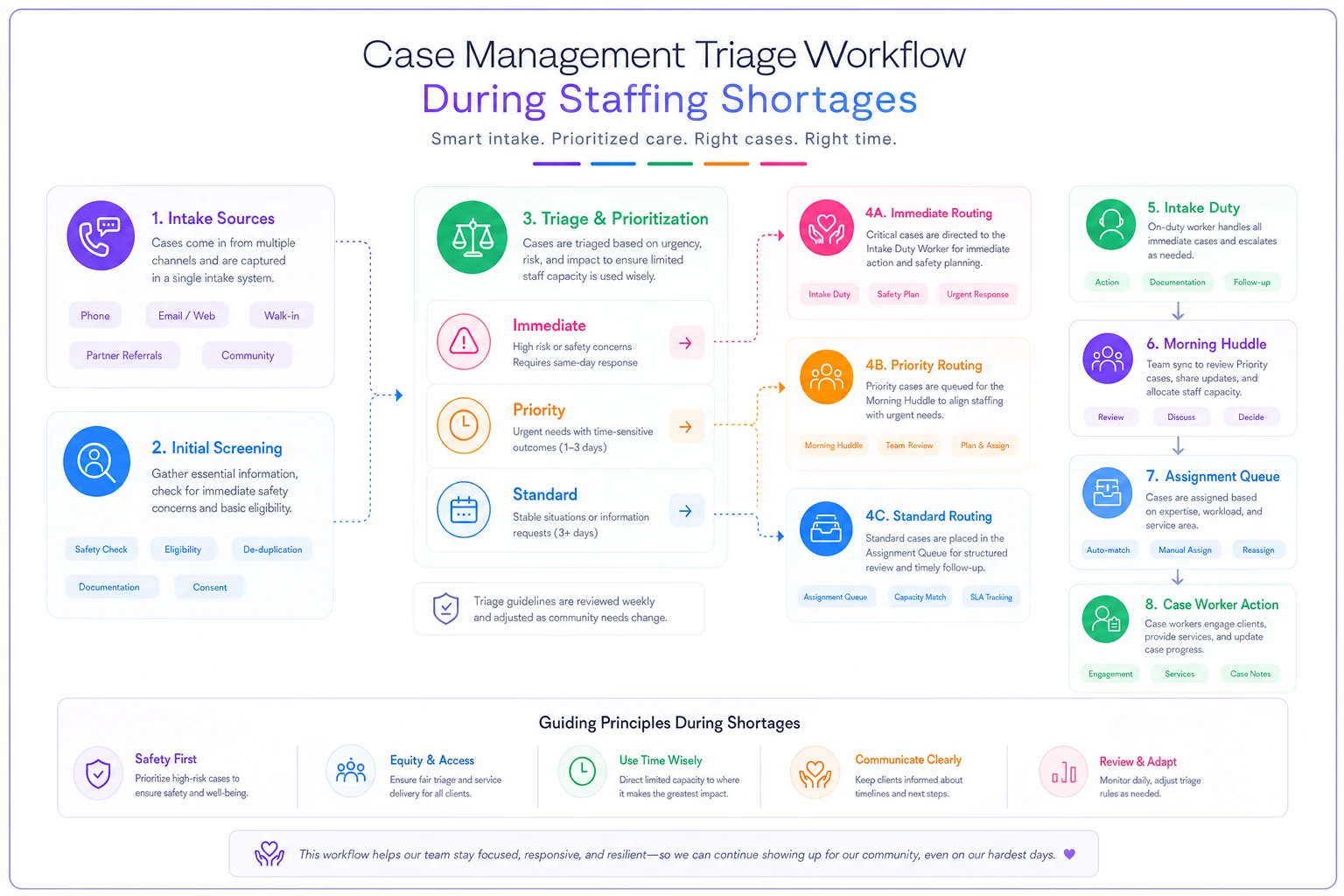
This illustrates how cases flow from intake categories to intake duty, morning huddle, and assignment queue.
One program serving roughly 400 families implemented this after losing about 30% of their case management staff. They maintained their same-day response rate for safety concerns while extending standard response times by just two days. Clients actually reported feeling more confident in the system—because they knew when to expect contact instead of wondering if they'd been forgotten.
Partner Communication Loops Under Strain
Your referral partners are drowning too. The behavioral health clinic that used to respond within 48 hours now takes two weeks. The housing specialist who knew every client's situation retired and wasn't replaced. These broken feedback loops mean case managers waste hours following up on referrals that went nowhere.
-
Weekly batch status requests Instead of individual follow-ups, send one spreadsheet listing all pending referrals. Partners fill in three options: accepted, waitlisted, or declined. Takes them five minutes instead of responding to 15 separate emails.
-
Capacity alerts Partners send a monthly one-liner about current waitlist length and acceptance restrictions. "Currently 6-week wait for initial assessment, not accepting new substance abuse cases without active insurance." This prevents dead-end referrals before they happen.
-
Warm handoff windows Schedule recurring 30-minute slots where partners can transfer cases directly. Tuesday 2–2:30pm for housing navigation, Thursday 10–10:30am for mental health. Case managers know exactly when they can reach someone.
-
Outcome snapshots Partners report back three data points after 90 days: still engaged, services complete, or lost contact. Not detailed progress notes—just enough to close the loop.
A multi-county consortium managing homeless services coordination built this system when their network partners started operating at around 60% capacity. They cut failed referrals roughly in half just by knowing which partners had actual openings versus theoretical availability.
Teleconsent and Remote Service Delivery
The traditional consent process—paper forms, wet signatures, in-person verification—falls apart when case managers can't meet every client face-to-face. But remote service delivery creates liability exposure if consent isn't properly documented.
Build conditional consent workflows that match client circumstances:
Video consent (highest validity):
-
Recorded verbal consent with visual ID verification
-
Screen-shared consent form review
-
Email confirmation with session recording link
-
Follow-up text with consent summary
Phone consent with verification:
-
Two-factor identity verification (DOB + last four SSN)
-
Full consent script read and recorded
-
SMS confirmation code sent during the call
-
Written summary emailed or mailed within 24 hours
Text-based consent for basic services:
-
Pre-authorized opt-in for specific service types
-
Standardized yes/no response format
-
Screenshot documentation retained
-
Escalation to phone for anything complex
The challenge isn't just getting consent—it's maintaining audit trails that satisfy state requirements. One Medicaid-funded program developed a graduated consent framework where low-risk services like information referrals and resource lists required minimal consent, while high-risk services like medical referrals and benefits applications required full video verification. They maintained compliance while cutting consent-related delays from days to hours.
Practical Client Access Preservation
When a client calls in crisis and their case manager is out, the covering worker usually lacks the context to help effectively. The fix is building information structures that assume any team member might need to serve any client on any given day.
Universal client snapshots: One-page summaries updated monthly with current benefits, active referrals, key contacts, and immediate risks. Not detailed histories—just what someone needs to handle today's situation.
Service matrices: A simple grid showing every client's active services and next required actions. Case manager A can immediately see that Client X has a food stamps recertification due this week, even if they've never worked together.
Contact hierarchies: Clear documentation of who to call first, second, and third for each client. Include relationship, best times to reach, and any communication restrictions.
Decision scripts: Pre-written responses for common situations. When Client Y calls about an eviction notice, any case manager can follow the same validated steps without starting from scratch.
This isn't about replacing relationship-based case management. It's about making sure clients get help when their primary support is unavailable. One agency serving around 250 youth implemented this after staff turnover hit 40%. They maintained their crisis response rate despite running at roughly half their intended staffing.
Tech Adoption Without the Learning Curve
The typical response to staffing constraints—implement new case management software—often backfires. Remaining staff spend weeks in training while caseloads pile up. The solutions that actually reduce burden share a few specific traits:
Start with automating appointment reminders to show quick wins and build staff buy-in.
Immediate value workflows: The system should save time on day one, not after full implementation. Start with automating appointment reminders or benefits deadline tracking—discrete tasks with clear, measurable time savings.
Parallel documentation: New tools should create required documentation as a byproduct of normal work, not require duplicate entry. Phone logs automatically generate case notes. Text conversations produce audit trails.
Progressive complexity: Start with basic functions everyone needs, then add advanced features once the foundation is stable. An AI-powered operational platform that tries to change everything at once will get abandoned. One that starts by tracking referral outcomes might actually stick.
Mobile-first for field work: Case managers spend half their time outside the office. If a system requires desktop access for basic functions, it won't get used consistently.
The agencies successfully adopting tech right now pick narrow problems and solve them completely. They automate benefits renewal reminders. They centralize referral tracking. They standardize intake assessments. Each solution removes specific friction without requiring wholesale workflow changes.
Metrics That Matter During Crisis
Traditional performance metrics—average caseload size, contact frequency, documentation completeness—become hard to sustain when everyone's already stretched. Track what actually indicates whether clients are getting served:
| Metric | What It Tells You |
|---|---|
| Time to first response | How long between initial contact and meaningful action—not just acknowledgment, but actual service delivery or concrete next steps |
| Referral completion rate | What percentage of referrals result in clients actually receiving services; reveals whether your partner network is functional or just theoretically available |
| Crisis recurrence | Whether the same clients are calling with emergencies repeatedly, which usually means preventive services aren't reaching them |
| Coverage gaps | How many clients haven't had any contact in 30+ days; these are your highest-risk cases for falling through the cracks |
| Partner response time | How long referral partners take to accept or decline; this drives your workload planning more than most teams realize |
A regional case management collaborative started tracking these metrics when traditional measures became impossible to maintain. They found their crisis recurrence rate was roughly three times higher for clients who hadn't received benefits assistance—which led them to prioritize those services even with staffing constraints. That single finding changed how they deployed their remaining staff.
Sustainable Workflows for Extended Shortages
The healthcare workforce shortage case management teams are dealing with isn't going away soon. Federal data shows job openings persistently exceeding hires across healthcare and social assistance sectors. This is the new operational reality, not a temporary disruption.
Building sustainable workflows means accepting trade-offs. You can't maintain pre-shortage service levels with 60% staffing. But you can preserve core functions:
-
Universal intake processes any available staff can handle
-
Graduated service tiers based on actual capacity, not ideal standards
-
Automated workflows for routine tasks like appointment reminders and deadline tracking
-
Partner coordination systems that don't require constant manual follow-up
-
Documentation approaches that capture essential information without requiring comprehensive narratives every time
The agencies managing despite these constraints have made hard choices about what to preserve and what to modify. They've shifted from comprehensive case management to focused intervention. They've replaced lengthy assessments with rapid triage. They've substituted automated check-ins for monthly home visits in lower-risk cases.
None of these are ideal. All of them represent compromises from best practices. But they keep clients connected to services when the alternative is no support at all.
Moving Forward With What You Have
The workforce shortage isn't your fault, and you can't fix it through individual effort. But you can build workflows that stretch the impact of available staff. Start with one bottleneck—maybe it's intake delays, referral tracking, or consent documentation. Fix that completely before moving to the next problem.
Pick solutions that work within existing constraints. If your team barely manages email, don't implement a complex ticketing system. If clients primarily use phones, don't make video meetings mandatory. If partners won't adopt new tools, build workarounds using what they already do.
For many agencies, that means using operational software that adapts to existing workflows rather than demanding new ones. AI automation can handle appointment scheduling, benefits deadline tracking, and referral follow-ups without requiring staff to learn complicated systems. Those same platforms can maintain audit trails, generate required reports, and flag at-risk cases—freeing case managers to focus on direct client contact instead of administrative overhead.
The healthcare workforce shortage case management organizations face will outlast quick fixes. Building operational resilience means rethinking how services get delivered when full staffing isn't achievable. The agencies maintaining client access aren't the ones waiting for conditions to improve—they're the ones adapting to current reality right now.
Your clients need services today, not when the crisis ends. These workflows aren't perfect, but they're sustainable. And sustainability is what keeps clients from falling through the cracks when every case manager is already covering for someone who isn't there.
Ready to transform your social services workflow?
Join 500+ agencies using TryCasi to improve case outcomes, enhance collaboration, and reduce administrative burden.