

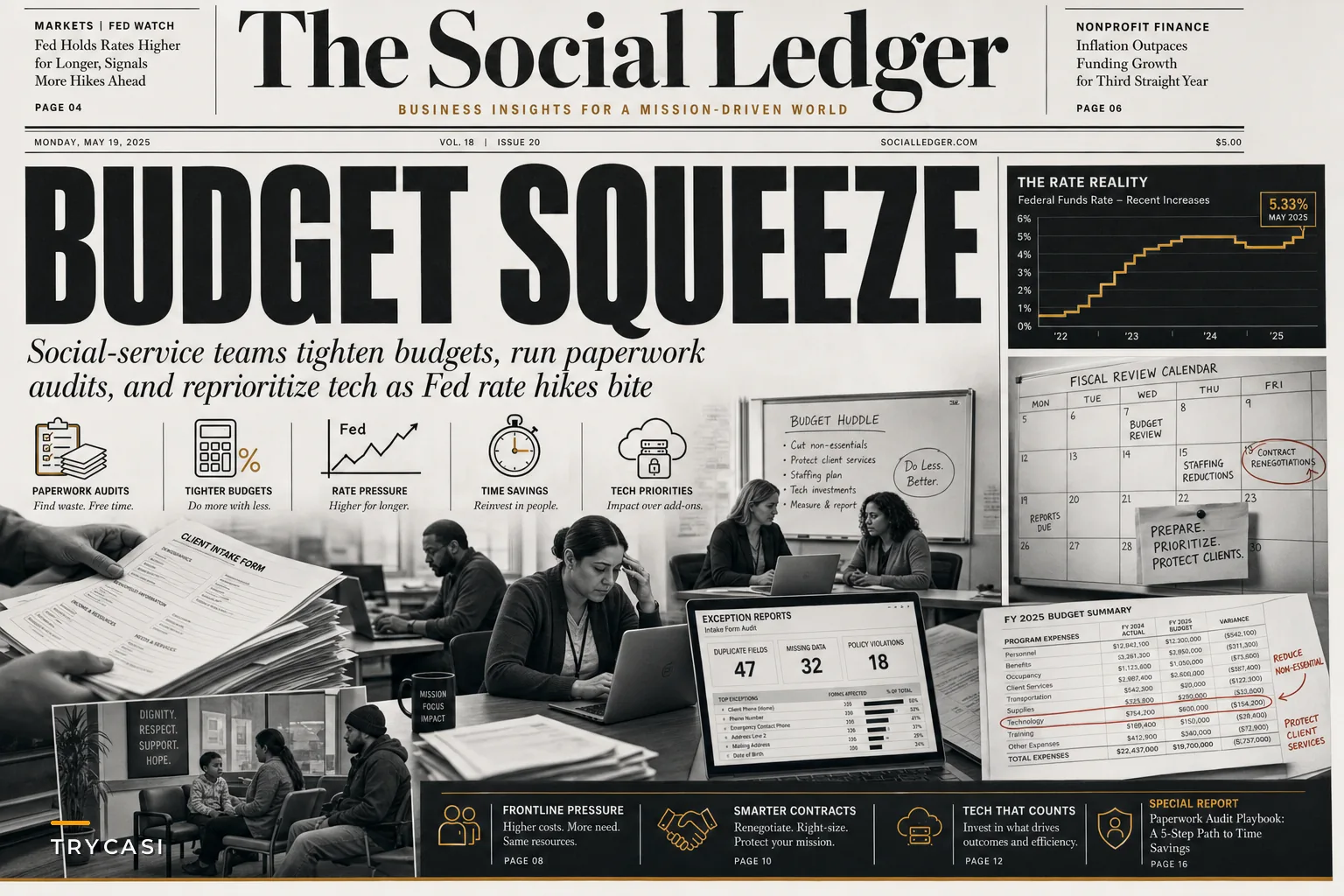

The Fed minutes released last week paint an uncomfortable picture for anyone managing social service budgets. Officials are still split on rates, with several members pushing for potential hikes to fight persistent inflation. For organizations already running on razor-thin margins, that uncertainty lands differently than it does in other sectors.
Your line of credit just got more expensive. That case management software vendor just emailed about a 15% price adjustment. Utility bills at your drop-in centers keep climbing. Meanwhile, funders are tightening up, demanding more detailed outcome reporting while offering flat or reduced grants.
This isn't really about balancing spreadsheets anymore. When inflation squeezes social service budgets, the real casualties are the families waiting weeks for intake appointments, the case managers drowning in redundant paperwork, and the partner organizations trying to coordinate services through broken referral loops.
The Hidden Multiplier Effect on Social Service Operations
Most program directors understand the direct hit — higher costs mean less money for services. But inflation creates operational chaos that compounds the financial pressure in ways that aren't always obvious upfront.
Take vendor relationships. That community transportation provider you've partnered with for years is facing the same pressures. When they raise rates or cut routes, you end up redesigning your entire home visit workflow. One mid-sized family services organization in Ohio found their transportation costs jumped 42% over eighteen months — not just from price increases, but from having to use multiple vendors after their primary partner reduced coverage areas.
Technology subscriptions are a separate headache. Enterprise case management systems often lock you into multi-year contracts with automatic escalation clauses. A director running homeless services in Denver told me they're paying $47,000 annually for a system that maybe 30% of their team actually uses well. The vendor wants a 20% increase at renewal. Switching would cost even more in migration and training time.
Staff retention is the one that sneaks up on you. When experienced case managers leave for better pay elsewhere, the replacement costs go way beyond salary. New hires take longer on assessments, make more documentation errors, and need extensive shadowing before handling complex cases on their own. One workforce development nonprofit calculated each departing case manager cost them around $31,000 in lost productivity and training investment.
Three Immediate Moves to Protect Core Services
1. Run a Ruthless Documentation Audit
Eliminate case management chaos.
TryCasi helps you organize, monitor, and report on every case efficiently and securely.
- Centralized case tracking
- Automated client notifications
- Team task coordination
No credit card required
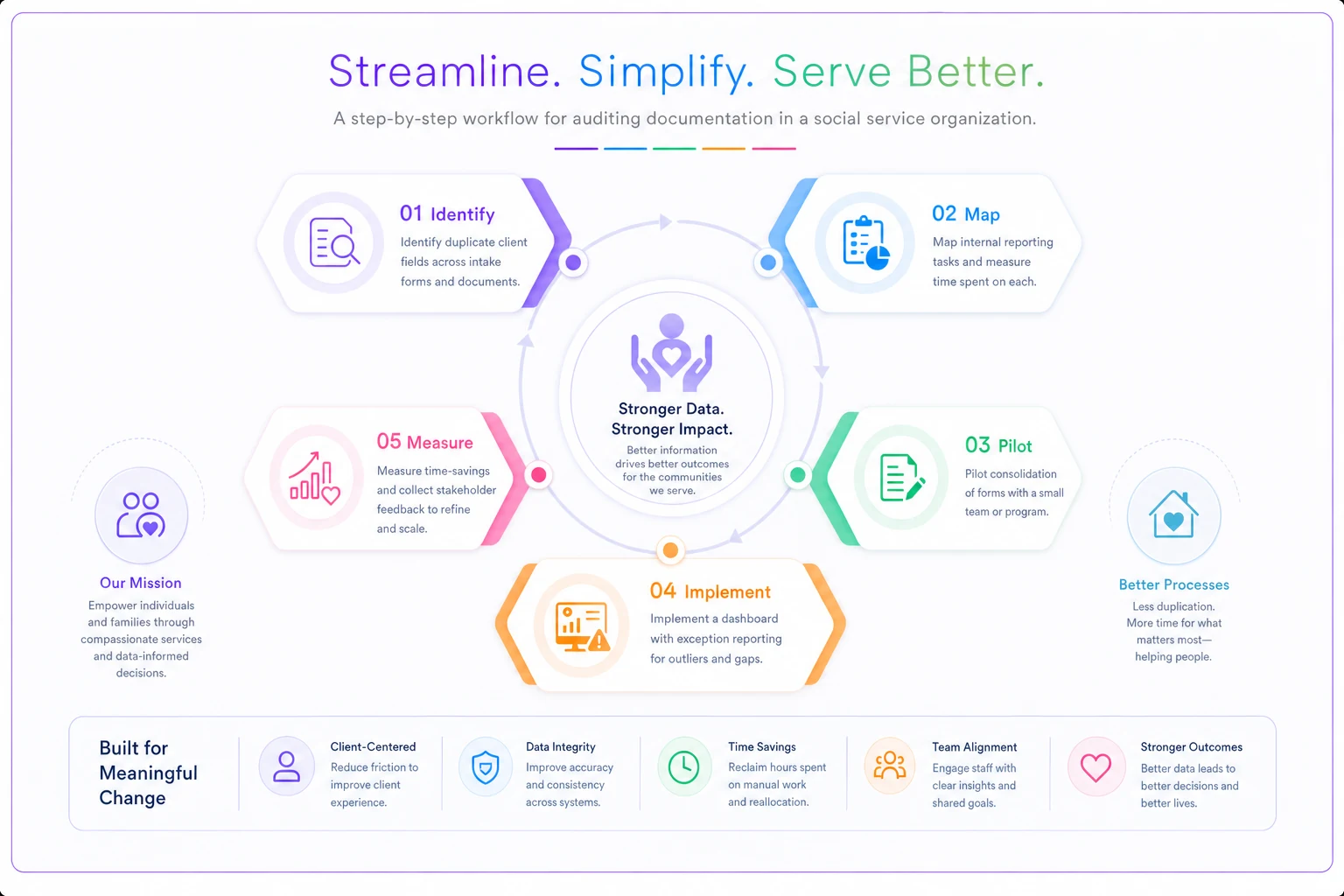
Before touching program budgets, go after the paperwork burden. Most organizations have layers of documentation requirements that have built up over years — some mandated, plenty just habit.
Start with intake. Count how many times clients provide the same information across different forms. A youth services organization in Phoenix found clients were writing their address eleven times during initial enrollment. They consolidated to three points: initial screening, formal intake, and consent forms.
Then map internal reporting. Track how many hours staff spend producing reports nobody really reads. One substance abuse treatment center found case managers were spending four hours a week writing detailed narratives that supervisors only skimmed for red flags. They switched to a dashboard with exception reporting and saved 12 hours a week across the team.
For a more systematic approach to cutting documentation waste, our audit framework walks through the full process including pilot testing and getting stakeholder buy-in.
Here's a simple workflow to audit documentation.
2. Renegotiate Everything (But Start Smart)
Don't wait for contracts to expire. Vendors expect these conversations right now and most would rather keep you at a lower rate than lose the account entirely.
Focus where you have leverage. Software vendors with low switching costs should be first. One mental health clinic cut their scheduling software costs by 35% just by sharing competitor quotes and their own usage data with the vendor. The vendor offered a lower-tier plan they'd never mentioned before.
Energy and facility costs need a different approach. Form buying cooperatives with other nonprofits. A coalition of six social service agencies in Michigan negotiated group rates for utilities, office supplies, and liability insurance, saving each organization somewhere between $18,000 and $34,000 annually.
Build a vendor scorecard tracking actual usage versus cost. That expensive grant management platform might look essential until you realize only two people log in regularly. Sometimes the threat of cancellation unlocks pricing tiers vendors don't advertise.
3. Shift Caseload Distribution Before Adding Technology
When budgets tighten, the instinct is either to freeze technology spending or desperately search for a silver bullet platform. Neither works.
Examine caseload distribution first. Most organizations have case managers carrying wildly different complexity levels without adjusting expectations. A veteran worker might handle 15 high-need families while a newer colleague manages 15 routine check-ins. That creates burnout, mistakes, and inefficiency at the same time.
One family resource center restructured caseloads using a simple scoring system:
| Factor | Points |
|---|---|
| stable housing | 1 point |
| employment | 1 point |
| childcare | 1 point |
| active crisis | 3 points |
| multiple children | 2 points |
They aimed for roughly equal point totals rather than equal case counts. Crisis escalations dropped about 20% and overtime hours fell by nearly half.
Only after you've sorted out human workflows should you evaluate technology. And when you do, go after the biggest time sinks first. If case noting takes 40% of staff time, that's where automation actually helps.
The False Economy of Freezing Everything
Cutting all discretionary spending feels responsible but often backfires. A few patterns that show up repeatedly across organizations trying to weather inflation:
Skipping system maintenance creates compound failures. One homeless services agency delayed a $4,000 database upgrade. Six months later a compatibility issue corrupted three months of case notes, leading to $22,000 in data recovery and manual re-entry.
Eliminating training budgets seems logical until you count the error costs. Case managers without proper training on eligibility requirements submit flawed applications. Each rejection means clients wait longer, staff spend hours on appeals, and funder relationships take a hit.
Freezing hiring while relying on overtime burns out your best people. The math looks fine initially — overtime costs less than salary plus benefits. But when experienced staff leave from exhaustion, you lose institutional knowledge that takes years to rebuild.
Building Inflation Resistance into Operations
Flexible Vendor Contracts
Stop signing multi-year agreements without escape clauses. Build in:
-
Annual usage reviews with automatic downgrades if utilization falls below 70%
-
Price increase caps tied to CPI or capped at 5% annually
-
90-day termination rights if service levels decline
-
Portability clauses for your data
Outcomes-Based Budget Allocation
Traditional line-item budgets become straightjackets during inflation. Shift toward outcome pools where managers have flexibility to get results.
Instead of separate lines for transportation, interpretation, and childcare during appointments, create a "successful engagement" budget. Let frontline supervisors decide whether $50 on rideshare prevents a no-show or whether that money works better as childcare vouchers.
Partner Load Balancing
Document what each referral partner actually costs you in staff time. Some partnerships that look free drain resources through complex intake requirements, poor communication, or high rejection rates.
A workforce development program tracked partner efficiency and found massive variation. Their healthcare training partner took two hours of staff time per successful placement. Their hospitality partner took eleven hours because of convoluted application processes and poor feedback loops. They renegotiated expectations with the inefficient partners or shifted volume to better performers.
Technology Decisions That Actually Save Money
The pressure to "digitize everything" intensifies when budgets tighten, with vendors promising big savings through automation. The reality is messier. Technology only saves money when it genuinely reduces work — not when it just moves the work somewhere else.
The implementations that work share common traits. They start small, targeting one specific workflow that frustrates everyone. They measure time-to-complete before and after. They involve frontline staff in configuration decisions. And they accept that the first version won't be perfect.
Start small, target the single highest time-consuming task, and measure time-to-complete before and after.
A supportive housing program wanted to automate their entire operation but started with just appointment reminders. Simple text messages cut no-shows by around 30%, saving roughly eight hours a week in rescheduling. They used those savings to fund the next phase: intake prescreening.
Bad implementations share patterns too. They kick off with vague goals like "modernization" or "going paperless." They purchase based on features rather than workflow fit. They underestimate training needs. They have no clear success metrics.
The worst scenario I've seen: a youth services organization spent $80,000 on a comprehensive case management platform. Two years later, staff were still printing forms from the system, filling them out by hand, and scanning them back in. The software worked fine. The implementation was a disaster.
Platforms that combine human workflows with AI assistance for routine tasks tend to outperform pure automation plays. AI handles the repetitive stuff — scheduling, initial data entry, basic reporting — while people focus on relationship building and complex decisions.
When Inflation Forces Impossible Choices
Sometimes the math just doesn't work. After you've cut waste, renegotiated contracts, and tightened workflows, there are still shortfalls. At that point the decisions get harder.
Document the operational impact of each potential cut, not just the dollar amount. Closing intake two days a month saves $3,000 but creates a 20% backlog that compounds over time. Eliminating transportation support saves $15,000 but increases no-shows by 40%, burning 60 hours of staff time monthly.
Share those trade-offs with funders. According to recent Reuters reporting, inflation concerns are driving scrutiny across the board. Funders face the same pressures and may have flexibility if you can show operational thinking rather than just asking for more money.
Consider service consolidation with trusted partners. Two mental health agencies might share an intake coordinator. Three workforce programs could rotate career fair responsibilities. These arrangements feel uncomfortable but work when both sides commit to clear agreements and regular communication.
Preparing for the Next Six Months
The inflation picture stays murky, with Fed officials split on whether rates need to climb further. Organizations should prepare for continued pressure rather than counting on relief.
Build variable cost structures where possible. Convert fixed costs to usage-based models. Negotiate shorter contract terms even if they cost slightly more — flexibility matters more than marginal savings right now.
Track your true unit costs monthly, not annually. How much does each completed assessment actually cost, including staff time, overhead, and materials? Cost per successful housing placement? Per family stabilized? These numbers help you make informed cuts when you have to make them.
Create contingency workflows for your highest-cost activities. If you had to cut transportation support tomorrow, what's the backup plan? If your case management software became unaffordable, what's the minimum viable alternative? Better to think through those scenarios now than scramble through them in a crisis.
And protect your core operational capacity. It's tempting to sacrifice infrastructure in order to maintain service levels, but that creates a slow death spiral. When operational systems degrade, service delivery gets more expensive and less effective, which forces more cuts.
The organizations that come out strongest from this inflationary period won't be the ones that cut deepest or spent most on technology. They'll be the ones that used the budget pressure as a reason to finally eliminate years of accumulated operational waste while protecting the workflows that actually serve clients.
Every dollar saved on redundant documentation or inefficient vendor relationships is a dollar available for direct service. That math holds regardless of what the Fed decides next.
Ready to transform your social services workflow?
Join 500+ agencies using TryCasi to improve case outcomes, enhance collaboration, and reduce administrative burden.