

Most teams treat closure as a finish line. You've hit your outcomes, the file's documented, the case is off your active roster. Then six weeks later the same client shows up at intake again — except this time it's a crisis, not a planned return, and they've lost whatever momentum the original case built.
That's avoidable recidivism. Not every re-open is preventable, but a surprising share of them are. And the gap between a quiet, low-cost re-engagement and a full crisis re-intake usually comes down to whether anyone was watching the right signals in the 30–90 day window after closure.
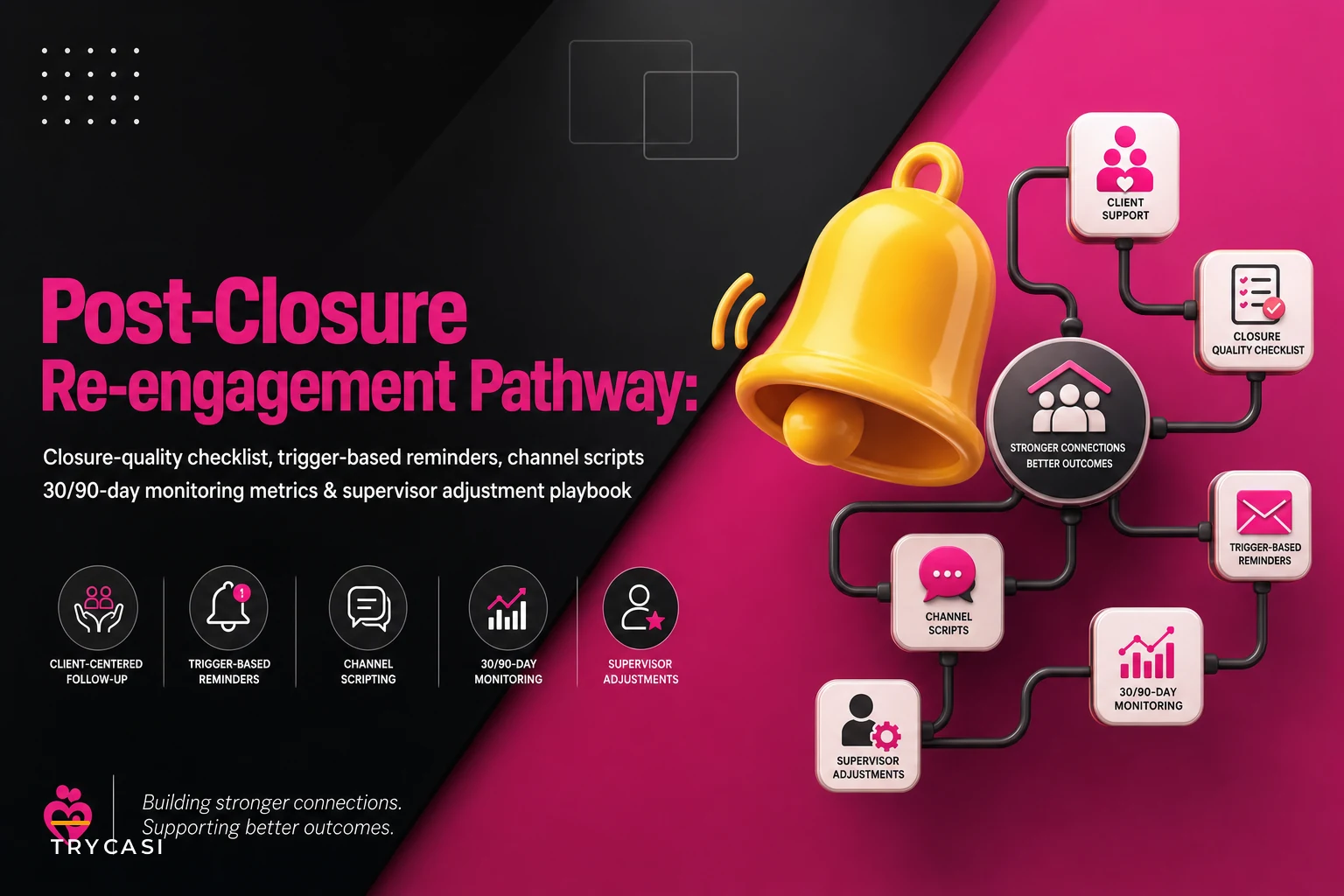
This post is about building a pathway that catches those signals early — what triggers a re-engagement attempt, how you word that outreach depending on the channel, and how supervisors measure whether the whole thing is actually working or just generating busywork.
The closure-quality problem nobody names
Here's the pattern that keeps repeating. A case gets closed because it met the closure criteria on paper — housing secured, benefits active, three stable check-ins. But closure quality varies wildly between cases that technically meet the same bar.
A client who closed with a strong informal support network, a reliable phone, and a case plan they actually understood is in a very different position than one who closed because they stopped answering calls and the worker marked it "closed — goals substantially met." Both look identical in the dashboard. One of them is coming back.
The core issue is that closure is almost always graded as a binary. Closed or open. What's missing is a quick closure-quality read that flags which closures are fragile — the ones that warrant a tighter monitoring window and faster re-engagement triggers.
Fragile closures tend to cluster around a few conditions: closures that happened right after a missed appointment streak, closures where the client's contact info changed in the last 60 days, closures tied to a single external resource with no backup, and closures where the final contact was by proxy rather than the client directly.
If you can tag those at the moment of closure, you've already done most of the work. The rest is deciding what to do when a trigger fires.
A lightweight closure-quality checklist
This isn't a 40-field assessment. The whole point is that a worker can run it in the two minutes before they hit "close." Score each item, and anything that lands in the fragile column bumps the case into a tighter monitoring tier.
Eliminate case management chaos.
TryCasi helps you organize, monitor, and report on every case efficiently and securely.
- Centralized case tracking
- Automated client notifications
- Team task coordination
No credit card required
| Factor | Stable closure | Fragile closure (tighten monitoring) |
|---|---|---|
| Final contact | Direct with client | By proxy or unconfirmed |
| Contact info | Verified in last 30 days | Changed recently or unverified |
| Support network | Two+ informal supports named | One or none |
| Key resource | Has a backup option | Single point of failure |
| Appointment history | Consistent attendance | Missed streak before closure |
| Client understanding | Teach-back confirmed plan | Plan not confirmed with client |
You don't need a perfect score to close. A case can be entirely appropriate to close and still be fragile — maybe the client genuinely doesn't want ongoing contact, and that's their call. The checklist isn't a gate. It's a sorting mechanism that decides how closely you watch after the door closes.
-
Standard tier light 30 and 90-day touchpoints, mostly passive.
-
Watch tier fragile closures get an earlier check-in (around day 14), more persistent re-engagement attempts, and a supervisor glance at the 30-day mark.
Two tiers is enough for most teams.
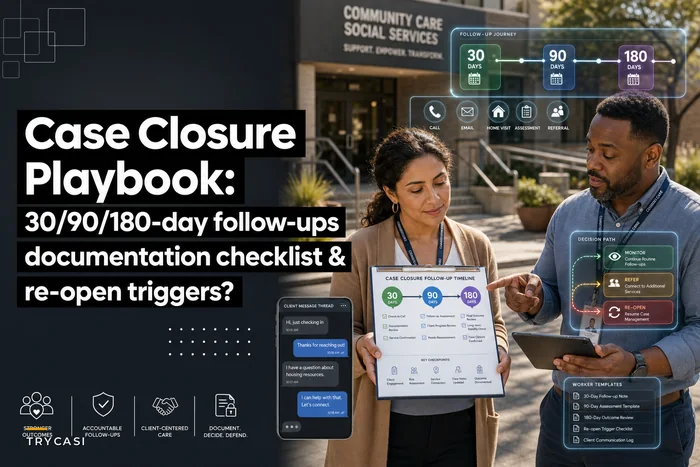
If you've already built out a structured closure process, this slots directly into it. The earlier case closure playbook covering 30/90/180-day follow-ups and re-open triggers lays out the follow-up cadence — the closure-quality read is the piece that tells you which cadence a given case should get.
Automated reminder rules that fire on triggers, not calendars
The weakness in most follow-up systems is that they're calendar-driven. Everyone gets the same day-30 and day-90 ping regardless of what's happening in their life. Fine as a baseline, but it misses the clients who are drifting between those dates.
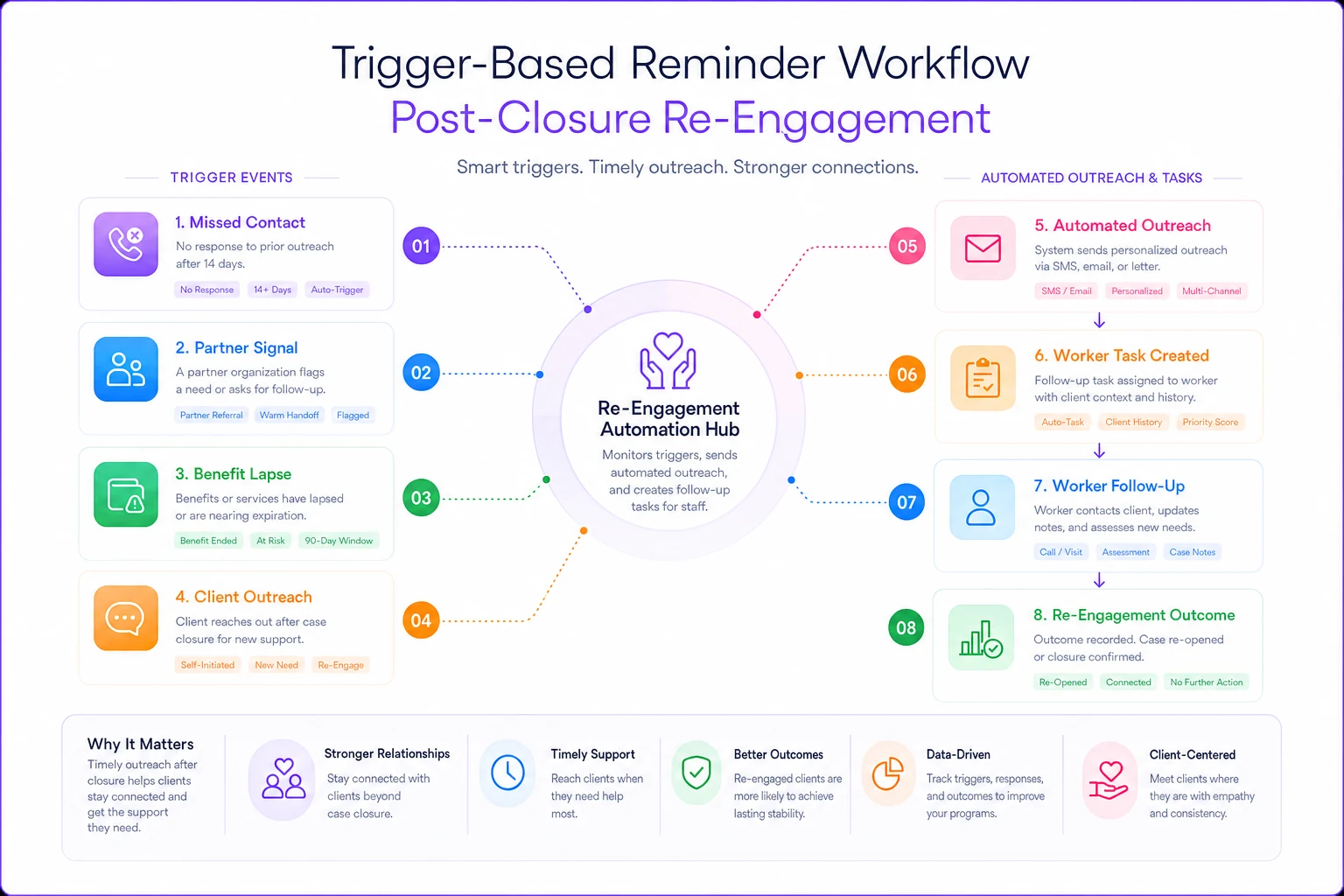
A better approach layers trigger-based reminders on top of the calendar baseline. The trigger is some observable event that correlates with re-engagement risk, and it fires an outreach task to the assigned worker.
-
Missed return contact. A scheduled 30-day check-in attempt goes unanswered after two tries → escalate to the next channel within 48 hours rather than waiting for day 90.
-
Partner signal. A referral partner flags that the client didn't show for a handoff appointment → re-engagement task fires same day.
-
Benefit lapse window. A known benefit renewal date passes without confirmation → outreach task to check status.
-
Client-initiated contact that isn't a crisis. Client calls about something small — treat it as a warm re-engagement opportunity, not just a transaction.
The reason this matters: clients who come back as crisis re-intakes almost never go from "fine" to "crisis" overnight. There's a drift period, usually a couple of weeks, where small signals pile up. A benefit letter went unopened. A proxy contact mentioned things were "a bit rough." The trigger window is your chance to intervene during the drift instead of after the collapse.
The honest limitation here is staff bandwidth. If every fragile closure generates four reminders and nobody has time to act on them, you've built a notification graveyard. Keep the watch tier genuinely small — if more than a quarter of your closures are landing in it, your closure-quality bar is probably too strict and needs recalibrating.
Channel-specific re-engagement scripts
A re-engagement message that works over SMS falls flat as a voicemail, and both fail if you use intake language on someone who just closed. The tone has to say we're checking in because we care how you're doing, not you're a case again.
SMS (first attempt, standard tier):
> "Hi [name], it's [worker] from [program]. Just checking in since we wrapped up — how are things going? No need for anything formal, just wanted to see you're doing okay. Text back anytime."
Short, no buried ask, no link to click, no form. The goal is a reply, not an action.
Voicemail (watch tier, after SMS goes unanswered):
> "Hi [name], this is [worker] from [program]. I was thinking about how things have been going since we closed your case and wanted to check in. No problem at all, nothing's wrong — I just like to make sure folks are doing alright after we wrap up. If you want to catch up, give me a ring at [number]. Take care."
The phrase "nothing's wrong" matters more than it looks. Clients who've been through the system often read an unprompted call from a worker as something has gone wrong with my benefits/housing/custody. Defuse that in the first ten seconds or they won't call back.
Email (for clients who prefer written, slower channel):
Keep it to three sentences. A warm check-in line, one sentence naming a concrete thing they can reach out about, and an easy reply option. Email is the weakest re-engagement channel for most populations — treat it as backup, not primary.
Proxy or support-network contact (last resort, with consent on file):
Only if you have documented permission to contact the listed support person, and only to confirm the client is reachable — never to share case details. The script is tight: "Hi, I'm checking in on [name] from [program] — are they doing okay, and is this still the best number to reach them?"
One pattern worth naming: the first reply is the whole game. Once a client responds at all, re-engagement success jumps dramatically. So every script is built to lower the cost of replying to almost nothing. No forms, no scheduling, no "please call during business hours." Just a human opening.
Monitoring metrics: 30 and 90-day avoidable recidivism
You can't improve a re-engagement pathway you're not measuring, and the metric most teams default to — total re-opens — is too blunt. It lumps together planned returns, appropriate re-opens, and the avoidable crisis re-intakes you actually want to reduce.
-
30-day avoidable recidivism share of closures that returned within 30 days as an unplanned crisis that could plausibly have been caught earlier. A spike here usually means closures are happening too soon or closure-quality tagging is off.
-
90-day avoidable recidivism the broader picture, catching the slower drifts. This is the number to trend over quarters.
The hard part is the "avoidable" judgment. You don't want workers grading their own cases as unavoidable to protect their numbers, and you don't want supervisors retroactively blaming closures that were genuinely sound. Keep the determination simple: a re-intake is avoidable if a trigger fired (or should have fired) during the monitoring window and no re-engagement attempt was logged, or if the closure was tagged fragile and got standard-tier monitoring by mistake.
A realistic target isn't zero. Some recidivism is the system working as intended — people's lives change. What you're hunting is the preventable slice. Teams that start measuring this usually find their avoidable rate is higher than expected, and that most of it traces back to a handful of fragile-closure patterns they can address directly.
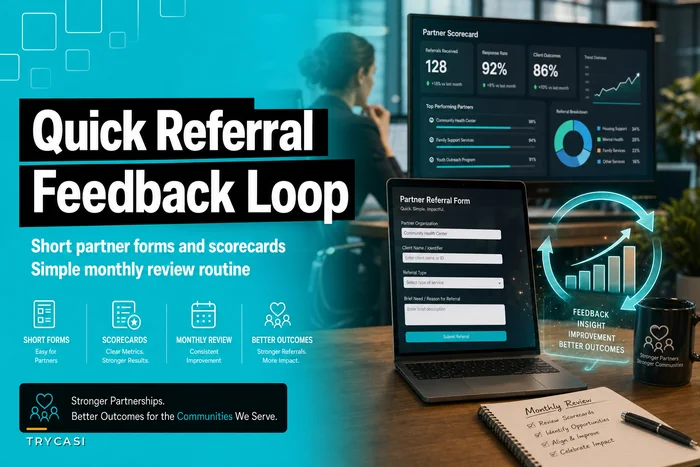
Pair this with partner-side signals too. If a referral partner keeps sending clients back, that's data about your closures, not just theirs — the kind of thing a running referral feedback loop with short partner forms and scorecards surfaces before it becomes a trend you only notice at re-intake.
A real scenario
A mid-sized family services program — roughly 90 active cases across four caseworkers — was seeing a steady trickle of clients returning within a couple months of closure, almost always in crisis. Nobody had a clean number on it; it just felt like the same families kept cycling back.
When they started tagging closures for fragility and tracking avoidable recidivism, the picture sharpened fast. Over a quarter, about 1 in 6 closures was coming back within 90 days, and a big chunk of those were fragile closures that had received the same light-touch follow-up as everyone else. The single biggest cluster: closures where the final contact was by proxy and contact info hadn't been reverified.
They changed two things. Fragile closures got a day-14 check-in and the SMS-then-voicemail sequence. And proxy-only closures couldn't be finalized without one more direct contact attempt logged.
Over the next two quarters the avoidable 90-day rate dropped by roughly a third. Not dramatic, not a miracle — but that's several families a quarter who got a two-minute check-in instead of a crisis re-intake, and caseworkers said the re-engagements felt lighter and less adversarial than the crisis returns they replaced.
Supervisor adjustment playbook
The pathway drifts if nobody tunes it. Supervisors need a short, regular ritual to adjust triggers, scripts, and tiers based on what the monitoring data shows.
-
Check the watch-tier size. If it's ballooning past a quarter of closures, the fragility bar is too loose — or your population genuinely shifted and caseloads need to reflect that.
-
Pull the avoidable re-intakes from the last period and read the closure notes. Look for a common thread. It's almost always one or two repeating patterns, not scattered bad luck.
-
Audit the "no re-engagement logged" cases. If triggers fired and nobody acted, the problem is bandwidth or workflow, not strategy. Fix the bottleneck before adding more triggers.
-
Test one script change at a time. Swap one line in the SMS opener, watch reply rates for a month. Don't rewrite everything at once or you'll never know what moved the number.
When this makes sense — and when it doesn't
This pathway earns its keep when you serve a population with real re-entry risk — housing instability, benefit cliffs, families in transition — and when your closures genuinely vary in quality.
It's overkill for programs where closure is clean and final by nature, or where clients age out or exit the system entirely. And if your team is already underwater on active caseload, don't bolt on a watch tier you can't staff. Start with just the closure-quality tag and the 90-day avoidable metric — measure first, add outreach once you know where the fragile closures actually are.
Re-engagement isn't about keeping cases open longer. It's about making sure the ones you close stay closed because the client was actually ready — and catching the few who weren't before the gap turns into a crisis.
Ready to transform your social services workflow?
Join 500+ agencies using TryCasi to improve case outcomes, enhance collaboration, and reduce administrative burden.