
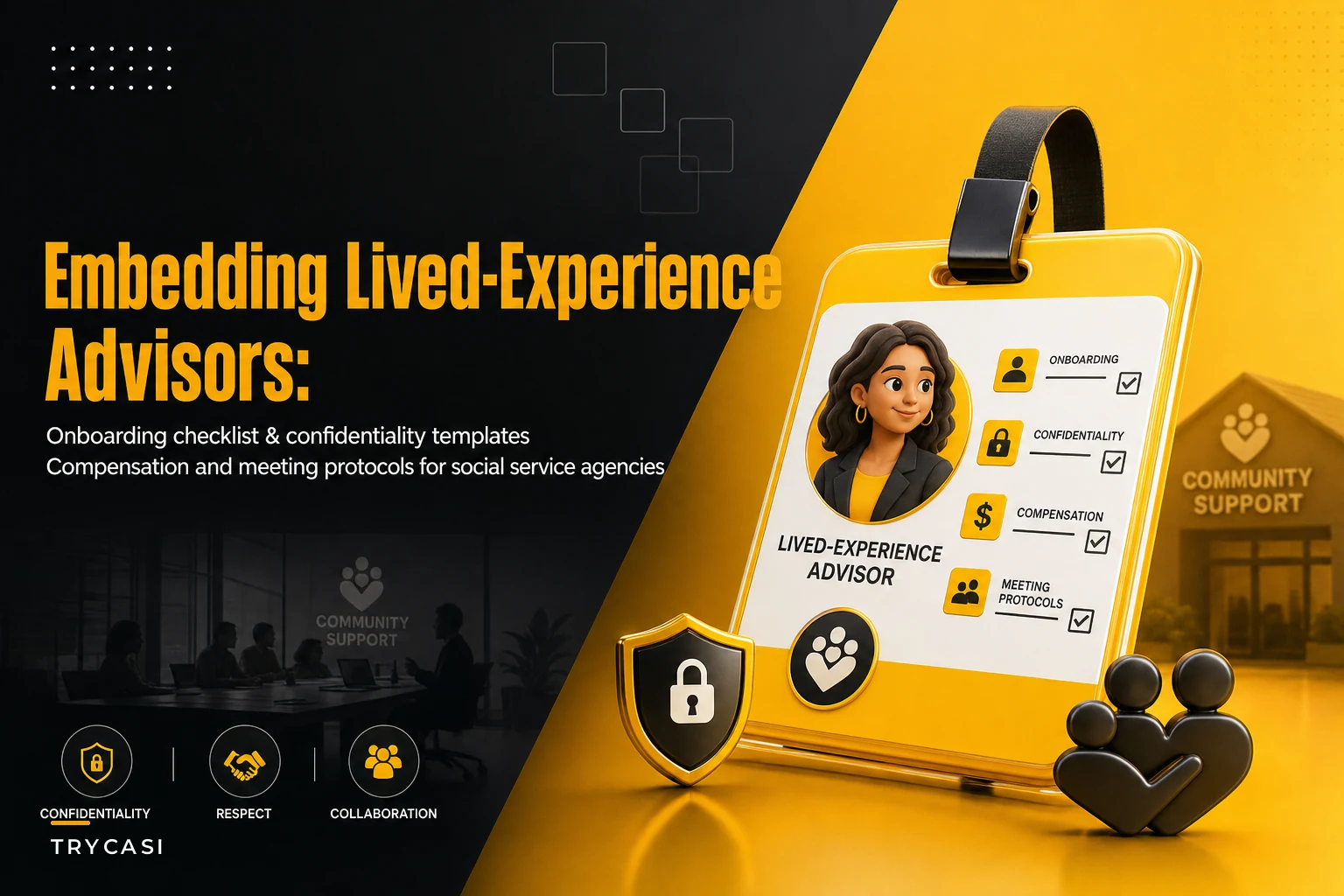

Most programs bring in a lived-experience advisor with good intentions and almost no infrastructure. Someone on the leadership team says "we really need a person who's actually been through this," and three weeks later there's a name on a meeting invite. No role description. No idea how they're getting paid. Nobody thought through what happens when the advisor mentions, mid-meeting, that they still receive services from your agency.
That gap is where most of these arrangements quietly fall apart — not because the advisor wasn't valuable, but because the program never built the scaffolding to make the relationship workable for either side. If you want to embed lived experience advisors in social services in a way that lasts more than two quarters, the boring operational stuff is what carries it. The paperwork, the pay math, the meeting rules.
This is the part almost nobody writes about.
Start with the role, not the person
The most common failure isn't hiring the wrong advisor. It's never defining what the advisor is actually supposed to do.
What tends to happen: a program recruits someone with strong personal experience of the housing system or the child welfare system, invites them to "advise," and hands them nothing concrete. The advisor shows up to meetings, gets asked to react to things already decided, and slowly realizes they're decoration. Attendance drops after a few months, and leadership concludes that "lived-experience advisory boards don't really work here."
The role was just never real.
A usable role description for a small program should fit on one page and answer five questions plainly:
-
What decisions does this person actually influence? (Program design? Intake language? Hiring panels? Grant narratives?)
-
What are they NOT responsible for? (This matters more than people think — advisors get pulled into crisis coverage and free peer support constantly.)
-
How many hours per month, roughly? Give a real range, like 6–10 hours, not "as needed."
-
Who do they report to or coordinate with? One named person, not "the team."
-
How is their input recorded and acted on? If there's no mechanism to close the loop, advice evaporates.
Programs that write "NOT responsible for" sections keep their advisors longer. When you're the only person in the room who's been evicted, everyone assumes you're available to talk any survivor through anything at any hour. A written boundary protects the advisor from becoming unpaid overflow staff.
The onboarding checklist that prevents the awkward first month
Onboarding a lived-experience advisor is different from onboarding a caseworker, and treating them the same causes real problems. A caseworker starts with training and shadowing. An advisor often starts with a vague welcome email and then gets thrown into a strategy meeting where everyone else already knows the acronyms.
Eliminate case management chaos.
TryCasi helps you organize, monitor, and report on every case efficiently and securely.
- Centralized case tracking
- Automated client notifications
- Team task coordination
No credit card required
Here's a checklist built specifically for small programs with limited admin capacity:
Before their first meeting
-
Signed role description (with hours and pay stated in writing)
-
Confidentiality and consent agreement reviewed conversationally, not just signed
-
Plain-language glossary of your program's terms and acronyms
-
Named point of contact and their direct line
-
Clarity on whether the advisor is still a client of the agency, and what that means for their advisor role
In the first two weeks
-
A 30-minute one-on-one that is NOT a group meeting — advisors disclose concerns privately they'd never raise in a room
-
Walkthrough of how decisions actually get made (who has final say, where their input enters)
-
Payment logistics confirmed
how they invoice, when they get paid, what documentation they need
-
Explicit permission to say "I don't want to answer that" or "I'd rather not share that story today"
By day 30
-
First real task with a concrete deliverable, not just "attend and react"
-
A check-in on whether the workload matches the stated hours
-
Confirmation the first payment actually went out (this one gets missed constantly)
That last point isn't minor. The fastest way to lose trust with someone who has experienced institutional neglect is to promise pay and then let it get stuck in a finance queue for six weeks.
Programs that already run structured onboarding for staff and volunteers tend to adapt faster here. If you've built milestone-based onboarding before — the kind covered in this governance playbook for cross-team casework — you can borrow that milestone structure and strip it down for a one-person advisory role.
Confidentiality and consent — the part people get wrong twice
There are two confidentiality directions here, and programs usually only think about one.
Direction one: protecting client information the advisor might encounter. Standard stuff. The advisor signs the same confidentiality agreement your volunteers sign, they don't take notes with identifying details home, they don't discuss cases outside the room.
Direction two — the one people forget: protecting the advisor's own story. A lived-experience advisor's history is the whole reason they're in the room, which means their personal disclosures constantly leak into meeting notes, grant applications, and website copy. Someone writes "our advisor, a former foster youth, said…" in a public report, and now the advisor's private history is fundraising material they never consented to.
A workable consent template covers both directions and stays short. The core pieces:
| Clause | What it actually covers | Why small programs skip it (and shouldn't) |
|---|---|---|
| Client confidentiality | Advisor won't share identifying case details | Usually included — this one's fine |
| Advisor story consent | How the advisor's personal history may/may not be used | Almost always missing; causes the worst breaches |
| Attribution rules | When the advisor is named vs. kept anonymous | Grant writers grab quotes without asking |
| Withdrawal of consent | Advisor can revoke permission to use a story later | People assume consent is permanent; it isn't |
| Dual-role clarity | What happens if advisor is also a current client | Creates access-to-services fears if unaddressed |
The dual-role clause deserves extra attention. In small programs, the lived-experience advisor is very often still connected to the agency as a client, or has a family member who is. That creates a quiet fear: if I criticize the program as an advisor, will it affect the services I'm receiving? If you don't name that dynamic in writing and verbally reassure them, you'll get polite, useless feedback forever.
A simple line handles it: "Your role as an advisor is completely separate from your access to services. Nothing you say in this role will affect the support you or your family receive." Say it out loud in the first meeting. Then say it again in month two.
Compensation without the finance-department headache
This is where good intentions collapse into a mess. Programs want to pay advisors fairly but have no framework, so they either underpay, pay inconsistently, or accidentally jeopardize the advisor's benefits.
That last risk is real and specific. An advisor receiving public benefits can lose eligibility if a payment pushes them over an income threshold, or if a lump-sum stipend gets counted the wrong way. Paying someone $600 for a quarter of advisory work and accidentally costing them their housing subsidy is a catastrophic outcome dressed up as generosity.
A few practical compensation models for small programs:
-
Hourly at a fixed rate. Cleanest option. Pick a defensible rate — often somewhere around $25–$40/hour depending on region and role depth — and track hours simply. Works well when the advisor's workload varies month to month.
-
Flat per-meeting stipend. Something like $75–$150 per session including prep time. Predictable, easy to budget. Works well for advisory boards that meet monthly.
-
Project-based. A set amount for a defined deliverable — reviewing intake forms, co-designing a workflow, sitting on three hiring panels. Good when work is bursty rather than consistent.
-
Gift cards or non-cash options. Sometimes necessary for benefits reasons, but treat this as a fallback, not a default. Being paid in gift cards while staff get salaries sends a message about who's a "real" contributor.
The programs that keep advisors longest almost always pay per hour or per meeting rather than in occasional lump sums, because it feels like a job rather than a favor. When it feels like a favor, people burn out on being grateful.
Whatever you pick, write down three things and give a copy to the advisor: the rate and how it's calculated, how and when they submit for payment, and roughly how long payment takes to arrive.
Genuinely, quietly encourage them to check with a benefits counselor before accepting a payment structure.
Genuinely, quietly encourage them to check with a benefits counselor before accepting a payment structure. It's not your job to give benefits advice, but a two-line heads-up — "some people check with a benefits counselor first, no pressure" — shows you've thought about their reality.
Meeting protocols that don't waste the one perspective you actually needed
You brought in a lived-experience advisor to hear something you couldn't generate internally. Then you run the meeting exactly the way you always have, and the advisor spends 55 minutes listening to staff argue about budget line items before getting three minutes at the end.
Small changes fix most of this.
Put advisor input early, not last. If their agenda item is last, it's the first thing cut when the meeting runs long. Front-load it.
Send materials ahead, in plain language. Handing someone a 12-page report at the table guarantees they can't engage with it meaningfully. A two-paragraph plain summary sent two days early does more than any live presentation.
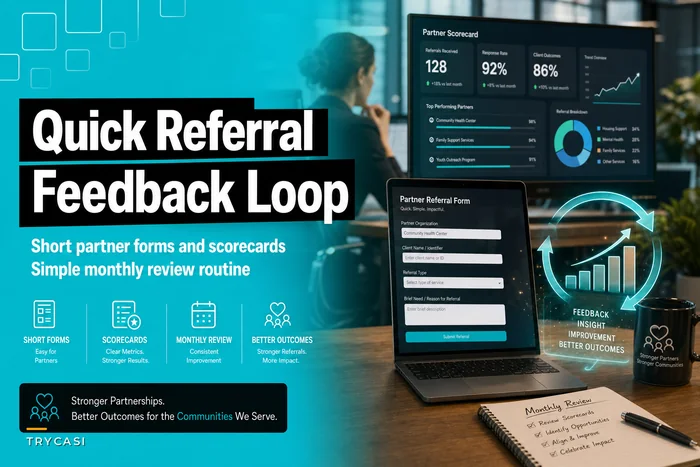
Assign someone to close the loop. After every meeting, someone should record what the advisor said, what the program decided to do about it, and what happened. Without this, advisors correctly sense that their input goes nowhere. The mechanics of a lightweight feedback routine — short forms, a monthly review — mirror what works in a quick referral feedback loop, where the whole point is proving to contributors that their input actually moved something.
Build in an exit ramp for hard topics. If the meeting turns to something that touches the advisor's own trauma, they need a pre-agreed way to step back without explaining themselves. Agree on it beforehand.
A short workflow for turning advisor input into action
Here's the loop that separates real advisory relationships from decorative ones:
-
Advisor raises a concern
-
Point-of-contact logs it in one shared place
-
It gets tagged to a decision-maker
-
A decision is made and dated
-
The outcome gets reported back to the advisor at the next meeting
No software required — a shared doc works fine. What matters is that the advisor can see their input travel from "I said this" to "the program did this." When that path is invisible, participation dies, and no amount of stipend money brings it back.
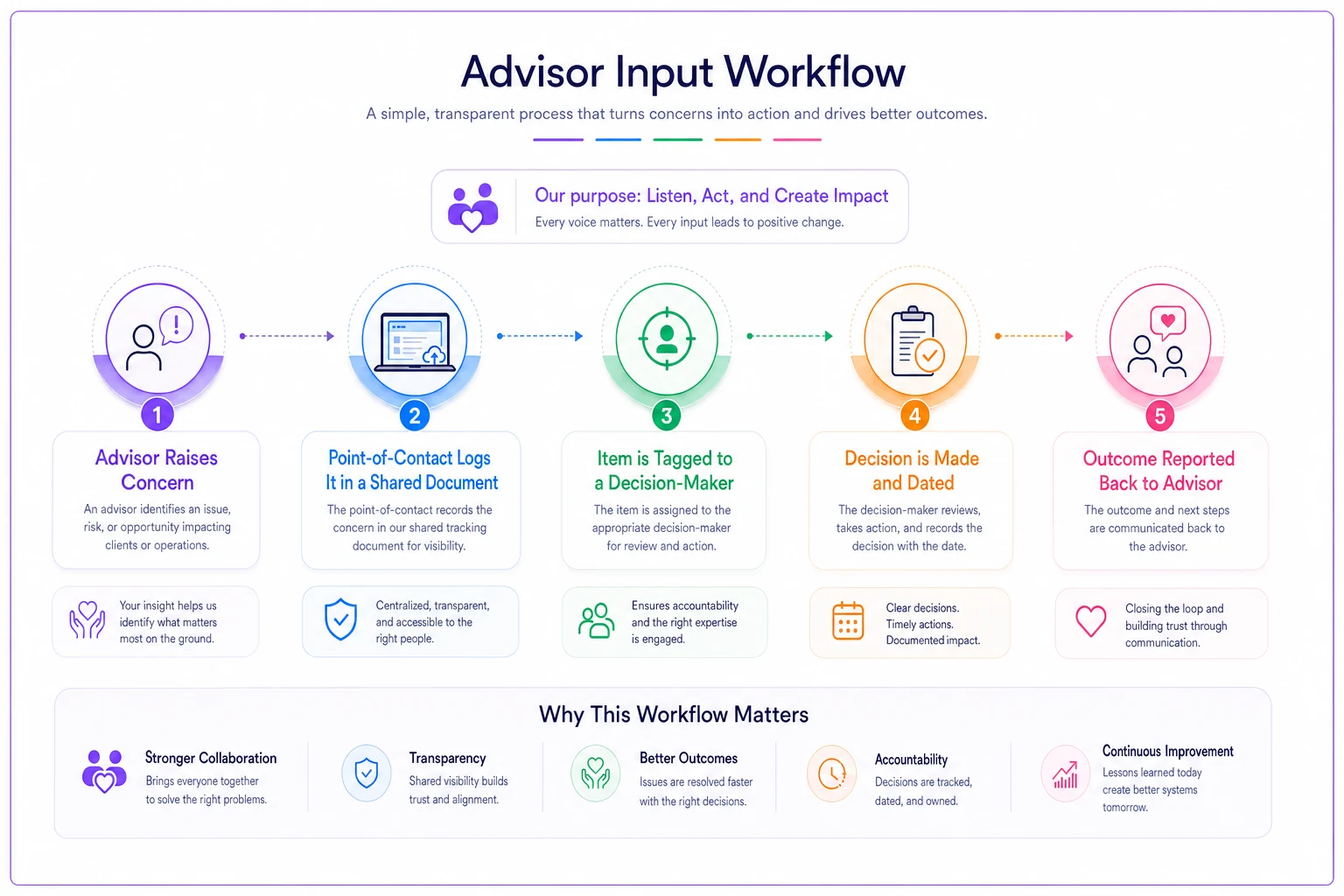
A quick visual makes it easier for a small team to adopt the loop.
A real scenario
A small family-support program — around nine staff, serving roughly 200 families a year — brought on two parent advisors with prior child-welfare involvement. First attempt: no role description, quarterly $500 lump-sum stipends, and a standing invite to the monthly all-staff meeting.
Within four months, one advisor had stopped attending and the other was giving cautious, agreeable feedback that told leadership nothing. One of the lump-sum payments had also triggered a benefits scare for the advisor who left — which nobody at the program even knew about until later.
They rebuilt it. One-page role description with a 6–8 hour monthly range. Switched to $30/hour paid monthly, with a note encouraging a benefits check first. Moved advisor items to the top of the agenda, sent plain-language summaries two days ahead, and assigned the program coordinator to log every piece of advice and report back what happened to it.
The remaining advisor started raising real objections — including one that reshaped how the intake letter was worded — and a third parent joined a few months later on a referral from the first. Retention went from "lost one in four months" to both advisors staying past the year mark. The difference wasn't better recruitment. It was infrastructure.
When this makes sense — and when it doesn't
Embedding advisors properly takes real setup work, so it's worth being honest about fit.
This makes sense when your program is making decisions that directly shape client experience — intake design, communication, program rules, hiring — and you have at least one staff member with the capacity to be a genuine point of contact.
This is a bad idea when you can't actually pay people. Recruiting lived-experience advisors and offering "exposure" or "a chance to give back" instead of money extracts the exact expertise you claim to value. If there's no budget line, wait until there is.
Who should NOT do this yet: programs in active crisis with no bandwidth to close the feedback loop. If advisor input will sit unread for months, you'll damage trust with the very community you're trying to include. Build the loop first, then bring people into it.
The organizations that get real value from lived-experience advisors aren't the ones with the most inspiring recruitment pitch. They're the ones that treated the role like a job — with a description, a paycheck, a confidentiality agreement that protects the advisor too, and a meeting structure where being heard actually leads somewhere. The advisor's experience is the rare part. Everything around it is just operations you can build.
Ready to transform your social services workflow?
Join 500+ agencies using TryCasi to improve case outcomes, enhance collaboration, and reduce administrative burden.