

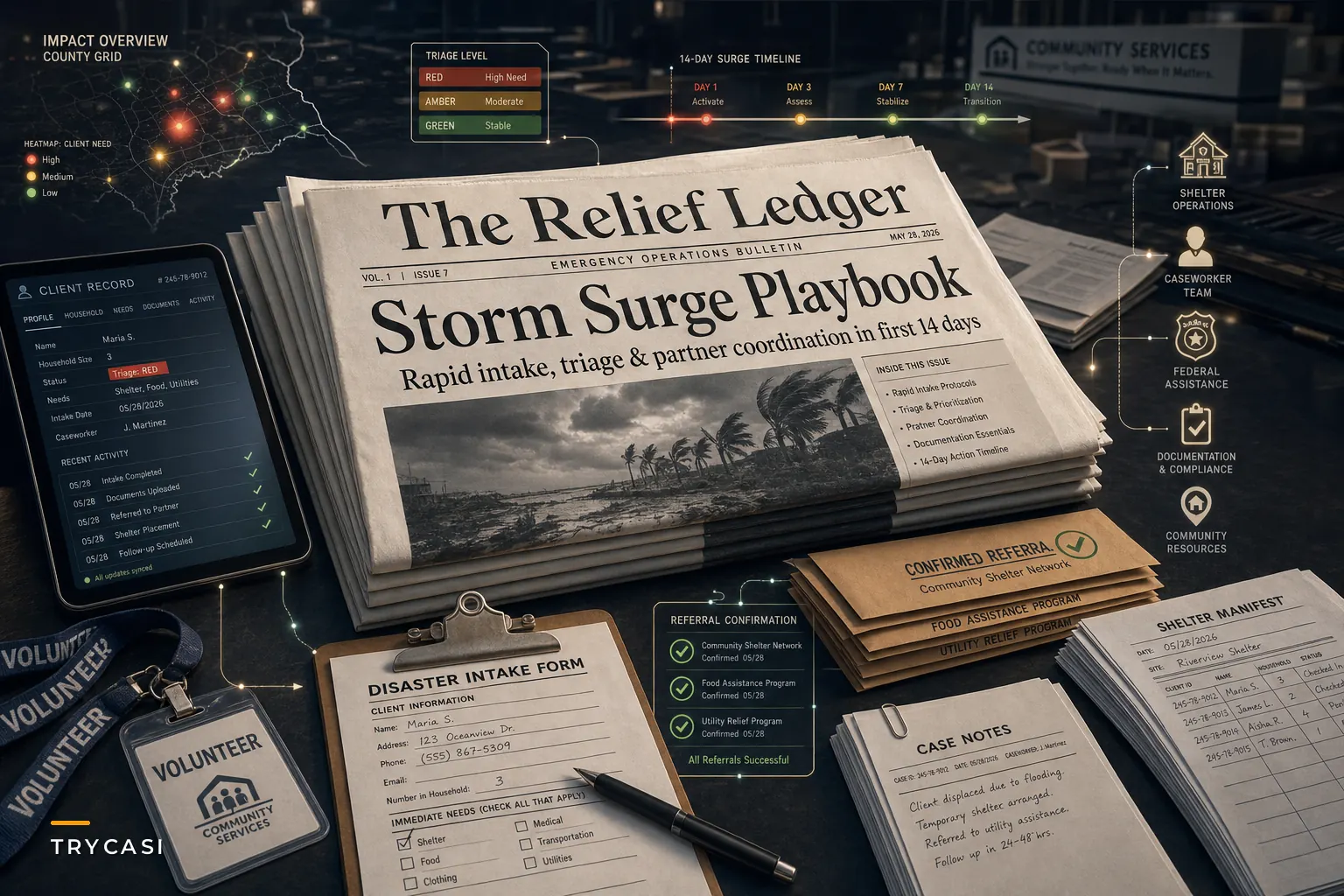

When a major disaster declaration lands, most agencies don't fail because they lack compassion or effort. They fail because systems that worked fine at a steady caseload of 40 per worker suddenly get asked to absorb 120, and everything that was slightly loose—intake handoffs, referral confirmations, documentation—snaps under the weight.
That's the situation a lot of Indiana providers are staring down right now. The FEMA press release confirming the major disaster declaration opened up federal individual assistance across 21 counties after the storms, straight-line winds, tornadoes, and flooding that started August 11. The National Weather Service's writeup of the August 11 derecho gives a sense of just how wide the wind damage stretched across northern Indiana. For frontline social workers and case managers, that declaration isn't a headline—it's a signal that the phones are about to ring in a way they don't during normal operations.
This post isn't about the storm. It's about the operational shockwave that follows one, and how case management teams can build a surge posture that holds up when displaced families, FEMA paperwork, and emergency housing requests all hit at once.
The First 72 Hours Are Where Most of the Damage Gets Baked In
The decisions your team makes in the first three days of a surge determine how painful the next three months will be. That's not an exaggeration—it's just how these things compound.
In steady-state casework, a sloppy intake gets caught later. Someone notices the missing consent, the duplicate record, the referral that never got confirmed. During a surge, there is no "later." The person who could catch it is on their fourth intake of the hour, and the mistake just rides along with the case indefinitely.
The most common early failure isn't dramatic. It's duplication. A displaced family shows up at a shelter, gets intaked there. Then they call the main office two days later because someone handed them a flyer, and they get intaked again—new record, new number, no link between the two. Now you've got two partial files, two workers who each think they own the case, and a family repeating their worst week to strangers over and over.
Multiply that by a few hundred households and you don't have a caseload problem—you have a data reconciliation nightmare that eats supervisor time for months.
What a strong first-72-hours posture actually includes:
-
A single, agreed-upon intake front door—even if physical intake happens in five locations, all of it flows into one record system with one client identifier
-
A stripped-down intake form that captures only what's needed to triage and follow up (name, contact, household size, immediate safety, housing status, one consent)
-
A "no re-ask" rule
if a client has already been intaked anywhere in your network, the next contact updates the existing record instead of starting over
-
Clear ownership assigned at the moment of intake, not figured out later
-
A daily 15-minute reconciliation huddle to catch duplicates while they're still fresh
Use the daily 15-minute reconciliation huddle to assign and merge duplicates immediately.
None of that requires new software or heroic effort. It requires deciding before the surge that speed without a shared record is just fast chaos.
Triage That Bends Without Breaking
During a surge, your normal triage rubric will get overwhelmed because a huge share of new cases look urgent. Everyone is displaced. Everyone needs something. If your escalation thresholds are calibrated for normal volume, you'll escalate everything—which effectively means you've escalated nothing.
Eliminate case management chaos.
TryCasi helps you organize, monitor, and report on every case efficiently and securely.
- Centralized case tracking
- Automated client notifications
- Team task coordination
No credit card required
The fix isn't a more complicated rubric. It's a temporary surge tier that sits on top of your normal one.
| Tier | Situation | Response window | Who handles it |
|---|---|---|---|
| Immediate | No safe place to sleep tonight, medical need, unaccompanied minor, DV risk | Same day | Senior caseworker + supervisor loop |
| Urgent | Displaced but has temporary shelter for 3–5 days, needs benefits/FEMA navigation | 48–72 hours | Assigned caseworker |
| Standard-surge | Stable temporary housing, documentation and recovery support | Within the week | Caseworker or trained volunteer |
| Info-only | Has resources, needs guidance or referral | Ongoing / self-serve | Volunteer or resource line |
The biggest triage win during a surge isn't identifying the top tier—it's confidently identifying the bottom two tiers so you stop treating stable families like emergencies. A household with a relative's couch for two weeks and intact income does not need the same response as a family sleeping in a car. Both are hurting. Only one is at acute risk tonight.
Getting comfortable with that distinction is what frees your senior staff to actually work the cases that can go sideways.
The Documentation Problem Nobody Wants to Deal With Mid-Crisis
FEMA individual assistance runs on documentation. Clients will need to prove residency, damage, identity, income loss, and insurance status—often while they've lost the very papers that prove all of it in a flooded basement.
This creates a specific operational trap. Caseworkers, wanting to help, start informally collecting and holding documents. Photos of IDs on personal phones. Insurance letters shoved in a folder on someone's desk. It feels helpful in the moment and turns into a confidentiality and audit disaster within weeks.
-
Client presents a document during intake or a visit
-
Worker captures it into the client's single record (not a personal device)
-
Worker tags what the document proves (residency, income, damage)
-
System flags what's still missing for that client's FEMA or benefits path
-
Client gets a short, plain-language list of what they still need to gather
That fifth step matters more than it looks. When a displaced person leaves an intake knowing exactly which three documents they still need, they come back prepared. When they leave vague and overwhelmed, they often don't come back at all—which shows up later as your no-show and outreach-failure rate climbing.
This is also where a lightweight, consistent crisis-capture form pays off. A one-page format that captures safety status and next steps without bogging a worker down keeps documentation usable even when everything else is moving fast. If you haven't built one yet, the approach in our writeup on one-page crisis documentation and post-crisis audit is a solid starting point—the same minimal-form logic that works for a single crisis scales surprisingly well across a surge.
Outreach Fails Differently During a Surge
In normal operations, no-shows are usually about scheduling friction or ambivalence. After a disaster, they're about instability. Phones die. Numbers change because someone lost a phone in the flood. People relocate to a cousin's place two counties over. The client who "no-showed" often didn't ghost you—they just became unreachable.
That changes your outreach strategy. Single-channel follow-up (just calling) will quietly lose people. The teams that keep displaced clients engaged do a few things differently:
-
Capture two contact methods at intake, plus an emergency contact who isn't displaced
-
Send confirmation and reminders across channels—text and call, not either/or
-
Treat a bounced text or dead number as an active alert, not a passive gap
-
Build a short "we lost contact" protocol so unreachable cases get one deliberate multi-channel attempt before going dormant, instead of silently falling off
Surge outreach isn't about being more persistent with everyone—it's about noticing fast when someone slips out of reach. In a displacement event, the window to re-establish contact is short. A week later, they may have moved on to another agency, another county, or given up entirely.
Partner Coordination Is Where Surges Are Won or Lost
No single agency handles a disaster surge alone. You're suddenly enmeshed with shelters, FEMA reps, faith-based groups, housing authorities, mutual aid networks, and other case management orgs—many of whom you've never formally worked with before.
The failure mode is predictable: everyone is helping the same families without knowing it, or worse, everyone assumes someone else is handling a family that's actually falling through the cracks. During a surge, "I thought Agency B had them" is how people end up unhoused.
A surge-ready partner coordination setup needs:
-
A shared understanding of who does what (housing vs. benefits vs. material goods vs. long-term case management)
-
Required fields on every referral so partners aren't chasing missing info
-
A confirmation step—the receiving partner acknowledges within a set window or the referral bounces back to the sender
-
A weekly cross-partner review of shared cases to catch families sitting in the gaps
-
One agreed way to flag when a client is already being served, to kill duplicate outreach
Partner coordination during a disaster is fundamentally a tracking problem, not a relationship problem. Warm relationships help, but under surge volume you cannot hold in your head who has whom. You need it recorded and visible, or families disappear into the seams between organizations.
Where Shared Systems Genuinely Help—and Where They Don't
At some point the tooling conversation comes up, so it's worth being direct about it. A shared case management platform—one where intake, documents, referrals, and contact history live in a single record every authorized partner can see—removes a lot of the surge friction described above. Duplicate intakes get caught because the record already exists. Referrals get confirmed because the loop is built into the workflow. Missing FEMA documents get flagged instead of discovered three weeks late.
The routine, error-prone coordination work—the checking, the flagging, the "did anyone follow up on this"—is exactly the kind of thing AI-assisted automation handles well, freeing caseworkers to do the actual human work that requires them.
But this only works under specific conditions.
Trying to implement a shared platform in the middle of a surge is a bad idea. You cannot roll out new software while your team is drowning. The agencies that benefit are the ones who set this up before disaster hit and simply flip into surge mode.
A simple workflow for a shared-platform surge mode looks like this.
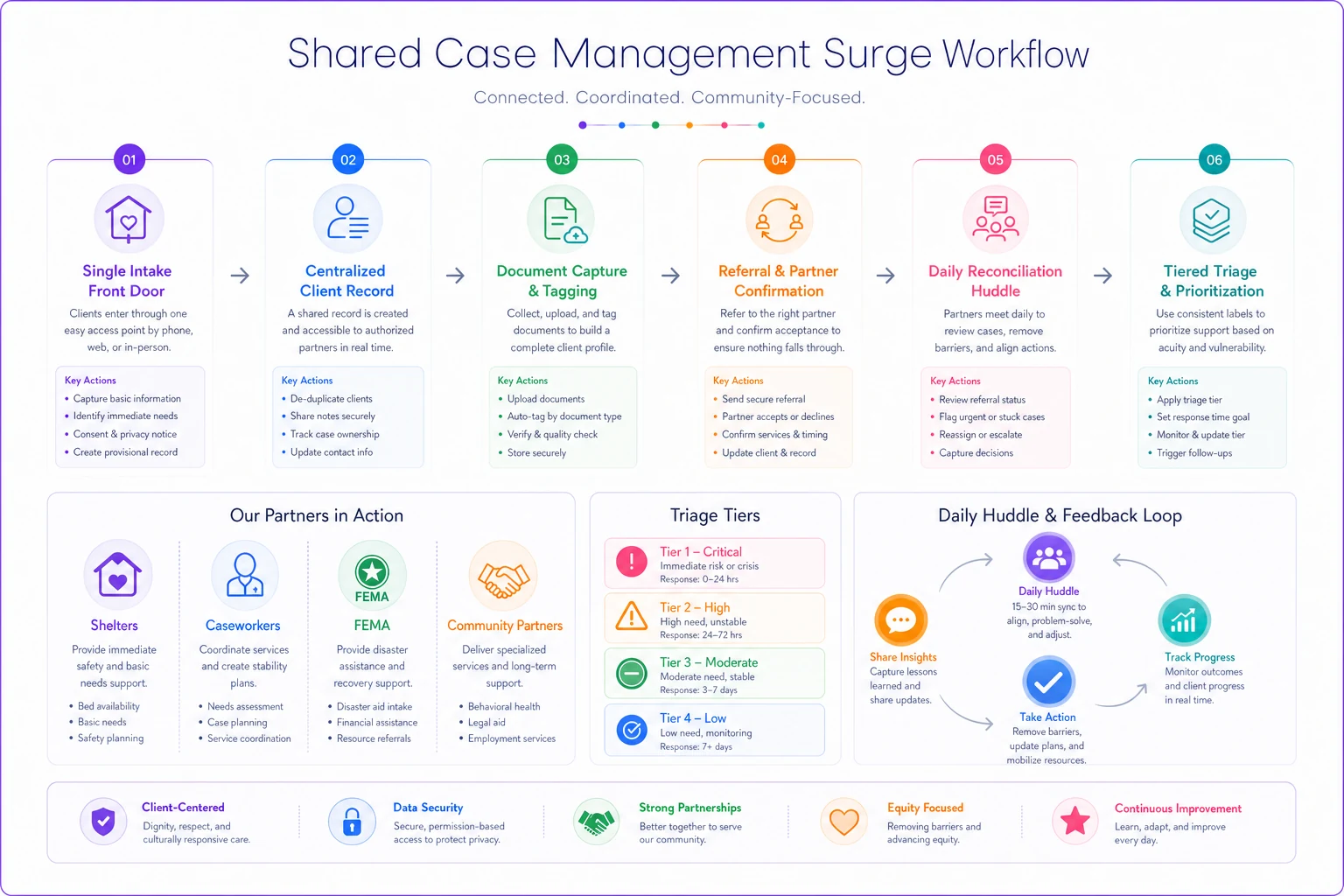
When a shared system makes real sense:
-
You regularly coordinate with the same partner network
-
You've already agreed on data governance and consent before a crisis
-
Your staff are trained on it during calm periods
When it's the wrong move:
-
You're mid-surge with no existing infrastructure (use whatever works now; rebuild after)
-
Your partners won't commit to shared records or confirmation loops
-
Nobody owns keeping the data clean
Tooling amplifies whatever operational discipline you already have. It doesn't create discipline where none exists.
A Real Scenario: Mid-Sized Agency, Rural County
Picture a case management agency covering a semi-rural county that normally carries around 200 active cases across six caseworkers. A derecho and flooding displace a chunk of the county in a single day.
In the first ten days, intake requests jump from a typical 12–15 a week to well over 100. Under their old process, roughly a fifth of early intakes end up duplicated because families are being served at both a shelter and the main office with no linked record. Two senior workers spend most of a week untangling who's actually working which case instead of doing casework.
After they impose a single intake front door, a same-day reconciliation huddle, and a required confirmation step on every partner referral, things shift. Duplicate records drop to a handful. The lost-contact rate on displaced clients improves noticeably once they start capturing a second contact method and an out-of-area emergency contact at intake. Supervisors get their week back. None of it was high-tech—it was mostly deciding, early, that speed without a shared record wasn't actually speed.
The families who benefit most are the ones who would otherwise have sat in the gap between the shelter and the office, with each organization assuming someone else had them.
What to Set Up Now, Before the Next One
If you're reading this after a declaration in your area, you're already behind—so do the fast version: single intake front door, daily reconciliation, required referral confirmations, two contact methods per client. That alone prevents most of the worst outcomes.
If you're reading this during a calm stretch, treat that as the gift it is. Surge readiness is almost entirely a pre-crisis exercise:
-
Pre-agree your intake front door and shared identifier logic with partners
-
Build and drill a surge triage tier before you need it
-
Settle consent and data governance while nobody's under pressure
-
Establish referral confirmation loops now so they're muscle memory later
-
Keep a minimal crisis documentation form ready to deploy
The agencies that handle disaster surges with something resembling grace aren't the ones with the biggest budgets or the most staff.
They're the ones who decided, in advance, how information would flow when everything else stopped being predictable. A storm tests your community. The surge afterward tests your operations—and that's a test you can actually study for.
Ready to transform your social services workflow?
Join 500+ agencies using TryCasi to improve case outcomes, enhance collaboration, and reduce administrative burden.