

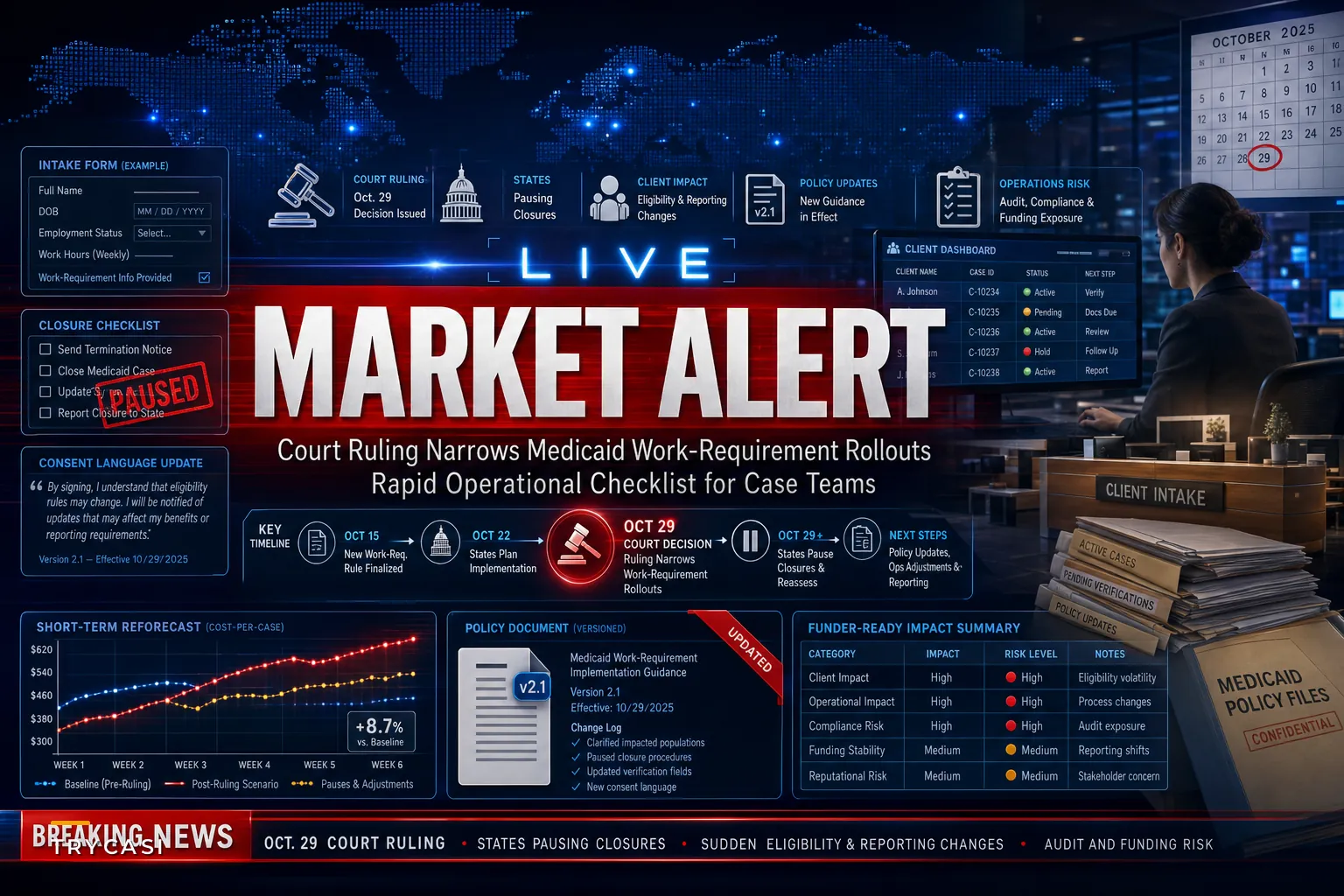

On October 29, 2026, a federal judge blocked new limits on Medicaid work‑requirement exemptions, pausing a rule that would have narrowed who qualifies for exceptions to the upcoming work and reporting requirements scheduled for 2027. For a lot of case managers, the immediate reaction was somewhere between relief and confusion. The exemption criteria you were bracing to retrain everyone on are, at least for now, not the criteria you'll actually be using.
That "for now" is what matters operationally. A ruling like this doesn't settle anything — it freezes a moving target mid‑air. And the teams that tend to get hurt in these situations aren't the ones who read the wrong rule. They're the ones whose intake and verification workflows were hard‑wired to a single version of the rules and couldn't flex when the ground shifted.
So skip the legal play‑by‑play. The useful question is: what does court‑induced policy limbo actually do to your caseload, your verification steps, and your reporting — and how do you keep clients from falling through the cracks while the courts sort it out?
The real operational risk isn't the rule — it's the whiplash
When exemption criteria get narrowed, paused, reinstated, or appealed, the damage rarely comes from the final policy. It comes from the lag between what the rule says today and what your frontline staff believe it says.
A specialist who trained three weeks ago on the narrowed criteria may now be applying standards a judge just suspended. A caseworker closing out a file might flag someone as non‑exempt based on guidance that's no longer in effect. Multiply that across a team of fifteen eligibility specialists each handling a few hundred cases, and you don't have a policy problem — you have a consistency problem.
In practice this shows up as two people reviewing nearly identical client situations and reaching opposite conclusions, simply because they absorbed different versions of the same rule at different points in the timeline. Nobody budgets for that — for the cost of your own team being out of sync with itself.
The stakes are also higher than a typical process hiccup. An incorrect non‑exemption determination can trigger a wrongful case closure. A wrongful closure means a client loses coverage, re‑applies weeks later, and lands back in your intake queue — now as an urgent re‑enrollment with a coverage gap you have to document and explain to a funder. The rework isn't just inefficient. It's a client without care for the duration.
What actually changes in your workflow right now
Before you touch anything, get clear on what this ruling does and doesn't do for your program. It pauses the narrowed exemption limits. It does not cancel the underlying 2027 work and reporting requirements. You're still preparing for the same future — just with a wider, less certain set of exemption categories in the interim.
Eliminate case management chaos.
TryCasi helps you organize, monitor, and report on every case efficiently and securely.
- Centralized case tracking
- Automated client notifications
- Team task coordination
No credit card required
| Workflow Layer | What Shifts | Immediate Risk If Ignored |
|---|---|---|
| Intake screening | More clients may now screen as potentially exempt under the broader (restored) criteria | Staff applying paused criteria wrongly flag clients as subject to requirements |
| Eligibility verification | Evidence standards for exemptions revert; some recently collected docs may no longer be the right ones | Verification built around the narrowed rule asks for the wrong proof |
| Triage & prioritization | Caseload composition shifts — fewer "at‑risk of losing coverage" flags in the short term | Priority rules tuned to the narrow rule over‑escalate the wrong cases |
| Funder & compliance reporting | Exemption counts and projected caseloads need re‑forecasting | Reports submitted on stale assumptions misstate who's affected |
The quiet one on that list is verification. When exemption criteria change, the documents that count as valid proof often change with them. Teams that already started collecting evidence tailored to the narrowed rule may now be sitting on files built for a standard that's been suspended. That's not wasted effort exactly, but it's effort pointed at the wrong target — and it's the kind of thing that only surfaces during an audit, which is the worst possible time to find it.
A rapid operational checklist
This is the part to act on this week, not next quarter. None of it requires a policy expert — it just requires some discipline about keeping your team synchronized while the rules stay unsettled.
-
Freeze automated non‑exemption closures. If any part of your process auto‑flags clients as subject to requirements, add a manual review gate until your criteria are confirmed stable. A closure is easy to trigger and painful to reverse.
-
Issue a one‑page "current standard" bulletin. Date it. State plainly: as of this date, these exemption categories apply, these are paused, these are under appeal. Re‑issue it every time the status moves. Staff should never have to guess which version is live.
-
Re‑map your verification evidence list to the restored criteria. For each exemption category, note what proof is currently acceptable and flag any doc requests that were tied to the narrowed rule.
-
Pull a list of every case closed or re‑determined in the last 30–45 days on exemption grounds. These are your highest‑risk files for wrongful closure. Review these before anything else.
-
Tag affected clients for monitoring. Anyone whose status depends on the exemption rules should be flagged so that when the policy moves again, you can find them in minutes, not days.
-
Assign one person to own state guidance watch. Federal rulings are the headline, but your actual marching orders come from state implementation notes. One named owner, checking a known source on a set cadence, beats five people half‑watching.
Name a single owner for state guidance watch — it beats five people half‑watching.
A useful habit while things are in flux: cross‑check your enrollment assumptions against a neutral external tracker like KFF's Medicaid and CHIP enrollment data. It won't tell you the legal status of a rule, but it gives you a sanity check on whether the enrollment shifts you're seeing in your own numbers line up with broader trends — which helps you separate a real caseload change from a data‑entry artifact.
A realistic scenario of how this goes sideways
Picture a mid‑size county program running eligibility and case management for a few thousand active Medicaid clients. In the weeks before the ruling, leadership did the responsible thing and started retraining staff on the narrowed exemption criteria, expecting them to take effect. Intake scripts got updated. The verification checklist got revised to request the tighter documentation.
Then the ruling drops. Nobody updates the intake scripts for nine days because everyone assumes someone else owns that. During those nine days, maybe 60–80 intakes get screened against suspended criteria. A handful of clients who should screen as exempt get routed toward the work‑requirement track. Two get pre‑closure notices.
The program catches it during a weekly file review, but now they're doing damage control — reversing notices, re‑contacting clients, re‑documenting the reasons, and explaining the discrepancy in their next funder report. The fix probably ate 20–30 staff hours that didn't need to be spent. The harder cost is trust: two clients who received a frightening notice they never should have gotten.
Nothing in that scenario required bad staff. It required a process that assumed the rules would hold still. That's the real vulnerability — and it's worth engineering out, because this won't be the last time a court reshapes the landscape mid‑cycle.
The deeper problem this exposes
Policy churn isn't new to anyone who's worked eligibility. What this episode makes obvious is how tightly most programs couple their operational rules to a specific version of policy, instead of building something that expects policy to shift.
When caseworkers memorize criteria, when verification lists are baked into static forms, when triage thresholds are tuned to one assumed rule set — the whole operation becomes brittle. A single ruling forces a scramble across intake, verification, triage, and reporting all at once, and the scramble is where errors breed.
Below is a simple diagram to visualize that cascade and how a centralized source of truth can break the chain of errors.
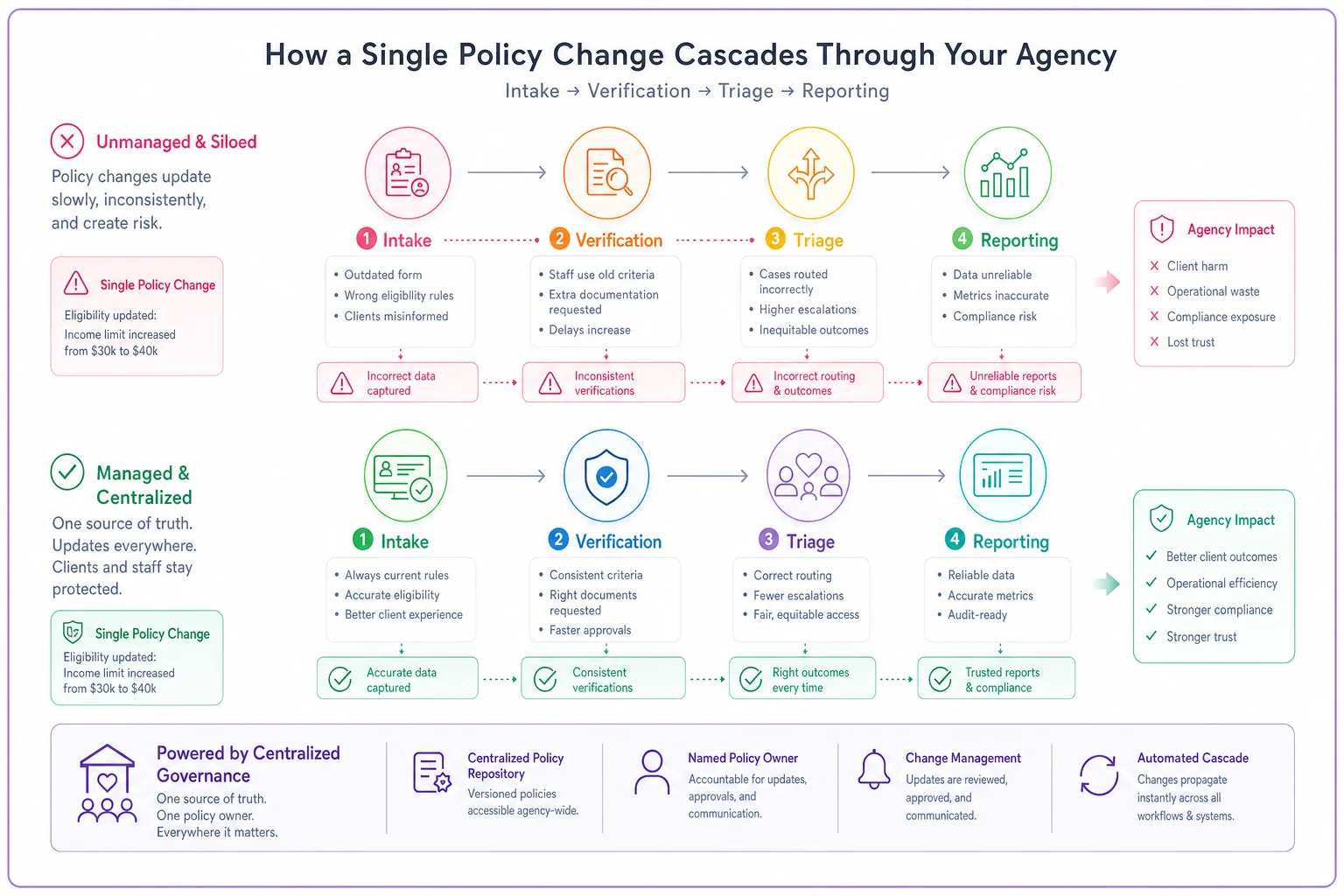
The programs that handle these moments well tend to share one thing: they treat the alignment between casework, funding rules, and compliance as a standing system, not a one‑time setup. A clear owner for policy watch, a versioned source of truth for current criteria, and verification steps that can be updated in one place and propagate everywhere. If you want a fuller framework for building that kind of resilience, this breakdown of an operating model that aligns casework, funding, and compliance walks through how to keep those three layers moving together instead of lurching independently every time the rules shift.
The practical payoff shows up precisely in moments like this one. When your current‑standard bulletin, your verification criteria, and your triage rules all trace back to a single maintained source, updating for a court ruling becomes a controlled change — not a fire drill. Case‑management platforms with configurable eligibility logic help here, because you adjust the criteria once at the system level rather than retraining fifteen people and hoping they all got the memo. Less about automation for its own sake, more about removing the lag that turns a policy change into a client harm.
When to move fast — and when to hold
Not every ruling demands an all‑hands response, and over‑reacting has its own costs. Spinning up a full retraining cycle for a rule that gets re‑reversed in a month just exhausts your team and erodes their confidence in the next bulletin you send.
A rapid response makes sense when the change touches active closures, pending determinations, or anything that could cause a client to lose coverage incorrectly. Those are irreversible enough to justify moving immediately. It makes less sense to overhaul long‑term training materials or rebuild reporting templates while a ruling is still under appeal — that's effort you may end up spending twice.
The smarter posture during limbo is to stabilize the things that can harm clients now, monitor the things that are still contested, and hold your bigger structural changes until the 2027 requirements firm up. The teams that get this balance right aren't the ones with the most detailed policy knowledge. They're the ones who built the muscle to absorb a change, keep everyone pointed at the same current standard, and protect clients during the uncertain stretch in between. This ruling is a stress test for exactly that muscle — and there will be more before the 2027 requirements settle into their final shape.
Ready to transform your social services workflow?
Join 500+ agencies using TryCasi to improve case outcomes, enhance collaboration, and reduce administrative burden.