

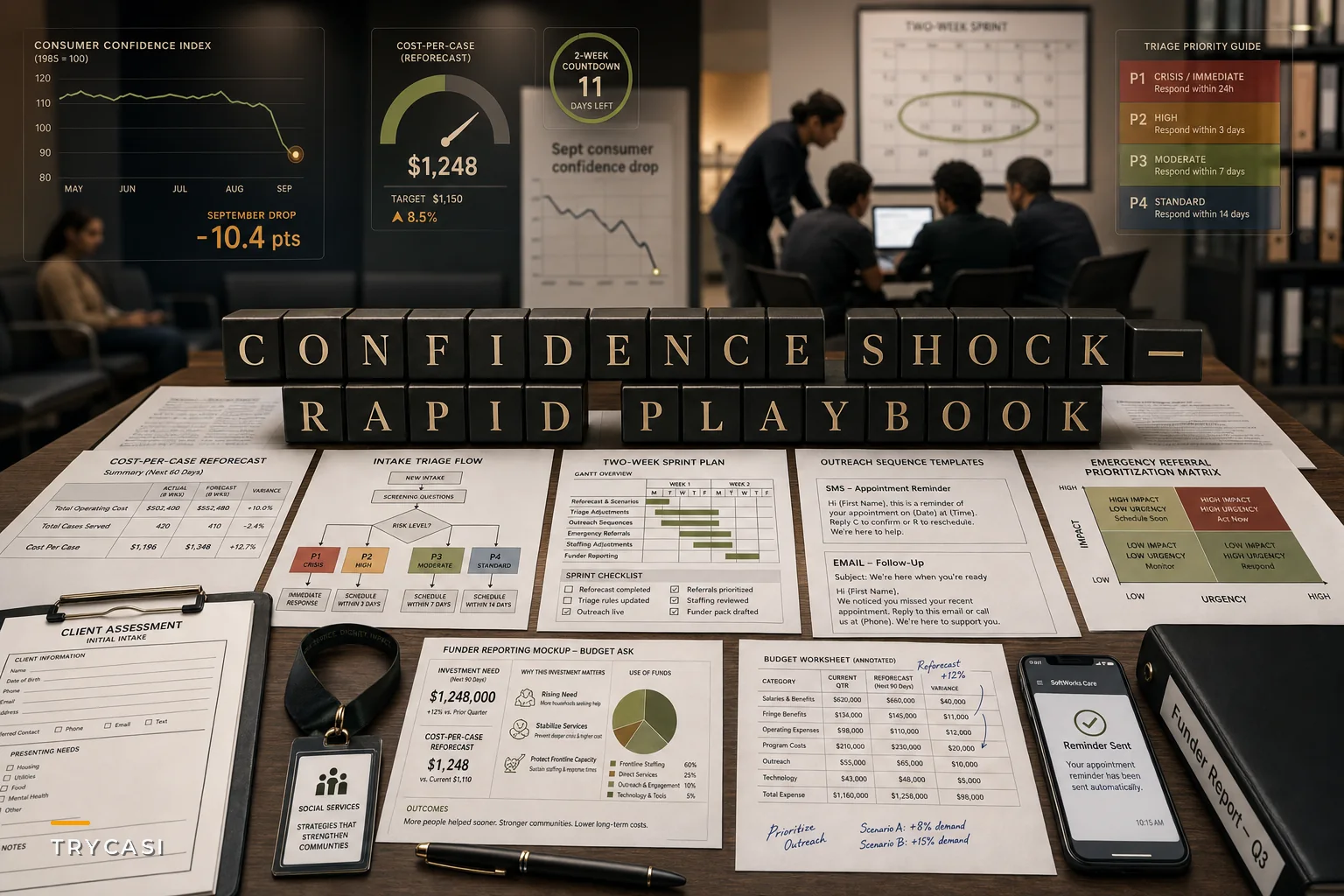

The Conference Board's September 2026 reading landed at 81.9 — the lowest confidence number in more than twelve years. Reuters covered the drop as a signal of rising worry about jobs and finances, and the Conference Board's own index page framed it around labor-market anxiety.
For most people reading that headline, it's an abstract macro number. For a program manager running an intake queue, it's a forecast. When confidence drops this hard, the stress doesn't stay in people's heads — it shows up as skipped rent, a car that can't get fixed, a grocery budget that stops stretching. And a few weeks later it shows up at your door as a spike in intake calls, more crisis flags, and a queue that won't clear.
This post isn't about the index. It's about what you do in the weeks between the number dropping and your caseload catching up with it.
The lag is your only real advantage
Most agencies miss this: there's a delay between a confidence shock and the caseload surge. Households don't call the day they feel anxious. They call when the second missed paycheck hits, when the eviction notice is taped to the door, when the utility shutoff date is circled on the calendar. That lag is usually somewhere between three and eight weeks depending on what services you run.
That gap is the only window you get to prepare instead of react. And most teams waste it because nothing feels urgent yet. The phones are normal. The queue looks fine. Then four weeks later everyone's underwater and you're making triage decisions at 5pm on a Friday with no plan.
The agencies that handle these shocks well treat the quiet weeks as prep time, not downtime. The difference between a surge that's merely hard and one that breaks the team almost always comes down to decisions made before the volume arrived.
Re-run your numbers before the surge, not during it
The first move isn't operational — it's financial. Before you touch triage or staffing, you need to know what a case actually costs you right now, because that number is about to get squeezed from both ends: more cases coming in, and funders who may pull back as their own donors feel the same pinch.
Eliminate case management chaos.
TryCasi helps you organize, monitor, and report on every case efficiently and securely.
- Centralized case tracking
- Automated client notifications
- Team task coordination
No credit card required
Two things happen at once during a confidence shock. Demand goes up, and the money to meet it gets tighter. Individual donors give less when they're worried about their own jobs. Some grant-makers slow disbursements. You can't manage that collision without a live view of cost-per-case.
If you haven't refreshed that model recently, it's the most useful thing you can do this week. Our practical operational cost-per-case model walks through how to build one that's actually usable — not a spreadsheet that gets built once and never opened again, but something you can re-run when conditions change. And conditions just changed.
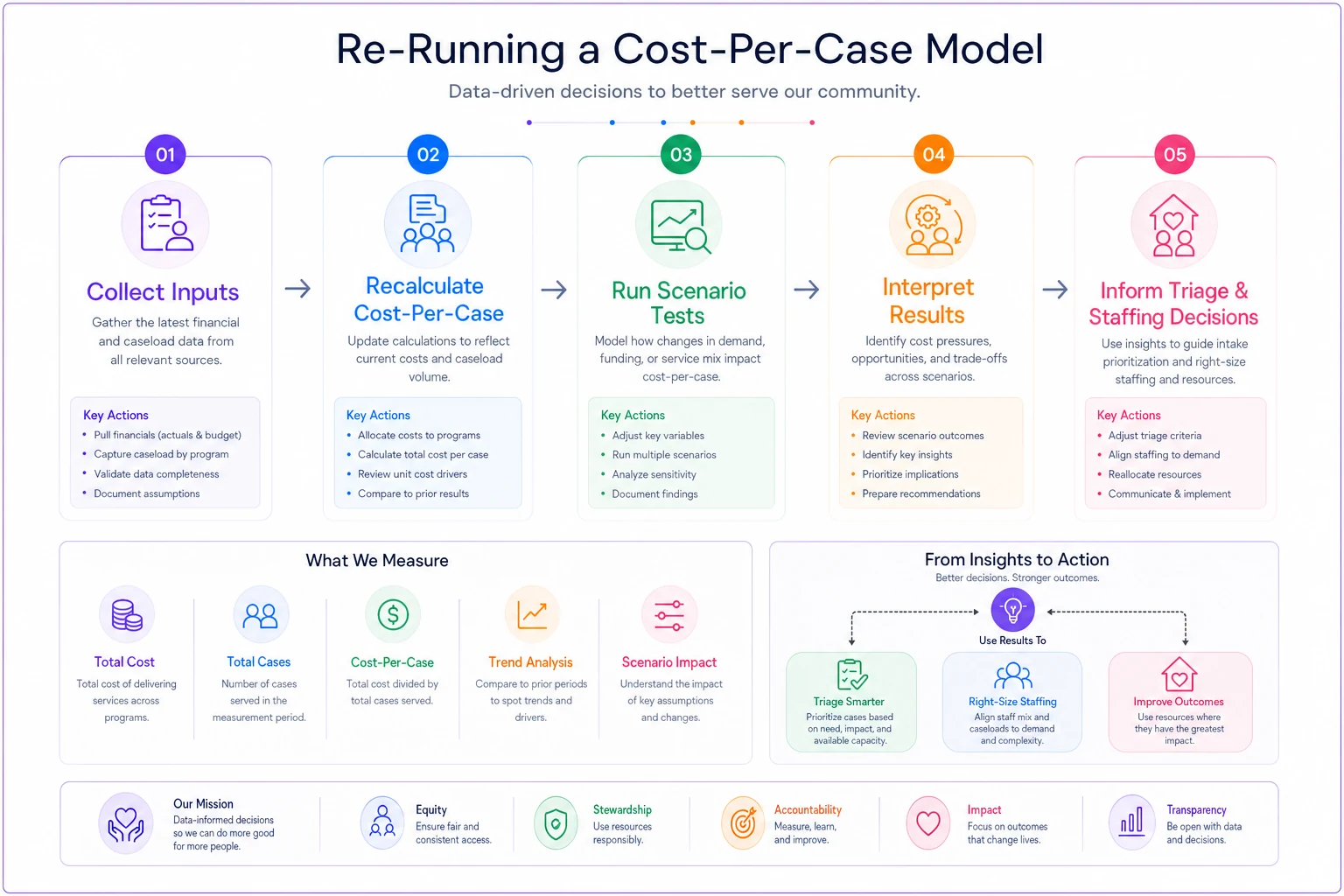
This shows the steps to refresh the model and turn the results into immediate operational choices.
A rough illustration of how this plays out: an agency running housing stabilization might carry a cost-per-case somewhere around $900–$1,100 under normal volume. Push caseload up 25% without adding staff and that number doesn't hold steady — it creeps, because overloaded caseworkers make more errors, cases take longer to close, and rework piles up. Knowing your baseline is what lets you see that drift early instead of at the end of the quarter.
Where the surge actually hits — and in what order
Not all services spike at once. The sequence matters because it tells you where to put your attention first.
| Service area | When it tends to spike | Early warning sign |
|---|---|---|
| Food assistance | First (days to ~2 weeks) | Pantry visit volume climbs, more first-time clients |
| Crisis / emergency support | Early (1–3 weeks) | More after-hours calls, higher-acuity intakes |
| Utility & bill assistance | Mid (3–5 weeks) | Shutoff-date urgency in intake notes |
| Housing / eviction prevention | Later (4–8 weeks) | Notices already filed, shorter timelines to act |
| Employment / benefits navigation | Rolling, sustained | Steady lift that doesn't recede |
Food and crisis demand move fast because they're immediate-need services. Housing lags because the eviction process itself takes weeks to play out — which means the hardest, highest-stakes cases arrive after your team is already tired from the earlier waves.
The mistake is staffing for the first wave and getting caught flat by the fourth. If you throw everyone at the food and crisis spike in week two, you've got nothing left when eviction-prevention cases — the ones with 72-hour deadlines — start landing in week six.
Tighten triage before volume forces your hand
When queues get long, triage quality quietly collapses. Not because people stop caring, but because overwhelmed intake staff default to first-come-first-served, which is the worst possible way to allocate scarce capacity during a surge. The client with a shutoff notice three weeks out gets the same slot as the family being locked out tomorrow.
You don't need a new system. You need your existing triage thresholds revisited now, while there's still time to think it through:
-
Re-confirm your escalation triggers. What counts as "immediate" when everything feels urgent? Write it down so it's not a judgment call made by a stressed intake worker at hour seven.
-
Set a capacity ceiling per caseworker and decide in advance what happens when it's hit — warm handoff, waitlist with a callback SLA, partner referral. Deciding this under pressure guarantees a bad answer.
-
Flag the slow-burn high-risk cases early. An eviction that's filed but not yet scheduled is your highest-leverage intervention. Catch it in week four and you prevent a crisis in week seven.
-
Pre-write your referral paths for overflow. Know which partners have capacity before you need them, not after your queue is already full.
Worth flagging: agencies that stay functional during surges almost always have fewer triage categories, not more. When you're moving fast, a three-tier system beats a seven-tier one every time. Complexity is a luxury of slower periods.
A real scenario: the community services agency that saw it coming
A mid-sized community services agency — roughly 14 caseworkers across food, utility, and housing programs — had been through a surge two years earlier that nearly broke them. That time, they reacted. Queues hit three-week waits, two staff left within a quarter, and case-closure time nearly doubled.
When the confidence numbers dropped this time around, their program director did three things in the first two weeks. She re-ran the cost-per-case model and flagged that a 20% volume bump would push them past budget by roughly $18k–$22k for the quarter unless something changed. She reworked triage thresholds so eviction-prevention cases got flagged the moment a notice was mentioned, even before a formal intake. And she called four partner agencies to confirm overflow capacity in advance.
The surge still came — food requests climbed first, housing followed about five weeks later, roughly in the sequence you'd expect. But the queue never blew past about a week. Closure times held. No one quit. The difference wasn't more resources; it was that the decisions got made during the quiet window instead of in the middle of the fire.
Not every agency has the slack to do all three of those things. But even one changes the trajectory.
Protect your low-cost outreach — it does more work during a surge
When budgets tighten, outreach is usually the first thing cut because it feels optional. That's backwards. During a confidence shock, your cheapest outreach channels become your most important ones, because appointment churn goes up exactly when people are most stressed.
Stressed clients no-show more. They're juggling shutoff dates, job interviews, childcare that fell through. A missed home visit during a surge isn't just a wasted slot — it's a high-risk case slipping out of view at the worst possible moment. Simple reminder sequences and confirmation loops hold onto those clients for almost nothing, and they're the last thing you should cut when things get lean.
This is also where decent case-management tooling earns its keep — not as a flashy upgrade, but as basic plumbing. When a system can automatically flag which high-risk cases haven't been contacted in the last several days, or surface eviction-prevention cases buried in a growing queue, your staff spend their limited attention on the right people instead of re-sorting spreadsheets. Overloaded humans miss things. The right workflow quietly catches what a tired caseworker at the end of a long week wouldn't.
When to hold steady instead of scrambling
Not every confidence drop turns into a surge for every agency. If your service area is tied to needs that aren't especially economy-sensitive, or if you've already got a long waitlist absorbing volume, blowing up your operation in anticipation can do more harm than the surge itself.
Reorganizing triage, shifting staff, pausing programs to free capacity — these all carry a cost in disruption and morale. If your early indicators (first-time intakes, pantry volume, after-hours calls) aren't actually moving two or three weeks in, don't manufacture an emergency. Watch the leading signals, keep the cost-per-case model current, and move when the data moves. Preparation is cheap; premature overhaul is not.
The teams that handle this worst tend to either ignore the signal entirely or overreact so hard they exhaust themselves before the real demand arrives.
The quiet weeks are the whole game
A confidence number dropping to a twelve-year low is a forecast with a delay built in. The households feeling it today become your intake queue in a month. That gap is a gift — a rare chance in social-service operations to prepare before the pressure rather than absorb it and hope the team holds.
Use it on the unglamorous stuff: refresh what a case actually costs you, revisit your triage thresholds while you can still think clearly, confirm overflow partners before you need them, and protect the cheap outreach that keeps high-risk clients from disappearing. None of it is dramatic. All of it is the difference between a hard few months and a few months that break your team.
A confidence number dropping to a twelve-year low is a forecast with a delay built in. The households feeling it today become your intake queue in a month. That gap is a gift — a rare chance in social-service operations to prepare before the pressure rather than absorb it and hope the team holds.
Use it on the unglamorous stuff: refresh what a case actually costs you, revisit your triage thresholds while you can still think clearly, confirm overflow partners before you need them, and protect the cheap outreach that keeps high-risk clients from disappearing. None of it is dramatic. All of it is the difference between a hard few months and a few months that break your team.
Ready to transform your social services workflow?
Join 500+ agencies using TryCasi to improve case outcomes, enhance collaboration, and reduce administrative burden.