

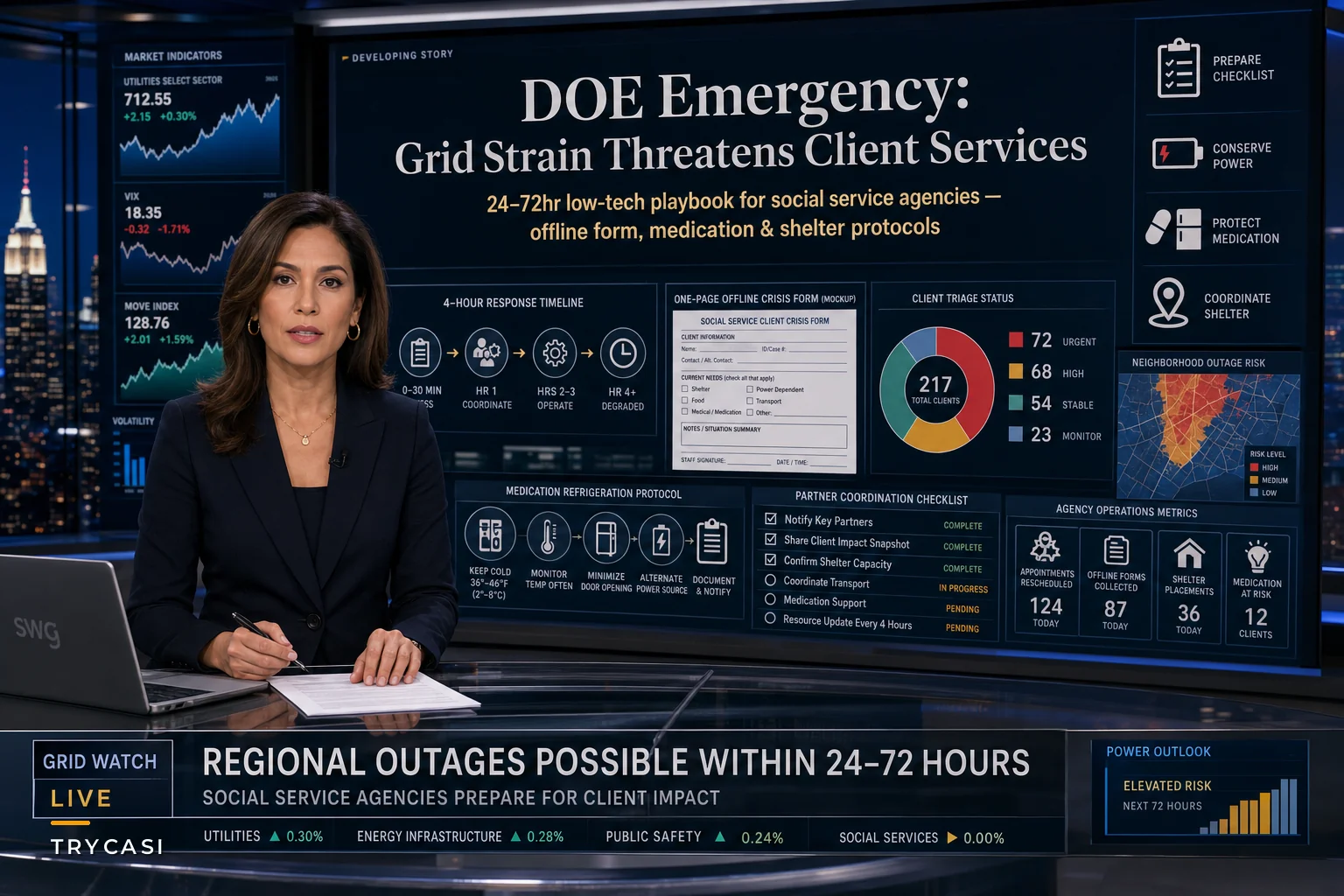

The Department of Energy just issued an emergency order covering 17 states through August 3rd, activating backup generation across the western grid to prevent rolling blackouts during this heat wave. But we know how this plays out at the ground level. Power flickers right when you're coordinating an emergency placement. Your client's insulin spoils in their non-functioning fridge. The cooling center you referred three families to loses AC capacity.
Last summer, a case management team in Phoenix lost power for four hours during their busiest intake period. No computer access meant no client histories, no medication lists, no emergency contacts. They had 47 clients in the waiting room, including several experiencing heat exhaustion. The paper backup forms they scrambled to find? Missing critical fields for medical conditions and shelter preferences. Two clients ended up at incompatible facilities because workers couldn't verify restrictions without their systems. Power outage case management isn't about having a generator. It's about maintaining service continuity when every digital tool fails simultaneously.
The cascade effect
Most case managers think power outages mean laptops die and phones stop charging. The operational reality hits differently.
Your shelter placement system goes dark, but that's actually problem number three. Problem one: the shelters themselves lose power, triggering capacity changes you can't track. Problem two: your partner agencies can't update availability because their systems are down too. By the time you realize your laptop battery is dying, you're already coordinating blind.
A mid-sized nonprofit in Sacramento discovered this during a planned outage. They had backup power for their main office and felt prepared. What they didn't anticipate: three satellite locations going dark meant field workers couldn't submit safety checks. Their partner network of a dozen shelters had varying backup power, creating a constantly shifting availability puzzle. Their SMS notification system, hosted externally, kept sending alerts about services that were temporarily unavailable.
The worst part? Insurance required documentation of every client interaction during the outage. They ended up with 200+ paper forms that took three weeks to digitize and match to client records.
Paper forms that actually work when systems don't
After watching organizations fumble through outages, clear patterns emerge. The teams that maintain service quality share one trait: they've accepted that paper processes need different information hierarchies than digital ones.
Eliminate case management chaos.
TryCasi helps you organize, monitor, and report on every case efficiently and securely.
- Centralized case tracking
- Automated client notifications
- Team task coordination
No credit card required
Your electronic case management system pulls client history instantly. Paper can't. So your emergency form needs current medication names and dosages, not just "see medical history." Your shelter referral tracking relies on real-time bed counts online. On paper, you need space to note which facilities you've already called and their last stated capacity, with timestamps.
Here's what functional emergency documentation actually includes:
Client Safety Assessment (one page max)
-
Current location (specific address, not "downtown area")
-
Medical needs that expire in 48 hours (insulin, oxygen, dialysis)
-
Cannot be placed with (names and relationships)
-
Languages spoken/understood
-
Mobility restrictions (can't use stairs, needs wheelchair access)
-
Time-sensitive medications with dosage
-
Emergency contact who doesn't need power to be reached
Shelter Coordination Tracker
-
Facility name and last known capacity
-
Time called and result
-
Special populations accepted (families, pets, medical needs)
-
Transportation available from facility
-
Backup contact if main line is down
-
Power status at facility (confirmed/assumed/unknown)
The teams that struggle try to recreate their full digital workflow on paper. The teams that succeed strip everything down to immediate safety and basic coordination, knowing they'll reconcile records later when systems come back online.
Building your 4-hour response kit
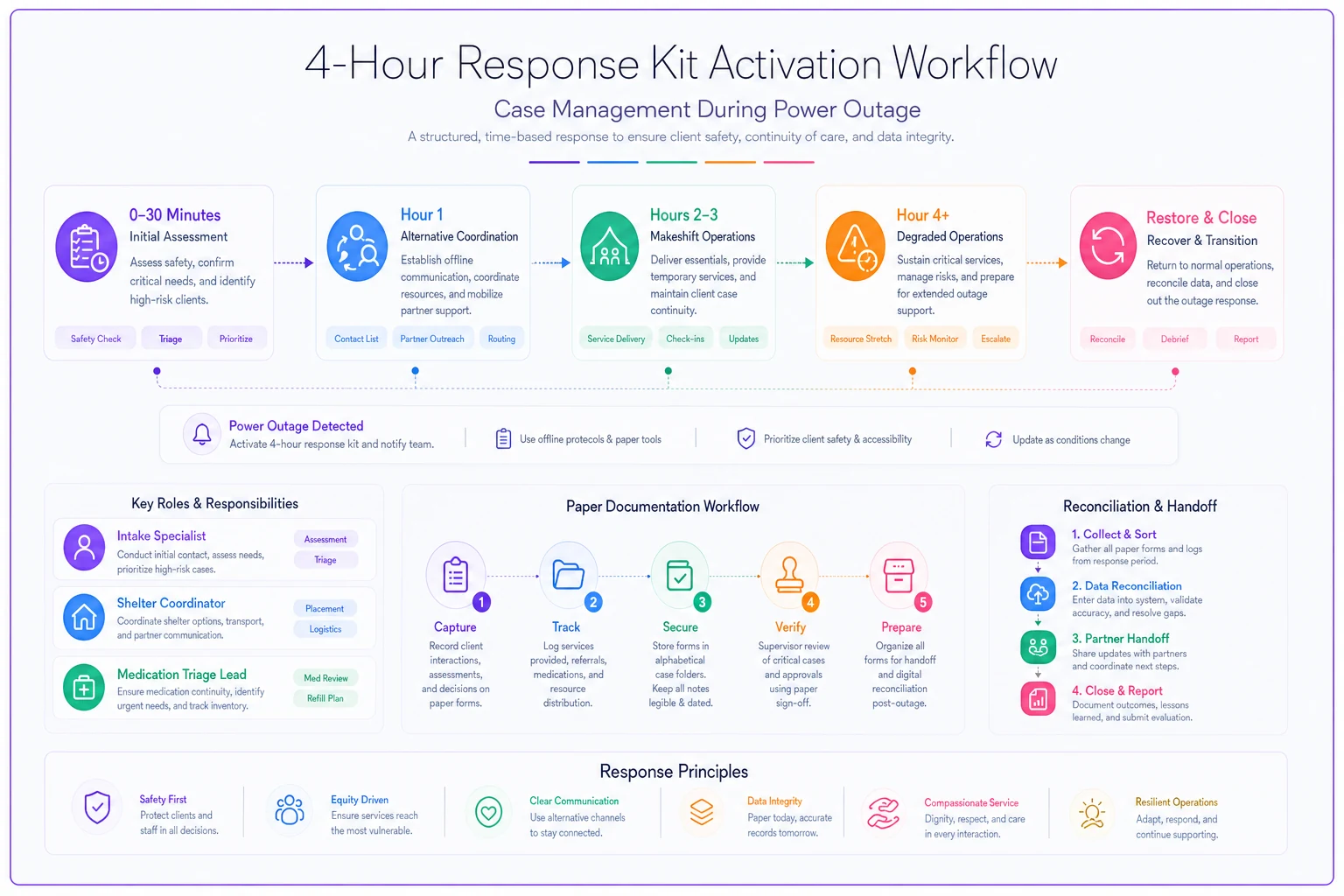
Power disruptions in case management tend to follow a predictable timeline. First 30 minutes: confusion about what's affected. Next hour: scrambling for alternatives. Hours 2-3: establishing makeshift processes. Hour 4 and beyond: operating in degraded mode or waiting for restoration.
Your response kit targets that 2-4 hour window where you need to maintain operations without creating massive reconciliation problems later.
Here's a quick visual of the 4-hour response workflow.
Physical Kit Components
-
25 copies of single-page intake forms
-
25 copies of shelter coordination sheets
-
Battery pack that can charge 5 phones twice
-
Paper map with shelter locations marked
-
Laminated card with critical phone numbers
-
$200 petty cash for emergency transport
-
Clipboard with working pens (sounds obvious, but it comes up every time)
Information Architecture
The hardest lesson: your team needs different information during an outage than during normal operations. A case manager typically needs client history, service plans, and past interventions. During an outage, they need immediate medical needs, today's shelter options, and safety flags.
One organization in Riverside created a "power outage flip chart" — a bound set of laminated pages with decision trees. Page one: medical emergency protocols when 911 is overloaded. Page two: shelter capacity as of last update, with phone numbers. Page three: medication refrigeration sites. Simple, analog, effective.
Communication protocols that assume nothing works
Every power outage case management plan assumes phones work. Then cell towers lose backup power after 4-6 hours, or the network gets overwhelmed.
The most resilient teams build degraded communication hierarchies:
Tier 1: Full Systems
-
Normal digital operations
-
All platforms accessible
-
Real-time coordination
Tier 2: Partial Outage
-
Office power out but phones work
-
SMS for client updates
-
Voice calls for coordination
-
Paper documentation for later entry
Tier 3: Extended Disruption
-
Cell networks struggling
-
Designated rally points for team updates
-
Runner system between locations
-
Partner agency liaison at each major shelter
Tier 4: Complete Breakdown
-
Pre-designated physical meeting point every 2 hours
-
Paper message board at main office
-
Buddy system for field workers
-
AM/FM radio for emergency broadcasts
A team in Fresno tested their Tier 3 protocols during a planned exercise. Their rally point was a coffee shop that closed during power outages. Their runner system assumed personal vehicles, but two key staff took public transit. These aren't details you want to discover during an actual emergency.
The partner coordination problem
Your organization might have solid outage protocols. Your partners probably don't. During a 6-hour outage in Bakersfield, one case management agency had their paper processes ready to go. Their partner network was chaos. The mental health clinic couldn't access client medication lists. The shelter couldn't verify bed availability. The food bank's refrigerated truck lost temperature control and had to dump inventory. Every partner failure became the case management team's problem to solve.
Pre-outage partner mapping:
| Partner Type | Critical During Outage? | Has Backup Power? | Alternate Process? | Contact Without Power? |
|---|---|---|---|---|
| Emergency Shelter A | Yes | Generator (8 hrs) | Paper intake | Site phone + cell |
| Mental Health Clinic | Yes | No | None established | Cell only |
| Food Bank | Sometimes | No | Direct distribution | Unknown |
| County Health | Yes | Full backup | Limited systems | Multiple options |
| Transport Service | Critical | N/A (vehicles) | Dispatch radio | Radio + cell |
The real work happens in those "Alternate Process" and "Contact Without Power" columns. A monthly five-minute call to verify backup contact methods prevents hours of confusion during an actual outage.
Managing medication and refrigeration crises
The Reuters report on grid reliability mentions backup generation, but frontline reality involves clients whose life-sustaining medications require refrigeration. Insulin, certain antibiotics, biologics for autoimmune conditions — they spoil within hours at room temperature.
A case manager in Modesto shared their medication triage protocol:
First 2 hours: Identify all clients with refrigerated medications. SMS blast with pharmacy locations that have backup power. Document who responds and who doesn't.
Hours 2-4: Physical welfare checks on non-responders with critical medications. Coordinate with home health agencies for temporary storage. Track which medications can be replaced immediately versus which require prior authorization.
Beyond 4 hours: Activate emergency prescription protocols with partner clinics. Transport clients to powered facilities if medications can't be preserved. Document everything for insurance claims.
They learned the expensive way that some insurers won't cover spoiled medication without specific documentation: timestamp of power loss, temperature readings if available, photos of spoiled medication, and attempted mitigation steps.
The home visit safety paradox
Power outages create a brutal irony for case managers: the clients most needing welfare checks are often in buildings where powered entry systems, elevators, and emergency lighting have all failed. Your most vulnerable clients become least accessible precisely when they need you most.
A team in downtown Oakland standardized their outage home visit protocol after a field worker got trapped in a dark stairwell for 45 minutes. Now they run two-person teams during outages with specific rules:
-
No entering buildings without working emergency lighting
-
Flashlight check before entering any stairwell
-
One person stays at building entrance with charged phone
-
Maximum 20-minute check before returning to entrance
-
Written log of buildings that couldn't be accessed safely
The protocol feels excessive until you're standing outside a 12-story senior housing complex with no working elevators, knowing your mobility-impaired clients on floor 8 haven't been checked in six hours.
Technology for degraded operations
The instinct during power planning is to buy generators and battery backups. But operational software configured for intermittent connectivity often provides better continuity than trying to maintain full power.
Modern case management platforms with offline-first architecture let workers keep documenting on battery-powered devices, then sync when connectivity returns. The key is configuring them correctly before an outage hits.
Essential offline capabilities:
-
Client contact information and critical alerts
-
Today's appointments and scheduled visits
-
Basic intake forms that queue for submission
-
Medication lists and safety flags
-
Emergency contact for each client
A San Diego nonprofit learned to pre-cache critical data every morning during high-risk periods. Takes five minutes, saves hours of scrambling. Their system automatically downloads priority client information to each device at 6am, so even if power fails at 8am, workers have current data.
Pre-cache critical data every morning during high-risk periods.
The automation aspect matters most for tracking during chaos. Instead of manually logging every decision on paper, workers can quick-tap predefined outage responses: "attempted visit - building inaccessible," "client relocated to cooling center," "medication spoilage documented." The system timestamps everything and queues it for upload, creating an audit trail without adding paperwork burden.
Post-outage reconciliation without losing your mind
Power comes back on, and now you face 200+ paper forms, conflicting shelter counts, and insurance documentation requirements. Organizations that handle this smoothly share one thing in common: they plan the reconciliation process before the outage.
The 24-hour reconciliation sprint:
-
Morning after power restoration
Sort paper documents into "safety-critical" and "administrative." Safety-critical gets entered immediately — new shelter placements, medication issues, wellness checks. Administrative can wait.
-
First afternoon
Reconcile shelter numbers with partner agencies. Every facility might have different counts depending on when their power failed and restored. A shared spreadsheet with timestamps prevents arguments later.
-
Day two morning
Begin systematic data entry of paper forms. One organization assigns each worker to enter their own notes; another uses dedicated data entry staff. Either works as long as roles are clear upfront.
-
Within 48 hours
Complete a preliminary incident report for insurance and compliance. Don't wait for perfect data. "Approximately 47 clients affected" beats missing filing deadlines.
-
Within one week
Full audit comparing paper records to digital entries — check for duplicates, missing clients, and conflicting information.
The teams that struggle try to reconstruct perfect records. The teams that succeed accept that outage documentation will have gaps and focus on capturing what matters for client safety and regulatory compliance.
Who shouldn't rely on standard protocols
Some case management scenarios need specialized outage planning that goes well beyond standard protocols:
Medical case management: If you're coordinating dialysis, chemotherapy, or other time-critical medical services, generic outage plans fall apart immediately. These teams need direct communication channels with hospital command centers and medical transport dispatch.
Domestic violence services: Safe house locations and client whereabouts become extremely vulnerable when systems go dark. Paper documentation with names and addresses is a security risk. These programs often maintain completely separate outage protocols with enhanced confidentiality measures.
Rural service areas: Urban outage plans assume alternatives exist — another pharmacy, another shelter, another clinic. A rural case manager might cover 500 square miles with one hospital. Outage planning there involves pre-staged resources and agreements with neighboring counties.
Court-mandated services: Missing a supervised visit or required check-in due to power outage can violate court orders. These programs need pre-approved exception protocols with judicial systems and alternate verification methods.
Building beyond the emergency order
This DOE emergency order runs through August 3rd, but grid stress isn't going away. According to the Department of Energy, backup generation and demand response are becoming routine requirements, not emergency measures.
For case management teams, that means power outage protocols can't stay buried in the emergency binder nobody reads. They need to be part of daily operations.
Start with monthly five-minute drills. Not full scenarios — just quick checks. Can everyone find the paper forms? Do backup batteries hold charge? Are partner contact lists current? Small, regular validations prevent massive failures when it actually matters.
Some organizations now run "Degraded Wednesdays" — one Wednesday per quarter, they operate without their primary case management system for two hours. Not during a real outage, just practiced degradation. Staff learn the paper processes, identify gaps, and build muscle memory before they need it.
The investment seems excessive until you're explaining to state auditors why you lost track of 30 clients during a four-hour outage. Or worse, until a client has a preventable medical emergency because their insulin spoiled and nobody could verify their prescription for replacement.
Power outage case management isn't about perfection during disruption. It's about maintaining enough coordination to keep vulnerable people safe when infrastructure fails. The gap between "we have a generator" and "we can actually operate without power" is where real preparation happens.
The grid will stabilize after August 3rd. The next stress period will come. The question isn't whether your team will face extended power disruption — it's whether you'll handle it as a crisis or as a degraded but functional operation.
The organizations that hold together during infrastructure failures don't rely on hope or heroics. They build boring, tested processes that work when nothing else does. In case management, boring preparation saves lives.
Ready to transform your social services workflow?
Join 500+ agencies using TryCasi to improve case outcomes, enhance collaboration, and reduce administrative burden.