


Three months ago, a mid-sized family services nonprofit in Michigan got sued for $180,000. Not because of staff misconduct. Not because of a data breach. Because a volunteer shared case details at her book club.
When good intentions create serious liability
She thought she was being careful—changed names, kept locations vague. But one book club member recognized the family anyway. Word spread through a church group. The family found out their abuse history had become community gossip. Legal action followed almost immediately.
This isn't as rare as organizations want to believe. Volunteer governance in casework creates a specific operational problem that most nonprofits handle badly. You need the extra hands—especially when caseloads hit 40+ families per worker. But every volunteer is also a potential confidentiality breach, a boundary violation, or a supervision gap waiting to happen.
The task matrix problem
Most organizations hand volunteers a background check result and a two-hour orientation, then act surprised when problems show up six weeks later.
Eliminate case management chaos.
TryCasi helps you organize, monitor, and report on every case efficiently and securely.
- Centralized case tracking
- Automated client notifications
- Team task coordination
No credit card required
Volunteers live in a gray zone between professional staff and community members. They're exposed to sensitive information but haven't had professional training. They want to help but don't fully understand where the lines are. They show up on irregular schedules while handling time-sensitive tasks.
A youth services coordinator in Denver described their wake-up call: "We had volunteers doing home visit prep—calling families, updating addresses, confirming appointments. Seemed pretty low-risk. Then we found out one volunteer had been adding personal commentary to case notes. Things like 'mother seems overwhelmed, probably drinking again' based on a two-minute phone call. Those notes were going into permanent records."
The organization had to review 400+ cases that volunteer touched. Three staff members, two weeks. They found problematic notes in roughly 60 cases that needed correction letters sent to families.
Without clear task limits, volunteers drift into areas they shouldn't be in. Or they go the other direction—avoid doing anything meaningful because they're terrified of overstepping—which defeats the whole purpose.
Building your task authorization matrix
The fix starts with explicit task segmentation. Not every volunteer needs access to everything, and not every task requires professional judgment.
Here's what actually works in practice:
Level 1 Tasks (No client contact, no case details)
-
Data entry from intake forms (pre-screened)
-
Appointment reminder calls from scripts
-
Supply inventory management
-
Office organization and filing
-
Transportation coordination (without knowing case details)
Level 2 Tasks (Limited client contact, basic case awareness)
-
Supervised activity assistance
-
Translation services during meetings
-
Document scanning and upload
-
Attendance tracking for programs
-
Basic survey administration
Level 3 Tasks (Direct service support, case-adjacent)
-
Mentorship programs (with boundaries)
-
Skills workshop facilitation
-
Resource navigation assistance
-
Supervised home visit support
-
Group session co-facilitation
A homeless services program in Portland built this matrix after a volunteer accidentally disclosed a client's HIV status while trying to arrange medical transportation. Now every volunteer goes through a task assessment before they touch anything:
-
What information will they see?
-
What decisions will they make?
-
Who supervises each interaction?
-
What happens if they're absent?
-
How do we audit their work?
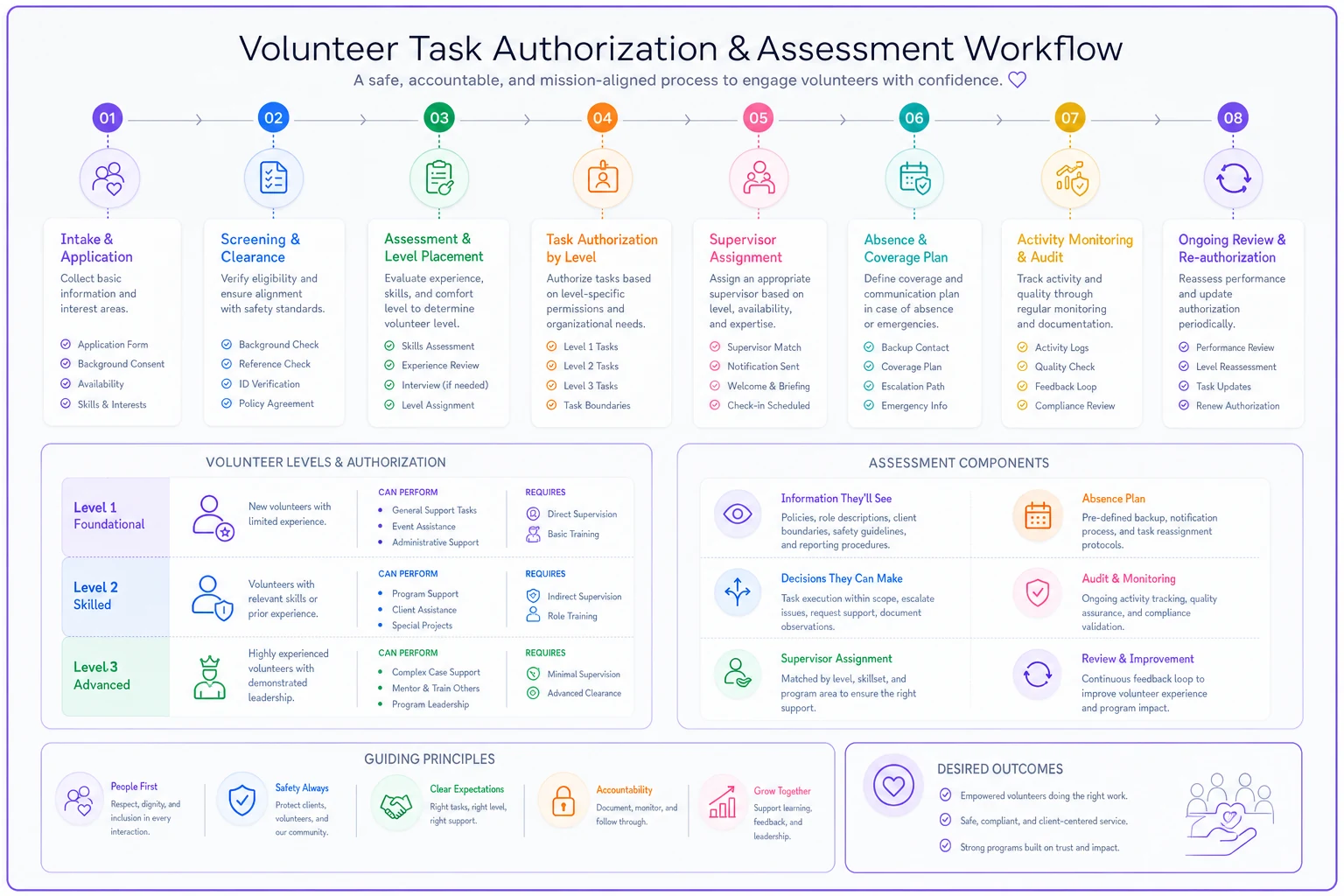
They went from roughly 8 volunteer-related incidents per quarter to 1. Volunteer retention also improved—people stayed longer because they actually knew what was expected of them.
Confidentiality templates that actually get signed and followed
Generic confidentiality agreements fail with volunteers because they're written for employees. Volunteers need different language, different examples, different stakes.
Five things your volunteer confidentiality agreement needs:
The scenario section: Real situations, not abstract policy language. Not "maintain confidentiality of protected health information" but "If you see a client at the grocery store, you cannot approach them or acknowledge knowing them unless they approach you first."
The social media clause: Explicit prohibition with examples. "You cannot post about your volunteer work on Facebook, even without names. This includes posts like 'Had a tough day helping a family' or 'So proud of one of our kids for graduating.'"
The personal device section: Clear rules about phones, tablets, laptops. One organization learned this the hard way when a volunteer's teenager found case photos on a shared family iPad.
The breach consequences: Not just "termination" but specifics. "First violation: immediate suspension and retraining. Second violation: permanent removal from volunteer roster. Violations causing harm: potential legal action."
The question protocol: Who to ask when unsure. Names, phone numbers, email addresses, expected response times.
A refugee services organization in Houston overhauled their confidentiality process after a volunteer posted a "success story" on LinkedIn with enough detail that an abusive ex-partner was able to track down a client. Their new agreement includes a section called "Stories that seem safe but aren't"—15 real examples of problematic sharing. It's uncomfortable reading. That's the point.
Supervision checkpoints that prevent drift
Weekly supervision schedules don't work for volunteers who show up twice a month. Traditional models assume consistent presence. Volunteer supervision needs a different rhythm.
Checkpoint-based supervision works better. The table below outlines a practical structure:
| Checkpoint | Timing | Key Focus Areas |
|---|---|---|
| Entry | Before first client contact | Role clarity, boundary scenarios, emergency protocols |
| 30-Day | After initial period | Task creep, information handling, relationship dynamics |
| Incident | Within 24 hours of any issue | Debrief, documentation review, re-authorization |
| Quarterly | Ongoing volunteers | Task matrix review, confidentiality refresh, continued fit |
A domestic violence shelter in Seattle found that volunteers were gradually absorbing case management tasks because staff were stretched too thin. It started as "help me file these papers" and eventually turned into volunteers making follow-up calls to attorneys and housing programs.
The 30-day checkpoint caught this drift early for new volunteers. They put a specific protocol in place: volunteers can organize papers but cannot read them. Can dial phone numbers but cannot speak to providers. Can schedule appointments but cannot discuss case details. Sounds granular, but it held.
Use short, specific do/don't examples during the 30-day checkpoint to make limits concrete.
Supervision isn't just about catching problems. Done consistently, it also gives volunteers a legitimate place to flag concerns—which means issues surface through the right channels instead of becoming incidents later.
Onboarding scripts that set boundaries from day one
The first conversation with a volunteer sets the tone for everything that follows. Most organizations waste this moment on logistics and paperwork.
Good onboarding addresses the hero complex upfront. A lot of volunteers arrive wanting to "save" someone. That impulse causes most of the problems.
Opening frame: "Your role is to strengthen our capacity to serve families professionally. You're not here to be anyone's friend, counselor, or savior. You're here to help our professional staff maintain quality services."
The boundary talk: "Clients may want to connect with you personally. They might share phone numbers, invite you to family events, or send you a friend request. These come from a good place, but accepting them damages our ability to serve them professionally. Your response is always: 'I care about your progress, but our relationship needs to stay within the program.'"
The information talk: "You'll see and hear things that break your heart. You can't fix these problems personally. You can't give clients money, rides outside of program parameters, or personal advice. What you can do is flag needs for staff so we can respond through the right channels."
The sustainability talk: "Burnout happens when volunteers try to do too much. We'd rather have you here consistently doing Level 1 tasks than burning out trying to solve everything. Consistency matters more than heroics."
A youth mentorship program in Phoenix restructured their onboarding after a volunteer started tutoring a student outside program hours, then giving them rides home, then buying school supplies, then having them over for dinner. What began as genuine kindness ended with accusations of inappropriate relationship development and a family threatening legal action.
The documentation balance: enough but not too much
Volunteers shouldn't be writing case notes. But they need to document something for supervision and liability purposes.
A volunteer activity log handles this without crossing into clinical territory. Basic format:
-
Date and time
-
Task performed (from approved matrix)
-
Any unusual circumstances (client no-show, technical issues)
-
Questions for supervisor
-
Next scheduled activity
What volunteers should never document:
-
Clinical observations
-
Personal opinions about clients
-
Detailed conversation summaries
-
Assessment of progress
-
Service recommendations
A substance abuse treatment program learned this distinction the hard way when a volunteer's notes got pulled into a custody case. The volunteer had written "parent seemed intoxicated during group session" based on perceived behavior. The parent was actually experiencing medication side effects. That note almost cost them custody of their children.
Now volunteers use a checkbox system: Task completed? Yes/No. Any concerns? Flag for supervisor. No narrative, no interpretation, no assessment.
When volunteer governance fails: warning signs
Organizations rarely see volunteer problems coming. But the warning signs usually show up weeks before anything serious happens.
Early warning signals:
-
Volunteers starting to give advice during programs. Even small suggestions about parenting, budgeting, or relationships signal boundary confusion.
-
Clients requesting specific volunteers or avoiding others. Personal preferences suggest the relationship has moved outside professional territory.
-
Volunteers staying after hours or arriving early without specific tasks. Unstructured time leads to unstructured relationships.
-
Volunteers bringing personal items for specific clients. Small gifts change relationship dynamics in ways that are hard to undo.
-
Staff depending on a specific volunteer for core functions. When your program can't operate without them, they've exceeded appropriate scope.
A family resource center in Denver identified these patterns after a volunteer started meeting with a client family outside the center, eventually becoming their unofficial case manager. When the volunteer went on vacation, the family felt abandoned and filed a complaint about service disruption. The organization had never authorized any of it, but they'd let the drift happen through insufficient supervision.
Technology's role in volunteer governance
Manual supervision of volunteers across multiple programs becomes unmanageable once you're running at any real scale. This is where operational software makes a genuine difference.
AI-powered platforms can track volunteer activity patterns, flag documentation that falls outside scope, and keep checkpoint compliance on schedule—without adding hours of administrative burden. Automated systems can catch when a volunteer accesses case files above their authorization level, or when documentation starts drifting toward clinical territory.
The real value is in pattern recognition. Software can identify when a volunteer's activity starts shifting from assigned Level 1 tasks toward Level 2 involvement before it becomes a formal incident. That early warning gives supervisors a chance to address things through a conversation rather than a crisis response.
Some organizations use automated scheduling that prevents volunteers from signing up for shifts beyond their authorization level. Others use documentation platforms that only surface the fields a volunteer is cleared to complete. The system enforces the boundaries automatically instead of depending on memory and judgment in the moment.
Making it sustainable
Volunteer governance in casework isn't about restricting volunteers or building bureaucracy. It's about protecting everyone—clients, volunteers, and the organization—from problems that are largely predictable.
The organizations that get this right treat volunteer governance as an operational priority, not something to figure out after the first incident. They invest time upfront in clear matrices, specific agreements, and regular checkpoints because the alternative is crisis management and legal exposure.
A mental health coalition in Portland calculated what poor volunteer governance actually costs: each incident requiring investigation averaged around 40 staff hours. Legal consultations ran $3,000–$5,000 per situation. Client trust, once broken, rarely came back. One preventable incident could consume enough resources to have served 20 additional families.
The task matrix, confidentiality agreements, supervision checkpoints, and onboarding scripts aren't bureaucracy. They're the infrastructure that allows volunteers to contribute meaningfully without compromising casework integrity. Every hour spent building this foundation prevents dozens of hours spent managing avoidable problems.
Clear governance also helps volunteers succeed. They know what's expected, how to contribute, and where the lines are. That clarity turns volunteer programs from liability risks into genuine capacity multipliers—and the volunteers who thrive within clear boundaries are exactly the ones you want supporting your casework.
Clear governance also helps volunteers succeed. They know what's expected, how to contribute, and where the lines are. That clarity turns volunteer programs from liability risks into genuine capacity multipliers—and the volunteers who thrive within clear boundaries are exactly the ones you want supporting your casework.
Ready to transform your social services workflow?
Join 500+ agencies using TryCasi to improve case outcomes, enhance collaboration, and reduce administrative burden.