

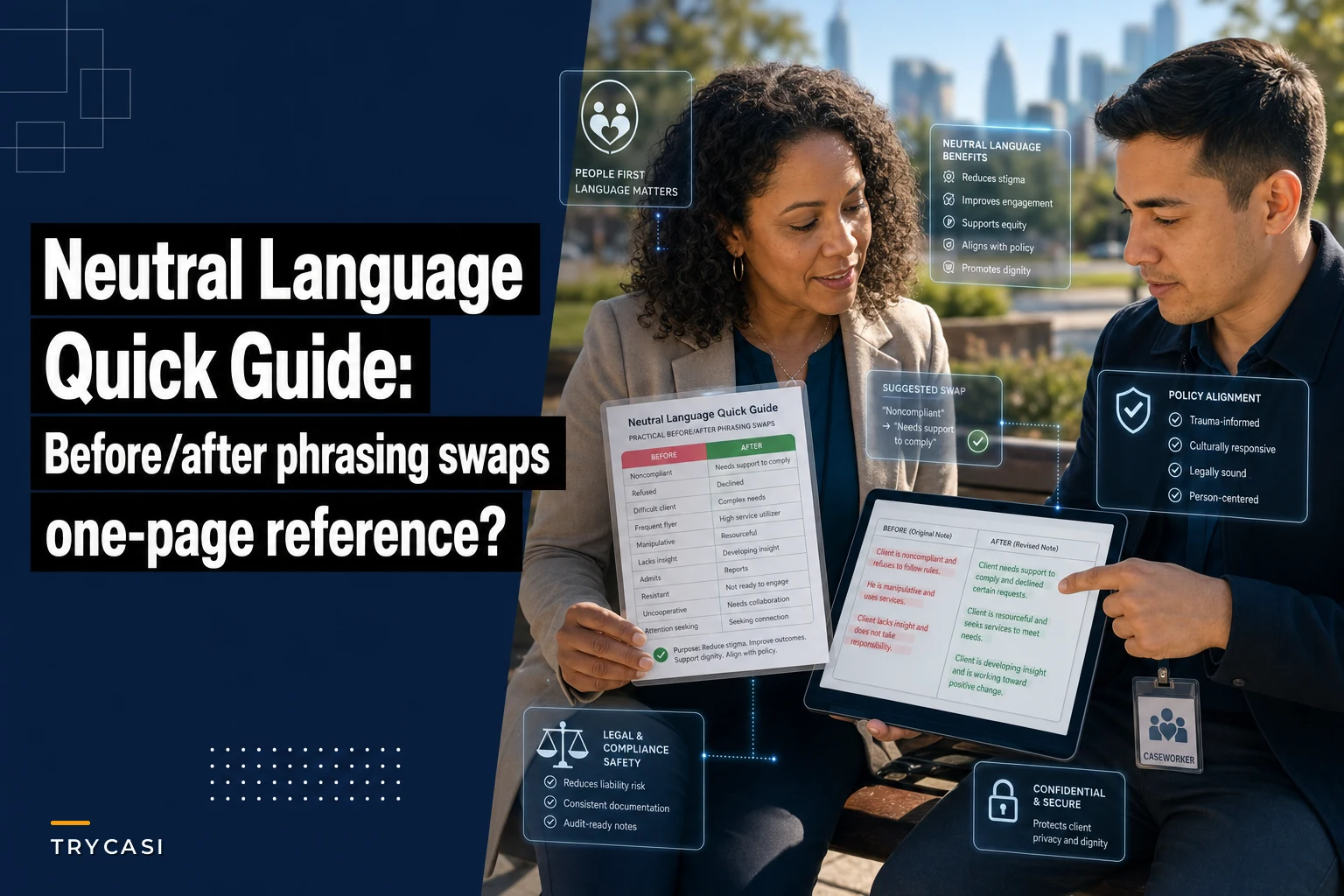

Watch a caseworker type "mother seemed drunk at visit" into a case note and you're looking at a documentation time bomb. That single phrase can trigger custody challenges, derail family reunification, and create years of legal headaches — all from six words written in about 30 seconds.
The problem isn't the observation. It's the language.
After reviewing thousands of case notes across child welfare, housing assistance, and mental health programs, the pattern becomes painfully obvious: frontline staff default to subjective phrasing under pressure. They're juggling 30+ cases, writing notes between crisis calls, trying to capture complex situations fast. Nobody taught them the operational difference between "appeared intoxicated" and "exhibited unsteady gait, slurred speech."
Why neutral language breaks down in real operations
Case documentation happens in the worst possible conditions for careful writing. A typical social worker writes notes:
-
During home visits on a phone
-
Between back-to-back appointments
-
After emotionally intense encounters
-
While managing multiple urgent situations
-
Under constant documentation deadlines
One housing coordinator managing 42 families told me she types most notes standing in apartment building hallways, trying to capture details before driving to the next visit. She's not thinking about legal implications — she's thinking about getting through her day.
That operational reality creates three documentation failures that show up constantly:
Speed writing creates judgment language. Workers type their immediate reactions: "hostile," "uncooperative," "neglectful." These words feel accurate in the moment but create serious downstream problems. A family court judge reading "hostile mother" six months later sees something completely different than what the caseworker intended to document.
Copy-paste culture spreads problematic phrasing. Once someone writes "client was being difficult," that phrase gets copied into progress notes, shared in team meetings, and becomes the unofficial label for that client. One bad phrase infects dozens of documents across multiple systems.
No standardization means no consistency. Different workers describe identical behaviors using wildly different language. One writes "aggressive," another writes "raised voice," a third writes "seemed upset." Courts, supervisors, and partner agencies reading those notes have no idea what actually happened.
The cascade effect of subjective language
A single poorly-worded case note doesn't stay contained. It moves through systems and gets progressively worse with each retelling.
Eliminate case management chaos.
TryCasi helps you organize, monitor, and report on every case efficiently and securely.
- Centralized case tracking
- Automated client notifications
- Team task coordination
No credit card required
Here's a real sequence from a family services program:
Initial note: "Father appeared under the influence during visit" ↓ Supervisor report: "Substance abuse concerns with father" ↓ Court filing: "Ongoing substance abuse issues" ↓ Partner agency referral: "Family with addiction problems" ↓ Insurance coding: "Substance abuse disorder - family unit"
Five transformations later, a father who might have been exhausted from a double shift is now coded as having a substance abuse disorder across multiple permanent systems. Three seconds of word choice created a documentation cascade that follows this family forever.
The legal exposure compounds fast. Agencies face lawsuits over biased documentation, lose funding for discriminatory practices, and watch good caseworkers burn out from documentation-related legal stress. One mental health clinic spent around $180,000 defending documentation practices in a single year — roughly the cost of three full-time positions.
Building an operational language standard
Creating neutral documentation isn't about political correctness or bureaucratic wordsmithing. It's about building a system that protects everyone — clients from bias, workers from lawsuits, and agencies from liability.
The most effective approach uses three operational tools:
1. The before/after swap guide
Behavior documentation swaps:
| Instead of | Write |
|---|---|
| "Aggressive" | "Raised voice, stood up quickly from chair" |
| "Uncooperative" | "Declined to answer questions about employment" |
| "Drunk/high" | "Bloodshot eyes, slurred speech, unsteady gait observed" |
| "Hostile" | "Crossed arms, maintained no eye contact, responded with one-word answers" |
| "Neglectful parent" | "Child presented with soiled clothing, reported not eating breakfast" |
| "Lying" | "Client's statement contradicts previous documentation from [date]" |
| "Manipulative" | "Client requested exception to policy after being informed of requirements" |
| "Non-compliant" | "Did not attend scheduled appointment on [date]" |
Appearance documentation swaps:
| Instead of | Write |
|---|---|
| "Disheveled" | "Wearing wrinkled clothing with visible stains" |
| "Inappropriate dress" | "Wearing tank top and shorts to formal meeting" |
| "Poor hygiene" | "Strong body odor noted, visible dirt under fingernails" |
| "Looked homeless" | "Carrying multiple bags, wearing several layers of clothing" |
Mental state documentation swaps:
| Instead of | Write |
|---|---|
| "Crazy/psychotic" | "Reported hearing voices others don't hear" |
| "Manic" | "Speaking rapidly, jumping between topics, reported not sleeping for 3 days" |
| "Depressed" | "Reported feeling sad most days, difficulty getting out of bed" |
| "Paranoid" | "Expressed belief that neighbors are monitoring their apartment" |
2. The controlled vocabulary system
Beyond individual swaps, agencies need a controlled vocabulary — a defined set of approved terms for common situations. This isn't censorship. It's operational standardization.
Observable behaviors:
-
Arrived/departed
-
Stated/reported/indicated
-
Declined/accepted/requested
-
Exhibited/displayed/demonstrated
Factual time markers:
-
"On [date] at [time]"
-
"During scheduled visit"
-
"Following incident on [date]"
-
"As documented in report dated [date]"
Neutral transitions:
-
"Client reported that..."
-
"According to client..."
-
"Documentation indicates..."
-
"Observed behavior included..."
3. The one-page quick reference
Condense everything into a single page that lives on every desk. Not a binder, not a digital folder — one physical page workers actually see.
The reference includes:
-
Top 10 most dangerous phrases to avoid
-
Quick behavior description formulas
-
Citation format for contradictions
-
Emergency documentation protocol
-
Supervisor review triggers
The reference includes:
Real implementation: A housing program's transformation
A supportive housing program with 8 caseworkers managing 120 residents implemented this system after a discrimination complaint nearly cost them federal funding. Their documentation contained phrases like "typical addict behavior" and "acting ghetto" — language that created enormous liability exposure.
Implementation took four weeks:
-
Week 1 Audit existing documentation to identify problem patterns
-
Week 2 Create customized swap guide using actual phrases from their notes
-
Week 3 Train staff using their own problematic examples
-
Week 4 Implementation with daily supervisor spot-checks
The results were immediate. Reviewing 500 case notes before and after:
-
Subjective descriptors dropped from 89% of notes to 12%
-
Legal challenges to documentation went from 3-4 monthly to zero
-
Case note completion time decreased by roughly 2 minutes per note
-
Worker confidence in documentation increased noticeably
Workers flagged a surprising benefit: neutral language actually made documentation faster. Instead of searching for the right subjective word, they just described what they saw. "The formulas make it automatic," one caseworker said. "I don't think anymore, I just describe."
Common resistance points and solutions
"This feels robotic and impersonal." Neutral doesn't mean emotionless. You can absolutely write "Client smiled when discussing daughter's graduation" or "Client became tearful describing loss of housing." These capture human moments while staying factual.
"It takes too long to write this way." Initially, yes. After two weeks of practice, workers typically write faster using neutral language because they stop second-guessing word choices. The mental energy spent worrying about phrasing just disappears.
"Some situations require judgment." Document the observations that support clinical or safety decisions without inserting opinion. Instead of "Mother is unfit," write "Mother unable to identify child's teacher name, school location, or current grade level during assessment."
"What about urgent safety situations?" Create a separate urgent documentation protocol. "IMMEDIATE SAFETY CONCERN:" followed by specific observable facts. Flags urgency without inserting judgment.
Making it stick: Operational reinforcement
Training alone never works. You need systems that reinforce neutral language daily.
Build it into supervision. Every supervision meeting includes a note review. Supervisor and worker go through one case note together, identify any subjective language, and practice rewrites. Five minutes. Consistent reinforcement.
Create peer review partnerships. Pair workers to review each other's notes weekly. They catch problems before documentation becomes permanent and learn from seeing different writing styles.
Use technology assists. Modern case management platforms can flag problematic phrases automatically — set up alerts for words like "aggressive," "uncooperative," or "refused" that trigger a review prompt. Some systems now use AI automation to suggest neutral alternatives as workers type, catching problems in real-time rather than after documentation is already filed.
Track improvement metrics:
-
Subjective phrases per 100 notes
-
Documentation-related complaints
-
Time spent on documentation revisions
-
Legal challenge frequency
Track improvement metrics:
The multiplier effect across systems
When documentation improves, everything downstream improves. Courts get clearer pictures of situations. Partner agencies receive actionable information. Insurance claims process more smoothly. Clients feel like people instead of case files.
One mental health collaborative tracked ripple effects after implementing neutral language standards across 12 partner agencies. Within six months:
-
Inter-agency referral acceptance rates increased 23%
-
Client engagement scores improved significantly
-
Documentation-related grievances dropped to near zero
-
Court testimony preparation time decreased by roughly half
Workers spent less time in documentation meetings, less time revising notes for court, less time defending their word choices. That recovered time went directly back to client service.
Building your implementation plan
Start small and expand systematically:
A quick visual of the rollout process helps teams follow steps.
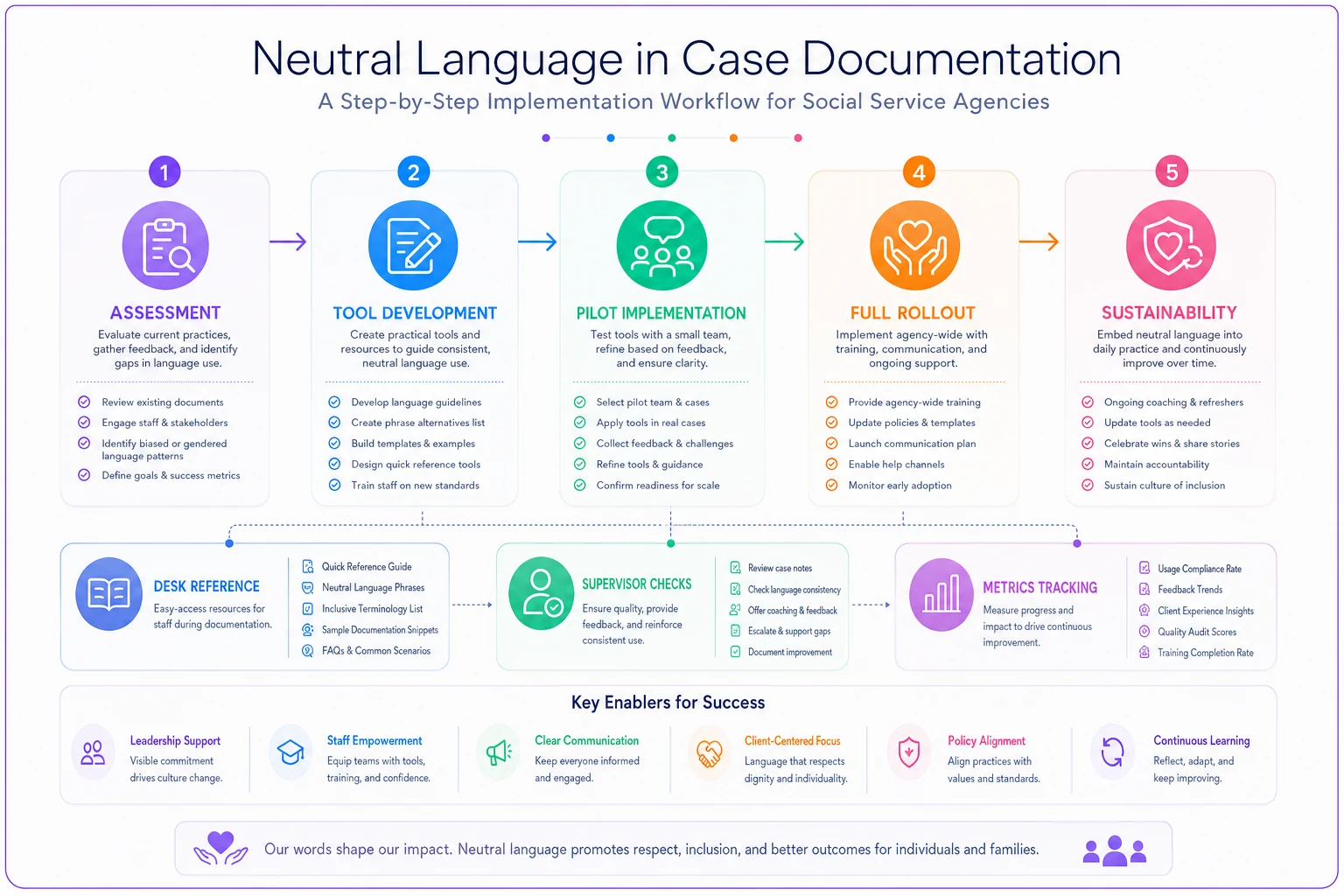
Phase 1 (Weeks 1-2): Assessment
-
Audit 50 recent case notes for problematic language
-
Identify your organization's top 10 problem phrases
-
Document current documentation completion times
Phase 2 (Weeks 3-4): Tool development
-
Create customized swap guide using your actual phrases
-
Develop one-page quick reference
-
Build controlled vocabulary list
Phase 3 (Weeks 5-6): Pilot implementation
-
Select 2-3 willing workers for pilot
-
Implement daily note reviews
-
Refine tools based on feedback
Phase 4 (Weeks 7-8): Full rollout
-
Train all staff using pilot examples
-
Distribute physical reference materials
-
Launch supervision reinforcement protocols
Phase 5 (Ongoing): Sustainability
-
Monthly metrics review
-
Quarterly swap guide updates
-
Annual documentation audit
Phase 5 (Ongoing): Sustainability
When neutral language isn't enough
Some situations require more than language swaps. If your agency deals with complex psychiatric presentations, multi-system involved families, high-conflict custody situations, or criminal justice overlap — you need additional documentation protocols on top of neutral language. These might include:
-
Mandatory supervisor review for specific situation types
-
Two-person documentation for high-risk cases
-
Audio recording with transcription for critical meetings
-
External clinical consultation for complex presentations
These might include:
Technology's emerging role
Documentation software keeps evolving to support better language practices. Current capabilities worth considering:
-
Real-time phrase flagging highlights problematic language as workers type — similar to spell-check, but for bias and judgment.
-
Template libraries offer pre-written neutral phrases for common situations that workers can quickly insert and modify.
-
Translation assistance — some platforms now use AI automation to help rephrase subjective language into observable behaviors, though human review still needs to be part of that process.
-
Consistency checking compares documentation across workers to identify outliers and inconsistencies in language use.
These tools reduce cognitive load on workers. They don't replace human judgment, and they shouldn't try to.
Measuring success
You know the system is working when workers stop asking "How should I word this?" Supervisors spend less time editing notes. Legal concerns about documentation fade out. Client complaints about biased language stop coming in. Partner agencies stop calling for clarification.
The transformation typically takes 60-90 days to feel natural. Workers need roughly 50-75 notes using the new system before it becomes automatic — which is exactly why the physical reference materials matter. They bridge the gap until the language becomes instinctive.
Neutral case note language isn't about compliance or political correctness. It's about building documentation that protects everyone while making operations run more smoothly. When workers stop agonizing over word choices, they focus on actual casework. When documentation becomes legally defensible, agencies stop spending money on legal defense.
Start with your next case note. Pick one subjective phrase you commonly use and rewrite it as a direct observation. Build from there. The documentation culture shift follows.
Ready to transform your social services workflow?
Join 500+ agencies using TryCasi to improve case outcomes, enhance collaboration, and reduce administrative burden.